OpenAI describes its Performance Factory: a Codex-driven regression workflow tracked over 1,700 investigations and root-caused over 600 in just over three months
A production case where agents carry the work from alert to verified fix. Its four parts and how it evolved, for teams moving coding agents out of chat and into workflows.
// Key points
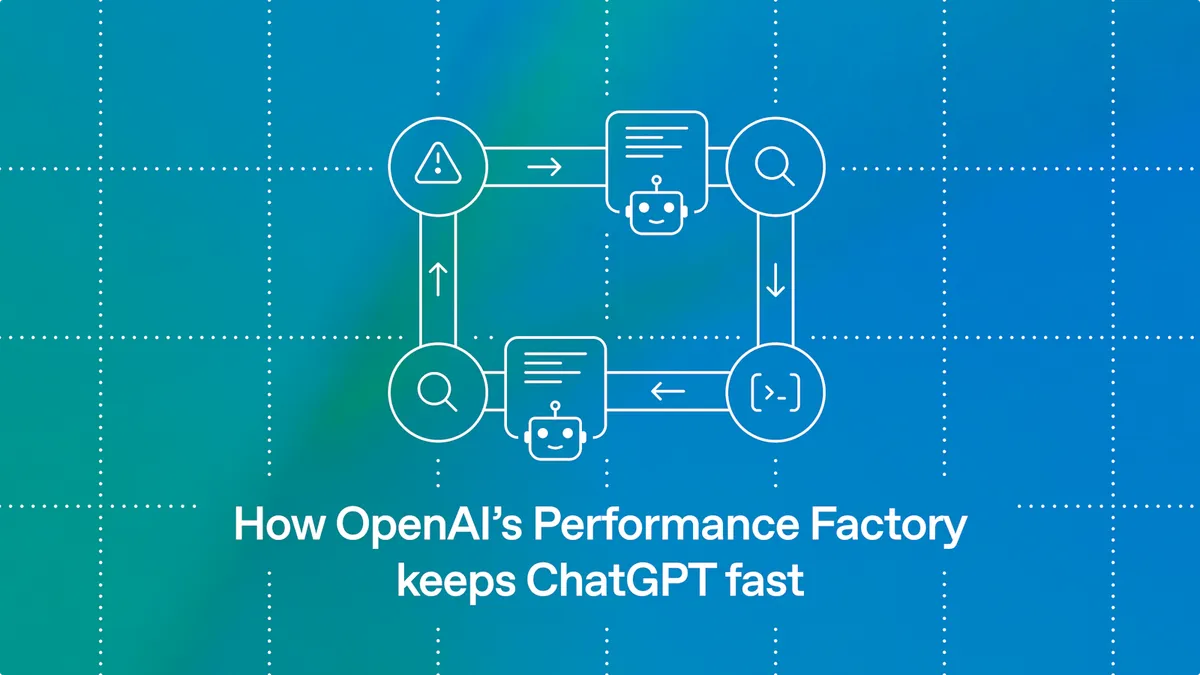
- The Regression Workflow opens a task when a performance alert fires: an agent investigates, records findings and proposes a fix for an engineer to review, and after deployment another agent checks whether performance is back to baseline.
- In just over three months it tracked more than 1,700 investigations and root-caused over 600 cases, about 17 automated investigations a day.
- It has four parts: a task service with configurable workflows (Markdown prompts plus config files), a dispatch loop that assigns ready work, an API that runs Codex in the cloud, and subscriptions that wake agents on events such as a GitHub review comment or a finished deployment.
- The team first captured its investigation process in a shared skill, perf-forensics, refined with evals built from past regressions, before automating end to end.
Builder's takeWhat's worth copying is the path, not the scale: write the expert's investigation steps into a skill, evaluate it on past incidents, and only then wire it to alerts, leaving people on review and merge. Our PandaClaws backend could follow the same order, starting with the most common publishing-failure alert and getting to automatic diagnosis before talking about automatic fixes.
// Background · from #OpenAI
Full timeline →- Nov 21 OpenAI details its defenses against adversarial distillation: attacks recovering GPT-6.2 Astra's protected reasoning succeed 0.2% of the time, down from 54.0%
- Nov 21 OpenAI releases MedChemBench, a medicinal chemistry benchmark: 99 problems from 117 papers and patents, with GPT-6.2 Astra earning 84.5% of available credit
- Nov 18 OpenAI releases GPT-6.2 Astra and GPT-6.2 Sol, with better professional outputs, coding, computer use and efficiency at lower cost