OpenAI details anti-distillation defenses, Inkling 2 Mini goes open, Hugging Face tunes models to their harness with RL
Today's thread is the layer around the model: OpenAI ties reasoning to conversation history to block distillation, Hugging Face shows a small harness-specific adapter beats swapping models, and OpenAI and AWS wire agents into performance triage and least-privilege credentials. On the local side, Inkling 2 Mini, with 3B active parameters, is the first real challenger to Qwen3.8-27B.
In an internal adaptive red-teaming evaluation, the average success rate for recovering protected reasoning (chain-of-thought) fell from 54.0% against GPT-6 Astra with its original safeguards to 0.2% against GPT-6.2 Astra.
Defenses work at two levels: per request, through adversarial training, input and output classifiers (covering streaming responses and tool-call arguments) and API controls; per campaign, by spotting coordinated extraction in request and account signals and enforcing against the account network.
GPT-6.2 Astra and Sol tie protected reasoning to the conversation history that produced it: if an earlier message is rewritten, the API drops the reasoning that followed; older model families with weaker safeguards cannot read it.
An internal study found students trained on exact reasoning traces generally outperformed those trained on reasoning summaries on cyber tasks; OpenAI shares indicators of compromise with other model providers.
Builder's takeThe practical part for ordinary developers is that rewriting history drops reasoning: if your agent trims or rewrites the conversation to save tokens, on 6.2 it may silently lose reasoning continuity, hurting quality and caching. I'd first check whether context compaction only appends or rewrites old messages, then decide when to move to 6.2.
Of 24 physical decoder layers, the middle 12 loop three times, acting like 48 logical layers; each layer routes to 8 of 128 experts (Small has 384), and a DSpark drafter is included for speed.
Against Gemma 4 31B, Qwen3.8-27B, Nemotron 3.5 Super VL and others it leads on 32 of 48 benchmarks; it leads FrontierCode v2.0 and ties Qwen3.8-27B on Terminal-Bench 4.0.
Day-one support covers Transformers, llama.cpp (Llama App) and MLX, with SGLang for datacenter deployment; expert weights ship in mixed NVFP4 and MXFP8 precision.
A research variant lets you set the loop to 1 or 2 passes for faster inference, though the team says it has not been evaluated in depth.
Builder's take3B active, 1M context and image input sits right in the sweet spot for local or single-GPU serving, and it is the first serious challenger to Qwen3.8-27B. For long-context document understanding in AI Cloud Drive I'd run Inkling 2 Mini against Qwen3.8-27B on the same files, and test the adjustable loop count separately for its speed-quality trade-off.
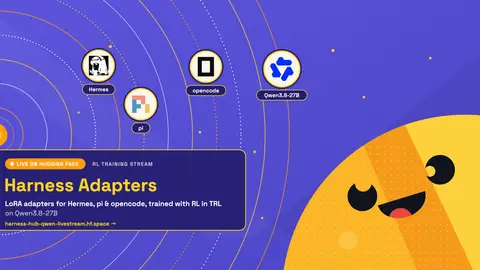
One LoRA per harness (pi, Hermes Agent, OpenCode), trained with RL inside the unmodified harness; tasks, training and rollouts all run in Hub Jobs with TRL's AsyncGRPOTrainer, OpenEnv and Harbor.
On the 51 hardest SWE-bench Pro tasks: pi goes from 39.2% to 64.7%, Hermes from 29.4% to 43.1% and OpenCode from 35.3% to 51.0%; on the full Terminal-Bench 2.1, pi gains 16.3 points.
On tasks both solve, the adapters make 53% to 72% fewer tool calls per task.
The three LoRAs merge at weight 1/2 into one super-adapter that beats the base model under all three harnesses; adapters, GGUFs, RL tasks and the safeagents plugin are all public.
Builder's takeIt shows a model and its harness should be tuned as one unit rather than swapped hoping for luck: the same 27B base, plus one LoRA, solves a quarter more of the hard tasks with over half the tool calls gone. If you run a fixed workflow on an open model, I'd start by turning your past tasks into a verifiable RL environment; that step is worth more than the training itself.
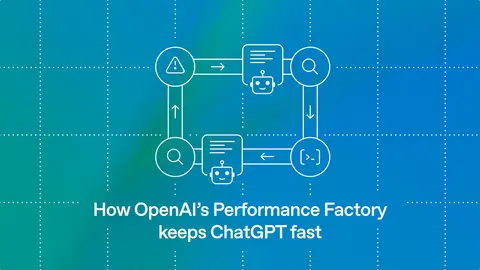
The Regression Workflow opens a task when a performance alert fires: an agent investigates, records findings and proposes a fix for an engineer to review, and after deployment another agent checks whether performance is back to baseline.
In just over three months it tracked more than 1,700 investigations and root-caused over 600 cases, about 17 automated investigations a day.
It has four parts: a task service with configurable workflows (Markdown prompts plus config files), a dispatch loop that assigns ready work, an API that runs Codex in the cloud, and subscriptions that wake agents on events such as a GitHub review comment or a finished deployment.
The team first captured its investigation process in a shared skill, perf-forensics, refined with evals built from past regressions, before automating end to end.
Builder's takeWhat's worth copying is the path, not the scale: write the expert's investigation steps into a skill, evaluate it on past incidents, and only then wire it to alerts, leaving people on review and merge. Our PandaClaws backend could follow the same order, starting with the most common publishing-failure alert and getting to automatic diagnosis before talking about automatic fixes.
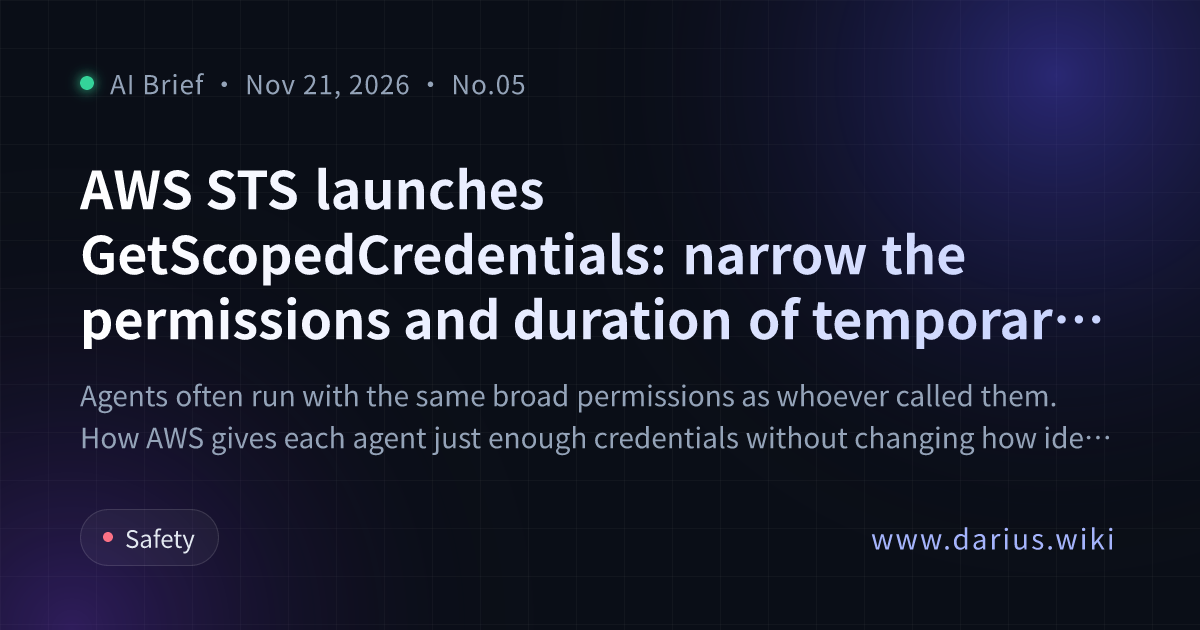
Call it with the temporary credentials you already use to reduce permissions, session duration or both; the resulting credentials keep the caller's original identity.
Permissions and duration narrow monotonically and never exceed the caller's; access is governed by IAM policies and every call is logged to CloudTrail.
It is available in all commercial Regions, GovCloud (US), the European Sovereign Cloud (Germany) and the China Regions.
Builder's takeThis is the least-effort way to do least privilege for agents: no role per sub-agent, the main flow just cuts a scoped credential per task. Read alongside Cognito's token exchange on 11-12 and Foundry's agent identities on 11-19, every cloud is filling the same gap: how to narrow permissions when acting for a user. My advice is to cut a read-only or single-resource credential per tool call, starting with tools that write to S3 or databases.
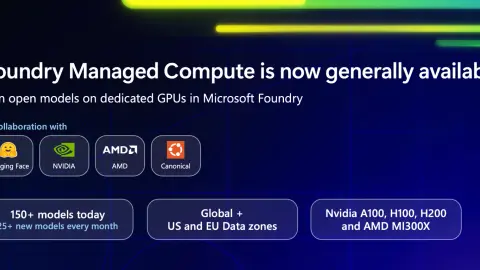
Previewed at Build in June and now generally available; since preview it has scaled serving capacity, improved prompt reuse and added US and EU Data Zone options.
Filtering the model catalog by Managed Compute shows 150+ open models; a deployment template sets the context length, serving runtime and GPU configuration.
The deployment wizard shows the hourly cost; the sample deploys DeepSeek V4.1 Flash on four MI300X GPUs and calls it through the OpenAI-compatible Chat Completions API.
Builder's takeRenting dedicated GPUs by the hour suits steady traffic and data-residency requirements; for spiky traffic, per-token managed APIs are usually cheaper. I'd work out daily token volume first and migrate only past the break-even point, and try an MI300X template while at it: a second GPU supplier is leverage in itself.
Fields are defined in a blueprint: a JSON Schema in which each field has a natural-language description and an inference type (read verbatim or inferred from content); public blueprints cover the W-2, Form 1040, passports and more.
One asynchronous request takes a mixed file of up to 3,000 pages, splits it into sub-documents and matches each to a blueprint; every value carries a confidence score and page-level grounding, with no training.
It supports PDF, PNG, JPEG and TIFF in English, French, German, Italian, Portuguese and Spanish, and is priced per page rather than per token with no minimum commitment.
Builder's takeSource plus confidence is what lets document automation scale: only then can you set a threshold for auto-accept versus human review. AI Cloud Drive's structured extraction should output in this shape whichever model it uses. Chinese isn't supported yet, so for China-facing work borrow the blueprint design rather than the service.
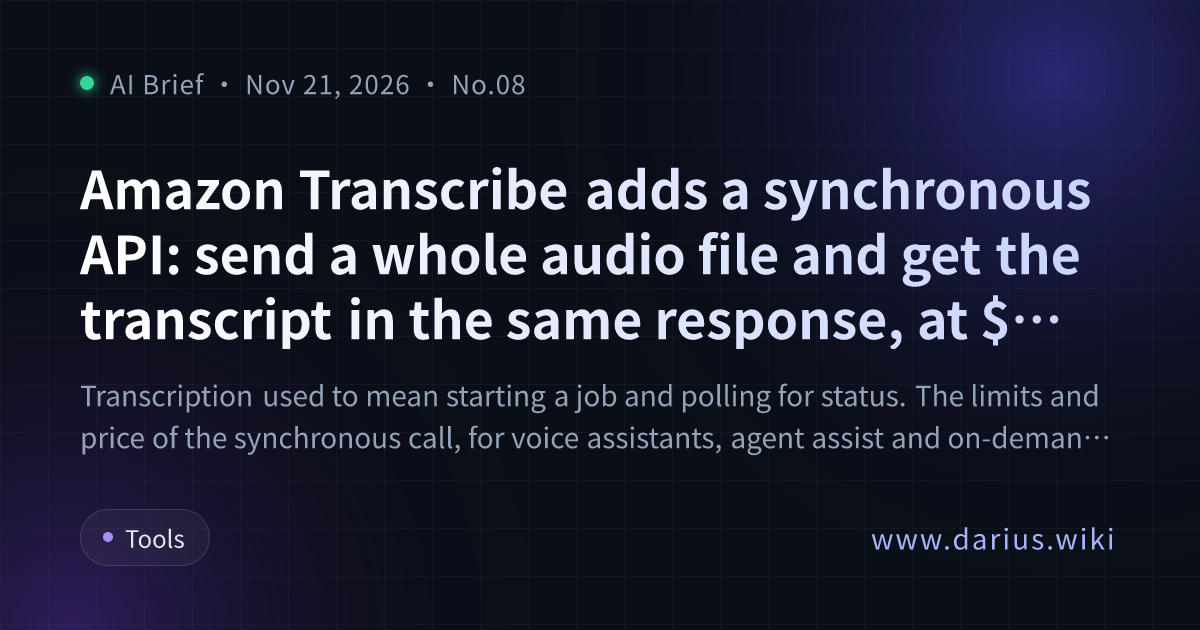
The new TranscribeAudio call takes audio inline (up to 25 MB) or from S3 (up to 500 MB), 0.5 seconds to 1 hour long, in eight formats including WAV, MP3, FLAC and M4A.
It costs $0.0070 per minute billed per second, with speaker diarization, language identification, custom vocabulary and channel identification included; PII redaction is an add-on.
Languages include English, Spanish, French, Italian, German, Japanese, Portuguese, Korean and Chinese (Simplified, Traditional and Hong Kong).
Builder's takeSynchronous calls plus Chinese support mean flows like AI Interview, which transcribes and scores each answer as it ends, can drop the job queue; an hour of interview costs about $0.42 to transcribe. I'd use the sync call per answer, keep full recordings async, and compare Chinese accuracy against the open 0.5B Rumble-2-Flash from 11-18.
99 problems drawn from 117 papers and patents, covering 761 distinct molecular structures; it grades molecular structures, scientific reasoning, ranking and selection, and property predictions.
At the xhigh reasoning setting, GPT-6.2 Astra earned 84.5%, GPT-6 Astra 83.3%, GPT-6.1 Sol 82.0% and GPT-5.6 Sol 58.2%.
On one task that requires preserving an 18-atom ring, GPT-6 Astra was correct in all ten responses, while GPT-5.6 Sol and GPT-5.6 Luna failed in all ten.
Builder's takeFor most product teams the point isn't drug discovery but how to build a vertical benchmark: drawn from real decisions, partial credit, structural errors scored on their own. The 6.x generations sit within about two and a half points of each other, so upgrades now buy little on tasks like this. If you build a vertical product, a small benchmark in this shape is worth making.
It tracks response time and GPU use and checks configuration by default, without reading requests or responses; findings include an older serving container, missing speculative decoding or missing GPU kernel tuning.
When a change holds for a week or a gap is found, it sends one AWS Health notification per endpoint, linking to inference recommendations that compare response time, throughput and cost per million tokens.
Tests leave the production endpoint untouched and nothing changes until you apply a result; monitoring is free, with standard compute charges for recommendation jobs.
Builder's takeThe most common waste in self-hosted inference is tuning at launch and never looking again. Even off SageMaker, copy the checklist: review GPU utilization and P95 latency weekly, upgrade the serving container quarterly, and turn speculative decoding on by default.
Researched and drafted with AI assistance; editorial standards and views set by Darius.
Every Monday, the week in AI in one email
Every Monday morning: the 6 AI stories that mattered most in the past seven days, with my take, in your inbox.
Your email is only used to send the weekly and is never shared. Every email has a one-click unsubscribe link. See the latest issue →