Google checks agent tool calls before they run, AWS Quick bundles plugins by job role, AWS turns KV cache setup into a skill
This weekend's thread is moving the rules outside the agent: Google checks each tool call with an independent judge at the gateway, while AWS gives agents verified domain identities and ships capabilities as plugins and skills. On the open side, two NVIDIA posts bring engineering fixes to two fragile spots in self-hosted inference: RL rollouts and tool-call parsing.
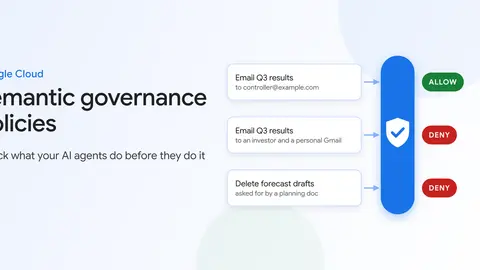
Available in preview in Gemini platform and enforced through Agent Gateway: all agent egress goes through the gateway, and when the model returns a tool call, the policy engine evaluates it before the response reaches the agent.
Each call must pass two checks: your rules written in plain language (such as "before the earnings release, quarterly results may be shared only with @example.com addresses"), and a user-intent check, on by default, that catches calls drifting from the original request, as with indirect prompt injection.
If a call fails, the engine replaces the response content, tool calls included, with a configurable denial message so the call never runs; every verdict, the judge's rationale and the tokens used go to Cloud Logging. Text-only responses are not evaluated.
Agents can call their model through the Gemini API, the Anthropic Messages API, Claude models in Gemini platform, or OpenAI-compatible Chat Completions APIs, including self-hosted servers such as vLLM.
Builder's takeThe point is where the check sits: rules in a system prompt can be argued away by a user or a document, a check at the gateway cannot. Even off Google's platform you can copy the shape: put an independent judge in front of write or send tools, at least checking that the call still matches what the user actually asked, and log every verdict and rationale. For a backend like PandaClaws that publishes content automatically, I'd try this layer on the outbound tools first.
Plugins package connectors to reach your systems, skills for how your team works, agents to reason through tasks and flows to orchestrate them, so users install everything a job needs in one step.
Official plugins include a Calendar and Meetings Assistant and a Sales Development plugin; more than 100 skills and plugins cover everyday productivity, roles such as finance, marketing and legal, industries and popular business apps.
Builders describe the job in chat and Quick assembles the plugin, which teammates can then discover; the same release adds multi-agent orchestration, where several specialized agents work on one request in parallel and Quick combines the results.
Enterprise guardrails arrive in preview: content filters, denied topics, prompt-attack detection and PII controls, assignable per user or IdP group, with a detect-only mode for testing against real traffic.
Builder's takePlugin as connectors plus skills plus agents plus flows is the same vocabulary coding tools already use for skills and plugins, and enterprise workspaces are converging on it. If you build enterprise AI products, I'd package capabilities by job role rather than offer one generic chat box; the detect-only guardrail mode is worth copying, so you see false positives on real traffic before you start blocking.
A shared KV tier next to the GPU fleet extends GPU-local caches so any server can reuse KV state for days across sessions, routing shifts and server failures; AWS says this cuts cost by up to 40% and time to first token by up to 80%.
The skill lives in the Agent Toolkit for AWS and works in coding agents that support Agent Skills, such as Kiro, Claude Code and OpenAI Codex: it runs a fit check, estimates savings from your own traffic with KVTrace, and stops if they do not cover the cache's cost.
It adds the LMCache connector to existing vLLM or SGLang engines, including vLLM under llm-d and Ray Serve, and aligns KV ID mechanism and data type across servers; before production it empties local tiers and checks that two cache-loaded runs give the same output.
Prerequisites include GPU instances with EFA RDMA write such as p5, LMCache 0.5.8rc1+, vLLM 0.11.1+ (or SGLang 0.5.13+) and ElastiCache for Valkey 9.1+; creating, changing or deleting resources requires explicit approval.
Builder's takeThe more useful lesson is how the skill is written: read-only checks first, savings estimated from your own traffic, stop if the numbers do not work, human approval for high-impact steps. It is a good template for turning ops knowledge into a skill. For self-hosted services with many long conversations I'd run KVTrace on hit rates before deciding, and heed the trap it calls out: with a layout mismatch the hit counters look healthy while answers are wrong, so check output consistency before going live.
AWS evaluates every model on three reasoning benchmarks, BIG-Bench Hard, GPQA Diamond and MMLU-Pro, under the same setup, and measures time to first token, throughput and SageMaker instance cost for each JumpStart deployment configuration.
At launch it covers more than 70 LLMs from providers including Meta, Google, Qwen, IBM and Arcee.
You can filter by provider, license and modality, then pick a use-case profile and an optimization goal (balanced, cost, latency or throughput) to see metrics for the configuration you plan to deploy.
It is available at no additional charge in all AWS commercial Regions where SageMaker Studio is available.
Builder's takePutting quality scores next to latency and hourly cost for a specific configuration is far more useful than a bare leaderboard. All three benchmarks are generic reasoning tests and say nothing about your workload, so I'd use it as a first cut down to three or four candidates, then run my own task set; for latency-sensitive cases like AI Interview, sort by the latency goal first.
Bedrock AgentCore and Bedrock add Spanish, French, German, Italian and Japanese, plus non-US English, with results drawing on local-language sources.
A new optional country field takes an ISO 3166-1 alpha-2 code such as "JP" or "DE" to bias results toward that country's sources, useful for local regulations, prices or public officials.
The AgentCore version is available in US East (N. Virginia, Ohio), US West (Oregon), Sydney, Tokyo and Ireland, and the Bedrock version in US Regions; queries are processed in the Region you call, helping with data residency.
Existing customers get the new languages automatically with no code changes, and pricing is the same in every language.
Builder's takeChinese is not on the list yet, so this does not help products in China, but the country field is a design worth borrowing: passing the user's location explicitly as a search-tool parameter is more reliable than letting the model guess a country in its query. For multi-region products I'd inject the user's region from session context as a fixed tool parameter rather than leave it to the model.
Developers and network admins first verify domain ownership, then associate the verified domain with their agents and AI tools to make them publicly visible beyond their own registry and AWS account.
Public agent records are anchored to a verified domain identity, so you can confirm an agent's source before connecting; once published, they are searchable by any AWS-authenticated user with semantic and lexical search.
The same day, Agent Registry added WebBotAuth (WBA) bots as a record type: bots prove domain ownership, and you can combine verification status and bot identity in AWS WAF Bot Control rules.
Public naming and discovery is available at no additional charge for now, in all Regions where Agent Registry is available.
Builder's takeRead alongside last week's agent identities and task-scoped credentials, the identity layer for agents is filling in: a domain proves who you are, credentials limit what you can do. My advice: for agent-facing APIs you expose, record the caller's identity properly, and on the website side start telling verified crawlers apart from ordinary traffic instead of blocking everything.
The skill guides an agent to the right Textract Core API for each document and includes a tested parser that turns output into reading-order text and structured fields, such as answers to questions, receipt and invoice details and identity document fields.
It handles multi-page PDFs and returns every page in reading order; confidence scores let it accept high-confidence results and flag the rest for your own review process.
The skill itself is free, with standard Textract pricing; it is available in all commercial Regions where Textract runs, including Tokyo, Seoul, Singapore and Sydney.
Agents using the AWS MCP server with the aws-core plugin can load it automatically, and it is also published in the AWS Agent Toolkit.
Builder's takeTogether with yesterday's Textract Insights, AWS now offers two routes for documents: a managed API and an agent skill. In AI Cloud Drive's document ingestion I'd copy its confidence routing: store high-confidence fields directly and flag low-confidence ones for the user to confirm, rather than trusting everything or rerunning everything.
Dynamo sits between rollout orchestration and inference workers, handling routing, worker management and telemetry, while the RL framework keeps optimization, rewards, environments and sample acceptance.
KV-aware routing balances cache reuse against worker load, cutting redundant prefix compute when attempts share instructions or repository context.
ModelExpress transfers compressed delta weight updates and reuses weights already in GPU memory; on worker failure, requests reroute to healthy capacity and replacements catch up from a checkpoint plus deltas.
H Company cut average training-step time by up to 20% and GPU-hours by up to 5%; open-source integrations exist for verl, NeMo RL, Slime and prime-rl.
Builder's takeNext to yesterday's Hugging Face harness adapters and last week's DaisyRose-27B, the toolchain for small-team agent RL keeps filling in, and the bottleneck is moving from algorithms to inference infrastructure. If you really plan to train an adapter for your own workflow, I'd first check whether your RL framework is among these four integrations; at small scale, a 5% GPU-hour saving may not pay for adding a new component.
The parsers turn model output, as token IDs or decoded text, into visible text, reasoning and tool-call events, handling malformed, incomplete and streaming input by documented recovery rules rather than guessing intent, and without leaking model-specific markup.
A shared conformance corpus pairs model-specific inputs with expected GOLDEN outputs, so UNIFIED.* cases can be reused across model families including Beam, GPT-OSS, Muse Spark and Nemotron 3.
To add a parser, you adapt a GOLDEN test set from the UNIFIED.* cases, implement the parser against the model's grammar and validate with the local conformance report; the repository ships a tool-parser-generator skill for agents.
Guided decoding constrains generation to the model's markers and argument schema to reduce malformed calls, but truncation and semantic errors still need the parser's recovery checks.
Builder's takeAnyone self-hosting open models has probably hit half-parsed tool calls, and the cross-model test corpus is worth more than the parsers themselves. Before switching to a new open model, I'd run cases like UNIFIED.* through my own serving stack's tool-call parsing, especially streaming and truncation, before comparing quality.
Researched and drafted with AI assistance; editorial standards and views set by Darius.
Every Monday, the week in AI in one email
Every Monday morning: the 6 AI stories that mattered most in the past seven days, with my take, in your inbox.
Your email is only used to send the weekly and is never shared. Every email has a one-click unsubscribe link. See the latest issue →