Hugging Face publishes its harness adapter recipe: a LoRA trained with RL inside pi lifts Qwen3.8-27B on hard SWE-bench Pro tasks from 39.2% to 64.7%
Models are trained for general performance, so pairing one with a specific harness leaves accuracy and cost on the table. How much a small adapter trained inside your own harness wins back, and whether the recipe is reusable.
// Key points
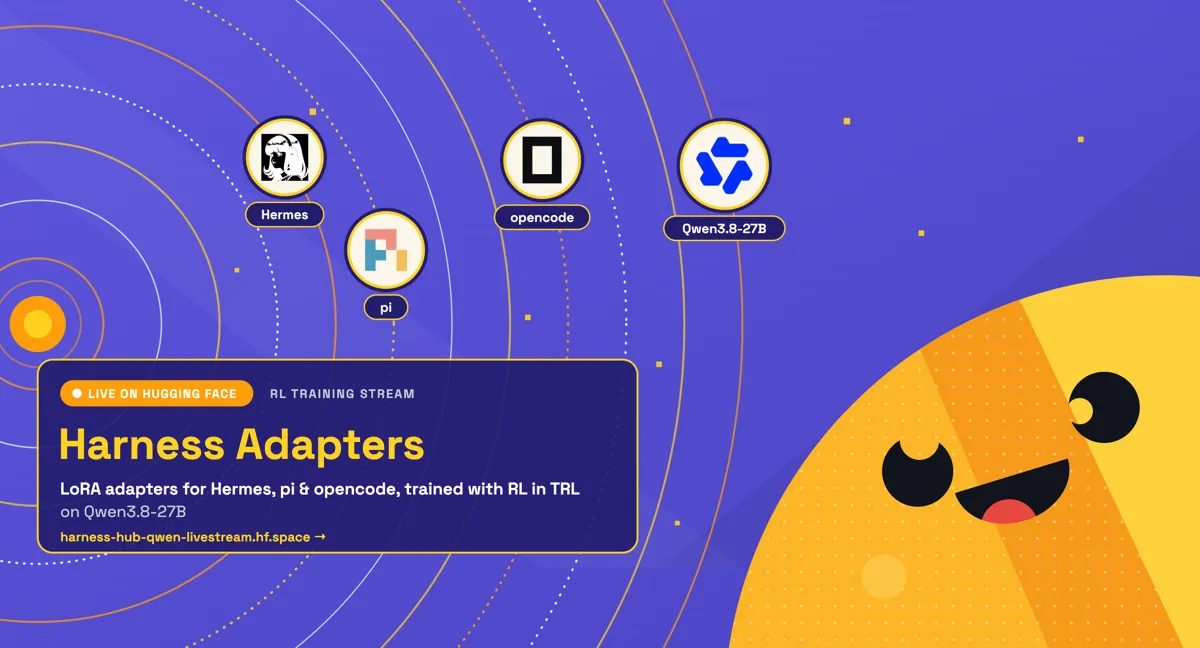
- One LoRA per harness (pi, Hermes Agent, OpenCode), trained with RL inside the unmodified harness; tasks, training and rollouts all run in Hub Jobs with TRL's AsyncGRPOTrainer, OpenEnv and Harbor.
- On the 51 hardest SWE-bench Pro tasks: pi goes from 39.2% to 64.7%, Hermes from 29.4% to 43.1% and OpenCode from 35.3% to 51.0%; on the full Terminal-Bench 2.1, pi gains 16.3 points.
- On tasks both solve, the adapters make 53% to 72% fewer tool calls per task.
- The three LoRAs merge at weight 1/2 into one super-adapter that beats the base model under all three harnesses; adapters, GGUFs, RL tasks and the safeagents plugin are all public.
Builder's takeIt shows a model and its harness should be tuned as one unit rather than swapped hoping for luck: the same 27B base, plus one LoRA, solves a quarter more of the hard tasks with over half the tool calls gone. If you run a fixed workflow on an open model, I'd start by turning your past tasks into a verifiable RL environment; that step is worth more than the training itself.
// Background · from #Open models
Full timeline →- Nov 21 Thinking Machines releases Inkling 2 Mini: a looped MoE with about 26B total and 3B active parameters per token, 1M-token context and image input
- Nov 21 Microsoft Foundry Managed Compute is generally available: deploy 150+ open models on dedicated GPUs, choosing NVIDIA A100, H100, H200 or AMD MI300X
- Nov 19 Cloudflare opens the weights of Clairic and Clairic-flash: 27B and 9B extraction models that read PDFs and bill only for input tokens