@GitHub goes GA in Slack and Teams, Kimi K3.1 Pro lands on Bedrock, OpenAI brings in Hacktron to test its own systems
Today's thread is putting agents under management: coding agents move into team chat, while review settings and agent configuration become things you manage through APIs and config files and review in PRs. On the other side, large open models keep entering managed catalogs, and GPU partitioning and on-device speech keep pushing inference cost down.
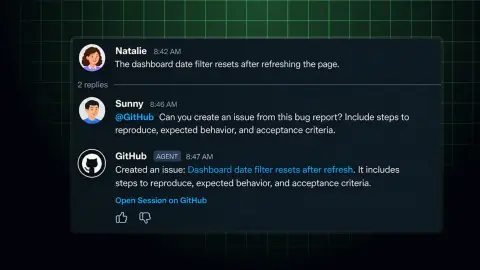
Mention @GitHub in Slack or Teams to investigate bugs, create issues, implement changes and open pull requests without leaving the conversation
Canvas in Teams lets people review implementation plans, code changes and previews next to the conversation and keep refining together
@GitHub now identifies the repository from the message and launches the session without asking you to select it again
Issues and pull requests it creates include "Created from a Slack/Teams conversation with @username" in their description
Builder's takeOpening a PR from one chat message lowers the bar, and review volume will rise with it. I would enable it on one non-core repository first, watch merge and rework rates for two weeks, then decide on the main repos; the automatic "created from a conversation with @user" line is exactly the accountability trail we need for agent-made changes.
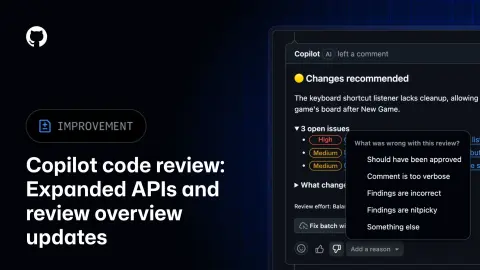
Enterprise admins can enable or disable code review for all organizations; organization admins manage enablement, default review effort and runner configuration, and enterprise-managed settings cannot be overridden
Repository admins manage review effort and whether reviews use custom instructions and MCP tools; repository endpoints support GitHub Apps and fine-grained PATs, enterprise and organization endpoints do not
The API identifies Copilot reviews and comments through explicit attribution fields, and reports the review effort used and the skills, MCP servers and custom instructions behind a comment
The review overview is more compact, review agent sessions show the AI credits a review consumed, and the automatic-review repository rule now honors its bypass list
Builder's takePut this next to the addressed-rate metric from two days ago: GitHub is making review measurable and configurable. I would keep each repository's review effort in a config repo via this API, then use the per-review credit figure to drop effort on low-adoption repos and spend the savings on core ones.
According to Moonshot AI, Kimi K3.1 Pro is an open-weight, natively multimodal agentic model with a 1-million-token context window and its most capable 3-trillion-parameter-class model to date
Bedrock offers the Highspeed variant, built for high output tokens per second in agentic work such as coding and document processing
It runs inside the same security boundary as proprietary models and supports explicit prompt caching to cut latency and input cost
It is available in every AWS Region that has Amazon Bedrock, through cross-Region inference
Builder's takeLess than a week after the 11-04 item on Kimi K3 in-country inference in India, Moonshot is moving fast on Bedrock. For AI Cloud Drive's long-document Q&A I would test it against our current model on the same files, focusing on real per-request cost with prompt caching on, not leaderboard scores.
NVIDIA MIG splits one physical GPU into isolated partitions, each with a fixed share of compute and dedicated memory enforced in hardware, up to seven depending on the GPU
It works only on endpoints that use inference components; single-model endpoints, serverless endpoints and heterogeneous instance pools cannot be partitioned
In AWS tests, a 40 GB partition of an H100 against a full A100-40GB delivered 53 to 89 percent more output tokens per second at each scenario's best-cost load, and 5.6 to 47.5 percent lower time to first token
Above a crossover that comes earlier as prompts lengthen, it was 18 to 34 percent cheaper per million output tokens, at on-demand prices
Builder's takeMany teams give every small model its own GPU and pay for idle silicon. For AI Interview's role-specific fine-tuned models I would move them onto inference components first, swap a full older GPU for half a newer one for a week, and compare latency and the bill before migrating everything.
With training and inference on separate GPUs, updated weights must be refit to the inference GPUs periodically; NVIDIA estimates about 10 TB per refit for today's largest open-weight models
Reshard treats refit as a DTensor-to-DTensor transfer and moves only the theoretical minimum data between arbitrary source and destination layouts
The open reference implementation, NCCL M2N Reshard, is in the NVIDIA/nccl-extensions repository
In NeMo RL tests on DGX H100 and DGX GB200 it ran 2.7x to 5.7x faster across models including Qwen 3 235B and DeepSeek v3 671B
Builder's takeMost product teams will not run RL at this scale, but it shows post-training cost for open models is still being engineered down, so training your own specialist model keeps getting cheaper. Get your eval set and reward signals ready now, and start once this lands in NeMo RL's default path.
The models are about 65 MB and 75 MB, cover English, French, German, Spanish and Portuguese, ship 100+ voices, and support voice cloning and voice design
Phonon 31m (English) is Apache 2.0; Phonon 40m, covering all five languages, is under a non-commercial license
On the Open TTS Leaderboard it ranks first for intelligibility in German and Spanish and top three in every language; CPU streaming p95 time to first audio is 28 ms (31m) and 38 ms (40m), against 165 ms for Pocket TTS
Its runtime supports 10+ backends including CPU, CUDA, Vulkan, Metal, WebGPU and NPUs; it is in Transformers from v5.21, and an ExecuTorch build runs in the browser on WebGPU
Builder's takeAI Interview's spoken follow-ups use cloud TTS today, and both latency and per-character billing hurt. For English I would try the Apache 2.0 31m model in the browser first; if first audio really stays in the tens of milliseconds it is worth switching. The multilingual model is non-commercial, so check licensing before shipping it.
OpenAI announced a partnership with Hacktron to find vulnerabilities in OpenAI's systems
The scope includes testing OpenAI's connections with third-party services
The stated goal is to strengthen defenses with frontier AI; OpenAI filed it under Security
Builder's takeKernel patches, then GPT-6 Cyber, now testing itself: security is OpenAI's most consistent thread this month. The part worth copying is third-party connections. PandaClaws holds authorizations for several content platforms, so I would list every OAuth callback and webhook and have an AI scanner run against them on a schedule.
It measures how well AI agents interpret raw experimental data
It covers everyday wet-lab science; OpenAI filed it as a publication
Builder's takeRead with GPT-6 Rosalind on 10-30 and LifeVal on 11-02: OpenAI is building its own ruler for each vertical. The lesson for product teams is to write tests from the raw data your users actually hold, not public question sets; I would add a batch of real resumes and interview recordings to AI Interview's eval set on the same principle.
The microsoft.foundry extension bundle reaches 1.0 and general availability; it needs Azure Developer CLI 1.37.0 or later
Agent and deployment configuration lives in azure.yaml with the code, so teammates and CI/CD reuse one definition
azd ai agent run tests locally, and Agent Inspector shows requests and responses
A hosted agent runs your own agent code on Foundry's managed compute with your choice of framework and orchestration; editable Bicep or Terraform can be ejected for customization
Builder's takeReviewing agent configuration alongside code is worth copying on any platform: a prompt or tool-list change should go through a PR like any code change. We are not on Azure, but I would move PandaClaws' agent prompts and tool permissions out of the admin database and into config files in the repo.
Researched and drafted with AI assistance; editorial standards and views set by Darius.
Every Monday, the week in AI in one email
Every Monday morning: the 6 AI stories that mattered most in the past seven days, with my take, in your inbox.
Your email is only used to send the weekly and is never shared. Every email has a one-click unsubscribe link. See the latest issue →