Claude Code runs as a remote agent on AgentCore, Anthropic details how agents should remember, Cloudflare and Okta give agents an identity layer
Today's thread is accountability once agents work unattended: remote coding runs that end in a draft PR, short tokens that name both user and agent, sites that can see the user behind an agent, and review metrics that count what people actually act on. Underneath, Anthropic's memory research says the same thing for the agent itself: keep less, verify more.
Each registered repository gets its own AgentCore runtime; every task runs in its own microVM inside a VPC with private endpoints to Amazon Bedrock, and the container holds no other AWS credentials
Claude Code plans with Claude Opus, writes the change with Claude Sonnet, runs the repository's own verification, then reviews with Opus and can send the task back to planning, up to three attempts
The agent never holds a long-lived GitHub credential: AgentCore Identity issues a user-to-server token that expires after 8 hours; task prompts are screened by a Bedrock Guardrails guardrail first
The pull request records the verification command, exit code and attempts used, opens as a draft unless verification passed, and the agent never merges
Builder's takePlan with the big model, write with the cheaper one, review with the big one again: that split is worth copying even if you never touch AgentCore. For PandaClaws' backend I'd adopt the two hard rules first, short-lived repo tokens and "draft unless verified", before worrying about where the sandbox runs.
Building a wiki from about 350,000 internal files (roughly 420M tokens) with Opus 5 agents, scaling dreaming from 2 to 128 sessions raised the wiki-only score on 25 questions from 13% to 48% of graded criteria
With search plus the wiki the score rose from 54% to 61% as the wiki grew, versus 53% with search alone, and saved about 20,000 tokens per question; on 24 merger questions the wiki scored 87% versus 73% for search
In Pokémon, Sonnet 3.7 wrote 413 memory files across 225 folders and earned one badge, while Fable 5 kept a small folder of strategy and tested rules and got much further
Telling Opus 5 and Opus 4.7 to "record only failures" cost them much of their memory gain; prompting Sonnet 4.6 to read memory and test its theories nearly doubled its score
Builder's takeThe useful finding is that what to remember matters more than how much: Sonnet 3.7's 413 files made it slower, not smarter. For the AI cloud drive I'd stop storing anything the user can re-read from the file itself, and run a nightly consolidation pass over the day's logs instead of writing memory mid-task.
Managed agents can use skills, sandboxes to run code, subagents and hooks, on the runtime that supports millions of Mistral Vibe sessions each week
Workflows resume interrupted runs, add event triggers from enterprise systems and a visual graph; teams can describe a process in Mistral Vibe and generate, test and deploy it
A new Mistral MCP server lets developers build with Mistral Vibe or their own coding agent and deploy to Studio with one command; OpenTelemetry traces cover model calls, tool use and approvals
Models and platform can run in Mistral's cloud, your own cloud or VPC, or on-premises; ABANCA, BNP Paribas and CMA CGM are among customers in production
Builder's takeSkills, subagents, hooks, sandboxes and traces are now the standard checklist; every platform ships the same five. What still sets Mistral apart is on-premises for both model and platform, so that's the one reason I'd shortlist it, for the AI interview product's enterprise customers who won't send candidate data out.
The post lists problems agents reintroduce for sites, including shared subscriptions, friendly fraud on agent purchases, credential stuffing through a shared agent, and content read without a visit
The Trusted Agent Delegation (TAD) coalition will examine existing protocols such as Web Bot Auth, OAuth and MOLE and bring well-defined problems to the IETF
Security Analytics now breaks out Personal Assistants as a traffic category, and AI Crawler and Agent access policies can allow or block each agent, including only on pages with ads
With Account Abuse Protection (early access), each login and sign-up shows whether a personal agent made it and which one, so a site can mitigate one account by its Hashed User ID
Builder's takeWith yesterday's 402 payouts, the sites side now has both a price and an identity layer for agents. If your product has a login page, start logging which logins come through agents now; once the data shows up, decide which flows need a real person and which can let agents through.
Okta mints an ID-JAG per request after checking the agent is active, the user is assigned and an admin connected the target; the grant is single-use and expires in 5 minutes
AgentCore Identity redeems it for a 5-minute access token naming both user and agent; across 10 requests the first redemption took about half a second, and a reused token came back in a median of 58 ms
Deleting the agent's resource connection refuses new requests immediately; removing the user's assignment refuses them within about 1 second; deactivating the agent was queued for 86 minutes in the test org
Tokens already issued keep working for up to 5 minutes; AgentCore Identity added about 0.6 seconds to a request of about 30 seconds end to end
Builder's takeThe number I'd remember is 86 minutes: "deactivate the agent" is not your kill switch, deleting its connection is. With the 11-04 ServiceNow on-behalf-of post, the pattern is settling on short tokens that carry both user and agent; I'd make that the default for any agent we let touch the AI cloud drive's sharing APIs.
With 4-bit quantization the model is about 18 GB and runs on consumer GPUs with 24 GB of VRAM with context windows up to 64K tokens
The stack uses DFlash2 speculative decoding, INT4 weights, KV-cache quantization, CPU offloading, prefix caching and continuous batching
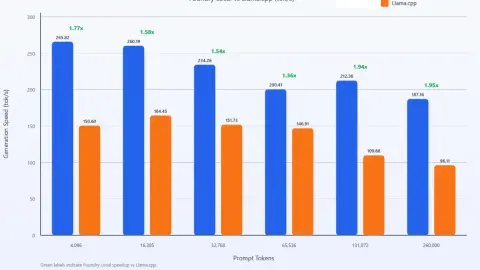
Against llama.cpp on an RTX 5090 and a DGX Spark, Foundry Local generated faster at every tested prompt length, with the gap widening beyond 131K tokens
Requires Foundry Local CLI 0.13.0 or later; Microsoft notes local models may reason less well than cloud models and suggests a hybrid workflow
Builder's takeA 27B model on a 24 GB card inside Copilot is the first local setup I'd actually hand to the team for routine edits and test writing. I'd route code that can't leave the office to it, keep cloud models for planning and hard bugs, and measure how often people have to switch back.
New counts: comments evaluated, comments the developer acted on (applying the suggestion, asking Copilot to fix, editing the code, or replying the fix comes later), and merged PRs with no human change request after Copilot's first review
Both counts are broken down by severity and by customization, such as custom instructions, skills, MCP servers or none
Comments are evaluated when their pull request merges, so they count on the merge day; comments on PRs opened by bots such as Copilot cloud agent are usually not evaluated
Available in enterprise and organization reports to owners, billing managers and custom roles with the permission; the Copilot usage metrics policy must be enabled
Builder's takeThis is the metric review bots have been missing: not how many comments, but how many anyone acted on. I'd pull it per repository for a month, compare repos with and without custom instructions, and cut the rules whose comments nobody addresses; note that bot-opened PRs are excluded, so agent PRs need their own measure.
The optimized engine adds support for agent traces, including OpenTelemetry traces, so traces and logs live in the same place
Span events, span links, prompts and tool calls keep their nested structure, allowing field-level queries without flattening at ingestion
On hot-tier data it supports update, delete and upsert by document ID to correct late or erroneous data in place
OpenSearch UI adds agent traces and sessions views; available on OpenSearch 3.7 at no additional charge in 12 Regions
Builder's takeMistral Studio, AgentCore and now OpenSearch all speak OpenTelemetry for agents, so I'd instrument with OTel now and treat the backend as swappable. If you already keep app logs in OpenSearch, this is the cheapest way to get prompt and tool-call search without adding another vendor.
FLUX 3 Image Klein combines Qwen3-VL-4B-Instruct for text conditioning, a diffusion transformer and an autoencoder, with Base and distilled checkpoints
NVFP4 alone is up to 1.62x faster for text-to-image and 1.58x for image-to-image than BF16 on a B200
Combined optimizations reach 3.46x for text-to-image (22.36 to 6.46 s) and 4.45x for image-to-image (54.64 to 12.28 s); Cache-DiT alone reaches 1.94x at 2048x2048 with an LPIPS of 0.033
On eight B200 GPUs, median text-to-image latency falls from 14.90 to 3.00 seconds for Base and from 2.73 to 1.08 seconds for the distilled model
Builder's takeFor PandaClaws' cover images the order of operations is clear from this: try step caching first, since it nearly halves latency at the smallest quality change, then NVFP4; multi-GPU only pays off for interactive editing. I'd rerun the LPIPS comparison on our own prompts before trusting the 0.033.
Researched and drafted with AI assistance; editorial standards and views set by Darius.
Every Monday, the week in AI in one email
Every Monday morning: the 6 AI stories that mattered most in the past seven days, with my take, in your inbox.
Your email is only used to send the weekly and is never shared. Every email has a one-click unsubscribe link. See the latest issue →