OpenAI ships GPT-6 Cyber, Claude adds an org IP allowlist, Microsoft proves agent-written code against a formal spec
The thread today is trust around agents: gated models for security work, tighter controls on where keys and sessions can be used, and new ways to check agent output, from formal proofs to cited answers and a redesigned review page. Meanwhile, generation keeps getting cheaper, from video at $0.07 a second to a 2B document model.
OpenAI describes GPT-6 Cyber as its cybersecurity model for finding exploitable vulnerabilities and developing fixes, trained to stay within authorized scope
The API use case: investigate vulnerabilities, reproduce them in an authorized test environment and verify fixes; organizations need Daybreak Red access and approval
1,050,000-token context window, up to 128,000 output tokens, text and image input; available on the Responses and Chat Completions APIs, not on Batch
Standard pricing is $20 input, $2 cached input and $100 output per million tokens
Builder's takeA day after the 948 kernel patches, OpenAI ships the model behind that kind of work, and at $100 per million output tokens it is a tool for targeted audits, not for scanning everything. If we get access, I'd use it only on the permission boundaries of the AI cloud drive and keep CodeQL-style static scanning as the cheap first pass.
gpt-image-2.6-sunburst targets detailed visual work and gpt-image-2.6-flare fast iteration, on v1/images/generations and v1/images/edits
A new complexity field (low, medium, high; default high) sets how much the model plans before rendering, at no separate fee
Both models support markup-guided edits, SVG output and animated GIF output through the Image API
OpenAI says Images 2.6 brings faster image generation, GIF creation and more precise editing across ChatGPT, Codex and the API
Builder's takeFor PandaClaws the useful part is complexity: covers with dense text get high, simple background swaps get low, and the default high is likely costing latency on the easy jobs. SVG output is worth a separate test for icons and charts, since a vector file can be edited instead of regenerated.
Requests to covered services from addresses not on the organization's list are refused, which limits where a leaked API key can be used
The allowlist takes IPv4 and IPv6 addresses or CIDR ranges, up to 1,000 per organization
POST /v1/organizations/users/{user_id}/sign_out (beta, admin-user-sign-out-2026-10-08 header) ends a Claude Enterprise member's sessions, trusted devices and OAuth tokens on every device
The member stays in the organization and can sign in again right away
Builder's takeThis is cheap insurance for any team whose keys only ever leave from a few egress IPs. I'd put our production gateways' egress ranges on the list first and check what the docs say is not covered, then wire the sign-out call into the offboarding script; note it ends sessions, it doesn't remove the person.
Web Answer builds on AgentCore Web Search, which launched in June, and plans its own searches, runs several in parallel and decides when it has enough evidence
Builders can scope it with domain include and deny lists and publish-date filters
It attaches as a target on an AgentCore Gateway, is called over MCP and authenticated with IAM, with zero data egress
Available in US East (N. Virginia) with per-tool-call pricing
Builder's takeA search tool that is itself an agent hides the intermediate steps, which is convenient until an answer is wrong. If I used it, I'd log every citation it returns and spot-check them against the source, and keep date filters on for anything time-sensitive; that is exactly the check this brief runs by hand every day.
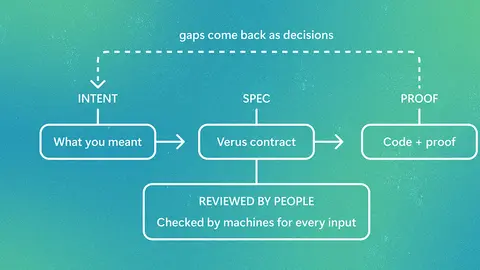
PDD Kit works with the developer to turn intent into a formal specification in Verus, proves the agent's code meets it for every input, and falls back to tests where a proof can't reach
Inside GitHub Next's Chopin, it verified the login logic of Pet Store, a Rust storefront; Verus hardened the code and uncovered existing bugs
The developer reviewed the intent and never read the generated code line by line
The authors argue agent-written tests usually check what the agent built rather than what was asked for
Builder's takeFormal proofs won't cover a whole product, but login, sharing permissions and billing are small enough to specify. I'd try the idea on the AI cloud drive's share-link permission check first; even without Verus, writing the spec before handing work to the agent already catches the gap between what I asked for and what its tests check.
The Overview page brings merge status and next available actions to the top of the page in a compact readiness summary
The redesigned merge box shows checks, comments and approvals in less than half the space and lets you act, such as updating the branch
The preview is opt-in, with rollout continuing through the weekend
GitHub says it is a first step, as people need to review more and more pull requests
Builder's takeWhen agents open a large share of the PRs, the scarce resource is the reviewer's attention, and GitHub is now designing for that. I'd turn the preview on for the reviewers who handle agent PRs and see whether it cuts the time spent finding the failing check.
Native generation and editing up to 15 seconds, up from 10 seconds with Omni 1.1, with duration set in one-second steps from 3 to 15 seconds
Multi-turn conversational editing lets you fix a detail with a follow-up edit instead of regenerating the whole clip
Price is 30% lower than Omni 1.1, at $0.07 per second for 720p; drafts at 360p or 720p can be upscaled to 1080p or 4K
Generation can be guided by character, product or style images, motion clips up to three seconds and audio cues
Builder's takeAt $0.07 a second a 15-second 720p clip is about a dollar, which puts short product videos within reach of a content tool's per-post budget. For PandaClaws I'd test the draft-low, edit, then upscale flow, since follow-up edits are where the real savings are, not the list price.
Publishers, content owners and API providers can collect stablecoin payments from AI bots and agents that settle in local currency to their Stripe balance
When an agent requests protected content, AWS WAF returns HTTP 402 with the accepted payment credential types; with a valid credential, the content is returned
Connect through Stripe Connect in the AWS WAF console; existing pricing and agent policies work unchanged
No additional charge for AWS WAF customers on Amazon CloudFront; standard AWS WAF and Stripe fees apply
Builder's takeRead with OpenAI's robots.txt training signal from 10-30: sites now have a way to say no and a way to say "pay". For products whose agents browse the web, I'd budget for 402 responses now and decide which sources are worth paying for, rather than treating a 402 as a failure.
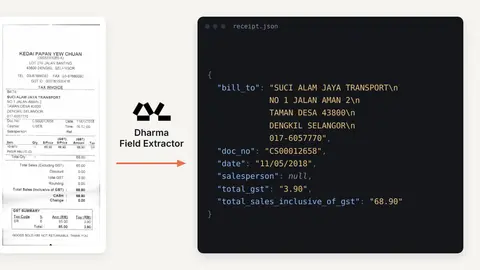
Built on DharmaOCR-LITE v1.1 (2B parameters) with a LoRA adapter trained on 43,384 examples; works open-ended or against an exact schema, returning null for fields not on the page
The benchmark covers 546 documents across three request scenarios, 1,638 cases, scored by field-level F1 times value similarity times valid-JSON share
The quality gap to general-purpose LLMs runs from 1.8 points (Claude Opus 5) to 9.3 points (GPT-5.6 Luna)
Cost is roughly 6 times lower than GPT-5.6 Luna and 147 times lower than GPT-5.6 Sol, measured as self-hosted GPU time on one L40S at $2.24 an hour
Builder's takeNote the benchmark is the vendor's own and the frontier models still score higher, but the cost gap is large enough to matter. In the AI cloud drive, invoice and receipt field extraction is exactly this shape of job; I'd run a few hundred of our own documents through it and send only low-confidence ones to a large model.
Specialised agents for different operational domains detect failures, correlate root causes across layers and surface recommendations through a chat interface, with every action tracked for auditability
Built around the NVIDIA NemoClaw blueprint on the OpenShell runtime; agents reach infrastructure through OpenClaw plugins and MCP servers that each expose a focused set of approved tools
Inference uses locally served Nemotron open models, and the framework runs across internal DGX H100, DGX B200 and DGX GB300 production clusters
Helm deploys it as a Kubernetes control-plane application; the orchestration framework is released as experimental open source, and APIs may change between releases
Builder's takeNemoClaw was announced on 10-30 and already has a production user at NVIDIA itself, which is more convincing than a blueprint. The design choice I'd copy for our own on-call bot is one MCP server per domain with only approved tools, so the agent can read everything but can only touch what a runbook already allows.
Researched and drafted with AI assistance; editorial standards and views set by Darius.
Every Monday, the week in AI in one email
Every Monday morning: the 6 AI stories that mattered most in the past seven days, with my take, in your inbox.
Your email is only used to send the weekly and is never shared. Every email has a one-click unsubscribe link. See the latest issue →