How Chinese Startups Can Use AI to Compete with Larger Incumbents

ALT: Chinese startup engineers building native AI products to compete with larger tech incumbents
How Chinese Startups Can Use AI to Compete with Larger Incumbents in a Crowded Market
A small team in Shenzhen ships a niche productivity tool, watches a well-funded incumbent copy the interface within weeks, and then loses users anyway because the copycat has more marketing budget and a bigger sales team. This scenario repeats across nearly every vertical in China's tech landscape, and it is exactly why the question of how Chinese startups can use AI to compete with larger incumbents has become urgent rather than theoretical. The answer is not to out-spend the giants — it is to out-build them by treating AI as a native architectural layer instead of a marketing feature bolted onto an existing product.
This list draws on patterns we consistently see in our work architecting production-ready AI systems: the startups that win are the ones that use AI to compress engineering timelines, own narrow but deep data advantages, and ship faster than the approval chains of larger organizations ever could. Each item below was selected because it addresses a structural disadvantage — capital, talent pool, or distribution — that startups typically hold against incumbents, and shows how AI reverses it. Read the list in order if you are building from zero, or jump to the sections most relevant to your current stage.
The List: Practical Ways Chinese Startups Can Use AI to Outmaneuver Larger Incumbents
Native AI Integration Over Bolt-On Features
Native AI integration means embedding AI reasoning and automation directly into a product's core workflow rather than adding a chatbot widget on top of an unchanged interface. Larger incumbents often struggle here because legacy codebases, internal approval processes, and cross-team dependencies slow down architectural change, even when they have far more engineering headcount. A startup that designs its data model and user flows around AI from day one can deliver an experience that feels fundamentally smarter, not just decorated with AI branding.
- Best for: Early-stage teams building a new product category or reimagining an existing workflow.
- Watch out: Retrofitting native AI into an already-shipped MVP is far harder than designing for it from the start, so this decision needs to happen at the architecture stage — a distinction explored in depth in the difference between AI prototypes and production-ready AI systems.
Leveraging Open-Source and Domestic LLMs to Cut Costs
Open-source and domestically developed large language models give startups access to competitive AI capability without the licensing costs or geopolitical exposure of relying solely on foreign proprietary APIs. China's model ecosystem has matured rapidly, and per Brookings Institution research on competing AI strategies for the US and China, domestic model availability has become a meaningful lever in the broader competitive landscape. This lets lean teams match the model quality that larger firms achieve through expensive proprietary contracts.
- Best for: Startups with tight budgets that still need strong reasoning or generation quality in production.
- Watch out: Model quality and licensing terms shift quickly, so architecture should be designed to swap models without a rewrite — a pattern covered in LLM integration patterns every engineering team should know.
Vertical-Specific AI Products for Underserved Niches
Vertical-specific AI products are tools built for a single industry or workflow rather than a broad horizontal audience, and they matter because incumbents rarely justify the engineering investment required to serve a narrow niche well. A startup that goes deep into one vertical — legal document review, manufacturing quality inspection, or logistics scheduling, for example — can build domain-specific data pipelines and prompt structures that a generalist competitor has no incentive to replicate. This depth becomes a genuine moat rather than a temporary feature advantage.
- Best for: Founders with domain expertise or access to proprietary workflow data in a specific industry.
- Watch out: Going too narrow before validating demand can leave a startup with a beautifully engineered product and too small a market.
Speed-to-Market Through Compressed Build Cycles
Speed-to-market is the ability to move from concept to a live, usable product in a compressed timeframe, and it is one of the few advantages a startup holds outright over a large incumbent. Bigger organizations carry review boards, compliance sign-offs, and cross-departmental dependencies that can turn a two-week feature into a two-quarter project. A startup using AI-assisted development, automated testing, and streamlined deployment pipelines can validate an idea with real users before an incumbent has finished its internal planning cycle.
- Best for: Teams racing to capture a narrow window of market opportunity or responding to a sudden shift in user demand.
- Watch out: Speed without a stable technical foundation creates fragile systems; a disciplined approach to shipping fast is detailed in how to ship your first live AI product in 30 days.
Lean, AI-Native Engineering Teams
An AI-native engineering team is a small group of engineers who use AI tooling throughout the development lifecycle — from code generation to testing to documentation — allowing them to operate with the output capacity of a much larger team. This matters because talent cost and headcount are traditionally where incumbents dominate. When a five-person team can ship, monitor, and iterate on a production AI system at a pace that once required twenty engineers, the talent-scale advantage of larger firms erodes significantly.
- Best for: Founders deciding how to structure early technical leadership and avoid premature hiring.
- Watch out: Velocity gains from AI tooling can mask burnout risk if process discipline is not built in alongside the tooling, a balance addressed in how to build and maintain engineering velocity without burning out your team. Deciding who leads this team technically is also a strategic choice, one weighed in Engineering Director vs. CTO: choosing the right leader for your stage.
Data Moats Built Through Proprietary Workflow Capture
A data moat is a durable competitive advantage created when a product generates and retains proprietary data that competitors cannot easily access or replicate. Startups that design their AI features to capture structured feedback loops — user corrections, workflow completions, domain-specific edge cases — accumulate a training and personalization advantage over time that pure scale cannot buy quickly. This is especially powerful in China's fragmented vertical markets, where generalized incumbent platforms often lack workflow-level data depth.
- Best for: Products with recurring user interaction where feedback naturally improves the AI over repeated use.
- Watch out: Data moats take sustained usage to form; they are a long-game advantage, not an immediate differentiator against a well-funded competitor.
Strategic Use of Ecosystem and Policy Tailwinds
Ecosystem tailwinds refer to the combination of government incentives, open-model availability, and industrial policy support that shape the environment in which Chinese AI startups operate. According to a report from the U.S.-China Economic and Security Review Commission on China's open AI strategy and its industrial dominance, the openness of the domestic model ecosystem functions as a structural asset that smaller players can tap into directly. Startups that align their technical stack with this open ecosystem — rather than depending entirely on foreign infrastructure — can reduce cost and regulatory friction simultaneously.
- Best for: Startups building for the domestic Chinese market where policy alignment reduces operational friction.
- Watch out: Ecosystem support is not a substitute for product quality; it lowers cost barriers but does not guarantee user adoption.
Rapid Iteration Using Real User Signal Over Assumption
Rapid iteration means adjusting a product frequently based on direct user behavior data rather than long planning cycles based on assumption. Large incumbents often batch product changes into scheduled release cycles shaped by internal governance, while a startup with a native AI layer can adjust prompts, workflows, and model behavior in near real time as usage patterns emerge. This tight feedback loop compounds over months into a product that feels more responsive and better tuned to actual user needs than a bureaucratically managed competitor's offering.
- Best for: Teams with active user bases and the technical maturity to run controlled, fast experiments.
- Watch out: Iterating without clear success metrics can create feature churn that confuses users rather than delighting them.
Quick Comparison at a Glance
| Item | Best For | Key Strength | Limitation |
|---|---|---|---|
| Native AI Integration | New products or reimagined workflows | Deep, defensible user experience | Hard to retrofit after launch |
| Open-Source/Domestic LLMs | Budget-conscious teams | Lower cost, competitive quality | Model landscape shifts quickly |
| Vertical-Specific AI Products | Founders with domain expertise | Strong niche moat | Risk of too-narrow a market |
| Speed-to-Market | Time-sensitive opportunities | Faster validation than incumbents | Fragile without solid foundation |
| Lean AI-Native Teams | Early technical org design | Output scale without headcount | Burnout risk if unmanaged |
| Data Moats | Recurring-use products | Compounding long-term advantage | Slow to materialize |
| Ecosystem/Policy Tailwinds | Domestic market builders | Lower structural cost barriers | Not a substitute for quality |
| Rapid Iteration on Real Signal | Active, data-rich products | Continuous responsiveness | Needs disciplined metrics |
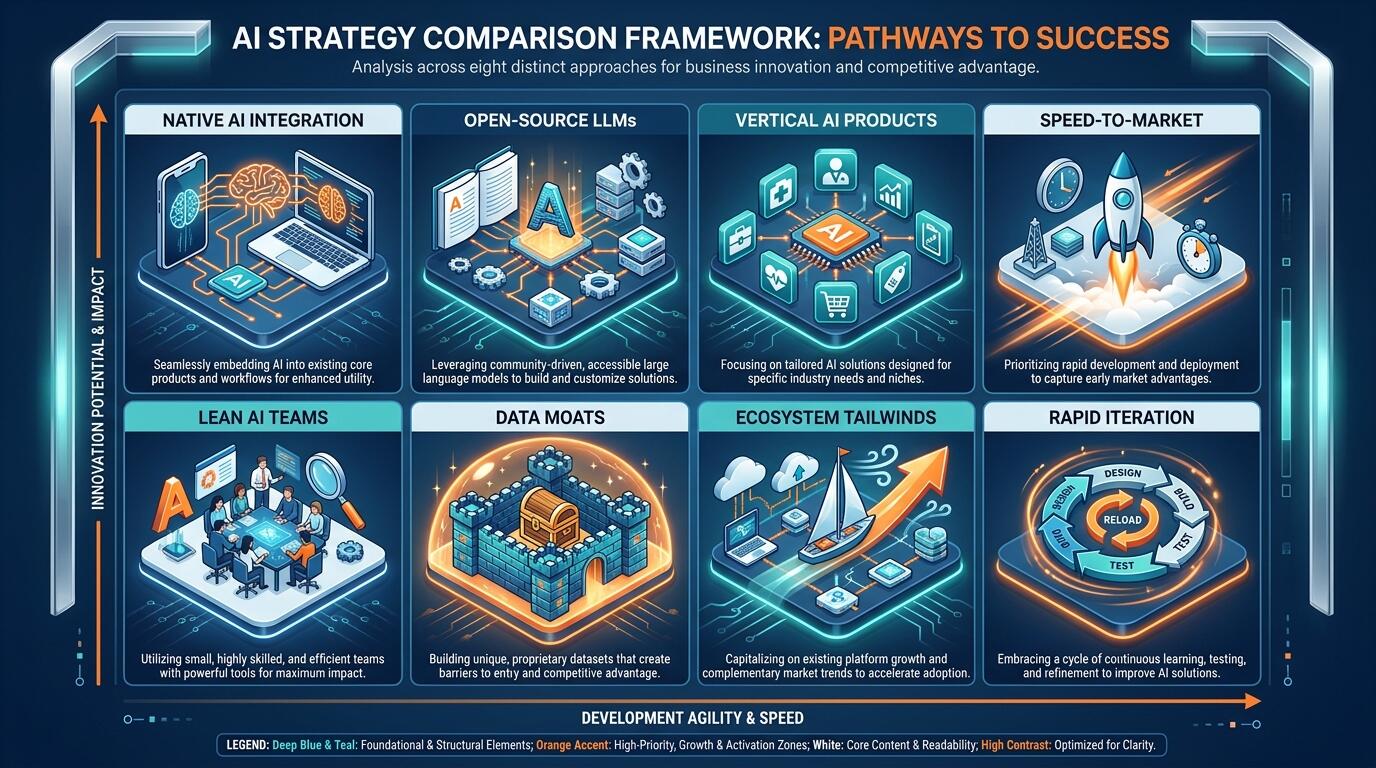
ALT: Comparison chart showing AI strategies Chinese startups use to challenge incumbent technology firms
How to Choose the Right One for Your Startup's Stage
The right combination depends less on ambition and more on where a startup sits in its lifecycle. A pre-launch team should prioritize native AI integration and a clear vertical focus, because these decisions are architectural and expensive to reverse later. A team with an early live product should focus on speed-to-market discipline and lean AI-native engineering practices, since these compound engineering output without adding headcount cost.
A common misconception is that competing with larger incumbents requires matching their feature breadth. In practice, per Cornell's research on China's domestic AI competition, the market has grown crowded enough that differentiation through depth — not breadth — is what separates surviving startups from those absorbed or outcompeted. Trying to be everything to everyone against a well-capitalized competitor is a losing strategy; narrow, native, and fast almost always outperforms broad and shallow.
Startups further along, with real usage data, should shift attention toward data moats and rapid iteration cycles, since these are the advantages that mature over time and become genuinely difficult for a larger, slower-moving organization to replicate. The right starting architecture matters here too — teams weighing what technical foundation to build on can review the minimum viable architecture for a first AI-powered app before committing to a stack.
Frequently Asked Questions FAQ
Q1: How can a small Chinese startup realistically compete with a well-funded tech incumbent using AI?
A small startup competes by using AI as a structural advantage rather than a marketing layer — designing native AI integration, focusing on a narrow vertical, and iterating faster than an incumbent's internal approval processes allow. This turns capital disadvantage into an engineering-speed advantage, which is often more decisive than budget size alone in fast-moving product categories.
Q2: Is open-source AI infrastructure reliable enough for a production startup product in China?
Open-source and domestic large language models have matured to a level where many startups build production systems on them successfully, particularly when paired with solid engineering architecture and fallback options. Reliability depends heavily on implementation quality rather than the model choice alone, which is why integration patterns matter as much as model selection.
Q3: How long does it typically take a lean team to ship a competitive AI-native product?
Timelines vary by scope, but disciplined teams using AI-assisted development and clear architectural planning can move from concept to a live, testable product in a matter of weeks rather than the quarters typical of larger organizational review cycles. The exact duration depends on product complexity, but compressed cycles are consistently achievable with the right process discipline.
The Bottom Line
Chinese startups can use AI to compete with larger incumbents by treating AI as a native structural capability, focusing depth over breadth in underserved verticals, and using lean, AI-assisted engineering practices to move faster than bureaucratic competitors ever can. The three consistent threads across every item in this list are architectural discipline, narrow strategic focus, and compounding data or speed advantages that larger organizations structurally struggle to replicate.
The next step for most teams is an honest audit: is AI genuinely embedded in the product's core logic, or is it sitting on top as a feature? That single question tends to separate startups building durable advantages from those chasing a trend. Getting that architecture right early saves months of costly rework later.
Ready to experience AI built the right way — as a native capability, not an afterthought? Explore Darius's suite of production-ready AI products, from smart cloud storage to AI-powered mock interviews and creator tools, at the Darius website. Visit today to see how Darius can help you work smarter, prepare better, and create faster with AI.
Sources & Further Reading
- Cornell SC Johnson College of Business. "China's Domestic AI Competition Heats Up".
https://business.cornell.edu/news/2024/12/13/chinas-domestic-ai-competition-heats-up/ - U.S.-China Economic and Security Review Commission. "Two Loops: How China's Open AI Strategy Reinforces Its Industrial Dominance".
https://www.uscc.gov/sites/default/files/2026-03/Two_Loops--How_Chinas_Open_AI_Strategy_Reinforces_Its_Industrial_Dominance.pdf - Brookings Institution. "Competing AI Strategies for the US and China".
https://www.brookings.edu/articles/competing-ai-strategies-for-the-us-and-china/ - National Institute of Standards and Technology (NIST).
https://www.nist.gov/ - Stanford Institute for Human-Centered Artificial Intelligence (HAI).
https://hai.stanford.edu/
Note: Standards may be updated; please check the latest official documents or consult professional advisors.