Engineering Director vs. CTO: Choosing the Right Leader for Your Stage
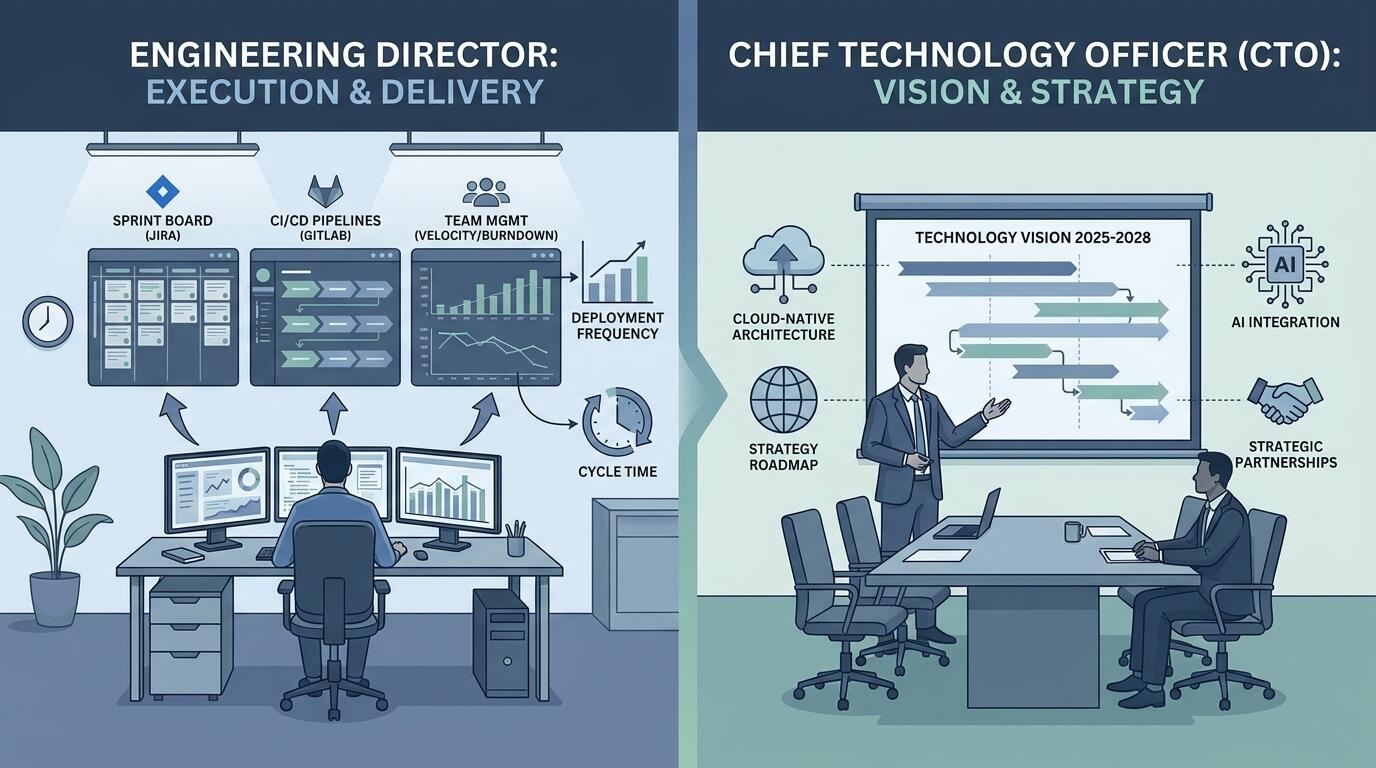
ALT: Engineering Director vs CTO comparison guide for choosing the right technical leader at each startup stage
Engineering Director vs. CTO: What Each Role Actually Means for Your Organization
Choosing between an Engineering Director and a Chief Technology Officer is one of the most consequential organizational decisions a startup or scaling company can make — and it is routinely made on instinct rather than clarity. The Engineering Director role is an execution-focused leadership position responsible for delivery, team health, and engineering process; a CTO is a strategic, externally-facing executive who owns the company's long-term technology vision and directly influences product-market positioning. Getting this distinction wrong doesn't just slow you down — it misaligns your entire technical organization with the stage your company is actually in.
In this comparison, we evaluate both roles across the dimensions that matter most in practice: strategic horizon, execution ownership, team leadership scope, stakeholder interaction, hands-on technical depth, and organizational cost-to-value. The goal is to give technical founders, product leaders, and engineering teams a clear framework for making the right hire at the right moment.
Evaluation Criteria: How to Judge the Right Technical Leader for Your Stage
The comparison between an Engineering Director and a CTO is not about seniority — it is about fit. A pattern that consistently surfaces in practice is that organizations struggle not because they have weak leaders, but because they have the right leader in the wrong role for their current stage. To cut through the noise, we evaluate both roles across six criteria that directly affect organizational outcomes.
Strategic horizon captures how far out each role is expected to think and plan. Early-stage companies need someone who can set a credible multi-year vision; later-stage companies may need that vision executed with precision at the team level.
Execution ownership addresses who is ultimately accountable for shipping. Delivery velocity, sprint health, and engineering process discipline are execution concerns — and they sit much closer to the Engineering Director's domain than a CTO's.
Team leadership scope defines whether the role manages individual contributors directly, manages managers, or leads across organizational functions. This determines hiring budget, reporting structures, and the caliber of direct reports you need beneath the role.
Stakeholder interaction distinguishes whether the role is primarily internal-facing (boards, VCs, customers, press) or internally operational (engineers, product managers, QA, DevOps). This has enormous implications for how the leader spends their time.
Hands-on technical depth is especially relevant in the AI era, where architecture decisions made early have compounding consequences. Understanding how much technical involvement is expected of each role helps founders avoid hiring a strategic leader who can't evaluate architecture trade-offs, or an execution leader who is being asked to represent the company's technology strategy to investors.
Organizational cost-to-value reflects the reality that both roles carry significant compensation expectations, and the right choice depends on what your organization actually needs right now — not what sounds most impressive on a LinkedIn announcement.
The Contenders: Understanding Each Role on Its Own Terms
The Engineering Director: The Builder's Leader
An Engineering Director is a senior leadership role responsible for the operational health, delivery execution, and team culture of one or more engineering organizations. The Engineering Director typically manages engineering managers rather than individual contributors directly, owns the engineering roadmap execution in partnership with product, and is deeply involved in hiring pipelines, performance management, and process improvement.
In practice, Engineering Directors are the people who ensure that what the CTO or CPO envisions actually gets built — on time, with acceptable quality, and without burning out the team. They are strong systems thinkers with a builder's instinct: they care about CI/CD pipelines, on-call rotations, technical debt paydown, and team throughput as much as they care about architecture diagrams. In work across early-to-mid-stage technical organizations, we consistently see the Engineering Director role undervalued — treated as a "senior manager" rather than recognized as the linchpin between vision and velocity.
The Engineering Director role is typically not externally facing. They are rarely presenting to the board, speaking at industry conferences, or defining three-year platform roadmaps independently. Their authority is largely internal, and their success is measured by delivery outcomes, team retention, and engineering quality metrics.
The CTO: The Strategic Technology Executive
A Chief Technology Officer is an executive-level leader responsible for the company's technology strategy, innovation direction, and external technology positioning. Per widely adopted organizational frameworks referenced in sources such as Harvard Business Review and practitioner communities like the CTO Craft organization, the CTO role spans multiple archetypes — from the deeply hands-on, code-writing CTO of a two-person startup to the enterprise CTO who manages platform strategy across multiple business units.
The CTO's primary accountability is to align technology investment with business strategy. They work directly with the CEO, board, and major customers. They define which platforms, languages, and architectural paradigms the company will bet on. In AI-native companies, the CTO's decisions about model selection, data infrastructure, and inference architecture are founding-level choices that shape the company's competitive moat.
Critically, a CTO who is expected to run engineering execution in addition to strategic responsibilities is a CTO being set up to fail. As organizations scale, the span of control required for both roles simultaneously becomes untenable — and this is precisely when bringing in a strong Engineering Director becomes the highest-leverage hire available. According to analysis from Full Scale's comparison of Head of Engineering vs. CTO roles, these two functions serve fundamentally distinct organizational needs and are most effective when clearly separated.
Head-to-Head Comparison: Engineering Director vs. CTO Across Key Dimensions
| Criterion | Engineering Director | CTO |
|---|---|---|
| Strategic horizon | Quarterly to annual execution planning | Multi-year technology vision and platform bets |
| Execution ownership | Primary owner of engineering delivery | Sets direction; delegates execution to eng leadership |
| Team leadership scope | Manages engineering managers; owns headcount planning within function | Leads across technology, product, and sometimes data organizations |
| Stakeholder interaction | Primarily internal: product, design, QA, DevOps | External and executive: board, investors, customers, press |
| Hands-on technical depth | High — actively involved in architecture reviews, technical escalations | Variable — ranges from hands-on (early-stage) to advisory (growth-stage) |
| Organizational cost-to-value | High ROI for execution-constrained organizations | High ROI for strategy-constrained or externally-positioning organizations |
| Typical reporting line | Reports to CTO or VP Engineering | Reports to CEO or COO |
| When most valuable | Post-product-market fit, scaling engineering team | Pre-PMF through growth stage, building technology differentiation |
The table above surfaces a critical insight: these roles are not interchangeable, and they are not on the same linear career ladder in the way many organizations assume. A strong Engineering Director is not simply a "CTO in waiting" — they are optimized for a different set of organizational problems.
The most common failure mode we observe in our work with technical organizations is a company hiring a CTO when they actually need an Engineering Director. The founding team has found product-market fit, the engineering team has grown to a size that requires real management, delivery is slipping — and the instinct is to hire a "big name" CTO to solve the problem. But the problem is an execution problem, not a strategy problem. A CTO who comes in expecting to set vision and interface with the board will be immediately frustrated by a team that needs sprint planning, technical debt governance, and manager coaching. Per the analysis at Harness's breakdown of CTO vs. VP of Engineering distinctions, the strategic and operational mandates of these roles diverge sharply as organizations grow.
The inverse failure is equally costly: promoting or hiring an Engineering Director-caliber leader into a CTO title when the company actually needs someone who can represent technology strategy to investors, make platform bets, and attract senior engineering talent through thought leadership. Execution-focused leaders in this role often become uncomfortable with the ambiguity and external demands — not because they lack capability, but because the role asks for a fundamentally different mode of leadership.
The nuance worth naming here — and one that experienced practitioners increasingly emphasize — is that the best technical organizations have both roles filled, with clear ownership boundaries. The CTO owns "what we build toward and why." The Engineering Director owns "how we build it and when it ships." When these two functions are collapsed into one role without explicit acknowledgment, one always dominates — and the other suffers. For AI-native organizations where architecture decisions and delivery velocity are both existential concerns, this separation becomes even more important. The strategic work of designing a scalable AI architecture for production requires the kind of forward-looking focus a CTO can sustain precisely because an Engineering Director is handling the operational weight.
Which Should You Choose? Scenario Recommendations for Your Stage
The right choice between an Engineering Director and a CTO depends almost entirely on where your organization is right now — not where it aspires to be.
If you are a pre-Series A startup with a founding CTO and a growing engineering team: You likely need an Engineering Director before you need a second executive. Your CTO should be focused on platform decisions, fundraising narratives, and technical recruiting — not managing sprint ceremonies and escalating on-call incidents. Bringing in a strong Engineering Director at this stage is often the hire that unlocks 30-50% more output from the same headcount, purely through process clarity and management quality.
If you are a growth-stage company without a clear technology strategy: You need a CTO, not just a head of engineering. When your technology choices are being driven by whoever is most available rather than a coherent platform vision, and when investors or customers are asking hard questions about your technical differentiation, a CTO is the right answer. This is a strategy gap, not an execution gap.
If you are scaling an AI-native product and your architecture is becoming a bottleneck: You may need both — a CTO who owns AI infrastructure direction and an Engineering Director who ensures teams can ship reliably against that direction. In our work with clients building production AI systems, the organizations that scale most effectively are those that separate these concerns early, before the bottleneck becomes a crisis.
If you have a CTO who is being pulled into day-to-day engineering management: This is the clearest signal that an Engineering Director hire is overdue. A CTO spending the majority of their time on execution is a CTO who is not doing strategy — and the company is paying a strategic premium for operational work.
Engineering Director — pros and cons in brief:
- Pro: Directly improves delivery velocity, team health, and execution quality
- Pro: High ROI at the team scale where management overhead becomes a real cost
- Con: Does not address strategic technology differentiation or external positioning
- Con: Cannot substitute for a CTO when investor or customer conversations require executive technical credibility
CTO — pros and cons in brief:
- Pro: Sets the technology vision that attracts top engineers and strategic partners
- Pro: Essential for companies where technology is the core differentiator and the board needs a technical executive voice
- Con: Will underdeliver if expected to own execution without an Engineering Director or equivalent beneath them
- Con: Can be a misaligned hire for companies whose primary constraint is shipping, not strategy
For teams looking to move quickly from idea to shipped product, the discipline required to ship a live product within a compressed timeline is fundamentally an Engineering Director function — execution focus, prioritization rigor, and delivery accountability applied end-to-end.
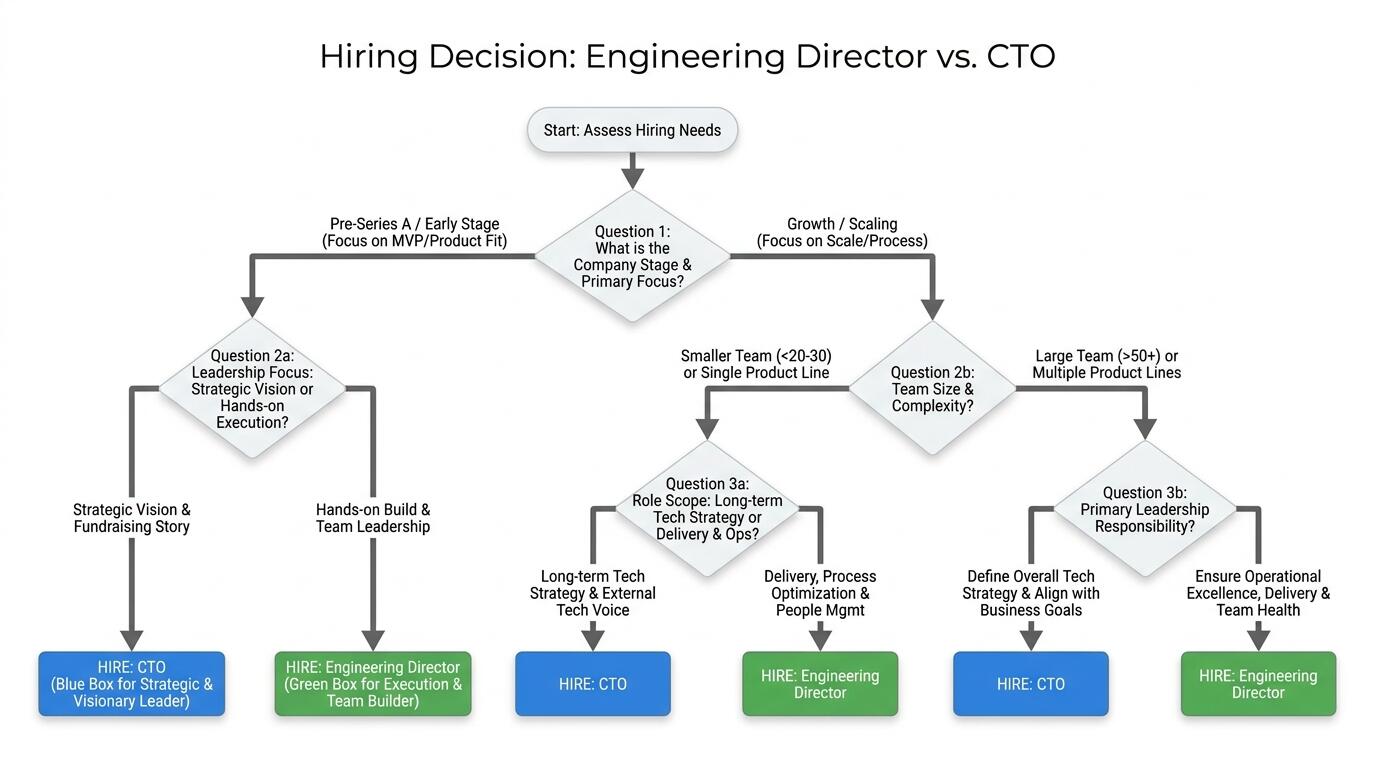
ALT: Flowchart comparing when to hire an Engineering Director versus a CTO based on company stage, team size, and strategic needs
Questions & Answers
Q1: How do you know when your company has outgrown a single technical leader handling both CTO and Engineering Director responsibilities?
The clearest signal is when delivery is consistently slipping while your technical leader reports being busy. When one person is simultaneously responsible for board-level technology strategy and sprint-level execution, one of those domains will be systematically under-served. If your engineering roadmap is drifting and your team is unclear on priorities, the problem is usually that the roles have been merged without the capacity to serve both. Separating them — even through a title shift rather than a new hire — often resolves the dysfunction quickly.
Q2: Is it possible for an Engineering Director to grow into a CTO role?
An Engineering Director can grow into a CTO role, but the transition requires a deliberate shift in operating mode, not just a promotion. The Engineering Director role rewards precision, process, and execution discipline. The CTO role rewards strategic ambiguity tolerance, external presence, and long-horizon thinking. According to career frameworks published by organizations like the Engineering Leadership community and CTO Craft, this transition typically requires explicit coaching toward board communication, product strategy involvement, and external thought leadership — skills that are rarely developed organically in an execution-focused role.
Q3: How much does the stage of company funding affect which role to prioritize?
Company stage is one of the strongest predictors of which role creates more immediate value. Pre-Series A companies typically need a CTO who is hands-on enough to also act as an Engineering Director. Post-Series A through Series B, the execution demands of a growing team usually justify a dedicated Engineering Director, even if the CTO is still strong. By Series C and beyond, both roles should be clearly separated with distinct mandates. Compensation ranges for both roles vary significantly by market and stage — consult current compensation benchmarks from sources like Radford or Levels.fyi for region-specific data.
Wrapping Up
The Engineering Director vs. CTO decision is ultimately a question of organizational diagnosis, not prestige. Three points distill the practical guidance here.
First, the roles solve different problems. A CTO solves strategy, differentiation, and external credibility problems. An Engineering Director solves execution, delivery, and team-health problems. Hiring the wrong role for the wrong problem delays both solutions.
Second, the most effective technical organizations staff both roles with clear ownership boundaries — particularly at growth stage, and particularly in AI-native companies where architecture decisions and shipping velocity are both existential. The full framework for choosing the right technical leader at each stage goes deeper on how to structure these boundaries as your organization evolves.
Third, role clarity is a forcing function for organizational clarity. When the CTO and Engineering Director have genuinely separate mandates, the entire engineering organization benefits from cleaner escalation paths, more coherent prioritization, and leadership that can operate at the right altitude without constant context-switching.
If your organization is at an inflection point — whether you are making your first senior technical hire or restructuring a leadership team that has outgrown its original shape — treat this decision with the same rigor you would apply to a major architectural choice. The cost of getting it wrong compounds over time in ways that are far harder to refactor than a codebase.
Ready to build or scale your technical organization with end-to-end engineering and AI architecture expertise? Visit Darius's portfolio and technical resource hub to explore shipped projects, architectural insights, and practical guidance — and reach out if you are looking for seasoned technical leadership from concept through launch.
References
- Full Scale. "Head of Engineering vs. CTO: Which One Your Startup Needs."
https://fullscale.io/blog/head-of-engineering-vs-cto/ - Harness. "What is the Difference Between a CTO and VP of Engineering."
https://www.harness.io/blog/difference-cto-vp-engineering - Darius. "Engineering Director vs. CTO: Choosing the Right Leader for Your Stage."
https://www.darius.wiki/en/blog/technology/engineering-director-vs-cto-choosing-right-leader.html - IEEE. IEEE Standards and Publications on Engineering Leadership and Technology Management.
https://www.ieee.org/
Note: Standards and organizational frameworks may be updated; please check the latest official documents or consult professional advisors.