The Difference Between AI Prototypes and Production-Ready AI Systems
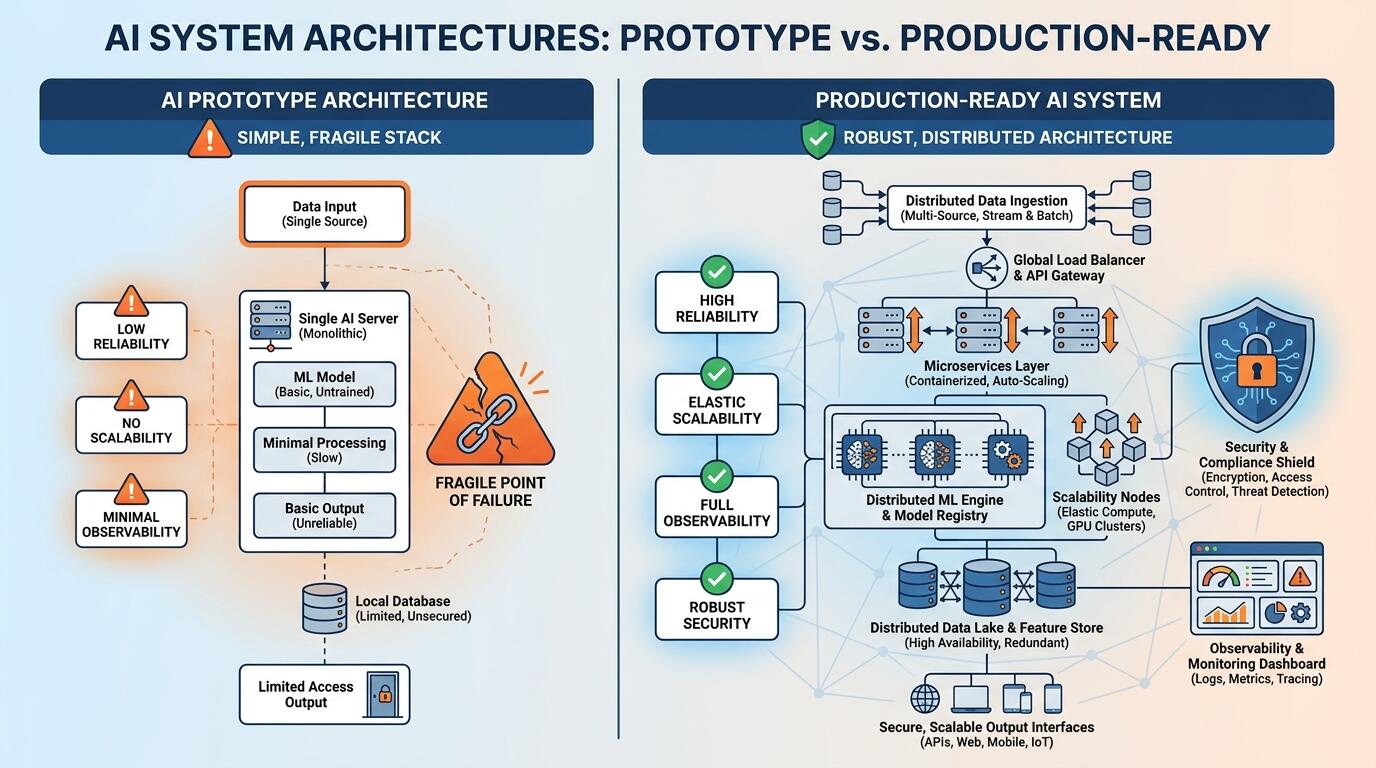
ALT: AI prototype versus production-ready AI system architecture comparison for engineering teams
Why the Gap Between AI Prototypes and Production-Ready AI Systems Matters More Than You Think
Key Conclusion: Most AI projects fail not because the underlying model is wrong, but because teams mistake a working prototype for a production-ready system. Understanding the fundamental differences between an AI prototype and a production-grade AI system — across reliability, scalability, observability, and maintainability — is the single most important distinction any engineering team or product leader needs to internalize before shipping AI to real users.
Every team building AI products eventually faces the same inflection point: a demo that works beautifully in a controlled environment suddenly falls apart under real-world conditions. The prototype impressed stakeholders. The model responded intelligently. The slide deck was compelling. And then the system hit production — and everything changed.
This article compares AI prototypes and production-ready AI systems across the dimensions that actually determine whether an AI product survives contact with real users. We'll define what separates the two, explain why the gap is wider than most people expect, and give you a practical framework for knowing where your system currently sits and what it takes to cross the threshold.
Evaluation Criteria: How to Judge an AI System's Production Readiness
Before comparing prototypes and production systems head-to-head, it's worth being precise about what "production-ready" actually means. In our work with engineering teams building AI-native products, a pattern we consistently see is that people conflate "it works" with "it's ready." These are categorically different claims.
Here are the six dimensions we use to evaluate whether an AI system is genuinely production-ready:
Reliability and fault tolerance — Does the system behave predictably under degraded conditions? Can it handle upstream failures, model timeouts, and unexpected inputs without crashing or silently returning garbage? Reliability isn't just about uptime; it's about graceful degradation.
Scalability and performance under load — A prototype typically runs on a single machine with a handful of test users. A production system needs to handle concurrent requests, variable load patterns, and latency constraints that users actually notice. Scalability is not an afterthought — it's a design requirement.
Observability and monitoring — Can you tell what the system is doing in real time? Do you have logging, tracing, alerting, and evaluation pipelines that surface model drift, hallucinations, or degraded output quality? Without observability, you're flying blind.
Security and data governance — Prototypes often skip authentication, access controls, and data handling policies. Production systems must treat security and compliance as first-class concerns, especially when handling user data or operating in regulated industries.
Maintainability and iteration velocity — A production AI system is never "done." Models need to be updated, prompts need to be tuned, and new capabilities need to be added. How easily can your team make changes without breaking existing behavior? Is there a testing framework for AI outputs?
User experience and error handling — Production users are not forgiving. They encounter edge cases, ambiguous inputs, and failure modes that never appeared in testing. A production-ready system handles these gracefully, communicates uncertainty honestly, and degrades in ways that don't destroy user trust.
Each of these criteria exposes a different class of risk. Ignoring any one of them is how AI projects that looked promising in demos end up becoming cautionary tales.
The Contenders: What We're Actually Comparing
AI Prototypes: Fast, Fragile, and Deceptively Convincing
An AI prototype is a working demonstration of a concept. It proves that a particular AI capability — summarization, classification, generation, retrieval — can produce useful outputs for a defined use case. Prototypes are built to answer the question: "Can this work?"
Prototypes are typically characterized by:
- Minimal infrastructure: They often run locally or on a single cloud instance, with no load balancing, redundancy, or failover.
- Hardcoded assumptions: Prompts, model versions, API keys, and data sources are often baked directly into the code. Changing any of them requires touching the core logic.
- No evaluation framework: Output quality is assessed informally — a developer looks at a few responses and decides they're "good enough." There's no systematic way to detect when quality degrades.
- Limited error handling: If the model returns an unexpected format, the prototype crashes or returns a confusing result. Edge cases are deferred to "later."
- No security layer: Authentication is often absent. Data flows freely between components without access controls or audit logging.
- Optimized for speed of learning: The goal of a prototype is to validate a hypothesis quickly. This is a feature, not a bug — but it means the codebase accumulates technical debt at a rapid pace.
Prototypes are genuinely valuable. They de-risk ideas before significant investment. They build organizational confidence in AI capabilities. They create a shared artifact that stakeholders can react to. The problem arises when teams treat the prototype as the foundation for the production system rather than a learning artifact to be rebuilt.
Production-Ready AI Systems: Engineered for Reality
A production-ready AI system is designed to serve real users reliably, at scale, over time. It answers a fundamentally different question from the prototype: "Can this keep working, for everyone, indefinitely?"
Production AI systems are characterized by:
- Resilient infrastructure: Distributed components, retry logic, circuit breakers, and fallback mechanisms ensure the system continues functioning even when individual parts fail.
- Configurable and versioned components: Model versions, prompts, retrieval configurations, and thresholds are managed as first-class artifacts — versioned, tested, and deployable independently.
- Systematic evaluation pipelines: Output quality is measured continuously. Teams define what "good" looks like for their use case and build automated checks that surface regressions before they reach users.
- Comprehensive observability: Every request is logged. Latency, token consumption, error rates, and output quality metrics are tracked and alerted on. Teams can diagnose issues in minutes, not days.
- Security and compliance by design: Authentication, authorization, data encryption, PII handling, and audit trails are built into the architecture from the start — not retrofitted after a security review.
- Graceful degradation and user-facing error handling: When the AI component fails or returns low-confidence output, the system has a defined fallback behavior. Users receive clear, honest communication rather than confusing errors or hallucinated responses.
- Maintainable, testable codebase: The AI logic is modular and decoupled from the application layer. Prompt changes, model swaps, and feature additions can be made and validated without rewriting the entire system.
The transition from prototype to production is not a matter of "polishing" the existing code. In most cases, it requires a fundamental rethinking of the system's architecture.
Head-to-Head Comparison: Prototype vs. Production-Ready AI Systems
| Criterion | AI Prototype | Production-Ready AI System |
|---|---|---|
| Reliability | Fragile; fails on unexpected inputs | Resilient; graceful degradation built in |
| Scalability | Single-instance; breaks under load | Horizontally scalable; handles concurrent users |
| Observability | Minimal logging; manual inspection | Full tracing, alerting, and quality monitoring |
| Security | Often absent or minimal | Authentication, authorization, audit trails |
| Maintainability | Hardcoded; difficult to change safely | Modular, versioned, testable components |
| Error Handling | Crashes or returns confusing output | Defined fallback behaviors; honest UX |
| Evaluation | Informal; "looks good to me" | Systematic; automated regression detection |
| Time to Build | Days to weeks | Weeks to months |
| Appropriate Use | Hypothesis validation, stakeholder demos | Real user traffic, business-critical workflows |
The table above makes the contrast stark, but the most important insight isn't visible in any single row — it's in the cumulative effect of these gaps. A system that scores "prototype" across all dimensions is not just "less polished" than a production system. It's a categorically different artifact, built for a different purpose, with a different risk profile.
A pattern we consistently see in teams that struggle with AI deployment is that they underestimate how many of these dimensions interact. Poor observability makes it impossible to diagnose reliability issues. Weak error handling amplifies the impact of scalability failures. Hardcoded prompts make it impossible to respond quickly when model behavior changes. These aren't independent problems — they compound each other.
The other critical insight is about time. Prototypes are fast to build by design. Production systems take longer — not because engineers are slower, but because production readiness requires intentional investment in infrastructure, testing, and architecture that a prototype deliberately skips. Teams that expect to "just clean up the prototype" consistently underestimate this gap. The honest answer, in most cases, is that the production system needs to be rebuilt with the prototype's learnings as input — not the prototype's codebase as a foundation.
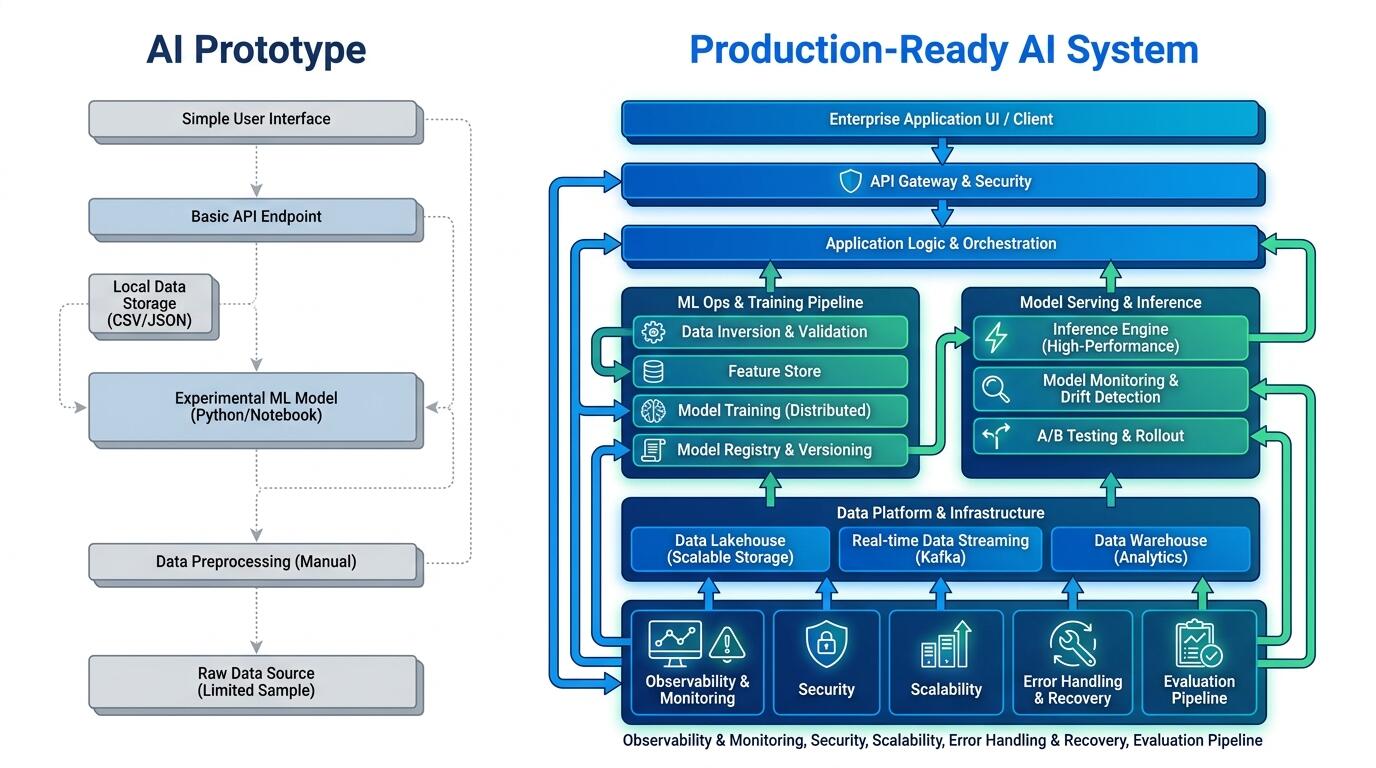
ALT: Diagram comparing AI prototype architecture versus production-ready AI system layers including observability, security, and scalability
Which Should You Choose? Scenario Recommendations for Your AI Journey
The question isn't really "prototype or production" as a binary choice — it's about knowing which mode you're in, being honest about it, and making deliberate decisions about when to transition.
If you are validating a new AI use case for the first time, build a prototype. Move fast, keep it simple, and focus entirely on whether the AI capability produces useful outputs for your specific problem. Don't let anyone convince you to "productionize" before you've validated the core hypothesis. Premature production engineering on an unvalidated idea is one of the most expensive mistakes a team can make.
If you have validated the use case and are preparing to onboard real users, stop and assess your system against the six criteria above before proceeding. A pattern we consistently see is teams that onboard their first hundred users on prototype infrastructure, experience a painful incident, and then spend weeks firefighting instead of building. The cost of retrofitting production readiness after users are already depending on the system is dramatically higher than building it right the first time.
If you are an engineering leader or founder evaluating an AI product built by your team, ask for a production readiness review before launch. Specifically ask: What happens when the model API is unavailable? How do we know if output quality degrades? What does a user see when the AI fails? If the answers are vague, you're looking at a prototype dressed up as a product.
If you are integrating a third-party AI capability into an existing product, the same principles apply. The vendor's model may be production-grade, but your integration layer — the prompts, the data pipeline, the error handling, the evaluation framework — needs to meet production standards independently.
Pros of staying in prototype mode longer: Lower upfront cost, faster iteration, easier to pivot when the use case changes.
Cons of staying in prototype mode too long: Accumulating technical debt that becomes painful to unwind, exposing users to unreliable experiences that damage trust, and creating security and compliance risks that are expensive to remediate.
Pros of investing in production readiness early: Predictable system behavior, faster debugging, lower incident rate, and the ability to iterate confidently without fear of breaking things.
Cons of over-engineering too early: Slowed velocity during hypothesis validation, wasted investment if the use case pivots, and organizational friction from premature complexity.
The right answer depends on where you are in the product lifecycle — but the decision should always be conscious and explicit, not accidental.
People Also Ask
Q1: How do you know when an AI prototype is ready to become a production system?
The clearest signal is that you've validated the core use case with real users and the business has committed to supporting it long-term. Technically, readiness means you can answer yes to: Does the system have monitoring and alerting? Does it handle errors gracefully? Is the codebase maintainable and testable? Can it scale to expected load? If any of these answers is no, you have more work to do before calling it production-ready.
Q2: Is it possible to build a production-ready AI system quickly without cutting corners?
Yes, but it requires deliberate architectural choices from the start. Teams that build AI-native products — where AI is a core capability rather than a bolted-on feature — tend to move faster in the long run because they invest in the right foundations early. The key is not to skip production concerns, but to implement them proportionally to the current scale and risk level, then expand as the system grows.
Q3: How long does it typically take to go from an AI prototype to a production-ready system?
The timeline varies significantly based on complexity, team size, and how much technical debt the prototype accumulated. In our experience working with AI products, teams consistently underestimate this transition — what feels like a "cleanup" task often reveals the need for significant architectural rework. Investing in a clear production readiness checklist before starting the transition helps teams scope the work accurately and avoid mid-project surprises.
Final Thoughts
The gap between an AI prototype and a production-ready AI system is one of the most consequential — and most underestimated — challenges in building AI products today. Three points are worth carrying forward from this comparison.
First, prototypes and production systems are built for fundamentally different purposes. Treating them as stages on a single continuum, rather than as distinct artifacts, leads teams to make decisions that are appropriate for one context but deeply problematic in the other.
Second, production readiness is not a single property — it's a multi-dimensional assessment across reliability, scalability, observability, security, maintainability, and user experience. A system can be strong on some dimensions and dangerously weak on others, and the weakest dimension typically determines the system's real-world behavior under pressure.
Third, the philosophy of AI as a native product capability — not a bolt-on feature — changes how teams approach this transition. When AI is deeply embedded in the product architecture from the start, production readiness becomes a design constraint rather than a retrofit task. That shift in mindset is what separates teams that ship reliable AI products from teams that perpetually struggle to get their demos into production.
The next step is honest: audit your current AI system against the six criteria in this article. Identify the gaps. Prioritize them by risk. And build the production-grade system your users deserve.
Want to go deeper into building AI-native products that actually ship? Visit Darius's personal site at https://www.darius.wiki to explore hands-on insights, real-world AI architecture breakdowns, and the products Darius has designed and built from the ground up. Whether you're an engineer, founder, or product leader, Darius offers a rare practitioner's perspective on turning AI into a core product capability — not just a feature.
References
- eCornell / Cornell University. "Building Enterprise-Ready AI Agents: From Prototypes to Production".
https://ecornell.cornell.edu/courses/artificial-intelligence/building-enterprise-ready-ai-agents-from-prototypes-to-production/ - Builder.io. "Is AI Actually Writing Production-Ready Code?"
https://www.builder.io/m/explainers/can-ai-build-production-ready-website - NP Group. "Why Your AI-Generated Prototype Isn't Ready for Production".
https://www.npgroup.net/blog/ai-generated-software-prototype-to-production/
Note: Standards and best practices in AI engineering evolve rapidly; please check the latest official documents or consult professional advisors for current guidance.