LLM Integration Patterns Every Engineering Team Should Know This Quarter
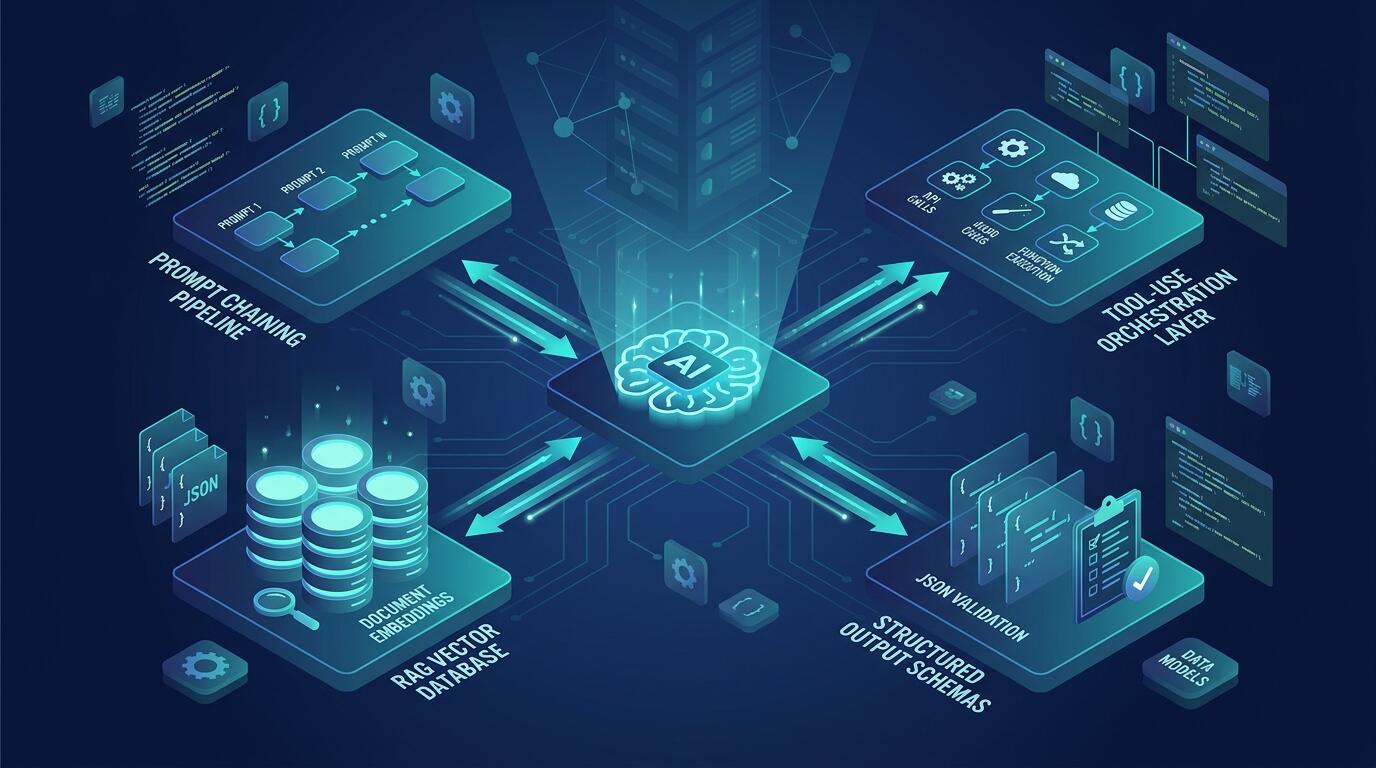
ALT: LLM integration patterns for engineering teams building production-ready AI-powered products
The LLM Integration Patterns Engineering Teams Are Getting Wrong Right Now
What is the single most important question engineering teams face when adopting large language models? It is not which model to pick — it is how to wire LLMs into real systems in ways that are reliable, maintainable, and actually useful in production. The difference between a prototype that impresses in a demo and a system that holds up under real user load almost always comes down to architectural decisions made early on.
This guide covers the integration patterns that matter most right now for teams shipping LLM-powered features. Each pattern was selected based on recurring challenges that surface when moving from experimentation to production: context management, reliability under uncertainty, cost control, and the ability to evolve the system as models and requirements change. Whether you are a CTO evaluating architectural approaches, an engineering manager planning sprint work, or a senior engineer designing the next AI feature, these patterns give you a shared vocabulary and a set of battle-tested choices.
The items below are not exhaustive, but they are the ones that separate teams who ship confidently from those who get stuck in an integration loop. Use this list as a decision guide, not a checklist — not every pattern belongs in every system, and part of the craft is knowing which to apply when.
Core LLM Integration Patterns Engineering Teams Must Understand
Direct Prompt Chaining for Multi-Step Workflows
Direct prompt chaining is the practice of decomposing a complex task into a sequence of discrete LLM calls, where the output of one prompt becomes the structured input to the next. Rather than asking a single prompt to do everything — reason, retrieve, format, and evaluate — you break the problem into stages, each of which is scoped and auditable.
This pattern matters because LLMs perform measurably better on narrow, well-defined tasks. A single monolithic prompt that asks the model to summarize a document, extract entities, classify sentiment, and generate a response tends to degrade in unpredictable ways. Chaining isolates each concern, makes failures visible, and allows individual stages to be tested and swapped independently.
In practice, this means designing each step with a clear input contract and expected output schema — ideally structured JSON or a typed object — before passing it downstream. Teams that skip this discipline end up with brittle pipelines where a formatting change in step two silently corrupts every downstream step.
Best for: Document processing pipelines, multi-stage content generation, automated reasoning workflows where intermediate outputs need human review or logging.
Watch out: Chain depth increases latency and cost. Each LLM call adds round-trip time, and long chains can become expensive quickly. Implement circuit breakers and caching at key stages to keep chains practical.
Retrieval-Augmented Generation for Knowledge-Grounded Responses
Retrieval-Augmented Generation (RAG) is an architecture in which an LLM's response is grounded by retrieving relevant documents or data chunks from an external knowledge store at inference time, rather than relying solely on the model's parametric memory. The retrieved context is injected into the prompt, giving the model current, domain-specific, or proprietary information it was never trained on.
RAG is one of the highest-leverage patterns available to teams building internal tools, customer-facing assistants, or any product where accuracy and up-to-date information matter. According to the analysis in "LLM Integration Patterns for Existing Codebases," retrieval-based approaches consistently outperform pure prompt engineering for domain-specific question answering because they decouple knowledge management from model selection.
The retrieval layer is where most teams underinvest. Embedding model choice, chunking strategy, metadata filtering, and re-ranking all have significant effects on output quality. A naive RAG implementation that dumps a flat vector search result into a prompt often produces answers that are worse than no retrieval at all — the irrelevant context confuses the model.
Best for: Internal knowledge bases, customer support automation, compliance Q&A, any scenario where the LLM needs access to information that changes faster than model retraining cycles.
Watch out: RAG quality is only as good as your retrieval layer. Poor chunking, stale embeddings, or missing metadata filters can introduce hallucinations rather than prevent them. Treat the retrieval pipeline as a first-class engineering concern, not a configuration detail.
Tool Use and Function Calling for Agentic Behavior
Tool use is an integration pattern in which the LLM is given a defined set of callable functions — APIs, database queries, calculators, web search tools — and decides at runtime which tools to invoke, in what order, and with what parameters. Modern LLM APIs expose this as structured function calling, where the model returns a typed invocation request rather than free-form text.
This pattern unlocks a category of applications that are genuinely agentic: the model is not just generating text, it is orchestrating actions. A system built on tool use can look up live data, write to external systems, trigger workflows, and validate its own outputs — all within a single coherent interaction.
The pattern requires careful interface design. Each tool definition should have a clear, unambiguous description that the model can reason about. Vague or overlapping tool descriptions produce erratic tool selection, which is a hard failure mode to debug because the model's selection logic is not directly observable.
Best for: Autonomous assistants, workflow automation, applications that require real-time data access, coding assistants that need to run and test code.
Watch out: Uncontrolled tool use in production is a security and reliability risk. Implement strict permission models, rate limits on tool calls, and human-in-the-loop checkpoints for any tool that writes to an external system.
Structured Output Enforcement for System Reliability
Structured output enforcement is the practice of constraining LLM responses to a predefined schema — JSON, XML, or a typed data structure — using grammar-constrained decoding, output parsers, or model-level configuration (where the provider supports it). The goal is to make LLM outputs machine-readable by construction, eliminating the fragile string parsing that causes downstream failures.
This pattern is foundational for production systems. A response that occasionally returns malformed JSON, adds an unexpected prose preamble, or omits a required field will silently break downstream consumers. Structured output enforcement moves the failure mode from silent data corruption to an explicit, catchable error at the boundary.
In our work on AI-powered products, this is one of the first patterns we enforce before moving any LLM feature out of prototype. The discipline of defining an output schema forces clarity about what the LLM is actually supposed to produce — which in turn improves prompt design.
Best for: Any LLM output that feeds into a downstream system: APIs, databases, UI rendering pipelines, or automated decision flows.
Watch out: Heavily constrained schemas can reduce the model's ability to express nuance or handle edge cases gracefully. Design schemas with appropriate optionality for fields that are genuinely uncertain, and build explicit handling for partial or null responses.
Semantic Caching to Control Cost and Latency
Semantic caching is a pattern in which similar or semantically equivalent queries are served from a cache rather than triggering a new LLM call. Unlike exact-match caching, semantic caching uses embedding similarity to identify queries that are "close enough" to a previously answered question, returning the cached response when the similarity score exceeds a defined threshold.
The business case for semantic caching is straightforward: LLM API costs scale with volume, and many production workloads contain a high proportion of near-duplicate queries. A well-tuned semantic cache can eliminate a meaningful fraction of redundant inference calls without any degradation in user experience.
The engineering challenge is setting the similarity threshold correctly. A threshold that is too permissive causes cache collisions — queries that are superficially similar but semantically distinct get the same answer. A threshold that is too strict reduces hit rate to near zero. This requires domain-specific calibration against real traffic, not just offline testing.
Best for: High-volume applications with repetitive query patterns: customer support bots, search interfaces, FAQ systems, and analytics assistants.
Watch out: Cached responses can become stale if the underlying knowledge base or business logic changes. Build cache invalidation hooks into your knowledge management pipeline, not as an afterthought.
Fallback and Model Routing for Resilience
Model routing is an architectural pattern in which a request is dynamically directed to one of several LLMs — or model configurations — based on criteria such as cost, latency, capability requirements, or availability. Fallback routing is the specific case in which a primary model failure or timeout triggers an automatic switch to a secondary model.
As the LLM provider ecosystem matures, teams that are locked to a single model vendor face a strategic risk: price changes, service degradation, capability gaps, and API deprecations all become outages. A routing layer abstracts model selection from application logic, making the system resilient to provider-level events.
A pattern we consistently see in teams that scale AI features successfully is that they treat the LLM as a swappable dependency from the start — not a hard-coded integration. This means defining a model interface contract at the application boundary so that routing decisions can be made at the infrastructure layer without touching feature code.
Best for: Production systems with uptime requirements, cost-sensitive applications that can route simpler queries to cheaper models, teams operating in regulated environments where model auditability matters.
Watch out: Routing adds operational complexity. Different models have different prompt formats, capability profiles, and output characteristics. A routing layer that treats all models as interchangeable will produce inconsistent results. Model-specific prompt adapters are often necessary.
Human-in-the-Loop Checkpoints for High-Stakes Decisions
Human-in-the-loop (HITL) is an integration pattern in which automated LLM outputs are routed to a human reviewer before being acted upon, either always or when a confidence signal falls below a defined threshold. HITL is not a workaround for model unreliability — it is a deliberate architectural choice for domains where the cost of an unreviewed error exceeds the cost of human intervention.
This pattern is increasingly relevant as LLMs are applied to higher-stakes domains: legal document drafting, financial analysis, medical information, and infrastructure automation. The architecture typically involves a confidence scoring layer (which may itself be an LLM call), a queuing mechanism for review tasks, and a feedback loop that routes reviewed outputs back into fine-tuning or prompt improvement workflows.
According to emerging analysis of LLM adoption patterns in software engineering — as noted in research published by practitioners on the dynamics of enterprise LLM deployment — the teams that move fastest in high-stakes domains are those that build HITL scaffolding early, before errors become visible to end users.
Best for: Any application where an incorrect LLM output has meaningful downstream consequences: legal, financial, medical, or infrastructure automation contexts.
Watch out: HITL introduces latency and operational cost. Poorly designed review queues become bottlenecks. Design the review interface to surface the minimum context a reviewer needs to act quickly, and track reviewer decision patterns to identify model failure modes over time.
Fine-Tuning and Prompt Optimization as Complementary Strategies
Fine-tuning is the process of adapting a pre-trained LLM's weights using domain-specific data, resulting in a model that exhibits consistent behavior on tasks relevant to that domain without requiring extensive prompting. Prompt optimization, by contrast, improves model behavior by systematically engineering the input context — system instructions, few-shot examples, chain-of-thought scaffolding — without modifying model weights.
These are not competing approaches; they are complementary, and choosing between them depends on the nature of the performance gap. If the model fails because it lacks domain knowledge, fine-tuning is appropriate. If the model has the knowledge but applies it inconsistently or in the wrong format, prompt optimization is usually faster and cheaper to iterate on.
As noted in analysis of how LLMs are reshaping data engineering workflows, domain adaptation through fine-tuning is most valuable when the target behavior is well-defined, consistent, and distinct from the base model's defaults. If the desired behavior can be described in a clear system prompt with a few examples, that is almost always the right starting point before incurring fine-tuning cost and complexity.
Best for: Fine-tuning fits specialized domains with high-volume, consistent task types and available labeled data. Prompt optimization fits early-stage products, rapidly changing requirements, and tasks where labeled data is scarce.
Watch out: Fine-tuned models require ongoing maintenance. As base model versions change or data distributions shift, fine-tuned versions can diverge from expected behavior. Build evaluation suites before fine-tuning, not after.
Quick Comparison at a Glance
| Pattern | Best For | Key Strength | Limitation |
|---|---|---|---|
| Prompt Chaining | Multi-step workflows, document pipelines | Isolates concerns, improves auditability | Adds latency and cost per chain link |
| Retrieval-Augmented Generation | Knowledge-grounded Q&A, internal tools | Grounds responses in current, domain-specific data | Quality depends heavily on retrieval layer design |
| Tool Use / Function Calling | Agentic workflows, live data access | Enables real-time action orchestration | Requires strict permission models and security controls |
| Structured Output Enforcement | Any LLM output feeding downstream systems | Eliminates fragile string parsing | Over-constraint can reduce model expressiveness |
| Semantic Caching | High-volume, repetitive query workloads | Reduces API cost and latency at scale | Requires careful threshold tuning and cache invalidation |
| Model Routing and Fallback | Production systems with uptime requirements | Decouples application logic from model vendor | Different models need prompt adapters for consistency |
| Human-in-the-Loop | High-stakes, regulated, or safety-critical domains | Catches errors before they reach end users | Introduces latency; review queues can become bottlenecks |
| Fine-Tuning vs. Prompt Optimization | Specialized domains or early-stage products | Adapts model behavior to domain | Fine-tuning requires labeled data and ongoing maintenance |
How to Choose the Right LLM Integration Pattern for Your Team
The right integration pattern is determined by the risk profile, query volume, and maturity stage of your system — not by which pattern is most technically sophisticated.
Start with the failure mode that would hurt most. If your system produces incorrect outputs that flow silently into downstream processes, structured output enforcement and HITL checkpoints are non-negotiable first investments. If your system is accurate but expensive at scale, semantic caching and model routing belong on the roadmap before you scale traffic. If your system gives correct answers but lacks domain specificity, RAG or fine-tuning should be evaluated in that order.
A common misconception is that agentic patterns — tool use, multi-step reasoning chains — are the default destination for LLM applications. In practice, most production value is delivered by simpler, well-engineered RAG and structured output patterns. Agentic architectures introduce compounding failure modes that require substantial engineering investment to manage safely. Reserve them for use cases where the autonomy is genuinely required, not because they feel more impressive.
For early-stage products and MVPs, the recommended starting sequence is: structured output enforcement first (to protect downstream systems), RAG next (to ground the model in your domain), and prompt chaining as complexity grows. Model routing and semantic caching become relevant when you have real traffic data to optimize against.
For teams scaling existing AI features, the highest-return investments are typically model routing (to manage cost without reducing capability) and building evaluation suites that let you iterate on prompts and retrieval configurations with confidence.
A final point worth making explicit: these patterns are not mutually exclusive. A mature production system will often combine RAG with structured output enforcement, layered inside a prompt chain, with semantic caching at the entry point and a HITL checkpoint for high-confidence-threshold failures. The architecture compounds as the product matures.
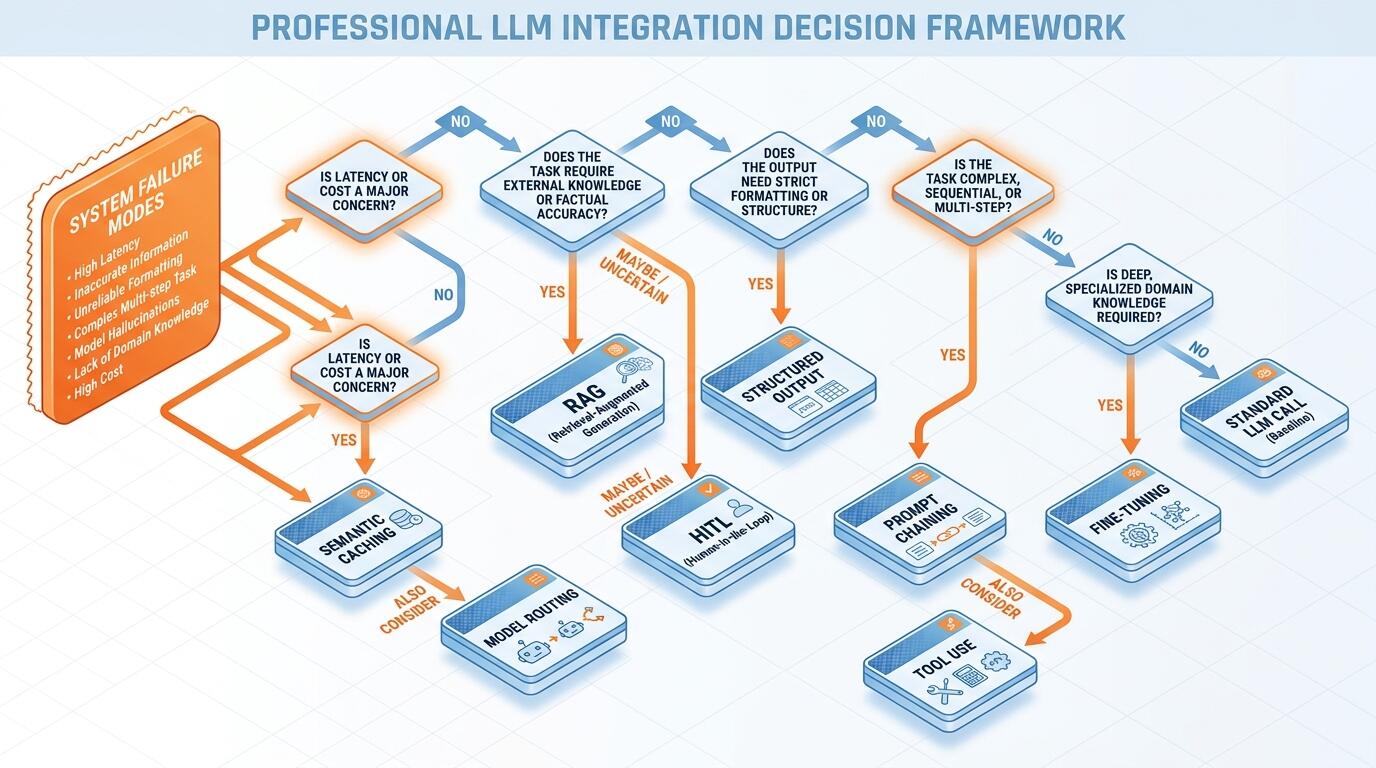
ALT: Engineering team decision framework for selecting LLM integration patterns in production AI systems and workflows
Frequently Asked Questions FAQ
Q1: How do you decide when to use RAG versus fine-tuning for an LLM-powered feature?
RAG is the right starting point when your domain knowledge changes frequently, when labeled training data is scarce, or when you need the model to cite specific sources. Fine-tuning is appropriate when the target task has a consistent, well-defined format that the base model handles poorly, and when you have sufficient high-quality labeled examples. In most production scenarios, a well-engineered RAG pipeline with prompt optimization will outperform a fine-tuned model for a fraction of the cost and complexity — and is significantly easier to update when requirements change.
Q2: Are LLM integration patterns applicable to teams working with open-source models rather than commercial APIs?
Yes. Every pattern described here — prompt chaining, RAG, structured output enforcement, semantic caching, model routing, and HITL — applies regardless of whether you are using a commercial API or a self-hosted open-source model. The implementation details differ: open-source deployments require you to manage inference infrastructure, and structured output enforcement may rely on grammar-constrained decoding libraries rather than provider-managed features. However, the architectural logic and the reasons for applying each pattern are model-agnostic.
Q3: How much engineering effort does it typically take to implement these patterns in an existing codebase?
Effort varies significantly by pattern and codebase maturity. Structured output enforcement and prompt chaining are typically achievable within a sprint for a focused engineer with clear requirements. RAG implementations with production-grade retrieval pipelines require meaningful investment in data pipeline design, embedding infrastructure, and evaluation frameworks — plan for multiple sprint cycles. Model routing and semantic caching are best introduced after you have real traffic data, and their ROI depends on query volume. Tool use and HITL architectures carry the highest implementation complexity and are best treated as dedicated workstreams rather than feature additions.
The Bottom Line
Large language model integration is a systems design problem before it is a model selection problem. The patterns covered here represent the architectural vocabulary teams need to ship AI features that are reliable, cost-controlled, and evolvable.
Key Takeaways:
- Structured output enforcement is the single highest-priority pattern for protecting downstream systems from LLM unpredictability.
- RAG outperforms prompt engineering for domain-specific accuracy in most production scenarios and should be the first architectural investment for knowledge-intensive applications.
- Agentic patterns (tool use, prompt chaining) are powerful but carry compounding failure risks — apply them where autonomy is genuinely required.
- Model routing and semantic caching are the primary levers for managing cost and resilience at scale, and they pay back quickly with sufficient query volume.
- Human-in-the-loop is not a sign of model failure — it is a deliberate architectural choice that enables teams to operate confidently in high-stakes domains.
The right next step is to map these patterns against your current system's failure modes, not its feature roadmap. Find the gap where errors are most costly or invisible, and close that first.
If you're working on a system where these architectural decisions matter — and getting them right the first time would save significant rework — explore how Darius approaches AI architecture, systems design, and full-stack product development. From early design through production deployment, the work is built on the same patterns and principles covered here.
References & Further Reading
- Boldare. "LLM Integration Patterns for Existing Codebases".
https://www.boldare.com/blog/llm-integration-patterns/ - LinkedIn / Russo. "What Really Drives LLM Adoption in Software Engineering".
https://www.linkedin.com/pulse/habit-over-heritage-what-really-drives-llm-adoption-software-russo-wg5af - Bethel Daniel. "How LLMs Are Revolutionizing Data Engineering".
https://betheldaniel332.medium.com/how-llms-are-revolutionizing-data-engineering-8a008cea81e9 - IEEE. IEEE Standards and Publications on Artificial Intelligence and Systems Engineering.
https://www.ieee.org
Note: Standards and technical guidance may be updated; please check the latest official documents or consult professional advisors.