The Minimum Viable Architecture for Your First AI-Powered App
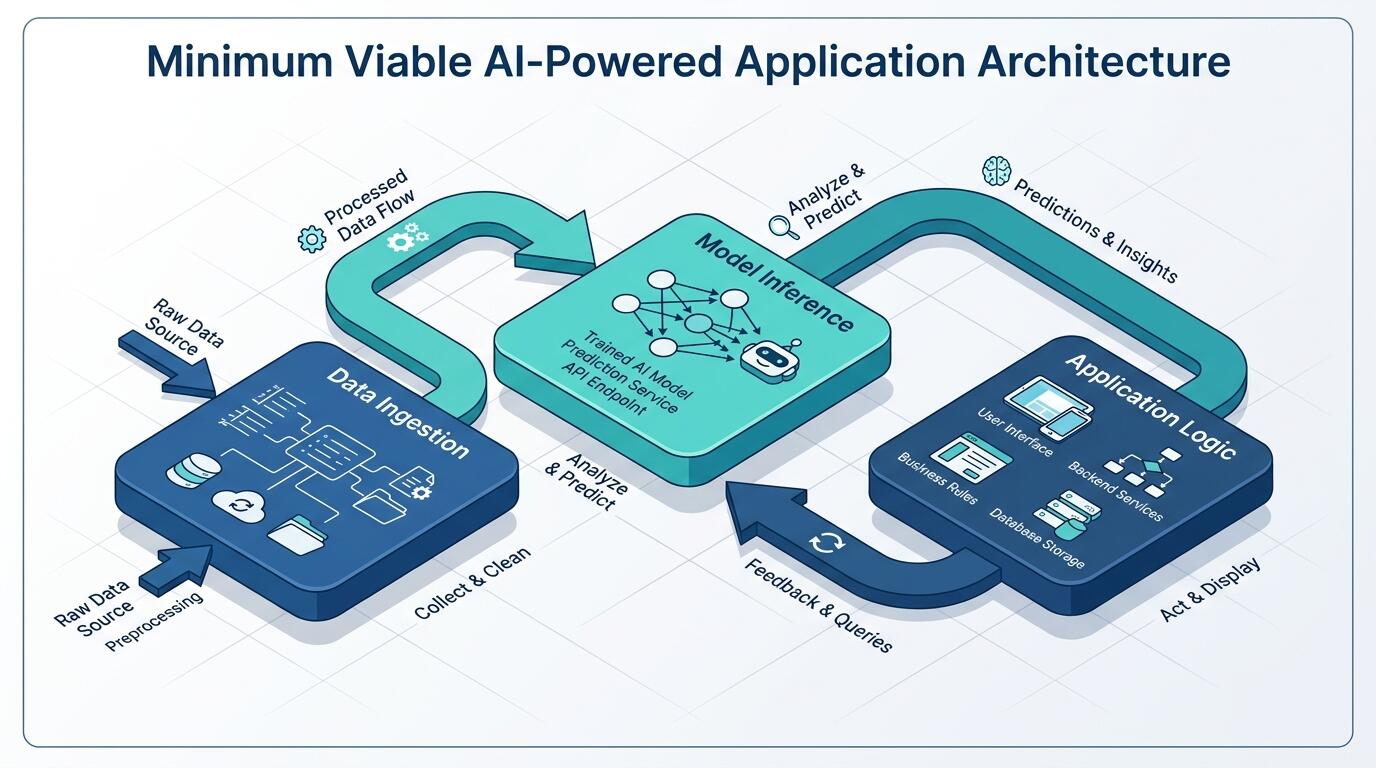
ALT: Minimum viable architecture diagram for building your first AI-powered app efficiently
Building Your First AI-Powered App: Why Architecture Decides Success or Failure
Key Conclusion: The minimum viable architecture for your first AI-powered app is a lean, modular system that separates data ingestion, model inference, and application logic from day one—so you can validate a real use case before over-engineering. Teams that skip this discipline typically rebuild their entire stack within months, wasting the very speed advantage AI was supposed to deliver.
Most engineering teams building their first AI-powered app make the same mistake: they either bolt a large language model onto an existing product as an afterthought, or they attempt to design a fully scalable, enterprise-grade AI platform before they have validated a single use case. Both paths lead to wasted budget and stalled launches. A minimum viable architecture threads the needle—it gives you just enough structure to ship something real, gather feedback, and iterate without accumulating technical debt that becomes impossible to unwind. This is a pattern we consistently see across teams shipping their first production AI feature, and the fix is almost always architectural, not algorithmic.
Scope of Application
Applicable Scenarios:
- You are shipping a first version of an AI feature (chat assistant, summarizer, recommendation engine, or similar) and need to validate demand quickly
- Your team has limited AI/ML infrastructure experience and needs a proven, low-risk starting pattern
- You expect to iterate on model choice, prompts, or vector stores frequently during early product-market fit
Not Applicable/Cautions:
- You are building a highly regulated system (medical diagnosis, financial underwriting) that requires certified pipelines and formal validation from the outset
- You already have significant scale (millions of daily requests) and need a fully distributed, multi-region architecture rather than a minimum viable one
The Architecture Debt Problem in Early AI Products
The rush to ship AI features has created a predictable failure pattern across the industry. According to Product School, teams building an MVP with AI often underestimate the operational complexity hiding behind a simple chatbot demo, leading to brittle systems that break the moment real users arrive. This is not a criticism of ambition—it is a structural problem rooted in how AI capabilities get bolted onto products rather than designed into them from the start.
Market signals reinforce this pattern. Low-code and AI-assisted development tools have made it trivially easy to spin up a prototype in a weekend, but the gap between a demo and a dependable product has, if anything, widened. Per Redwerk's analysis of AI-supercharged MVP development, the speed gains from AI tooling are frequently offset by teams skipping foundational architecture decisions—prompt versioning, data provenance, fallback handling—that only become visible once real traffic hits the system. The result is a wave of "AI-powered" apps that work beautifully in a demo and degrade rapidly in production.
This gap is exactly why architecture, not model selection, is the highest-leverage decision a team makes when building its first AI-powered app. Choosing the flashiest large language model matters far less than deciding how data flows into that model, how responses are validated, and how failures are handled gracefully. In our work architecting production AI systems, the projects that scale smoothly are never the ones with the most sophisticated model—they are the ones with the clearest separation of concerns between data, inference, and application logic.
This distinction between prototype thinking and production thinking is also central to the philosophy behind Darius, the personal brand of an Engineering Director and AI Architect who designs, builds, and ships production-ready AI products. The core argument is that AI should be a native, deeply integrated capability rather than a superficial add-on feature—and that argument starts with architecture, not marketing copy.
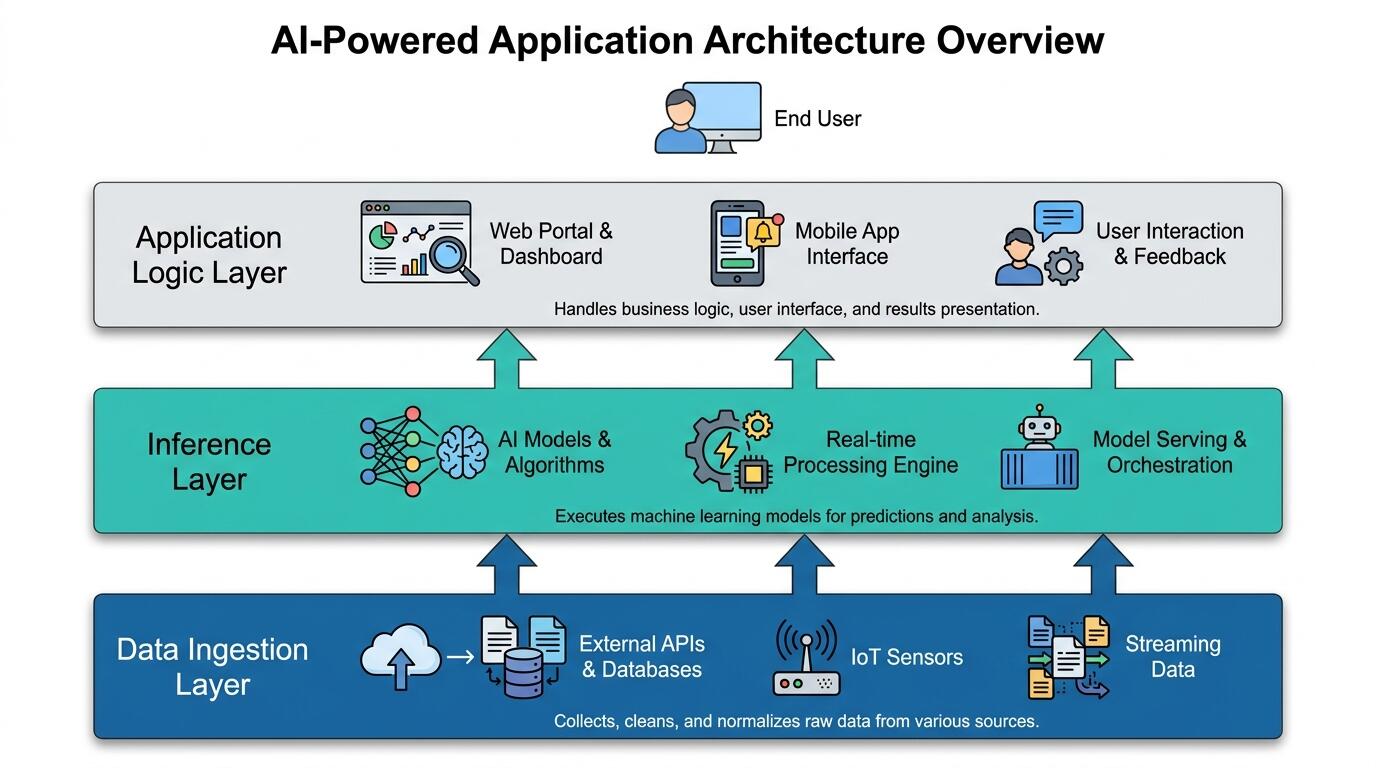
ALT: Layered diagram showing data ingestion, inference layer, and application logic in an AI app
Designing the Core: A Practical Blueprint for Your First AI-Powered App
A minimum viable architecture is not a smaller version of a full enterprise system—it is a different design philosophy entirely. It optimizes for learning speed and safe iteration rather than raw scale, and it deliberately defers decisions that do not affect whether users find the product valuable.
Three-Step Quick Start
Step 1: Define the Single Inference Boundary
Isolate all calls to your AI model—whether a hosted large language model API or a custom endpoint—behind one clearly defined service or module. This typically takes a day or two of setup and prevents model logic from leaking into your UI or business logic, which is the single most common source of rework later.
Step 2: Build a Thin Data Layer with Provenance
Create a lightweight data pipeline that tags every piece of content fed into the model with its source and timestamp. This step, usually completed within the first week, is what allows you to debug hallucinations, retrain retrieval indexes, or swap data sources without rewriting your application.
Step 3: Add a Fallback and Feedback Loop
Wire in a simple mechanism to catch model failures—timeouts, low-confidence outputs, or empty responses—and route them to a graceful default response, alongside a lightweight way to capture user feedback. This can be built in a few days and is what separates a demo from something people trust.
Comparing the Three Common Approaches to a First AI App
Teams generally choose among three architectural patterns when building their first AI-powered app, each with distinct tradeoffs in speed, cost, and long-term flexibility. Understanding these tradeoffs upfront prevents the costly mid-project pivot that so many teams experience.
| Comparison Dimension | Monolithic Bolt-On | Minimum Viable Modular Architecture | Full Enterprise Platform |
|---|---|---|---|
| Time to first working version | Fast initially, slows sharply after launch | Moderate, steady pace throughout | Slow, heavy upfront investment |
| Flexibility to swap AI models or vendors | Low—tightly coupled to existing code | High—isolated inference layer | High, but changes require formal review |
| Risk of technical debt | Very high | Low to moderate | Low |
| Suitability for validating product-market fit | Poor—hard to isolate what is working | Strong—built for iteration | Overkill, delays learning |
| Infrastructure and operations cost | Consult provider | Consult provider | Consult provider |
The monolithic bolt-on approach is tempting because it feels fast—you add an API call inside your existing controller and ship within days. But this pattern consistently breaks down once you need to change providers, add retrieval-augmented context, or handle rate limits gracefully, because the AI logic is entangled with everything else. The full enterprise platform, by contrast, is architecturally sound but wildly premature for a first version—teams that start here often spend months in infrastructure planning before a single user sees the product.
Why Modularity Beats Premature Scale
The minimum viable modular architecture wins because it treats the AI inference layer as a replaceable component, not a permanent foundation. This means your data ingestion, prompt templates, and business logic remain stable even as you experiment with different models, embeddings, or vector databases underneath.
A practical case illustrates this well. A team building an AI-powered mock interview experience—conceptually similar to the AI mock interview platform Darius has built—needs to swap between different language models to balance cost and response quality as usage grows. If the inference call is isolated behind a clean interface, that swap is a configuration change. If it is hardwired into the interview session logic, it becomes a multi-week refactor touching dozens of files.
The same principle applies to an AI-powered cloud drive, where native AI capability—search, summarization, tagging—must be woven directly into file handling rather than layered on top as a separate search box. This is precisely the distinction between AI as a native capability versus AI as an add-on feature, and it is why the modular minimum viable architecture consistently outperforms both extremes over a product's first year.
Readers who want a deeper walkthrough of how this philosophy plays out across a full product suite can explore the Darius website, where the underlying architecture patterns behind an AI-native cloud drive, mock interview platform, and creator cockpit are discussed in more depth.
Advanced Considerations for Scaling Beyond the First Version
Once your minimum viable architecture proves the concept, a few special situations demand deliberate handling rather than improvisation. The first is data drift: as user behavior evolves, the assumptions baked into your original prompts and retrieval indexes will quietly stop matching reality, so schedule periodic reviews of model outputs against real usage rather than assuming static performance.
The second is vendor lock-in disguised as convenience. Many teams adopt a single AI provider's SDK so deeply that switching later requires a rewrite—the fix is maintaining that thin inference boundary described earlier, even after launch, so provider changes remain a configuration exercise rather than an architectural crisis.
A common misconception is that a minimum viable architecture means minimum effort on reliability. In practice, the opposite is true: because the surface area is small, every component—especially the fallback and feedback loop—must be genuinely robust, since there is no redundant layer to catch failures. Teams that treat "minimum viable" as "quick and sloppy" are the ones who end up back at square one within a few months.
Finally, this architecture pattern relates closely to broader software engineering standards. According to IEEE's guidance on software architecture documentation practices, clearly separating concerns and documenting interface boundaries early reduces long-term maintenance costs regardless of whether the system involves AI—a principle that applies directly to the inference-boundary pattern described here.
People Also Ask
Q1: How do I know if my AI app architecture is truly minimum viable?
A minimum viable architecture is one where you can swap your AI model, vector store, or data source without rewriting your application logic. If changing any single component requires touching multiple unrelated files, per Product School's MVP guidance, your architecture has already accumulated hidden coupling that undermines the "minimum viable" goal.
Q2: Is it safe to launch an AI-powered app without a full MLOps pipeline?
Yes, for a first version, a full MLOps pipeline is rarely necessary. What matters more is a clean inference boundary, basic logging of inputs and outputs, and a fallback path for failures—these three elements cover most early-stage risk without the overhead of enterprise-grade monitoring infrastructure.
Q3: How long does it typically take to build a minimum viable AI architecture?
Based on the three-step pattern described here—inference boundary, data layer with provenance, and fallback loop—most small teams can assemble a working minimum viable architecture within one to two weeks, though actual timelines vary with team size, existing infrastructure, and the complexity of the chosen AI use case.
Key Takeaways
- A minimum viable architecture for your first AI-powered app separates data ingestion, model inference, and application logic from the start, preventing the costly rebuilds that come from treating AI as a bolt-on feature.
- Isolating your AI model behind a single, well-defined inference boundary is the highest-leverage architectural decision you can make, since it keeps future model or vendor changes cheap.
- Data provenance and a fallback/feedback loop are not optional extras—they are what separates a trustworthy product from an impressive demo.
- The modular minimum viable pattern consistently outperforms both the monolithic bolt-on and the premature enterprise platform approaches for validating product-market fit.
- Treating "minimum viable" as an excuse for sloppy reliability engineering is the most common and costly misconception teams fall into.
The next step is to apply this same architectural discipline to a real product, rather than a hypothetical one.
Ready to experience AI built the right way—native, not bolted-on? Explore Darius's suite of production-ready AI products, from an intelligent cloud drive to an AI-powered mock interview platform and creator cockpit, at darius.wiki. Visit today and discover how these tools can streamline your workflow and accelerate your goals.
Sources & Citations
- The Shep Report. "Building Minimum Viable Products using AI Tools".
https://www.theshepreport.com/p/building-minimum-viable-products - Product School. "How to Build an MVP with AI".
https://productschool.com/blog/artificial-intelligence/ai-mvp - Redwerk. "How to Supercharge MVP Development with AI: Low-Code Approaches".
https://redwerk.com/blog/mvp-development-with-ai/ - IEEE. Institute of Electrical and Electronics Engineers, software architecture and engineering standards.
https://www.ieee.org/ - ISO. International Organization for Standardization, software and systems engineering guidance.
https://www.iso.org/
Note: Standards may be updated; please check the latest official documents or consult professional advisors.