Transcribe Turbo adds turn detection for voice agents, NVIDIA open-sources document parsing training data, Hugging Face trains small-model agents to communicate
Thanksgiving week is quiet, but the direction is consistent: agent infrastructure is becoming off-the-shelf, layer by layer. Voice gets semantic turn detection, execution gets isolated sandboxes with checkpoints, and authorization can run through the enterprise IdP. Meanwhile document parsing and multi-agent training both come with reproducible data and recipes.
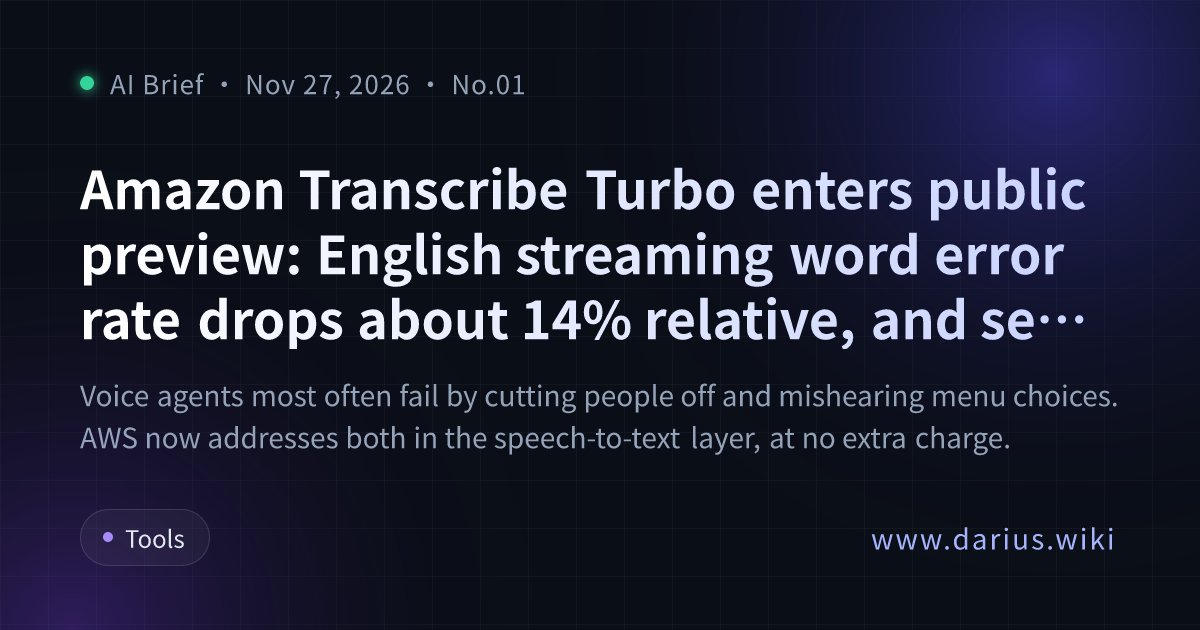
Streaming supports English, Portuguese, French, Italian, German and Spanish, with word error rate down about 14% relative in English and 11% in the others versus the current production model, and formatting accuracy up more than 20 points; the streaming preview is in US East (Ohio) only
Batch: English Turbo is generally available in most Regions; Portuguese, French, Italian, German, Spanish, Chinese, Japanese, Korean and Arabic are in preview with about 16% lower word error rate; the base model needs no API, code or SDK changes
Semantic turn-taking uses what the caller said and their prosody, not silence alone, responding in about 615 ms with a 5% interruption rate, and it can be tuned; runtime ASR hints send menu options, expected names and entity types each turn, raising menu-routing accuracy on English customer service data from 87% to 97%
Both features launch in English, reach other languages by the end of December 2026, and cost nothing extra
Builder's takeIf you build voice products, start with turn detection. In something like AI Interview, cutting a candidate off while they pause to think does far more damage than a few misheard words. I'd turn on EndOfTurnDetection for English first and compare interruptions against a silence-threshold setup on real recordings; runtime hints are a good fit for pushing each question's proper nouns in turn by turn. Chinese streaming isn't on the list yet, so Chinese-language products should hold off.
Three training datasets are open: Synthetic Charts V1 with about 9.98M examples, Synthetic Tables V1 with 1M, and OCR Synthetic Multilingual v2 with about 7.9M, each with images, annotations, generation docs and the training format
Training ran in two phases, SFT to teach page reading, then GRPO with verifiable rewards; in a matched comparison, loop-flagged pages fell from 126 to 29, outputs hitting the 9,000-token limit from 185 to 35, and the overall score rose from 66.24 to 71.38
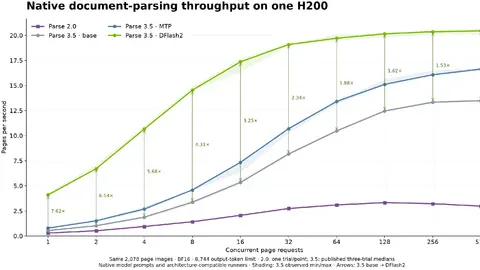
On one H200 in BF16 at concurrency 512, Parse 3.5 reaches 13.48 pages/s without speculation and 20.44 with DFlash2, versus 2.98 for Parse 2.0; double and triple passes add 2.18 and 2.46 ParseBench points over a single pass
In the recipe's dental-form example, sampled pass@1 rose from 0.00% for the base model to 95.85% after SFT and 96.58% after RLVR
Builder's takeFor something like AI Cloud Drive, which has to ingest whatever files users throw at it, this is more useful than another general model: dense tables and charts without printed values now come with ready synthetic data and a fine-tuning flow with verifiers. I'd pick the one document type we see most and parse worst, generate a few hundred pairs with the recipe and run SFT, then decide on RLVR based on the remaining errors. Use the second pass only on dense tables, not everywhere.
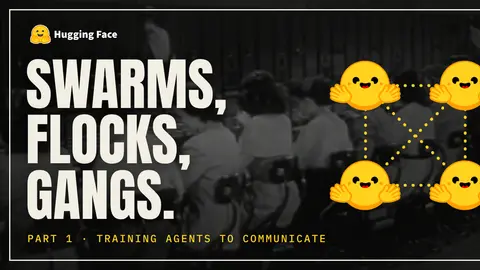
The task: four agents each hold an integer from 1 to 99 and must exchange messages to submit the full sorted list; the team reward is discounted by generated tokens, with no reward for sending messages
First five updates versus updates 71 to 75: success 6.56% to 82.34%, tokens per team about 12,827 to 8,026, broadcasts 2.38 to 5.73; at update 75 the team solved 26 of 32 held-out problems (81.25%)
The untrained team with best of 8 attempts solved 37.5% at about 103,000 tokens per problem; the trained team solved 82.3% in one attempt at about 8,000, which the authors call an estimate on training problems
The original run used one H200 for training and seven running vLLM; the walkthrough uses two H200s on Hugging Face Jobs, about five hours and roughly $50
Builder's takeWhat I like most is the comparison it insists on: at the same token budget, can several agents beat one? If you're thinking about multi-agent in a product, ask that first; most of the time the answer is no. This task can't be solved by a single agent, so it doesn't answer that yet, and the authors say the fair comparison comes next. Until then I'd reserve multi-agent setups for cases where the information really is split across separate contexts.
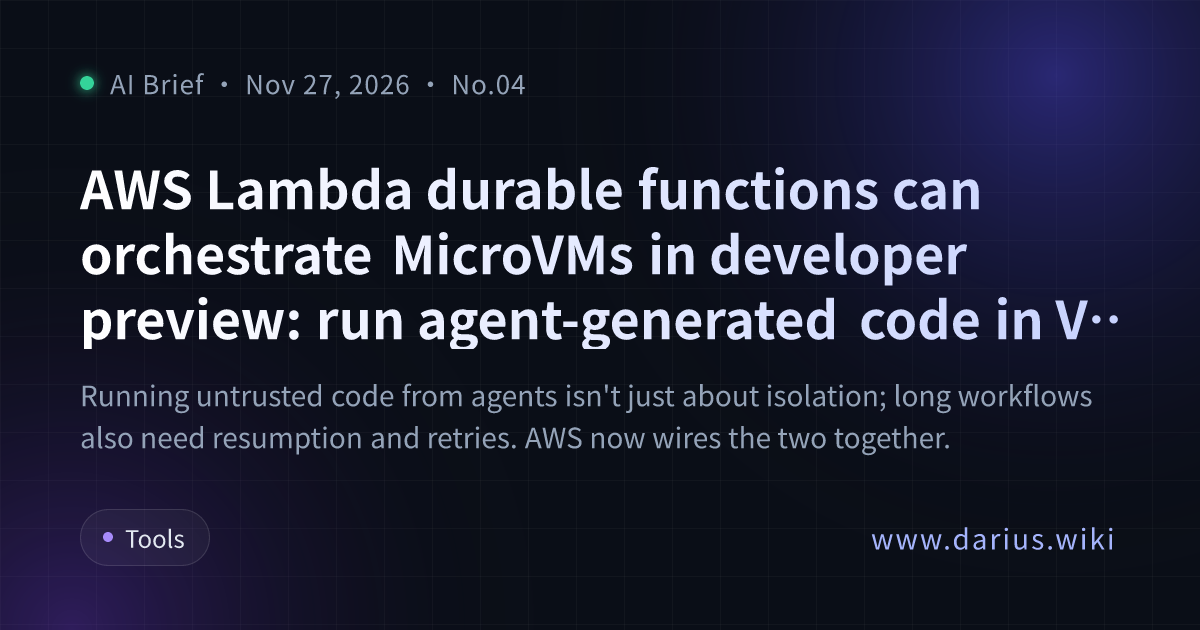
The new extension adds durable operations for running work on MicroVMs and managing their lifecycle; AWS cites software factories, security scanners and CI/CD that runs untrusted or agent-generated code
You can run a single task in a MicroVM or open a MicroVM session where tasks share files and memory; the durable function checkpoints progress, retries failed tasks and refreshes MicroVM tokens as needed
One durable function can orchestrate several MicroVMs in parallel and be triggered from sources such as SQS or EventBridge; an optional worker library inside the image receives tasks, sends heartbeats and reports results
It works with the TypeScript and Python Durable Execution SDKs; AWS says developer preview features may change and should not run production workloads
Builder's takeRead alongside the iFood platform from 11-24, the execution layer for coding agents is turning into a standard cloud building block: you no longer write the sandbox, checkpoints or retries yourself. I'd try it first on offline batch jobs such as dependency upgrades or code scans and check whether a failed run resumes from its checkpoint. It's still a preview, so keep production paths where they are.
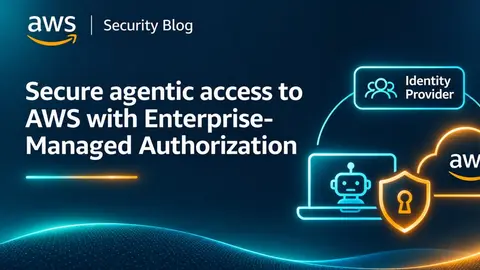
EMA is an MCP extension built on the Identity Assertion JWT Authorization Grant (ID-JAG); admins define in their existing IdP which AI apps can reach which resources, so employees don't authorize each MCP server
The flow: an employee signs in to the AI app via SSO; when it needs AWS MCP Server, the app requests a short-lived signed ID-JAG from Okta; AWS Sign-In checks issuer, signature, audience, expiry and intended resource, then issues an OAuth token tied to an IAM role
The IAM role's policies decide what the agent can do; the walkthrough uses Claude as the AI app with a read-only role
The AI app itself must support EMA and ID-JAG; the walkthrough runs in US West (Oregon)
Builder's takeAnother link in this week's authorization chain: Cognito token exchange on 11-24 covers an agent's downstream calls, IAM trusted identity propagation on 11-25 carries the identity along, and EMA covers the top step, who may let an AI app act for an employee. If you sell an enterprise AI product, I'd put support for IdP-issued assertions on the roadmap now; customers' security reviews will ask soon. For internal use, start with a read-only role.
Today, with no billing choice saved, reviews by members with a paid Copilot license use that member's entitlement; from December 30, 2026 they will be billed to the organization that owns the repository
To keep the current behavior, select Member in enterprise or organization Copilot policy settings; existing Member or Organization choices stay in effect
Accounts without AI Credits paid usage, with a billing lock or with no billable customer will be set to Member; the separate setting for members without a Copilot license doesn't change
GitHub notes organization billing requires AI Credits paid usage and can increase spending
Builder's takeIt's only a change of default, but it lands on the budget: code review moves from personal entitlements to the organization's bill, and heavy users will see a new line at month end. I'd make an explicit choice in settings this week and estimate cost from last month's review count. As with Airbnb's per-task cost approach on 11-18, coding agent spend needs to be accounted per task.
A target persona with a hidden motive interacts with other agents including the user; the user then recounts events to the assistant under test, which must infer the motive, judged by an LLM
The same model is much more accurate as a fly-on-the-wall observer of the events than as an assistant hearing only the user's account
The gap widens when the simulated user is biased, for instance with unfounded suspicion, as models often adopt the user's framing; models want more detail than they actually need, and longer conversations don't always help because models anchor on earlier turns
The simulations extend Google's open-source Concordia library; the framework and a dataset of over 20K examples are open
Builder's takeA reminder for anyone building conversational products: a model going along with the user is a measurable failure mode, not just a matter of tone. In AI Interview, a candidate asking whether the interviewer had it in for them lands right here. I'd pull the closest cases from this dataset and run them before and after any model or prompt change to see whether the assistant still just agrees; prompts can also ask it to list other explanations before giving advice.
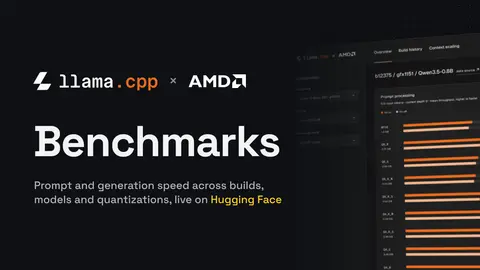
Current hardware is the Radeon 8060S (gfx1151) and Radeon AI Pro R9700S (gfx1201); PP512 processes 512 input tokens and TG128 generates 128 tokens, both from zero context, in tokens per second
It benchmarks the prebuilt binaries distributed through llama-install.sh, the project behind llama.app, weekly, with Flash Attention on and off and 10 repetitions per configuration
Models include Inkling 2 Mini, Qwen, Gemma, gpt-oss and LFM, covering dense and MoE architectures, plus a view of generation speed as context grows
Results are stored as JSONL by build, hardware, model and quantization in the public ggml-org/install.sh-benches-data bucket, for your own charts or comparisons with local runs
Builder's takeThe past two days' items were on NVIDIA workstation cards; this brings the same question to AMD: you only know whether an upgrade made things faster if you track speed per build. If you're considering AMD APUs or workstation cards for local inference, I'd check TG128 history for your model and quantization on the dashboard, then line up the raw JSONL with a local run, rather than trusting only the latest number.
Researched and drafted with AI assistance; editorial standards and views set by Darius.
Every Monday, the week in AI in one email
Every Monday morning: the 6 AI stories that mattered most in the past seven days, with my take, in your inbox.
Your email is only used to send the weekly and is never shared. Every email has a one-click unsubscribe link. See the latest issue →