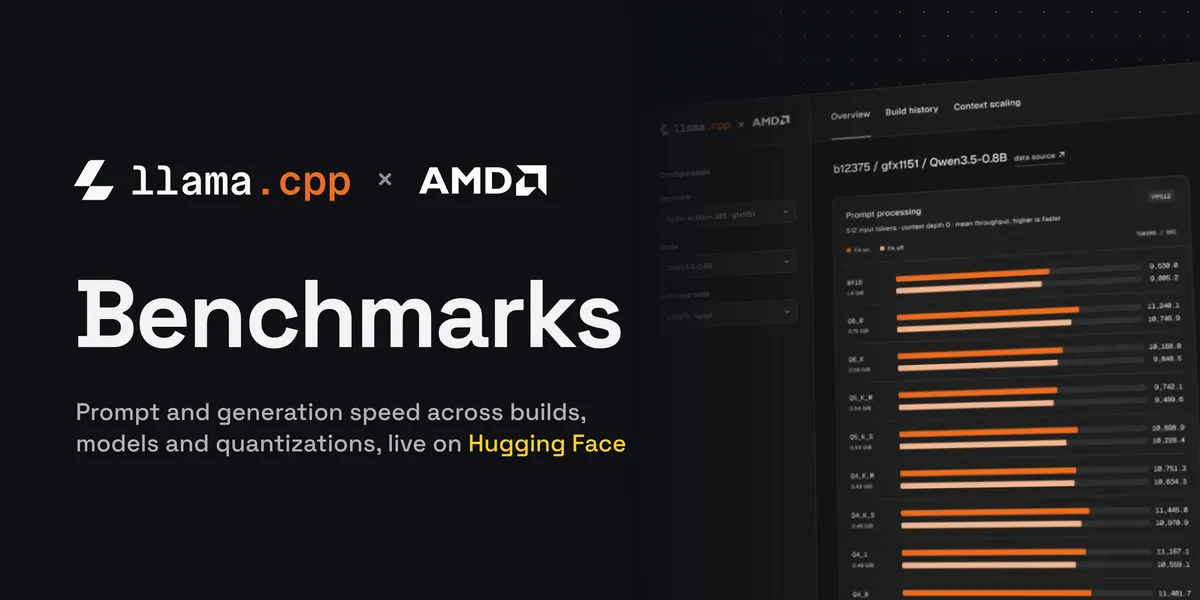
llama.cpp launches a benchmark dashboard for AMD Ryzen and Radeon: weekly llama-bench runs of PP512 and TG128, tracked by build, model and quantization, with raw data public
Local inference speed shifts with models, kernels and builds; this dashboard gives public numbers for choosing quantizations and builds on AMD hardware.
// Key points
- Current hardware is the Radeon 8060S (gfx1151) and Radeon AI Pro R9700S (gfx1201); PP512 processes 512 input tokens and TG128 generates 128 tokens, both from zero context, in tokens per second
- It benchmarks the prebuilt binaries distributed through llama-install.sh, the project behind llama.app, weekly, with Flash Attention on and off and 10 repetitions per configuration
- Models include Inkling 2 Mini, Qwen, Gemma, gpt-oss and LFM, covering dense and MoE architectures, plus a view of generation speed as context grows
- Results are stored as JSONL by build, hardware, model and quantization in the public ggml-org/install.sh-benches-data bucket, for your own charts or comparisons with local runs
Builder's takeThe past two days' items were on NVIDIA workstation cards; this brings the same question to AMD: you only know whether an upgrade made things faster if you track speed per build. If you're considering AMD APUs or workstation cards for local inference, I'd check TG128 history for your model and quantization on the dashboard, then line up the raw JSONL with a local run, rather than trusting only the latest number.
// Background · from #Open models
Full timeline →- Nov 27 NVIDIA open-sources three training datasets and a fine-tuning recipe for Nemotron 3.5 Parse: about 18.9M synthetic examples, and DFlash2 speculative decoding parses 20.44 pages per second on one H200
- Nov 27 Hugging Face trains four agents sharing one Qwen3-0.6B to communicate with TRL: after 75 updates, training success rises from 6.6% to 82.3% while tokens per attempt fall 37.4%
- Nov 26 Hugging Face lets a coding agent tune Inkling 2 Mini inference for an afternoon: single-user decode on one RTX PRO 6000 rises from 136 to 190.6 tok/s, and 8-user throughput from about 570 to 716 tok/s