NVIDIA open-sources three training datasets and a fine-tuning recipe for Nemotron 3.5 Parse: about 18.9M synthetic examples, and DFlash2 speculative decoding parses 20.44 pages per second on one H200
Turning document pages into structured data with reading order, classes and bounding boxes is the first step of RAG. This release adds the data, the training method and the speedups, so you can adapt it to your own document types.
// Key points
- Three training datasets are open: Synthetic Charts V1 with about 9.98M examples, Synthetic Tables V1 with 1M, and OCR Synthetic Multilingual v2 with about 7.9M, each with images, annotations, generation docs and the training format
- Training ran in two phases, SFT to teach page reading, then GRPO with verifiable rewards; in a matched comparison, loop-flagged pages fell from 126 to 29, outputs hitting the 9,000-token limit from 185 to 35, and the overall score rose from 66.24 to 71.38
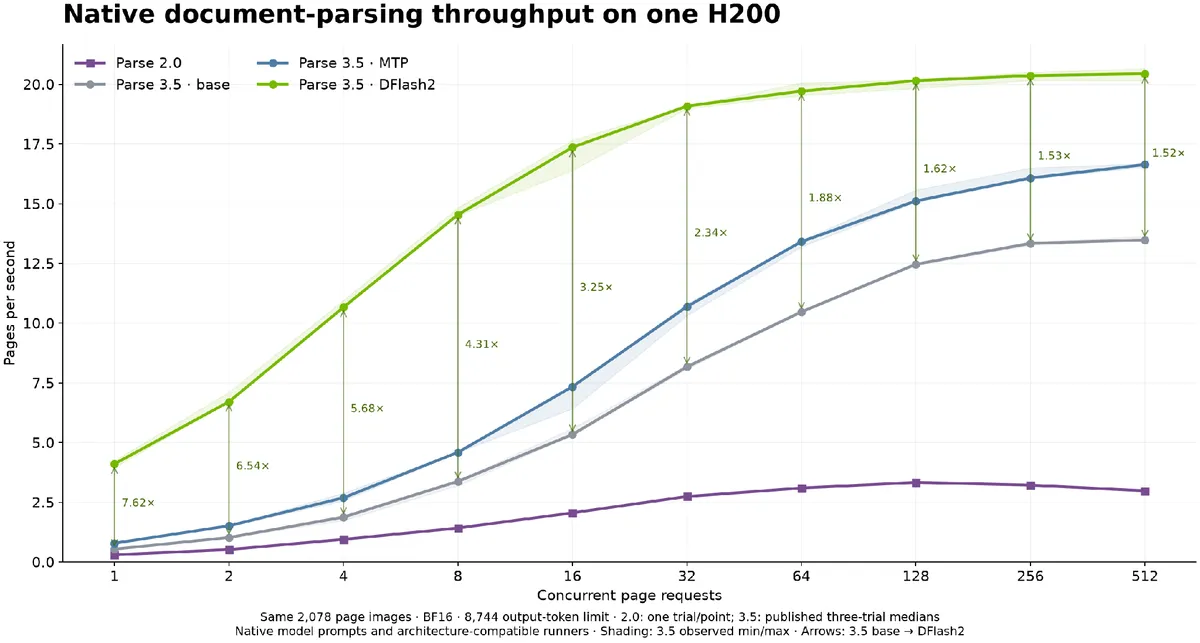
- On one H200 in BF16 at concurrency 512, Parse 3.5 reaches 13.48 pages/s without speculation and 20.44 with DFlash2, versus 2.98 for Parse 2.0; double and triple passes add 2.18 and 2.46 ParseBench points over a single pass
- In the recipe's dental-form example, sampled pass@1 rose from 0.00% for the base model to 95.85% after SFT and 96.58% after RLVR
Builder's takeFor something like AI Cloud Drive, which has to ingest whatever files users throw at it, this is more useful than another general model: dense tables and charts without printed values now come with ready synthetic data and a fine-tuning flow with verifiers. I'd pick the one document type we see most and parse worst, generate a few hundred pairs with the recipe and run SFT, then decide on RLVR based on the remaining errors. Use the second pass only on dense tables, not everywhere.
// Background · from #Open models
Full timeline →- Nov 27 Hugging Face trains four agents sharing one Qwen3-0.6B to communicate with TRL: after 75 updates, training success rises from 6.6% to 82.3% while tokens per attempt fall 37.4%
- Nov 27 llama.cpp launches a benchmark dashboard for AMD Ryzen and Radeon: weekly llama-bench runs of PP512 and TG128, tracked by build, model and quantization, with raw data public
- Nov 26 Hugging Face lets a coding agent tune Inkling 2 Mini inference for an afternoon: single-user decode on one RTX PRO 6000 rises from 136 to 190.6 tok/s, and 8-user throughput from about 570 to 716 tok/s