Cloudflare lets sites offer agents their own search, OpenAI launches healthcare model configurations, Microsoft finds contradictory docs cost coding agents 38% more tokens
Today's thread is what agents read: sites now hand agents a search endpoint, a single contradiction in the docs can send an agent on a detour or ship broken work, and well-packaged domain skills let a lightweight model match frontier ones. The other thread is general models moving into verticals: OpenAI launches healthcare configurations, and GPT-6 designs proteins without specialized models.
Once enabled for a zone, Cloudflare creates an AI Search instance, crawls and indexes the content, and serves queries at /.well-known/search; available to all customers, with limits on the Free plan, billed at AI Search pricing
Every HTML page gets agent:instructions, agent:endpoint and related metadata in its <head>; with Markdown for Agents also on, a request with Accept: text/markdown gets the same information in YAML front matter
The endpoint returns retrieved content in Markdown, not a generated answer; it supports GET and the HTTP QUERY method, published as RFC 10008 in June 2026, with plain-text or JSON bodies
Access still follows the site's bot management, AI Crawl Control and WAF settings; Cloudflare's developer docs turned it on first, and an OpenCode session discovered and used the endpoint on its own
Builder's takeFor docs and content sites, this is the first time "SEO for agents" is a single toggle. I like that it returns source text rather than answers: the user's own model writes the answer, and the site just hands over the right passages. If you're on Cloudflare, turn it on for your docs subdomain first and watch a week of logs to see what agents search for; that's your list of doc gaps. Check that your WAF and bot rules neither block it nor open it wider than you meant.
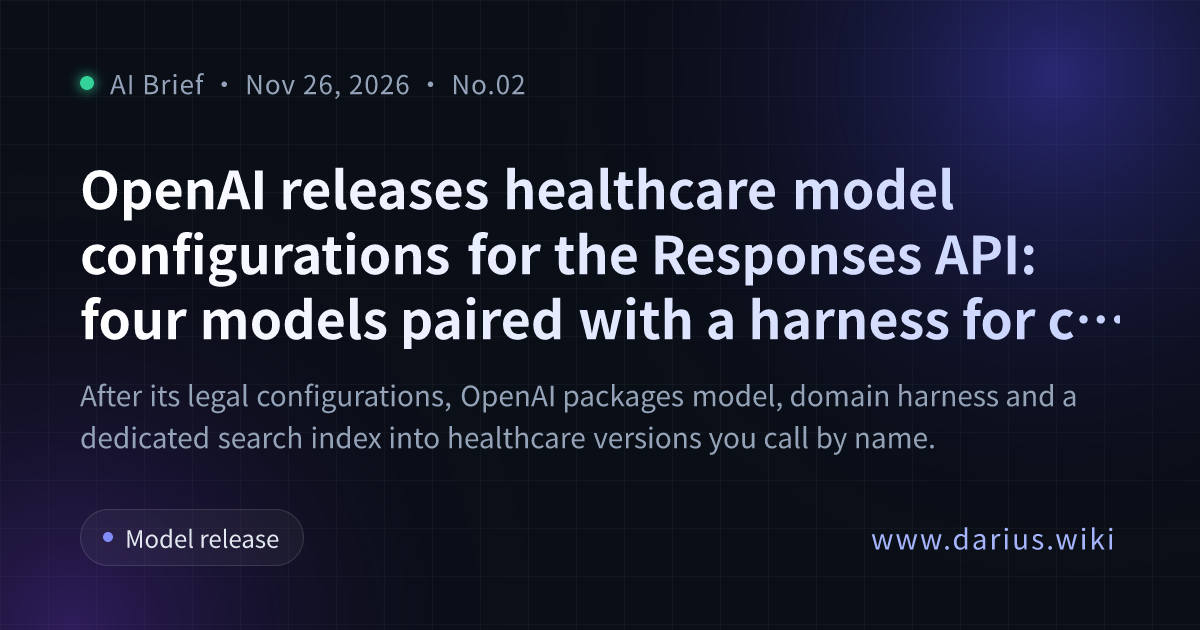
Four configurations: gpt-6.2-astra-healthcare, gpt-6.2-sol-healthcare, gpt-6-astra-healthcare and gpt-6.1-sol-healthcare, called through v1/responses
When the model uses web search, it searches a dedicated index of medical sources
The pricing page lists gpt-6.2-astra-healthcare at $8 input and $40 output per million tokens and gpt-6.2-sol-healthcare at $2 / $10, the same as standard gpt-6.2-astra and gpt-6.2-sol; promotional pricing for the healthcare configurations runs at least through December 31, 2026
The same pricing section also lists legal configurations such as gpt-6.2-astra-law
Builder's takeRead with MedChemBench on 11-21, OpenAI's approach to healthcare is evaluation first, then configuration. For vertical products the point isn't a model that knows more medicine; it's search locked to trusted sources, which you used to build yourself. If you ship health features, run your real question set against a general model with your own retrieval and against the healthcare configuration, comparing answers and citations. The promotional price lasts at least until year end, so evaluate now.
The material comes from Dev Proxy's docs: a consistency review pulled 3,827 facts from its Microsoft Learn pages and found 79 contradictions; this test used 3 of them with Claude Sonnet 5.5, Claude Haiku 5.5 and GPT-6.1 Terra in VS Code with GitHub Copilot Chat
Outdated API endpoints: Claude Sonnet 5.5 mentioned the contradiction in all 15 runs, still wrote the old endpoints in 10, and fixed every one after a 404, but median tokens rose from 1.16M to 1.60M; GPT-6.1 Terra read the API reference and ran devproxy api show first every time, with no mistakes
Silent failure: the old GitHub Actions page pinned the version without the v prefix, and Claude Haiku 5.5 copied it and told the user the work was done in 3 of 12 runs; the authors note that sample could still be chance
Runs that checked a second source (another page, the CLI, installed files) before writing code weren't misled; whether an agent recovers depends on whether the task lets it run into the mistake
Builder's takeThe line worth copying is the second half of the conclusion: whether an agent recovers depends on whether the task makes it hit the mistake. I'd do two things: tell agents to run a verification step so errors fail loudly, and require them to check key settings against the CLI or a schema before writing. If you maintain product docs, keep facts like version numbers and endpoints in one table every page pulls from; it's cheaper than fixing pages one by one.
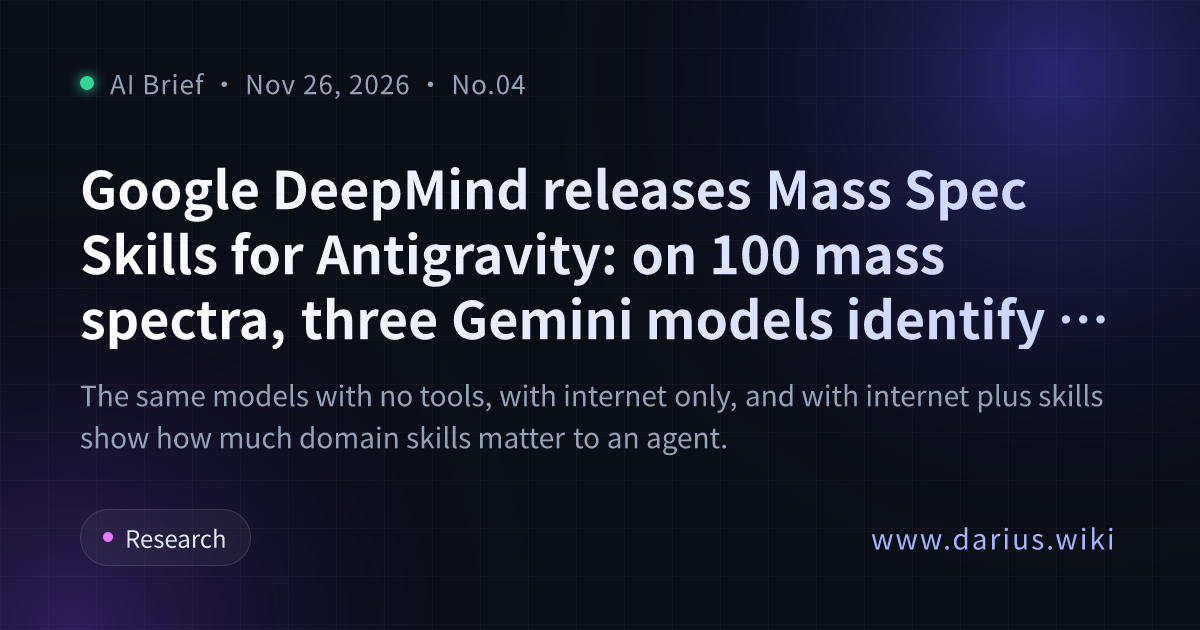
Mass Spec Skills wrap open tools such as matchms, SIRIUS, MAGMa, MetFrag and RDKit, and public libraries such as GNPS, MoNA and PubChem, as skills that Antigravity chains from a tandem mass spectrum to candidate structures and a reviewable report
On 100 compounds from the Enamine REAL collection in MoNA, all three models stayed below 4% accuracy with no internet or skills; with internet only, improvised scripts were brittle, and the frontier models missed a quarter to a third of spectra while the lightweight model missed more than three-quarters
With the skills, Gemini 3.8 Flash, Gemini 4 Argon and Gemini 4 Carbon all identified and verified the exact molecule in about 97% of attempts; generated tokens per attempt fell nearly fourfold on Flash, by half on Argon and by nearly a fifth on Carbon
Builder's takeThe comparison matters more than the domain: with internet only, models burn tokens improvising scripts and still fail often; wrap proven tools as skills and the lightweight model matches the frontier ones with fewer tokens. Alongside AWS shipping Textract as an agent skill on 11-22, skills are replacing bigger models as the first move in vertical work. If your product has a fixed workflow, package it as a skill first, then run the same comparison on your cheapest model.
GPT-6 models design protein structures and sequences without calling specialized biology models; across the 14 protein tasks tested, the latest models matched or beat specialized models on most, while predicting a complete protein structure remained a clear weakness
Researchers can specify in the prompt where a protein should attach and how many coils or strands it should have; an internal research model followed such instructions with near-perfect fidelity in its 3D designs
In lab tests with Onava, small proteins based on a pre-release GPT-6.2's designs showed evidence of binding for at least one design at each of the five chosen targets; redesigned antibodies also retained binding
Specialized models still supplied some sequences and selected candidates for testing
Builder's takeI don't work in biology, but product builders should notice this: a general model plus code execution is starting to stand in for a chain of specialized models, and switching tasks means changing the prompt, not retraining. Note the limits the post itself states: full structure prediction is still weak, and specialized models still screen candidates. My read is that in your own domain, letting the general model propose and keeping specialized models as checkers is safer than replacing them outright.
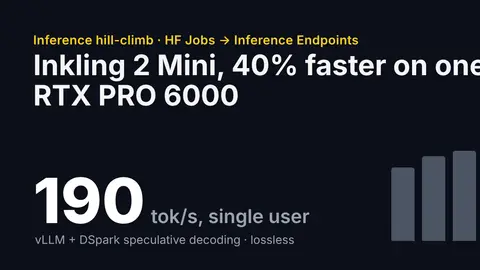
The agent followed a fixed protocol: measure hardware ceilings first, change one variable at a time, bracket every candidate between two control runs, and keep a change only if it beats both without regressing other metrics; 46 valid runs, with logs and scripts published
All the speedup came from three things: switching to vLLM nightly (136 to 157 tok/s without speculation), DSpark speculative decoding with 7 drafts and probabilistic draft sampling (157 to 190.6 tok/s), and two memory flags that let it start on 96 GB
Greedy outputs are byte-identical with and without speculation, and long-context retrieval passes 3/3 up to 250K tokens; at the measured acceptance rate the bandwidth ceiling is about 201 tok/s, so 190.6 is about 95% of it
The Jobs used the same GPU as the nvidia-rtx-pro-6000 Inference Endpoint, both at $2.75 an hour; greedy draft sampling was 11% slower at temperature 1.0
Builder's takeWe covered Inkling 2 Mini going open on 11-21; now there's a working setup for a single workstation card. The method matters more than the 40% speedup: bracketed controls, one variable at a time, and no win until equivalence checks pass, a protocol you can hand to a coding agent to run on its own. If you plan to self-host, reproduce the published config on the same card, then re-measure acceptance with your own prompts: change the temperature or the task and the speculative gain changes too.
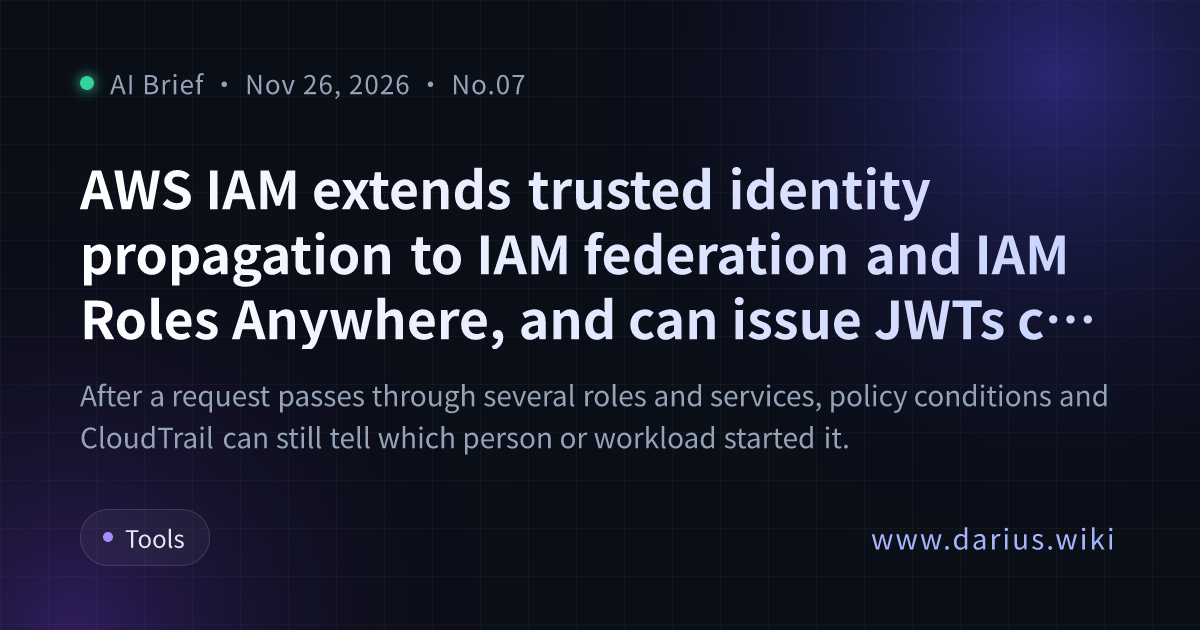
Trusted identity propagation (TIP) carries the identity of the originating human or workload with requests, for use in IAM policy conditions and CloudTrail; it now covers IAM federation and IAM Roles Anywhere with X.509 certificates
With federation, the identity and optional runtime claims such as a risk score or a CI/CD workflow name can be mapped from the SAML assertion or OIDC token into the role session
IAM outbound identity federation can request an AWS-signed JWT carrying identity from the TIP session, so external services can identify who started the request; identity carries across roles and services without per-role trust policy updates
Available in all commercial Regions, the AWS GovCloud (US) Regions and the AWS European Sovereign Cloud (Germany) Region
Builder's takeThe announcement doesn't mention agents, but this is a piece agent accountability was missing. Together with Cognito token exchange on 11-25 and STS GetScopedCredentials on 11-21, AWS now covers who started a request, narrowing its permissions, and carrying identity to outside services. If your agents act for users on AWS, map the user identity and workflow name into the session, confirm in CloudTrail that every step traces back to a person, then decide which automation to open up.
FlashAttention3 and 4 pipelines for Hopper and Blackwell data center GPUs can't be applied directly to the RTX PRO 6000 Blackwell (SM120), which uses a different Tensor Core architecture
The optimized SageAttention3 kernel splits each N128 score tile into two N64 register slots and reclaims registers once softmax output is packed into NVFP4, overlapping the next tile's QK computation with the current tile's remaining work without a second full score buffer
NVFP4 attention kernel latency improves by up to 1.64x on the RTX PRO 6000 Blackwell; Reactor put it into its production world-model serving, cutting end-to-end latency by up to 15.34% across LongLive, Helios, OmniDreams and Cosmos 3 Nano
The core optimization is merged into the FlashInfer main branch
Builder's takeIt's the same card as today's Inkling 2 Mini item, and the signal is consistent: the RTX PRO 6000 tier is being optimized as a real inference card, not just a dev box. A 1.64x kernel gain shrinks to at most 15% end to end, and that gap is itself a useful benchmark. If you run video or world models on these cards, upgrade FlashInfer and compare quality and latency against a BF16 baseline before switching to NVFP4.
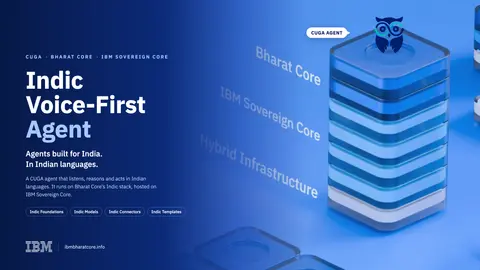
A farm assistant: the user asks aloud in their own language; speech becomes text, the agent searches a 154-page English agricultural handbook, and answers in two to four sentences in the question's language, with source pages
CUGA's default embedding model is English-only, so Hindi or Tamil questions still retrieved five passages, all wrong, and the model, told to answer only from them, said the handbook didn't cover it; switching to intfloat/multilingual-e5-large removed the need for translated copies
Other choices: the prompt bans Markdown and citation tags, with a formatter as backup; off-topic replies start with OFF_TOPIC instead of a second LLM call; the browser talks to the speech provider directly, so the server sees only text and never the user's key
CUGA is open source under Apache 2.0 and switches between watsonx and OpenAI models
Builder's takeProducts like AI Cloud Drive, with Chinese questions over mixed-language files, are exactly where this trap bites: no errors, just quietly worse recall. My post on migrating multimodal embedding models covers the engineering side of recall shifts. If you run multilingual RAG, do what they suggest before launch: ask in a non-English language and check the retrieved pages before tuning prompts. Flagging off-topic questions with an output prefix instead of a second call is a cheap trick worth copying.
Researched and drafted with AI assistance; editorial standards and views set by Darius.
Every Monday, the week in AI in one email
Every Monday morning: the 6 AI stories that mattered most in the past seven days, with my take, in your inbox.
Your email is only used to send the weekly and is never shared. Every email has a one-click unsubscribe link. See the latest issue →