Bedrock brings customer-held data retention to Claude, AWS WAF discovers and protects MCP endpoints, Cognito narrows user consent at every agent hop
Today's thread is drawing a boundary at every agent hop: data stays in your own bucket, AI endpoints are discovered before they're protected, and tokens get narrower with each downstream call. The other half is proving reliability: iFood uses structured outputs to decide when a task is done, Microsoft turns production traces into an evaluation loop, and DeepMind's new benchmark only counts getting it right every time.
The trusted access program API is GA: one place to list model provider programs, check eligibility and enroll, with IAM policies and service control policies deciding who may enroll; eligible means you can enroll, requestable means you must request approval first
EFS: prompts and completions are stored only in your own S3 bucket, encrypted with your KMS key, with no copy kept by Anthropic or Bedrock; Bedrock stops serving covered models 24 hours after it loses access to your key or bucket
When automated safety monitoring finds a risk, it writes a Case under review-cases/ in your bucket and your team answers in review-responses/; EDC instead keeps retained data in Amazon-managed storage for up to 30 days, and Cases aren't delivered during the preview
Covers Claude Fable, Claude Mythos, and Opus 5.5 and Sonnet 5.5 through the Cyber Verification Program; interim zero data retention for current Fable models runs through at least June 30, 2027, and joining the preview turns off that exception for the accounts you add
Builder's takeRead with yesterday's EFS item on the Claude API, "data stays in my account" now works on both major channels. If you run Fable on Bedrock under the interim zero-retention exception, don't rush into the preview: joining turns that exception off for those accounts. Try it in a non-production account first and put "24 hours without key or bucket access means no model" in your runbook; one bad KMS policy edit stops the model.
Discovery lives in the new API Gateway API Portal, which recognizes AI endpoints from traffic logs and service configuration records with no agents to deploy or logs to forward; it covers endpoints behind API Gateway, Application Load Balancers and CloudFront, and an undocumented public MCP server shows up as a shadow API
The new AWS WAF AI Security managed rule group performs protocol recognition and compliance checks to block malformed MCP and A2A messages; with content inspection on, it calls the Bedrock Guardrails InvokeGuardrailsCheck API to detect prompt injection, jailbreaks and harmful content in requests and sensitive information in responses
Additional fees apply, and Amazon Bedrock charges separately for content inspection calls
API Portal is available in 32 Regions; AI Security is available in 7: N. Virginia, Ohio, Oregon, London, Stockholm, Tokyo and Sydney
Builder's takeRun discovery once and look for public MCP servers you didn't know about; the ones teams expose while experimenting are the usual suspects. Protocol compliance checks can go on right away. Content inspection adds a Guardrails call to every request, so measure latency and cost on one endpoint for a week before deciding how widely to roll it out.
The caller sends the user's token to Cognito as the subject token: impersonation returns a token that represents the user, while delegation adds the caller's own actor token and Cognito writes an act claim naming the service that is acting
The issued token carries only scopes that both the subject token and the app client allow, can be bound to one resource server, never outlives the subject token, and comes without a refresh token
The pre token generation Lambda trigger also runs during token exchange (trigger source TokenGeneration_TokenExchange), but scopes it adds are ignored, so it can only remove them
Use the /oauth2/token endpoint on your user pool domain or call GetDerivedToken through an AWS SDK; the examples cover your own MCP server and Bedrock AgentCore Gateway
Builder's takeThis is the user-side half of the STS GetScopedCredentials item from 11-21: one narrows cloud permissions, the other narrows user consent. My AI Interview backend runs an MCP Server, and that second hop used to mean either forwarding the user's token or switching to the service's own identity, neither clean. With delegation, downstream logs show both the user and the service. Downstream APIs must check that act.client_id is a service you trust, or delegation is just decoration.
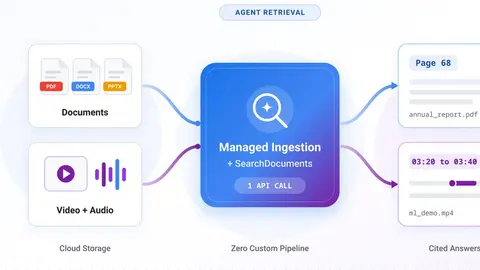
Agent Retrieval was formerly Vector Search 2.0; managed ingestion uses Gemini Embedding 2 on PDF, DOCX, PPTX, XLSX and TXT files and on MP4, MOV, WebM, MKV and other video formats
SearchDocuments needs only a data store and a text query, and documents get hybrid semantic plus full-text search automatically; every result carries its source URI with a page range for documents or start and end times for video; reranking is optional for documents and unsupported for video
In Google's tests, 18 Alphabet investor PDFs became searchable with page citations in about 9 minutes, and 19 minutes of video became searchable by visuals and speech at 0.3 to 0.5 seconds per query
Managed ingestion has no separate charge during the public preview (billing starts at GA), the backing Collection is billed at standard Agent Retrieval pricing, and the preview runs only in us-east4 and europe-west4
Builder's takeThis is exactly the pipeline we maintain ourselves for AI Cloud Drive. Going managed removes the parsing and embedding ops, at the cost of only two segmentation modes, chunk and page. I'd compare recall on our own files before switching, though video, a format we don't handle yet, is worth trying there first. As I wrote in my post on chunking and metadata, retrieval quality usually breaks in chunking and metadata, and managed doesn't mean you can skip checking.
Remote Agents Platform: users submit a prompt and environment requirements over REST, the task runs in an isolated sandbox on a remote runner, results come back as a merge request, and progress can be watched in real time
Deterministic steps bookend each run (clone the repository, import the skills the agent can use, set up the branch; then publish the merge request and artifacts), with GPT-5.6 Luna doing the agentic work inside the sandbox in between
After execution, results are processed with Structured Outputs against a predefined contract to determine automatically whether the agent completed the task
Vulnerabilities fixed through the internal security platform more than doubled
Builder's takeRead with Airbnb choosing models by cost per task on 11-18, big companies now care less about which model is strongest and more about dispatching work in bulk and deciding when it's done. The structure of deterministic steps around the agent plus structured-output acceptance is worth copying directly. I'd start with the most repetitive repository task, such as dependency upgrades, and measure merge rate rather than run count.
Insights (clustering production traces into actionable findings) and multi-turn evaluation are GA; human annotation and rubric evaluators are in preview, and in the team's HelpSteer3 tests rubrics from human annotation raised alignment with human judgment from 65% to 81%, against 89% between two human annotators
Microsoft-Decision-1 as a judge (preview) has a median latency of 0.59 seconds and costs about $0.12 per 1,000 evaluator calls; it gives no written rationale, and about 2% of verdicts changed on reruns
Skill optimization proposes plain-text Agent Skills from recent traces and existing skills, and cost optimization looks for cheaper configurations that still meet the quality bar; Agent Optimizer never changes a production agent automatically
Microsoft-Decision-1.1 is GA, built on Gemma 4 26B A4B, starting at $0.042 per million input tokens with output included; model router adds Auto in preview, so model="auto" routes requests without deploying a router
Builder's takeAt $0.12 per 1,000 calls, there's no excuse not to sample-evaluate live traffic, but with 2% of verdicts flipping on reruns, borderline calls still need a human. I'd run it against our current judge on the same data first, then let it take over routine content-quality spot checks for PandaClaws. The rule that the optimizer never changes a production agent on its own belongs in your release process too.
HFE measures not whether a model can solve a task once, but whether it solves the task and slight variations every single time
The dataset has 544 elementary text and image prompts across 20 foundational capabilities, with a live leaderboard on Kaggle and a technical report
A three-week Kaggle competition running through December 15 invites everyday questions that current models still get wrong, to keep the dataset up to date
Google says frontier models have made significant progress on HFE over the last 6 months
Builder's takeThis follows the same line as the pass^k idea in Hugging Face's evaluation guide on 11-24: users don't care how clever a model occasionally is, only that it doesn't trip on easy things. I wrote about the same problem in my post on why the same input gets different eval scores. Turn your users' most common simple questions into a variant set, run it several times on every model switch, and track the all-correct rate rather than the average.
Effective immediately, Jensen Huang is reinstated as President, Chief Executive Officer and board member; the board voted unanimously after a series of discussions and meetings with him, saying it was satisfied with his candor and ability to lead
The board received input from senior levels of the US government and, based on that input, is confident the reinstatement poses no national security risk
Colette Kress, who served as interim CEO, continues as Chief Financial Officer; Harvey Jones remains board chair
Builder's takeFor product teams this changes little in the short term; GPU supply and the software stack roadmap carry on, and I wouldn't adjust compute purchasing over a governance headline. What's worth watching is that the announcement says the US government was consulted; follow-up news on export and compliance is more likely than the personnel change itself to affect how and when teams get GPUs.
The Cosmos-Framework offloading package builds on Diffusers' native group offloading: most weights stay in system RAM and move to the GPU as needed, trading more RAM and PCIe traffic for less GPU memory, without interactive latency
An FP8 checkpoint with native mixed precision lowers peak GPU memory while keeping BF16 for the attention layers
Seven generation modes are supported through the official Diffusers modular pipeline, including text-to-video, image-to-video, video-to-video, sound, action and control-guided generation
An RTX 5070 produced 720p text-to-video in 2,624.9 seconds at 9.94 GiB peak memory in BF16; the test hosts had about 128 GB of system RAM, which is not a measured minimum
Builder's takeAt over 40 minutes per 720p clip, this isn't for production; it lets teams prototyping physical AI or video generation test ideas on a workstation without renting GPUs. I won't wire it into PandaClaws' video asset generation for now; if you want to try it, check you have RAM on the order of 128 GB and start from the FP8 branch.
Researched and drafted with AI assistance; editorial standards and views set by Darius.
Every Monday, the week in AI in one email
Every Monday morning: the 6 AI stories that mattered most in the past seven days, with my take, in your inbox.
Your email is only used to send the weekly and is never shared. Every email has a one-click unsubscribe link. See the latest issue →