Claude brings zero data retention to its top models, OpenAI and Cisco introduce open-source Shirudo, Gemini API bills only for the file slices it reads
Today's thread is narrowing what models touch: enterprise prompts and responses stay in your own bucket, Gemini reads only the pages you name, and Google's measurements show reviewing tool calls against user intent costs little capability. The other half is upgrade management: Opus 4.5 has a retirement date, and AWS lets you replay scores before switching evaluation models.
EFS is in beta on Claude Platform, Claude Platform on AWS and Claude Models on Google Cloud (Anthropic managed), offering zero data retention (ZDR) for eligible organizations using Claude's most capable models
Anthropic doesn't retain prompts and responses; encrypted copies, called Sealed Safety Data, go to a bucket in your own cloud account; a workspace on Anthropic-managed storage isn't on EFS
Organization webhooks (beta) add external_storage.failed and external_storage.recovered, sent when a customer-owned bucket fails or passes the daily check again
Claude Opus 4.5 (claude-opus-4-5-20251101 and claude-opus-4-5) is deprecated, retiring on the Claude API on January 22, 2027, with Opus 5.5 recommended as the replacement
Builder's takeFor enterprise products, EFS is the first time "data stays in my account" can apply to the most capable models, but the bucket becomes your own ops responsibility: route external_storage.failed into alerting and treat a failed check as an incident. Opus 4.5 has two months left; run your own eval set on 5.5 before migrating instead of waiting for the last week.
Introduced jointly by OpenAI and Cisco, filed under Security on OpenAI News
Shirudo is an open-source runtime for Linux
Its stated purpose is to help teams protect running systems while they roll out patches
Builder's takeRead it alongside Google's threat intelligence item on 11-17: attackers can already work out flaws from updates automatically, so the window between a patch and its rollout is the riskiest time. I've only seen the official summary, so don't rush it into production; wait for the repository and kernel and hardware requirements. What's worth doing now is measuring how many days your services take from patch release to full rollout.
Works across all Gemini 4 models in Google AI Studio and the Gemini platform (Vertex AI), alongside new native uploads for Microsoft Office and OpenDocument formats; existing file size and page limits still apply
Documents and slides slice by page range (start_page, end_page), resolution (low, medium or high) and content layer (page_text or page_image); spreadsheets by tab (sheet_index), cell range (visible_cells) and data, formulas or visuals
Video slices by time interval, fps, resolution and layer (transcript, frames or audio), audio by time interval; a file uploaded once to the Files API can be reused across turns and tool calls by URI
Partner results: Vercel used 14x fewer tokens skimming one page's text than rendering the whole PDF; LiteLLM cut prompt tokens by 67% for a PDF and 33% for a workbook
Builder's takeThis bears directly on AI Cloud Drive's costs: when a user asks about one clause in a 200-page contract, you shouldn't feed the whole PDF as images every time. I'd have the agent skim with page_text first to locate pages, then request page_image only for the few pages where layout matters. It's the same direction as Tool Retrieval on 11-19: Google is cutting, piece by piece, the context each request has to carry.
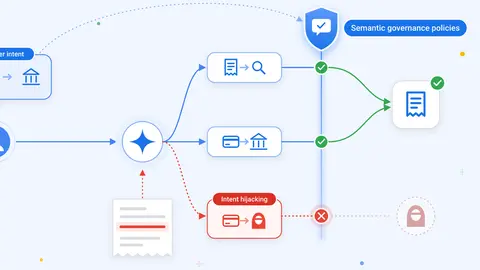
Tested on AgentDojo v1.2.2 (97 user tasks, 949 attacked runs) with a gemini-2.5-flash agent, averaging six runs per configuration, with default policy settings
None of the 929 attacks requiring a tool call succeeded in any run; banking, Slack and workspace saw zero successful attacks, while without the guardrail more than 9 in 10 Slack attacks succeeded
Over-blocking affected 1 of 97 benign tasks; utility under attack fell from 35.1% to 25.8%
Text-only manipulation with no tool call isn't covered, and adaptive attacks against the judge weren't tested; the post cites NIST CAISI results where red-teamed attacks raised success from 11% to 81%
Builder's takeThe numbers say reviewing tool calls against user intent is a very cheap default defense, but take the two limits seriously: adaptive attacks weren't tested, and text manipulation in replies isn't covered. I'd do what it recommends: a week in dry run mode to measure over-blocking, then enforce; and give users a readable explanation for a denied call, or the 9 points of utility lost under attack turn into support tickets.
Wallet started rolling out the same day, for mapping financial goals, cutting everyday spending and using card perks; AI Mode can read Wallet information but cannot move, manage or invest money
Google Drive and the Gemini app come "in the coming weeks", joining Gmail, Calendar and Photos; AI Overviews and AI Mode will also draw on recent search activity
Connecting is opt-in and can be toggled anytime under Connected Apps in Search Personalization; Google says a "Personalization" icon will soon show which context a response used
Builder's takeDrive arriving in Search means users will get used to asking about their own files from a general entry point, which is both competition and a template for AI Cloud Drive. I'd copy its three boundaries: read-only by default, a per-app toggle, and showing which files a response used. That reassures users more than any privacy policy.
Validate the eval before modeling: run a reference solution, a do-nothing agent and a shortcut; the reference should pass and the other two fail. The authors' shortcut matched the expected ratio on all eight tasks without fitting spectra
Report reliability by use: pass@k when retries are tolerated, pass^k for unattended use; in the worked example 11 of 24 rollouts passed, pass@3 was 7/8 and pass^3 only 1/8
Pin the model provider, harness and package versions; 98.2% of model-benchmark scores are reported by only one party, and OpenAI found material issues in 59.4% of 138 SWE-bench Verified problems it examined
Builder's takepass@3 of 7/8 against pass^3 of 1/8 is the pair worth pinning to the wall: unattended workflows should look at the latter. For AI Interview scoring I'd add its two controls, a candidate who answers nothing and one who only stacks keywords; if either scores well, the grader is testing answers rather than ability. My blog post on a model release evaluation checklist covers a similar approach.
When a new model version is available, managers can compare how it and the current version score the same contacts
The aim is to find scoring differences and adjust evaluation criteria before they affect agent performance results
Evaluation forms can auto-upgrade to the latest model version or stay pinned to one for consistent scoring; available in all AWS commercial Regions where Amazon Connect Customer is offered
Builder's takeScore drift after a model switch is exactly the trap AI Interview faces: users won't accept a 7 last month and a 6 this month for the same answers. I'd build the same mechanism: replay past interviews on the new model before switching, adjust criteria when the gap passes a threshold, and record the scoring model version with each result. Opus 4.5 got a retirement date today too; upgrades aren't optional.
Previously each instance type and Region combination needed its own search; one console search now spans multiple types and Regions
Capacity can be reserved for a future start date and for up to 6 months
On the API side, DescribeCapacityBlockOfferings searches multiple instance types within one Region per call
Builder's takeFor small teams running a one-off fine-tune or eval, the hard part is often getting the GPUs at all. Training jobs rarely care about Region, so I'd list both P6-B200 and Trn2 as candidates and make the code run on both ahead of time, narrowing only when data rules restrict the Region.
Distributed PyTorch and Ray training jobs are submitted through single-page forms with live YAML preview and reusable compute presets
Models deploy from SageMaker JumpStart, Amazon S3 or Amazon FSx
Detail pages embed metrics and logs from HyperPod Observability, Amazon Managed Service for Prometheus and CloudWatch plus Kubernetes events; with task governance, a unified queue lets users change a task's priority class
Builder's takeAlongside the HyperPod Global Inference Gateway on 11-23, AWS is turning HyperPod from a platform team's tool into something data scientists use directly. The forms are convenient, but I'd require the previewed YAML to be committed to the repo, or training configs end up scattered across people's click histories.
Researched and drafted with AI assistance; editorial standards and views set by Darius.
Every Monday, the week in AI in one email
Every Monday morning: the 6 AI stories that mattered most in the past seven days, with my take, in your inbox.
Your email is only used to send the weekly and is never shared. Every email has a one-click unsubscribe link. See the latest issue →