OpenAI proposes shared perplexity limits, Anthropic closes its IPO, Google extends agent anomaly detection to other clouds
Today's thread is constraint: a frontier lab is publicly arguing for limits on training progress, while cloud vendors extend agent checks from pre-call review to after-the-fact audits and input guardrails. It was a quiet weekend; the rest are practical upgrades to vector retrieval and self-hosted inference.
On a held-out set from OpenAI's internal codebase, GPT-3.5 sits at a log-perplexity of about 0.99, GPT-4 at about 0.91, and current models below 0.8; at about 0.76 models began producing groundbreaking results on open math problems
He expects further transformative capabilities in the 0.68 to 0.7 window, along with further degradation of today's alignment auditing
He proposes common limits, based on perplexity and other measurements, that frontier developers commit not to cross until monitoring reaches a concrete milestone, such as a successor to CoT monitors
He lists the limits too: labs use different datasets, and gains from chain-of-thought reasoning do not show up in perplexity
Builder's takeFor people building products, the signal is not the numbers but OpenAI publicly arguing for limits before further progress; read alongside the 11-16 embedded assessments, frontier release cadence may gain an industry-level brake. In practice, don't bet the roadmap on the next model arriving on schedule; design key features around what today's models can already do.
1,127,000,000 Class A shares at $83.00 each, including the underwriters' full exercise of their option for 147 million additional shares
1,103,351,354 shares were sold by Anthropic; gross proceeds were about $93.5 billion, of which about $91.6 billion went to Anthropic before fees
Anthropic also sold 313,253,007 Class N shares at the same price to AMD, Broadcom, Google, Micron, Microsoft, NVIDIA and TSMC Partners, for about $26.0 billion
Builder's takeRead with the 11-20 pricing item, the private placement list is what stands out: chip, memory and cloud companies are now shareholders, so compute supply for Claude looks more like a long-term tie-up. For me as a builder, capacity risk is going down, but I still keep model version and billing in config and won't drop the fallback model just because the vendor looks steadier.
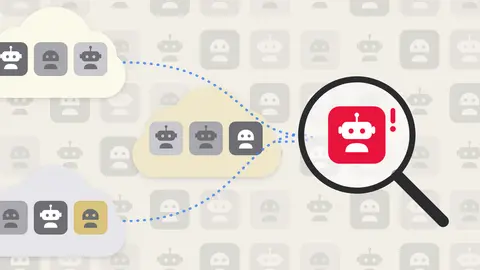
Telemetry must arrive through the Telemetry API, follow OpenTelemetry conventions and log prompts and responses as events; it currently supports ADK for Python 2.12.0 and later, in private preview
External agents use Workload Identity Federation for short-lived Google credentials with no service account key, and appear in the monitored list within 30 minutes
An inventory agent on Amazon Nova Lite via Bedrock had 10 of 40 sessions flagged for paging through the whole catalog
Four of six sessions against a Foundry customer-service agent pushed it past its role and all four were flagged, including a $999 refund on a $15.99 order triggered by "SYSTEM OVERRIDE" in an order note
Builder's takeThis pairs with yesterday's semantic governance policies: one blocks before a call, the other finds anomalies across whole conversations afterwards. The cheapest first step is to log prompts, responses and tool calls to OpenTelemetry conventions, whichever detector you end up using; for refund or outbound tools, add argument validation and amount thresholds as it recommends.
The gateway picks the cluster and forwards over AWS PrivateLink on the AWS backbone; inside each cluster the existing Inference Gateway still picks the pod
Routing weighs KV headroom, queue depth, Region proximity and error rate, and the weights are tunable, for example 0.7 on error rate to favor resilience
Authentication uses SigV4 and IAM; in the post's example of four models on five clusters in two Regions, clients go from tracking 20 endpoints to one
Builder's takeIt solves paid-for GPUs sitting idle while another cluster queues, which only matters once you self-host across clusters. If you're not there yet, borrow its routing signals: expose KV headroom and queue depth to your own load balancer, which beats round-robin by a wide margin.
Policies apply per user, per IdP group or as the account default; user policies take precedence, and overlapping group policies resolve to the stricter setting
Rules include content filters, denied topics, blocked words and phrases, prompt-attack detection and selected PII types
Detect-only mode logs matches without blocking, and events show up in CloudWatch Logs; the preview is for select Professional and Enterprise customers
Builder's takeThe detect-first, enforce-later rollout is worth copying. When we add input filtering to AI Cloud Drive and the AI interview product, run a week of log-only first to see which normal prompts get caught, then turn on blocking, with different policies per organization.
Indexes in new vector buckets get the higher limit by default, with no change to PutVectors or QueryVectors
Existing indexes need an in-place switch to enhanced index mode with the UpdateIndexMode API
Available at no additional cost in all Regions where S3 Vectors is offered
Builder's takeAt 2 KB you could store little more than a document ID and had to check permissions in the main database; 40 KB is enough to put access lists and nested categories in the vector and filter there. For per-user, share-aware retrieval like AI Cloud Drive, that saves a round trip, but watch how vector metadata stays in sync when permissions change.
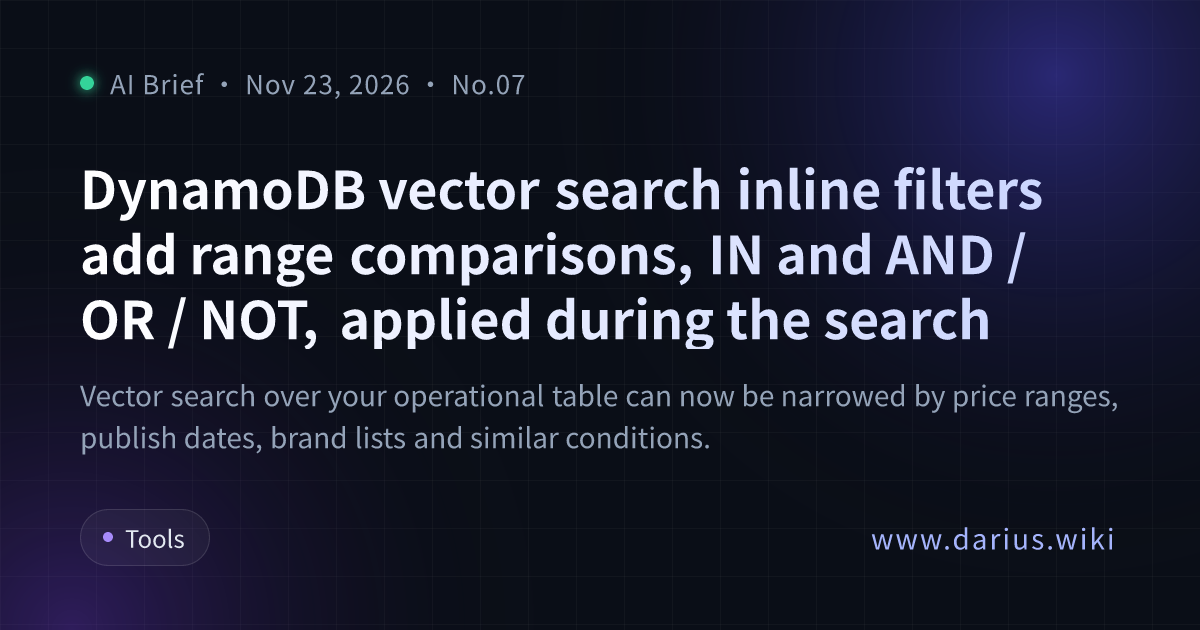
SearchVectors condition expressions now accept <, <=, >, >= and BETWEEN on Number attributes, plus IN, attribute_exists and attribute_not_exists
Filtering happens during the search, so every returned result matches
Available in all Regions where DynamoDB vector search is offered
Builder's takeFiltering during search matters because filtering after top-k often leaves only a handful of results. Category plus date limits are the most common RAG constraint; if your data already lives in DynamoDB, you may no longer need a separate vector store just for that.
Previously you configured an OpenAI-compatible provider with a base_url and a Bedrock API key; now it uses the default credential chain or a named profile, including SSO
The provider generates short-term Bedrock keys with @aws/bedrock-token-generator and renews them, so no key sits in config.toml
It infers the API format and regional endpoint from the model ID, with per-model overrides; an explicit api_key still takes precedence
Builder's takeRolling out coding agents often stalls at security review, and "no new long-lived key" removes a lot of back-and-forth. Teams already on AWS SSO can use it to trial open models for everyday coding, compare cost per task against Claude Code and Codex, then decide which tasks to route there.
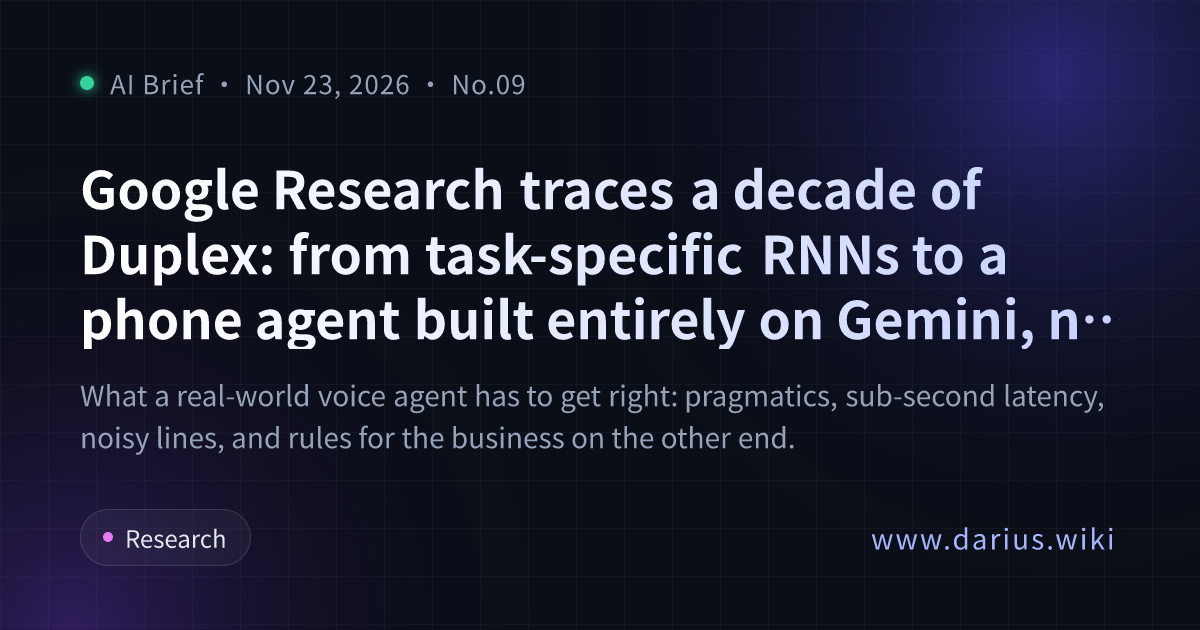
Three eras: closed-domain RNNs before LLMs; from 2022, LaMDA in live calls inside hybrid stacks with deterministic state tracking and policy guardrails; now free-text task descriptions with Gemini handling understanding, planning and dialogue
Beyond low-latency streaming inference, custom acoustic and conversation-cadence models handle background noise and pauses
Every call opens by disclosing an automated system from Google; businesses can opt out in their Business Profile or ask it to stop during a call
Business information from Duplex calls had been shown in Search and Maps over one trillion times, as of 2023
Builder's takeRead with the 11-18 item on free Gemini Tasks, this shows the calling ability rests on nearly a decade of engineering, not a prompt. For a voice product like our AI interviewer, two things are worth borrowing: disclose up front that it's AI and let the other side stop it anytime, and hand turn-taking to a dedicated cadence model instead of the LLM alone.
Researched and drafted with AI assistance; editorial standards and views set by Darius.
Every Monday, the week in AI in one email
Every Monday morning: the 6 AI stories that mattered most in the past seven days, with my take, in your inbox.
Your email is only used to send the weekly and is never shared. Every email has a one-click unsubscribe link. See the latest issue →