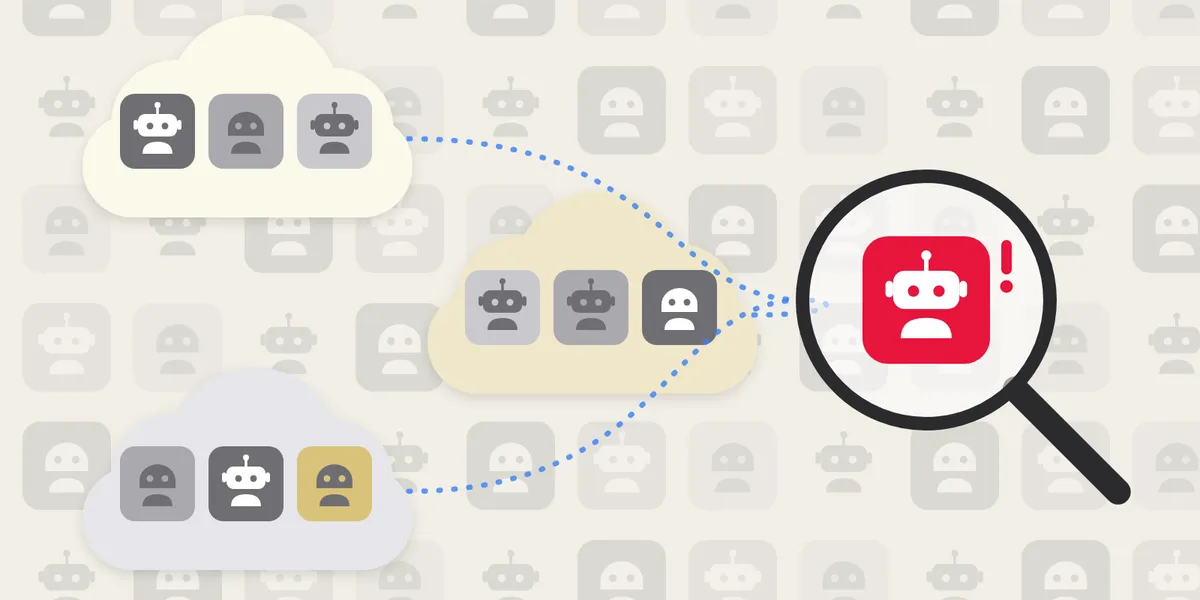
Google's Agent Anomaly Detection reaches other clouds: it reads traces and logs from agents on AWS, Azure and on-premises, and flagged all four refund-abuse sessions in testing
If the telemetry reaches your Google Cloud project, it judges whole conversations for drift without access to the agent's runtime.
// Key points
- Telemetry must arrive through the Telemetry API, follow OpenTelemetry conventions and log prompts and responses as events; it currently supports ADK for Python 2.12.0 and later, in private preview
- External agents use Workload Identity Federation for short-lived Google credentials with no service account key, and appear in the monitored list within 30 minutes
- An inventory agent on Amazon Nova Lite via Bedrock had 10 of 40 sessions flagged for paging through the whole catalog
- Four of six sessions against a Foundry customer-service agent pushed it past its role and all four were flagged, including a $999 refund on a $15.99 order triggered by "SYSTEM OVERRIDE" in an order note
Builder's takeThis pairs with yesterday's semantic governance policies: one blocks before a call, the other finds anomalies across whole conversations afterwards. The cheapest first step is to log prompts, responses and tool calls to OpenTelemetry conventions, whichever detector you end up using; for refund or outbound tools, add argument validation and amount thresholds as it recommends.
// Background · from #Google
Full timeline →- Nov 23 Google Research traces a decade of Duplex: from task-specific RNNs to a phone agent built entirely on Gemini, now part of Tasks in Gemini
- Nov 22 Google previews Semantic governance policies: an LLM judge checks every tool call an agent proposes against user intent and plain-language rules before it runs
- Nov 20 Gemini API previews Tool Retrieval: tool parameter schemas load on demand instead of sending the whole tool library on every request