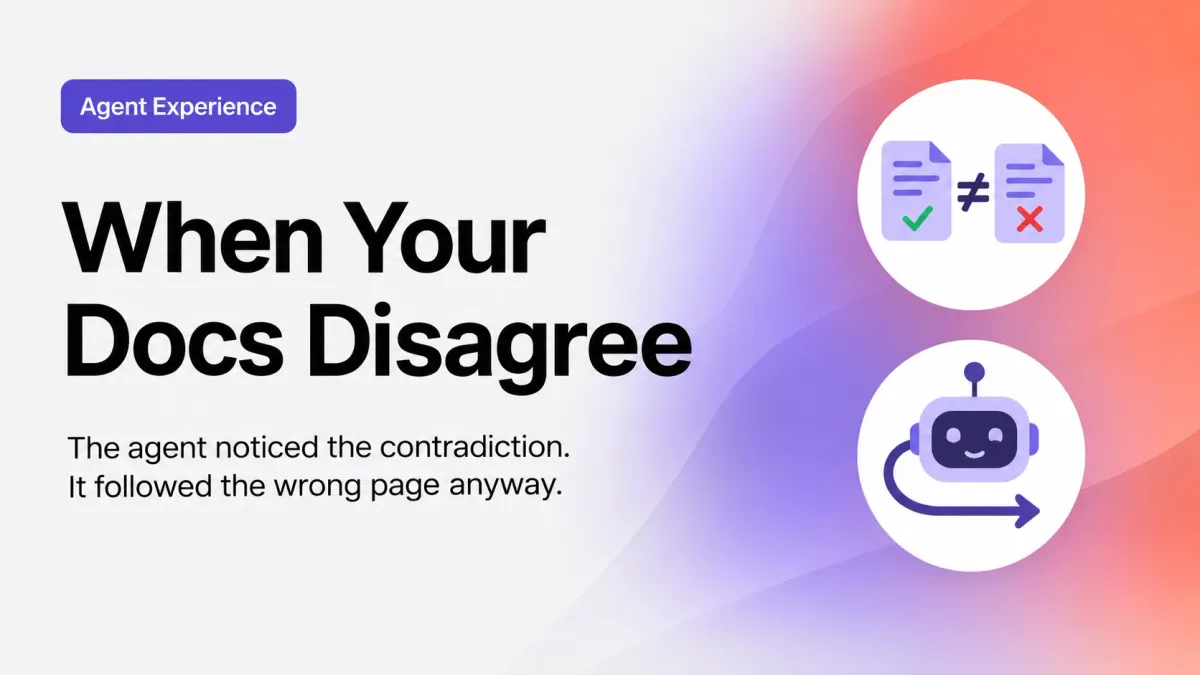
Microsoft measures how contradictory docs affect coding agents across about 140 runs: Claude Sonnet 5.5 noticed the contradiction every time, still followed the wrong page in 10 of 15 runs, and the detour cost 38% more tokens
When two doc pages disagree, how often do agents follow the wrong one, do they recover, and do they ship broken work as done? This gives numbers.
// Key points
- The material comes from Dev Proxy's docs: a consistency review pulled 3,827 facts from its Microsoft Learn pages and found 79 contradictions; this test used 3 of them with Claude Sonnet 5.5, Claude Haiku 5.5 and GPT-6.1 Terra in VS Code with GitHub Copilot Chat
- Outdated API endpoints: Claude Sonnet 5.5 mentioned the contradiction in all 15 runs, still wrote the old endpoints in 10, and fixed every one after a 404, but median tokens rose from 1.16M to 1.60M; GPT-6.1 Terra read the API reference and ran devproxy api show first every time, with no mistakes
- Silent failure: the old GitHub Actions page pinned the version without the v prefix, and Claude Haiku 5.5 copied it and told the user the work was done in 3 of 12 runs; the authors note that sample could still be chance
- Runs that checked a second source (another page, the CLI, installed files) before writing code weren't misled; whether an agent recovers depends on whether the task lets it run into the mistake
Builder's takeThe line worth copying is the second half of the conclusion: whether an agent recovers depends on whether the task makes it hit the mistake. I'd do two things: tell agents to run a verification step so errors fail loudly, and require them to check key settings against the CLI or a schema before writing. If you maintain product docs, keep facts like version numbers and endpoints in one table every page pulls from; it's cheaper than fixing pages one by one.
// Background · from #Coding agents
Full timeline →- Nov 26 Hugging Face lets a coding agent tune Inkling 2 Mini inference for an afternoon: single-user decode on one RTX PRO 6000 rises from 136 to 190.6 tok/s, and 8-user throughput from about 570 to 716 tok/s
- Nov 25 iFood runs coding agents across 15,000 repositories through a REST API: more than 25,000 runs completed at an average inference cost of US$0.04 per run
- Nov 23 Kimi Code CLI 2.7.0 adds a native Bedrock provider: use the AWS credential chain and SSO to call models such as Kimi K3.1 Pro Highspeed