Anthropic rewrites its Messages API in Rust, Microsoft Agent Framework hit by malicious PyPI uploads, Neptune adds scale-to-zero graphs for agents
Today's thread is trust: Anthropic says writing code is no longer the bottleneck, verification is, and Microsoft's malicious packages are a reminder that agent frameworks are a supply chain to verify too. News was light around Thanksgiving, so this issue has five items.
API traffic grew roughly 1,800 times from early 2024 to fall 2026; an earlier partial rewrite of output parsing in Rust cut CPU only about 8% to 10%, with each token crossing between Python and Rust three times
About 700 integration tests were not enough: an audit of the ported tests found more than 100 weakened assertions, so a pass did not prove correctness
They shadowed production traffic to compare Python and Rust inputs and outputs, grouped differences by fingerprint, dispatched agents to fix them, and saved corrections as memory rules every agent could read
The service never went offline and feature work never froze; the post concludes that verification is the new bottleneck
Builder's takeWhat I take from this is the order: build a comparator that can judge right and wrong on real traffic first, then let agents write the code, or a green test suite still won't give you the nerve to cut over. Read with Microsoft's contradictory-docs experiment from 11-26, a coding agent's ceiling increasingly depends on the verification you give it; if we change languages or storage engines behind AI Cloud Drive, shadow comparison and difference fingerprints come before any rewrite.
Only versions 1.26.1 and 1.26.2 of the agent-framework Python meta-package were affected; 1.26.0 and earlier, the .NET packages and Semantic Kernel were not, and the malicious code was in the published packages, not the repository
To check, look in site-packages for agent_framework_meta.pth and agent_framework_meta/_telemetry.py (1.26.1) or af_runtime_diag.pth and af_runtime_diag.py (1.26.2), and review lockfiles, CI logs, container images, internal mirrors and pip caches
The code runs when Python starts, even if your application never imports the package; treat an affected environment as compromised, rotate every credential it could reach and rebuild from a clean image instead of downgrading in place
If you never installed them, Microsoft recommends pinning agent-framework==1.26.0 until further guidance; there is no timeline yet for restoring the repository
Builder's takeToday I'd search every CI job and image for those two .pth filenames, even if we don't use this framework directly, since transitive dependencies and internal mirrors can pull it in. Longer term: pin fast-moving dependencies like agent frameworks through lockfiles, have a person review automated upgrade PRs before merging, and keep the credentials reachable from CI jobs as narrow as possible.
No 16 m-NCU minimum of a provisioned graph; you choose a starting size of 4 or 8 s-NCU of working memory
Memory headroom goes up to twice the starting size (8 for a 4 s-NCU graph, 16 for 8 s-NCU), and you are billed for the memory the graph uses
It scales to zero after 15 idle minutes and resumes in seconds on the next query, keeping the graph and its data so nothing is reloaded; queries use openCypher
Builder's takeFor a product like AI Cloud Drive, where each user has their own body of knowledge, this is the first time a graph per user makes sense on cost: most users' graphs sit idle most of the time. I'd build graphs from a small batch of active users' file relationships, measure how resume latency affects the first question, and then decide whether relationship queries beyond vector search belong here.
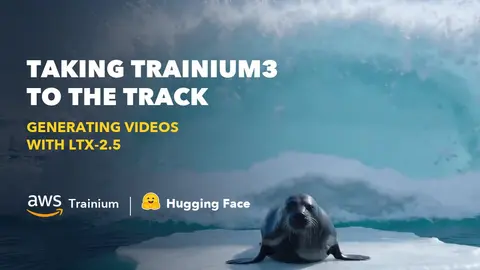
The model is Lightricks' LTX-2.5 (about 19B parameters in the Diffusers checkpoint) on a trn3.48xlarge; the optimized run uses 32 of 64 NeuronCores, and memory per core falls from 22.96 GiB to 10.2 GiB
The first attempt was 960x544 on 4 cores in 5 min 20 s; the optimized run is 2048x1024 on 32 cores in 22 to 23 s, about 15 s on the NeuronCores, with host time down from about 280 s to about 8 s
Video decode at 2048x1024 falls from 357 s to 1.6 s and prompt encoding from about 205 s to 7.5 s; the post says this beats the 23.7 s LTX's online API takes for a 10-second 1080p clip by about a second
About 160 lines of generation code are open at github.com/dacorvo/video-generation, the Diffusers PR adding tensor and context parallelism is still open, and the post gives no cost figures
Builder's takeThe part worth reading isn't the 23 seconds but that most of the bottleneck sat outside the model: decoding and prompt encoding used to take minutes. If PandaClaws adds short video generation, I'd time those stages separately before deciding whether to change hardware or implementation; the post has no cost figures, so price it on your own output volume before moving to Trainium.
Ai2 interviewed 17 scientists across the natural, applied and social sciences and identified five dimensions of scientific trust: validation, privacy, objectivity, accountability and transparency
Interviewees cared about more than whether an answer is right: they need to know which sources an agent omitted, whether it followed the requested method and what it accessed along the way
The post proposes evaluations to match: test literature-review agents on whether they overlook contradictory evidence and coding agents on whether they access files outside their authorized scope, plus a participatory benchmark scientists help define; these remain proposals
Builder's takeThese five dimensions work as an acceptance checklist for any agent product, not just research. AI Interview faces the same questions when it gives candidates feedback: conclusions need to trace back to evidence, and what the system looked at needs to be checkable. I'd add which files were accessed and which sources were skipped to our own eval logs, not just the final answer.
Researched and drafted with AI assistance; editorial standards and views set by Darius.
Every Monday, the week in AI in one email
Every Monday morning: the 6 AI stories that mattered most in the past seven days, with my take, in your inbox.
Your email is only used to send the weekly and is never shared. Every email has a one-click unsubscribe link. See the latest issue →