A Checklist for Designing Human-in-the-Loop Agent Confirmation
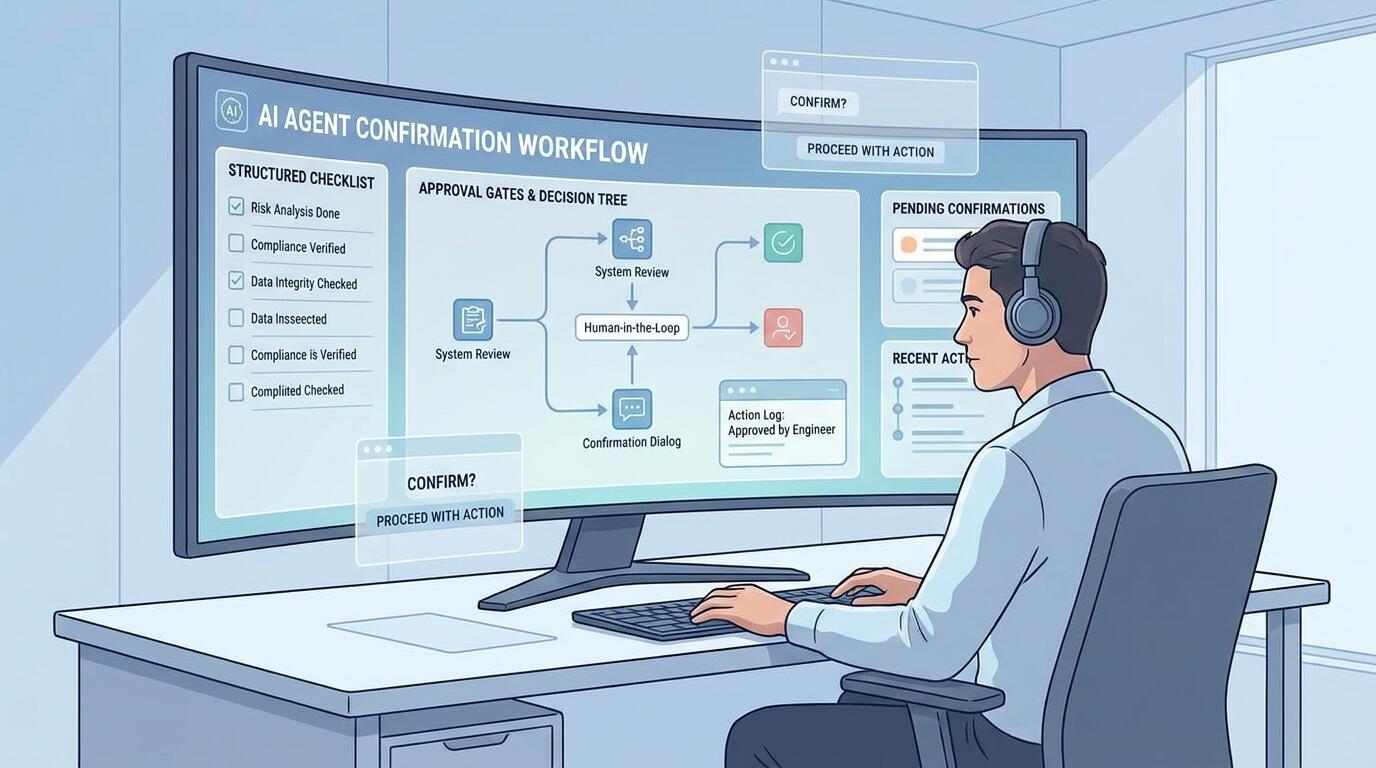
ALT: Engineer reviewing human-in-the-loop agent confirmation checklist for safe AI automation design
Why Most Agent Confirmation Designs Fail — and What a Good Checklist Fixes
The central question every engineer building agentic systems eventually faces is this: when should the agent stop and ask, and how should that ask be structured? Get it wrong in one direction and your agent interrupts users constantly, destroying the productivity gain you promised. Get it wrong the other direction and it executes irreversible actions — deletes records, sends emails, charges cards — without anyone realizing it happened until the damage is done.
Human-in-the-loop (HITL) confirmation is the design pattern that places a human decision point inside an agent's execution flow, requiring explicit approval before the agent takes a consequential action. Done well, it lets you deploy agents with meaningful autonomy while keeping humans accountable for outcomes they care about. Done poorly, it becomes a liability: confirmation dialogs nobody reads, approval gates that block the workflow for hours, or silent failures when the agent interprets a stale approval as covering a new situation.
The items in this checklist were selected from patterns observed consistently in production AI systems — pipelines that handle real user data, trigger real third-party actions, and face real consequences when something goes wrong. This is not a theoretical framework lifted from a whitepaper. It is the practical residue of running agentic systems and watching where they break. Use it as a design review gate before you ship a new confirmation flow, or as a diagnostic when an existing flow is generating complaints.
Each item below is designed to be evaluated independently. Work through them in order on your first pass; on subsequent reviews, jump to the items most relevant to the action type you are designing for.
The Checklist: Eight Design Dimensions for Agent Confirmation
Classify the Action by Reversibility Before Designing Anything Else
Reversibility classification is the foundational step in human-in-the-loop confirmation design: before you decide whether a confirmation is needed, you need to know how hard the consequences are to undo. A reversible action — creating a draft, generating a preview, updating an internal flag — carries a very different risk profile than an irreversible one — sending a message to a third party, deleting a record without soft-delete, or initiating a financial transaction.
In practice, we see teams conflate "low-stakes" with "reversible," and that is where problems start. An action can be low-stakes in probability but high-stakes in consequence, and irreversibility is the better axis to design around. Map every action your agent can take to one of three categories: fully reversible, partially reversible (recoverable with effort), and irreversible. Only irreversible and partially reversible actions require a hard confirmation gate. For reversible actions, a passive notification is usually sufficient.
Best for: Any team shipping a net-new agent capability, particularly those involving write operations on external systems.
Watch out: Reversibility is not always binary, and it can depend on timing. An email is irreversible the moment it is sent, but a scheduled email may be cancellable up to a delivery window. Build the classification with this temporal dimension in mind.
Define the Minimum Sufficient Context a Reviewer Actually Needs
A confirmation prompt that does not give the reviewer enough information to make a real decision is not a safety mechanism — it is theater. The reviewer clicks "approve" because refusing feels disruptive, not because they evaluated the action. This is one of the most consistent failure patterns in confirmation UX, documented in research on automation bias and human-computer interaction.
The minimum sufficient context is the smallest set of information that allows a reviewer to understand what the agent intends to do, why it intends to do it, and what the consequence of approval will be. In practice, this means surfacing: the specific action (not "send a message" but "send the following email to the following recipient"), the agent's stated rationale (one sentence derived from its reasoning trace, not a generic label), and the scope of the approval (does this cover just this instance, or does the reviewer's approval set a precedent for similar future actions?).
Best for: Confirmation flows involving external communications, financial operations, or data deletion, where the stakes of uninformed approval are high.
Watch out: More context is not always better. Walls of text cause reviewers to skim or skip. Aim for density — every piece of information shown should be decision-relevant.
Set a Scope and Expiry for Every Approval
An approval without a defined scope and expiry is a blank check. A pattern we consistently see in production systems is that teams design careful confirmation flows for the initial action but fail to define whether that approval covers only the current instance, a session, or a class of future actions. The agent then proceeds on the implicit assumption that prior approval covers new situations, and the human reviewer has no idea.
Every confirmation your agent requests should carry an explicit scope declaration — "this approval covers only this specific action" or "this approval authorizes this class of action for the next N hours" — and an expiry condition. The expiry should be both time-based and context-based: approval for an action in one context should not silently carry over to a different context, even within the same session. This is a design detail that is easy to implement and nearly always skipped on first build.
Best for: Long-running agents that operate across sessions, or agents that learn to batch similar actions under a single approval request.
Watch out: If your approval scope is too narrow, you will generate confirmation fatigue — users approving the same class of action dozens of times. Calibrate scope to match user mental models of "what counts as the same thing."
Design for Confirmation Fatigue from the Start
Confirmation fatigue is the degradation of reviewer attention and judgment that occurs when the rate of confirmation requests exceeds what a human can meaningfully evaluate. It is not a hypothetical edge case — it is the default outcome when engineers err on the side of "ask more often" without modeling the actual human workload.
The design countermeasure is a confirmation budget: an explicit target for how many confirmation requests a given user persona should receive per session or per day, based on their role and cognitive load tolerance. Teams that set this constraint upfront make different decisions about what actually needs a hard gate versus a passive log entry. A useful heuristic from agentic system design: if the reviewer cannot evaluate the specific action being confirmed in under thirty seconds, the confirmation prompt is either underspecified or the action should not be delegated to an agent at all.
Where an AI drafting pipeline fails, and the checks that catch it often comes down to exactly this — teams that build robust error-catching mechanisms but neglect to model the human load that reviewing those catches creates.
Best for: High-frequency agent workflows, such as agents that process large volumes of documents or monitor event streams and surface anomalies for review.
Watch out: Setting a confirmation budget does not mean suppressing legitimate safety gates. It means being ruthless about which actions genuinely require human judgment and routing only those.
Build a Clear Escalation Path for Ambiguous or Declined Actions
What happens when a reviewer declines an action? What happens when no reviewer responds within the timeout window? These are not edge cases — they are predictable states that your confirmation system will encounter in production, and failing to design for them means the agent will either stall indefinitely or make an implicit default decision that was never reviewed.
Every confirmation flow needs an explicit decision tree for three states: approved, declined, and timed out. For declined actions, the agent needs a defined fallback — abort the task, attempt an alternative, or escalate to a human supervisor with more context. For timed-out approvals, the safer default is almost always to abort and log, rather than to proceed. The escalation path should be documented and testable, not left as implicit agent behavior.
Best for: Enterprise agent deployments where approval chains can involve multiple stakeholders, and where SLA commitments mean "stalled agent" is a real operational risk.
Watch out: Avoid building escalation paths that route declined actions back to the same reviewer with no additional context. If an action was declined, additional context or a changed condition should be present before re-requesting approval.
Implement a Complete and Queryable Audit Log
An audit log for agent confirmations is not optional in any system where actions have real-world consequences. The log serves three distinct functions: it provides a post-incident forensic trail, it supports compliance and accountability requirements, and it generates the behavioral data you need to improve your confirmation design over time.
The minimum audit record for each confirmation event should capture: the agent's proposed action in full detail, the context presented to the reviewer, the reviewer's identity and decision, the timestamp of the request and the decision, and the scope of the approval as defined in the prompt. This log should be queryable — meaning you can answer questions like "how many approvals did this reviewer grant in the last hour" (a fatigue signal) or "what percentage of actions in this category are declined" (a calibration signal for your classification system).
For teams building on top of agentic frameworks, the agent pipeline behind a production AI briefing illustrates how verification and audit steps can be woven into the pipeline architecture rather than bolted on after the fact — the same principle applies to confirmation logging.
Best for: Any production system handling regulated data, financial operations, or actions with external legal or contractual implications.
Watch out: Logging the decision without logging the context presented to the reviewer undermines the audit value. If you cannot reconstruct exactly what the reviewer saw, you cannot evaluate whether the decision was informed.
Test Confirmation Flows Under Adversarial and Stress Conditions
A confirmation flow that works correctly when the system is healthy and the reviewer is attentive may fail in ways that matter when the system is under load or when the reviewer is fatigued. Testing only the happy path is insufficient.
Adversarial testing for confirmation flows means deliberately constructing scenarios where the agent's proposed action is subtly incorrect — the right action type but the wrong target, the right recipient but the wrong content — and verifying that the confirmation prompt surfaces enough information for a reviewer to catch the error. Stress testing means simulating high-volume approval queues and measuring whether reviewer decision quality degrades and at what rate. Both tests should be part of your pre-launch review for any confirmation system, and both should be repeated when you make significant changes to the agent's capabilities or the confirmation UX.
Best for: Teams preparing for production launch of an agent with write access to consequential systems, or teams responding to a post-incident review.
Watch out: Do not let adversarial testing focus exclusively on the agent's reasoning. The confirmation UX itself can be exploited — prompt injection that causes the agent to present misleading context to the reviewer is a real attack vector.
Establish a Feedback Loop Between Reviewer Decisions and Agent Behavior
The confirmation system should not be a one-way valve — reviewer decisions are a high-quality signal about where agent behavior diverges from user intent, and that signal should be systematically captured and used. A pattern we see consistently in teams that improve their agent systems over time: they build feedback loops where declined approvals trigger a structured review of the agent's decision logic, not just a one-off incident fix.
In practice, this means tagging each declined approval with a decline reason (wrong action, wrong target, wrong timing, insufficient context to decide), aggregating those tags over time, and routing the aggregated signal back into both the agent's policy and the confirmation prompt design. An agent whose proposals are declined at a high rate in a specific category is telling you something important: either its understanding of user intent in that category is miscalibrated, or the confirmation prompt is failing to surface the information reviewers need.
Teams building these systems would benefit from reviewing how writing editorial rules an agent can actually follow structures feedback from human reviewers into agent policy — the same feedback-loop logic applies directly to confirmation system design.
Best for: Any team with more than a few weeks of production data from an agent confirmation system, or any team planning for continuous improvement rather than a static deployment.
Watch out: Feedback loops can introduce bias if decline reasons are not systematically collected. If reviewers decline without categorizing why, you lose the signal. Build the reason-capture step into the decline UX, not as an afterthought survey.
Quick Comparison at a Glance
| Checklist Item | Best For | Key Strength | Limitation |
|---|---|---|---|
| Reversibility classification | Net-new agent capabilities | Grounds design in actual risk | Reversibility can be time-dependent |
| Minimum sufficient context | External comms, financial, data deletion | Prevents rubber-stamp approvals | More context risks reviewer overload |
| Scope and expiry definition | Long-running or session-spanning agents | Closes the "blank check" gap | Narrow scope triggers confirmation fatigue |
| Confirmation fatigue design | High-frequency workflows | Forces prioritization of real gates | Budget constraints may suppress edge-case safety |
| Escalation path design | Enterprise, multi-stakeholder deployments | Handles declined and timed-out states | Re-escalation without new context is ineffective |
| Audit log implementation | Regulated, financial, or legal contexts | Enables forensic review and calibration | Logging decisions without context is insufficient |
| Adversarial and stress testing | Pre-launch and post-incident reviews | Surfaces UX-level attack vectors | Happy-path testing bias is easy to fall back into |
| Reviewer feedback loop | Systems with production data and improvement goals | Converts declines into actionable signal | Requires structured reason-capture in the decline UX |
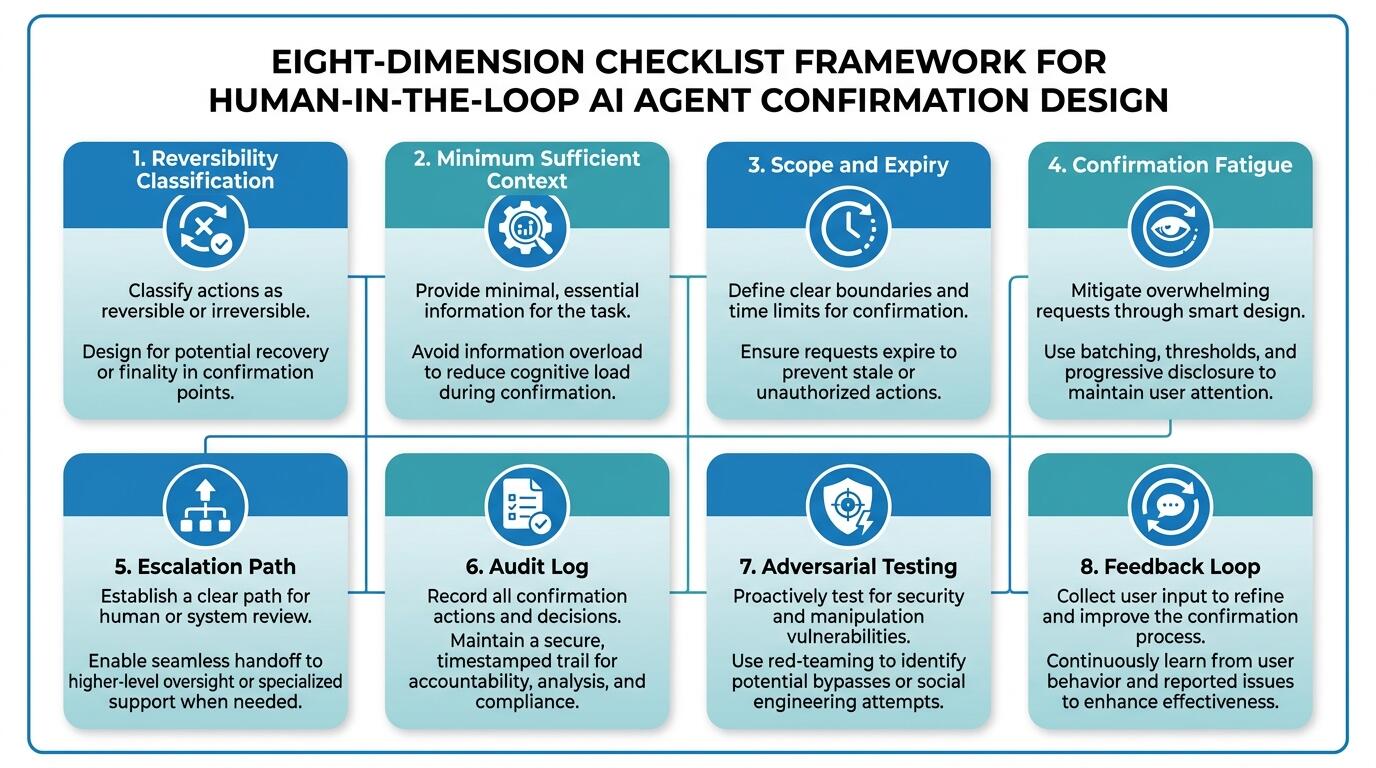
ALT: Eight-dimension checklist for designing human-in-the-loop agent confirmation flows in production AI agent systems, covering reversibility, context, scope, fatigue, escalation, audit, testing, and feedback
How to Choose Which Items to Prioritize First
The right starting point depends on the current state of your system and where the greatest risk lies right now.
If you are designing a confirmation system from scratch, start with reversibility classification and minimum sufficient context. These two items determine the architecture of everything else. You cannot design a sensible scope-and-expiry policy without first knowing which actions are irreversible, and you cannot prevent rubber-stamp approvals without first defining what information a reviewer actually needs.
If you already have a confirmation system in production and reviewers are complaining about too many prompts or are consistently approving without reading, confirmation fatigue design is your priority. Measure the actual rate of confirmation requests per reviewer per session before you make any changes — the data will tell you whether you need to raise the threshold for what triggers a gate, or whether the volume is appropriate but the UX is causing fatigue.
If you have had a production incident where an agent took an action that was not intended or expected, the audit log and adversarial testing items are your immediate focus. The audit log tells you what happened and why; adversarial testing tells you how to prevent recurrence.
A common misconception worth addressing directly: human-in-the-loop confirmation is often framed as a temporary measure — something you remove as the agent becomes more capable or the team builds more confidence. In practice, the confirmation layer tends to become more important as agents take on higher-stakes tasks, not less. The goal of improving agent reliability is not to eliminate human oversight but to shift human attention from low-stakes routine approvals to the genuinely consequential decisions where judgment matters most. The checklist above is designed with that long-term trajectory in mind.
For teams weighing the broader architectural question of how much custom infrastructure to build around their confirmation systems versus relying on platform-provided controls, our analysis of the build-vs-buy decision for AI infrastructure provides a structured framework for thinking through that tradeoff.
Questions & Answers
Q1: How do you determine the right threshold for triggering a human confirmation in an agent workflow?
The threshold should be calibrated to reversibility and consequence magnitude, not to agent confidence scores alone. An agent can be highly confident in an action that is both irreversible and high-consequence — and those are exactly the cases where human oversight matters most. A practical starting point: require confirmation for any action that a user could not easily undo within five minutes using the same tools the agent has access to. Revisit and refine the threshold after each production incident and after reviewing your audit log's decline-rate data by action category.
Q2: Are confirmation prompts alone sufficient to prevent agent errors in high-stakes workflows?
Confirmation prompts are a necessary but not sufficient control. Research on automation bias — extensively documented in the human factors and HCI literature — shows that human reviewers systematically over-approve agent proposals, especially under time pressure or high confirmation volume. Effective human-in-the-loop design treats the confirmation prompt as one layer within a broader system that includes reversibility-based action classification, adversarial UX testing, structured audit logging, and reviewer feedback loops. No single control is sufficient on its own.
Q3: How long does it typically take to implement a robust confirmation system for a new agent capability?
The timeline varies significantly by system complexity, existing infrastructure, and what "robust" means for the specific use case. For a single agent action category with a well-defined reviewer workflow, a minimal confirmation system can be functional in a matter of days. A complete system covering all eight checklist dimensions — including audit logging with queryable storage, adversarial test suites, and a feedback loop with structured decline reasons — typically requires several weeks of focused engineering. The audit log and feedback loop tend to be the longest-lead items because they depend on data infrastructure that may not exist yet.
The Bottom Line
Human-in-the-loop agent confirmation is not a checkbox for safety theater — it is a precision instrument that, when designed correctly, lets you deploy agents with real autonomy while keeping humans accountable for the decisions that matter.
Key Takeaways:
- Classify every agent action by reversibility before designing any confirmation logic — this single step shapes every downstream decision.
- Define the minimum sufficient context a reviewer needs to make a real decision, not just click through a dialog.
- Set explicit scope and expiry on every approval to prevent the "blank check" failure mode.
- Model confirmation fatigue as a design constraint from the start, not a UX polish item.
- Build a complete, queryable audit log — it is your forensic trail, your compliance record, and your calibration data source.
- Every declined approval is a high-quality signal; capture it with a structured reason and route it back into agent policy and confirmation UX improvement.
The next step is to run this checklist as a structured design review against your current or planned confirmation flows. Assign each item to an owner, document the current state, and identify the gaps that represent the most immediate risk given your action types and reviewer load. That review will surface the two or three items that need attention before your next production launch.
If you are building AI products and want practitioner-level analysis of the latest developments in agentic systems, model capabilities, and production AI infrastructure — not editorial summaries but first-hand engineering perspective — subscribe to the Darius AI briefing. Each issue covers five to ten developments that actually matter, with sourced analysis you can translate directly into product decisions.
References
- NeuralTrust. "Human-in-the-Loop AI Agents: 2026 Guide".
https://neuraltrust.ai/blog/human-in-the-loop-ai-agents - Stack AI. "Human-in-the-Loop AI Agents: How to Design Approval Workflows for Safe and Scalable Automation".
https://www.stackai.com/insights/human-in-the-loop-ai-agents-how-to-design-approval-workflows-for-safe-and-scalable-automation - arXiv. "AI Agents Push Humans Out of the Loop".
https://arxiv.org/html/2608.23642v1 - IEEE. IEEE Standards Association — Standards and Resources on Human Factors and Autonomous Systems.
https://www.ieee.org/ - NIST. National Institute of Standards and Technology — AI Risk Management Framework and Guidelines.
https://www.nist.gov/
Note: Standards and guidelines may be updated; please check the latest official documents or consult professional advisors.