Writing Editorial Rules an Agent Can Actually Follow

ALT: Engineer writing editorial rules for AI agents to follow in production content workflows
What You'll Achieve: Agent-Readable Editorial Rules That Actually Work in Production
How do you write editorial rules that an AI agent will interpret the way you intended — and not find creative ways around? The answer is that effective agent-facing editorial guidelines are not style guides written for humans and handed to a model; they are structured behavioral specifications that eliminate ambiguity at every decision boundary the agent will encounter.
This guide is for engineers and technical product builders who are embedding language model agents into editorial or content workflows — newsletter pipelines, multi-platform publishing systems, structured briefing generators — and who have discovered, often painfully, that vague prose instructions produce vague agent behavior. If you are operating AI products in production and need your agent to behave like a disciplined editor rather than an enthusiastic intern, this is the playbook.
Before You Start: Prerequisites and Preparation
Writing editorial rules an agent can follow is a design task, not a writing task. Before you open a text editor, you need to have answered several upstream questions — because the most common failure mode is drafting rules before you understand the agent's decision surface.
Expect this to take meaningful iteration. The first draft of your ruleset will be wrong in ways you cannot predict until you run it against real inputs. Budget for at least two or three full evaluation cycles before trusting the system in production.
Here is what you need to have in place before you begin:
- A clear model of the agent's task boundary — specifically, which decisions the agent makes autonomously versus which it escalates. Rules only help where the agent has discretion; if a decision is always human-reviewed, writing a rule for it adds noise without reducing risk.
- A representative sample of inputs the agent will process. You cannot write rules in the abstract. You need real or realistic content — articles, source documents, raw briefing notes — to test whether your rules actually resolve the ambiguous cases they are meant to address.
- A defined output schema. Know what the agent is producing: is it a structured JSON object, a markdown document, a set of labeled segments? Rules behave differently depending on whether the output has hard structure (machine-parseable fields) or soft structure (prose with formatting conventions).
- A failure log or a hypothesis about failure modes. If you have already run an earlier version of the system, collect the cases where the agent made wrong calls. If you are starting fresh, write down the five decisions you are most anxious about delegating to a model. Those are your rule-writing starting points.
- Familiarity with your model's instruction-following characteristics. Different base models handle conflicting instructions differently. Some surface the conflict and ask for clarification; others silently pick a side. Know which behavior you are working with.
Working familiarity with prompt engineering patterns is assumed. This guide does not cover basic prompting — it covers how to translate editorial judgment into specifications a model can execute reliably.
Step-by-Step Instructions: Building Editorial Rules an Agent Can Execute
Step 1: Map the Agent's Decision Surface Before Writing a Single Rule
Before writing any rule, produce an exhaustive list of every editorial decision the agent will make during a single task execution. Do not describe the task at a high level — enumerate the micro-decisions.
For a briefing-generation agent, this might include: selecting which source documents to treat as primary versus supplementary; deciding when a claim needs a citation versus when it is treated as established context; determining whether a piece of information is editorial commentary or factual reporting; choosing the appropriate reading level for the lead sentence; and flagging when a source document is too thin to support a story at all.
Each item on that list is a potential rule slot. The goal of this step is to make the decision surface explicit so you can see where ambiguity lives before it becomes an agent behavior problem.
Tip: Group your decisions into three categories — structural decisions (format, length, ordering), content decisions (what to include or exclude), and quality decisions (what constitutes acceptable output). This grouping will shape the architecture of your ruleset.
Step 2: Write Rules as Behavioral Specifications, Not Style Preferences
The most consequential shift in writing rules for agents is moving from preference language to behavioral specification language. Human editorial guidelines use preference language because human editors have enough shared context to interpret it. Agents do not have that context — they have only what is in the prompt.
Preference language sounds like: "Prefer concise sentences." Behavioral specification language sounds like: "If a sentence exceeds thirty words, restructure it into two sentences unless the sentence is a direct quotation from a primary source." One of these gives the agent a decision procedure; the other gives it a vague aesthetic signal.
For every rule you draft, ask: if I gave this rule to a very literal-minded engineer who had never read a news article, could they execute it mechanically without making any judgment calls? If the answer is no, the rule is not yet a specification — it is still a preference.
Tip: Use conditional logic explicitly in your rule language. "If X, then Y; except when Z, in which case W" is the grammatical shape of a rule an agent can actually follow. Avoid rules that are just nouns ("clarity," "accuracy") without attached decision procedures.
Step 3: Handle Conflicts Explicitly — Do Not Leave Priority Implicit
Rule conflicts are inevitable. An agent following a brevity rule and a completeness rule at the same time will eventually encounter a case where it cannot satisfy both. When that happens without explicit priority guidance, the agent will resolve the conflict according to whatever internal heuristic is dominant in that moment — which is unpredictable and usually wrong in the specific ways your editorial judgment would catch.
Build a conflict resolution hierarchy directly into your ruleset. The simplest form is a numbered priority list at the top of your system prompt: accuracy rules override length rules; attribution rules override style rules; source availability rules override publication schedule rules. State this hierarchy explicitly and refer back to it in individual rules when the conflict is predictable.
In practice, we consistently see that agents trained on internet text have strong implicit priors toward fluency and completion — meaning when rules conflict, they tend to silently optimize for producing something that sounds good rather than something that is correct. An explicit conflict hierarchy counteracts this default.
Tip: After drafting your conflict hierarchy, construct synthetic test cases where exactly two rules pull in opposite directions. Run them and check that the agent resolves the conflict the way your hierarchy says it should. If it does not, rewrite the rules until the hierarchy is legible to the model.
Step 4: Define Your Key Editorial Terms with the Precision of a Specification Document
Every abstract editorial term in your ruleset — "primary source," "editorial voice," "breaking news," "opinion," "verified claim" — must be defined with enough precision that the model can apply the definition consistently across diverse inputs.
A definition like "primary source means a direct quote or official document from the originating party" is workable. A definition like "primary source means reliable information" is not a definition at all — it just moves the ambiguity one level up. According to the Granta Publishing workshops, a common failure in editorial communication (even for human writers) is assuming shared definitions for terms that actually carry significant variation across contexts. The same problem is dramatically amplified when the reader is a language model without shared professional context.
Write your definitions as if you are writing a glossary for a new team member who has never worked in your specific editorial context before. Then test whether those definitions produce the right classification on ambiguous real-world examples.
Tip: For any term that appears more than twice in your ruleset, write a formal definition entry at the top of the document. Inline repetition of a definition in every rule wastes context window space and creates maintenance risk if the definition needs to change.
Step 5: Separate Invariant Rules from Tunable Parameters
Not all editorial rules are equally stable. Some rules reflect core commitments that should never change — attribution requirements, factual accuracy standards, disclosure policies. Others are tunable parameters that may shift by content type, audience, or publication cadence — target length, reading level, section ordering.
Keep these two categories physically separated in your ruleset. Put invariant rules first, mark them clearly as non-negotiable, and avoid giving the agent any conditional logic that could lead it to override them. Put tunable parameters in a separate configuration block that can be overridden per-request without touching the invariant core.
This separation is important not just for agent behavior but for maintainability. When your editorial strategy evolves, you want to change parameters without accidentally modifying core constraints. Mixing them in a single flat list creates the risk of inadvertent rule drift every time you make an update.
Tip: Consider representing tunable parameters as structured variables rather than prose — a JSON or YAML block that the agent reads alongside its prose instructions. This makes parameter overrides mechanical and auditable rather than requiring rewriting of natural language.
Step 6: Build Explicit Escape Hatches and Escalation Conditions
No ruleset covers every case. An agent without an explicit escalation mechanism will handle uncovered cases by extrapolating from the nearest applicable rule — which produces coherent-sounding but editorially wrong output that is hard to catch in review.
Write explicit conditions under which the agent should halt, flag, or produce a structured uncertainty signal rather than generating output. Examples: "If fewer than two primary sources are available for a claim, do not publish — output a SOURCES_INSUFFICIENT flag and list what is available." "If a source document is undated and cannot be corroborated by a dated source, treat all specific factual claims from it as unverified."
Authors Publish's guidance on manuscript submission notes that one of the most common errors in editorial workflows is treating an incomplete input as sufficient for a complete output — a failure mode that applies equally to human editors and AI agents. The fix in both cases is explicit minimum-input requirements with defined behavior when those requirements are not met.
Tip: After writing your escalation conditions, run your representative input sample through the full ruleset and count how many inputs trigger an escalation flag. If the number is zero, your thresholds are probably too permissive. If it is very high, your input pipeline needs work before the agent can be useful.
Step 7: Version, Test, and Treat Your Ruleset as a Living Engineering Artifact
Editorial rules for agents are code. They should be version-controlled, tested against a fixed evaluation set, reviewed before changes are deployed, and maintained with the same rigor as any production configuration file.
Create an evaluation dataset of at least a dozen cases that cover your most important decision boundaries — the cases from your failure log in the prerequisites, plus synthetic cases targeting each explicit conflict in your hierarchy. Every time you modify the ruleset, run the full evaluation set and confirm that the cases you care about still resolve correctly. Regression on a previously correct case is a deployment blocker.
Document the reason for each rule in a comment or annotation layer alongside the rule itself. Rules without documented rationale become unmaintainable quickly — six months from now, you will not remember why a specific exception was carved out, and neither will the next engineer who touches the file.
Tip: Treat a new failure mode discovered in production as a test-case addition, not just a hotfix. Add the failing case to your evaluation set before modifying the rule. This prevents the fix from becoming a new failure mode in a slightly different direction.
Common Mistakes and Troubleshooting in Agent Editorial Rule Design
| Symptom | Likely Cause | How to Fix |
|---|---|---|
| Agent produces grammatically correct but editorially wrong output | Rules specify surface properties (tone, length) but not content logic (what qualifies as a valid claim) | Add content validation rules with explicit criteria for what constitutes a well-supported assertion |
| Agent follows rules correctly on simple inputs but breaks on edge cases | Rules are written against typical cases; edge case decision logic is not specified | Run your representative input sample, identify the cases that produce wrong output, write explicit rules targeting those decision boundaries |
| Rule changes in one area cause unexpected behavior changes elsewhere | Rules have hidden dependencies; changing one rule implicitly changes the interpretation of another | Map rule dependencies explicitly; separate invariant from tunable parameters; run full evaluation set after every change |
| Agent appears to follow rules selectively or inconsistently | Conflict hierarchy is absent or ambiguous; model is resolving conflicts with internal heuristics | Add explicit priority ordering; test conflict cases directly; rewrite rules that produce inconsistent conflict resolution |
| Agent ignores an escape hatch condition and generates output anyway | Escalation language is too soft ("consider flagging") or buried after many other instructions | Move escalation conditions earlier in the prompt; use imperative language ("output ESCALATION_FLAG and halt"); test with inputs designed to trigger the condition |
| Ruleset becomes unmaintainable and engineers are afraid to change it | Rules are written as a flat prose document with no version control or documented rationale | Restructure as versioned configuration with inline comments; establish an evaluation set; treat modifications as code changes |
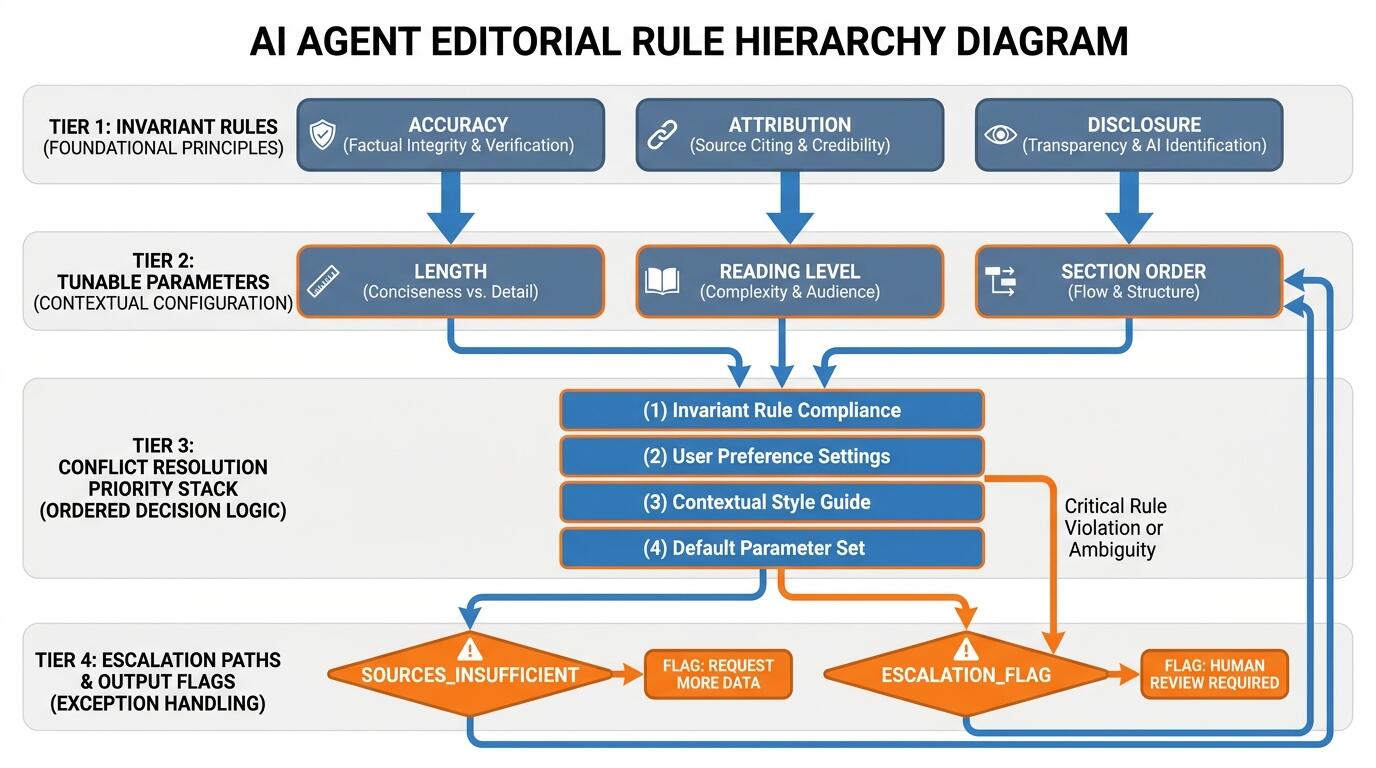
ALT: Diagram of AI agent editorial rule hierarchy showing invariant rules, tunable parameters, conflict resolution, and escalation paths for production content workflows
Pro Tips for Better Results With Agent-Facing Editorial Rules
Write rules in the second person addressed to the agent, not about the agent. "You are responsible for verifying that each factual claim is supported by at least one primary source" performs better than "The agent should verify claims." This is not a stylistic preference — it is consistent with how instruction-following fine-tuning is structured in most frontier models, which are trained on direct-address instruction formats.
Stress-test rules with adversarial inputs. Once your ruleset is stable, deliberately construct inputs designed to find the gaps — sources that are ambiguous about their primary/secondary status, content that sits exactly on the boundary between opinion and reported fact, documents that are formally cited but substantively empty. The goal is to discover failure modes in your test environment rather than in production.
Maintain a "rule graveyard" alongside your active ruleset. When you deprecate a rule, keep it in a commented-out section with a note explaining why it was removed. Rules get deprecated for important reasons — a finding that the rule was counterproductive, a change in content strategy, a discovery that it conflicted with a higher-priority constraint. That institutional memory prevents well-intentioned engineers from re-introducing a rule that was deliberately removed.
Avoid compensating for bad inputs with complex rules. A pattern we consistently see in production systems is ruleset complexity growing as a response to data quality problems. The agent is producing wrong output because the source documents are inconsistent or thin, and instead of fixing the input pipeline, engineers write increasingly baroque rules to handle the bad inputs. This compounds over time. If inputs are bad, fix the inputs.
Common misconception: more rules mean more control. In practice, beyond a certain complexity threshold, adding rules reduces control because the probability of inter-rule conflicts grows faster than your ability to manage them. A focused ruleset of twenty well-specified, tested rules with an explicit conflict hierarchy will outperform a hundred-rule document that tries to address every conceivable case. Discipline in rule writing looks like knowing which cases to specify and which to leave to the model's defaults.
Common Questions
Q1: How do you write editorial rules that prevent an agent from hallucinating citations?
Hallucinated citations result from the agent treating citation production as a fluency task rather than a retrieval task. The fix is a rule that explicitly prohibits citation generation and instead requires the agent to output only identifiers or markers for citations it finds in the provided source material. Paired with an escalation condition that flags any claim requiring a citation when no source material supports it, this eliminates the hallucination vector at the architectural level — the agent is not allowed to invent a citation, only to reference what it was given.
Q2: Are natural language rules or structured rules (JSON/YAML) better for agent editorial specifications?
Neither format is universally superior — the right choice depends on what you are specifying. Invariant behavioral rules (what the agent must and must not do) are better expressed in natural language, because current models handle conditional logic in prose better than they handle it in schema syntax. Tunable parameters (target length, section count, audience level) are better expressed as structured data because they are machine-readable, overridable per-request, and easy to audit. The highest-performing production systems we work with use both in combination: a natural language behavioral block followed by a structured configuration block.
Q3: How long does it take to build a stable, production-ready editorial ruleset for an agent?
Stability comes from iteration against real inputs, not from time spent drafting. A ruleset that has been tested against fewer than a dozen representative cases is not production-ready regardless of how carefully it was written. Expect to go through multiple full evaluation cycles — draft, test against representative inputs, find failure modes, revise, repeat — before the system earns enough trust to operate without close human review. The investment is front-loaded and pays off through reduced editorial overhead once the system is stable.
Summary
Writing editorial rules an agent can actually follow requires three things that most first attempts skip: a precise map of the agent's decision surface before any rules are written; behavioral specification language (decision procedures, not preferences) for every rule; and an explicit conflict resolution hierarchy that tells the agent what to do when two correct rules pull in different directions.
The three core principles to carry forward are: rules are code and should be treated with the same engineering discipline; complexity is a liability, not an asset — a focused, tested ruleset outperforms an exhaustive one; and escape hatches are not optional — an agent without defined escalation conditions will hallucinate its way through uncovered cases rather than ask for help.
The practical next step is to take your current agent prompt or editorial specification, apply the decision surface mapping in Step 1, and identify the five decisions where you have the least confidence in what the agent will do. Write explicit behavioral rules for those five decisions first. Test them before expanding the ruleset further.
For ongoing analysis of how production AI systems behave — including coverage of model capabilities, agent architecture patterns, and what actually works when you are shipping real AI products — explore the Darius briefing archive, where every issue is grounded in primary sources and lived engineering practice.
References & Further Reading
- Granta Workshops. "Expert Insight: Publishing FAQs".
https://workshops.granta.com/publishing-faqs/ - Erin Dorpress. "Should Writers Follow the Rules?".
https://www.erindorpress.com/2013/04/should-writers-follow-the-rules/ - Authors Publish. "The Seven Most Common Manuscript Submission Mistakes".
https://authorspublish.com/the-seven-most-common-manuscript-submission-mistakes/ - IEEE. IEEE Standards and Publications on AI Systems Engineering.
https://www.ieee.org/
Note: Standards and editorial guidance may be updated; verify the latest official documents or consult domain experts before finalizing production specifications.