The Agent Pipeline Behind a Daily AI Briefing: Retrieval, Verification, Publication — The Full Report
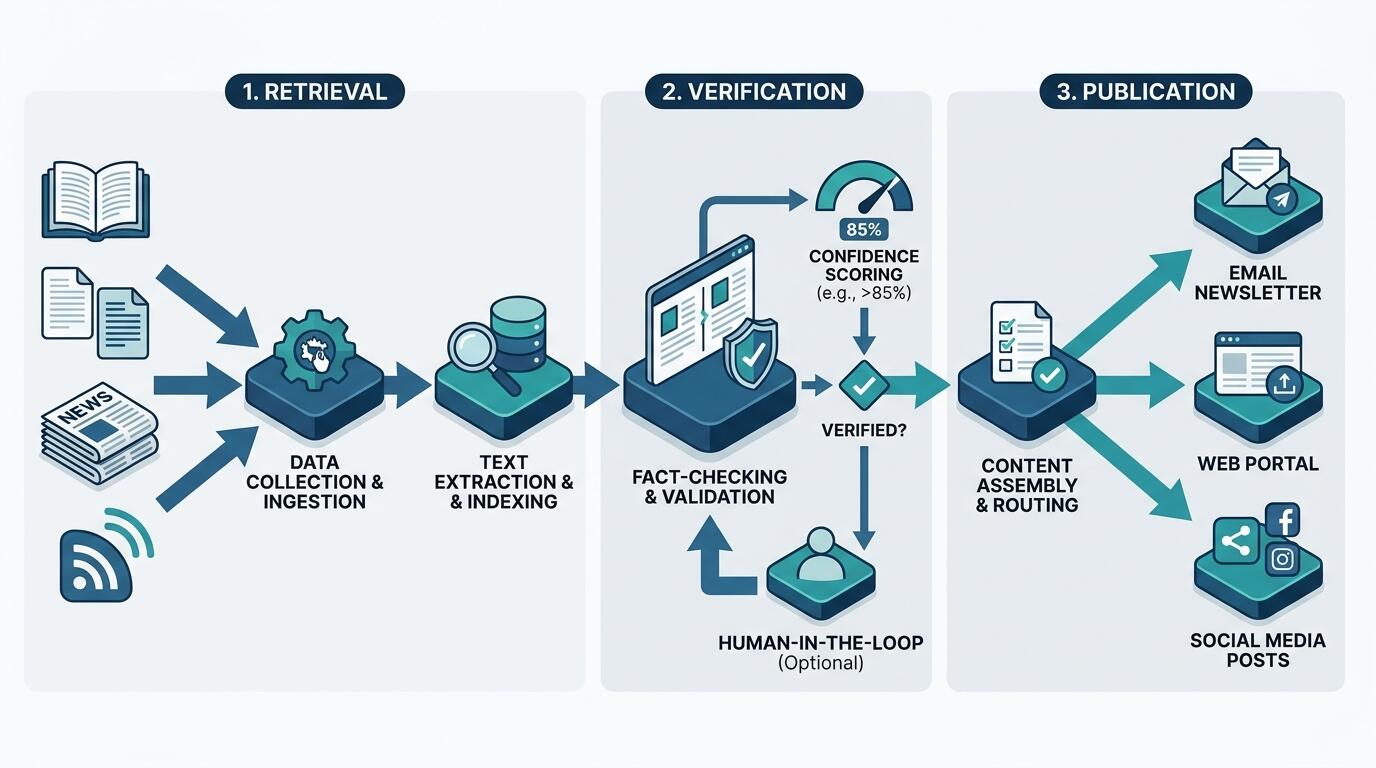
ALT: Agent pipeline diagram showing AI briefing retrieval, verification, and publication workflow stages
How a Daily AI Briefing Actually Gets Built: The Agent Pipeline Explained
Every morning, someone on a fast-moving engineering team opens a newsletter expecting the signal — not a summary of summaries, not a rewritten press release, but an account of what actually shipped, what the primary source says, and what it means for systems running in production. Building that kind of briefing at daily cadence without sacrificing accuracy is an engineering problem disguised as an editorial one. The solution, increasingly, is an agent pipeline: a structured sequence of retrieval, verification, and publication steps that automate the mechanical work while keeping a practitioner's judgment at every decision gate.
This article is a detailed account of how that pipeline is designed, where it typically breaks, and what the tradeoffs look like in practice — drawn from the experience of operating it inside Darius, a practitioner-first AI briefing written by an engineering director who actively ships and operates AI products in production.
The State of AI Briefing Pipelines Today
Automated content pipelines are not new. RSS aggregators, keyword-alert services, and scraper-to-CMS workflows have existed for decades. What has changed in the current generation of AI tooling is the feasibility of adding semantic reasoning steps — entity disambiguation, source credibility scoring, claim cross-referencing — inside the same pipeline, without requiring a dedicated data science team to maintain them.
The dominant pattern today is a multi-stage agent architecture where each stage is a bounded LLM call or retrieval operation with a defined output schema. According to Anthropic's published guidance on building effective AI agents, the most reliable production pipelines treat each agent node as a function with explicit inputs, outputs, and failure modes — rather than as an open-ended reasoning loop. This is not merely a stylistic preference; it directly affects how failures propagate and how a human operator can audit the system after the fact.
The practical pressure driving adoption of these pipelines in editorial contexts is straightforward: the volume of AI-related primary sources — model releases, technical papers, benchmark announcements, API changelog entries, official blog posts from labs — has grown to the point where manual triage is a bottleneck. A practitioner who wants to cover the field accurately, not just comprehensively, needs automated triage upstream so that human attention is rationed to the verification and framing steps that actually require expertise.
The secondary pressure is the bilingual dimension. A briefing serving both English and Chinese readers — the Darius model — cannot simply run Google Translate on finished English copy. Technical terminology, citations to Chinese-language lab announcements, and context about domestic deployments require separate retrieval branches that pull from Chinese-language primary sources directly. That structural requirement shapes the architecture from the start.
The Mechanism: How Each Stage of the Pipeline Works
A production-grade AI briefing pipeline decomposes into three primary stages: retrieval, verification, and publication. Each stage has internal sub-steps, and the failure modes of each are distinct enough to warrant treating them separately.
Retrieval: Building the Candidate Set
Retrieval is the process of gathering candidate items — potential story seeds — from primary sources before any editorial judgment is applied. In a daily briefing context, this means pulling from a curated set of high-authority sources: official lab blogs, arXiv (the open-access repository hosted by Cornell University), model release pages, API changelogs, government AI policy publications, and conference proceedings.
The key design decision at the retrieval stage is scope control. A naive implementation fetches broadly and relies on downstream filtering; this is efficient but generates noise that downstream verification steps must process. A tighter implementation maintains an allowlist of sources judged to be primary — meaning the entity making the announcement is the one being covered — and filters at ingestion. The Darius approach skews toward the tighter model: coverage is grounded in primary sources by design, which means the retrieval layer is built around those sources, not around aggregators that link to them.
Retrieval agents at this stage typically combine structured data pulls (RSS feeds, API endpoints where available, repository watch events) with lightweight semantic filtering that discards items clearly outside scope — product marketing copy about AI-adjacent SaaS features, for instance, is excluded at retrieval rather than burning a verification call on it.
Verification: Grounding Claims Against Primary Sources
Verification is the stage that separates a practitioner briefing from a content-farm digest. The verification agent takes each candidate item and attempts to locate the primary source document — the paper, the model card, the official changelog entry, the regulatory filing — and checks the claims in the candidate against what that source actually says.
This is where most pipeline implementations fail quietly. An LLM summarizing a secondary source (a news article about a paper) will often reproduce the secondary source's framing errors or emphasis choices without flagging them. A verification step that anchors to the primary document catches this class of error systematically. In practice, the verification agent issues a retrieval call for the primary document, extracts the relevant passage, and compares it against the candidate claim using a structured prompt that asks for a factual match, partial match, or mismatch judgment — not a free-form summary.
The research paper "WinSyn: An Automated Pipeline for Realistic Enterprise..." (published on arXiv) documents patterns in automated pipeline design that are directly applicable here: structured output schemas at each verification node reduce the error surface area significantly compared to free-text reasoning chains. Applying this principle, a verification agent that returns a JSON object with fields for source URL, matched passage, and confidence tier is far more auditable than one that returns a paragraph of prose reasoning.
Publication: From Verified Items to Formatted Briefing
Publication is the stage most teams underestimate in complexity. It encompasses three distinct sub-problems: format rendering, localization, and distribution routing. A verified item that reads clearly in plain text may require restructuring for newsletter format, web rendering, and social distribution — each with different character constraints and structural conventions.
In a bilingual briefing, publication also means running a parallel Chinese-language branch that is not a translation of the English output but a separately framed write-up for readers whose context differs. A Chinese AI practitioner reading about a model release from a Beijing-based lab does not need the same background scaffolding as an English-language reader encountering that lab for the first time. The publication agent must be told which branch each item routes to, and the framing instructions for each branch must be maintained as a separate prompt template.
Distribution routing — sending the right format to email, web CMS, and any social or platform publishing endpoints — is solved most cleanly by treating publication as a fanout step with a single canonical content object as input and multiple format-specific renderers downstream. This pattern, familiar from any event-driven architecture, maps naturally to the multi-platform publishing cockpit model that Darius uses to manage simultaneous publishing across channels.
Evidence, Tradeoffs, and Competing Approaches
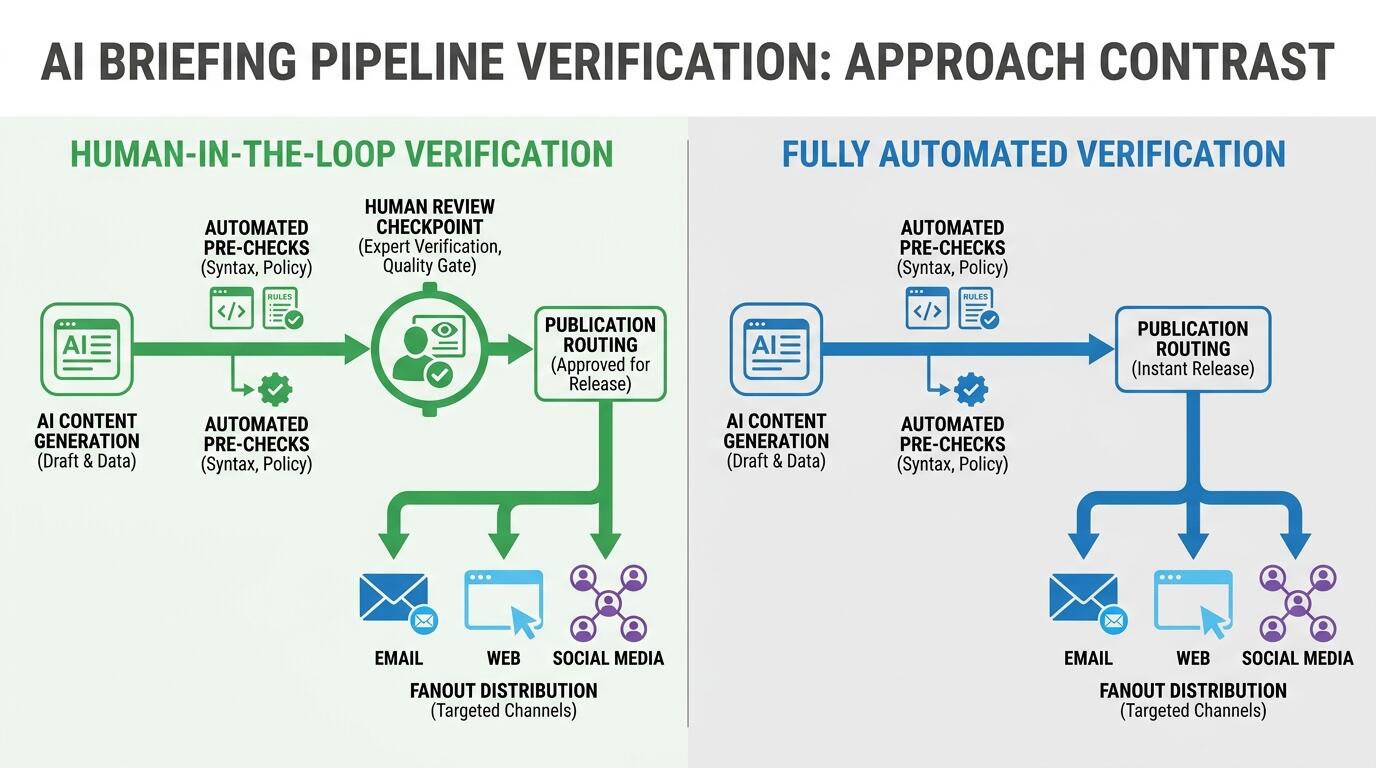
Teams building similar pipelines make meaningfully different architectural choices. The most consequential dimension is where human review sits in the pipeline — before publication, between stages, or only on exception.
The "Every AI Agent Needs an Owner" framing, articulated by Nate's Newsletter on Substack, captures a real organizational truth: automated pipelines do not eliminate the need for editorial accountability, they concentrate it. The agent needs an owner who understands both what the pipeline can do and what kinds of errors it produces systematically. In a daily briefing context, this means the engineering director or lead author cannot be purely hands-off — they must review the verification tier's confidence scores daily and personally handle items where the confidence score is below threshold.
| Perspective / Approach | Strengths | Trade-offs | Best Fit |
|---|---|---|---|
| Fully automated, post-hoc review | High throughput, low daily time cost | Silent errors ship before review catches them | High-volume, lower-stakes content |
| Human-in-the-loop at verification | Catches claim errors before publication | Slower cadence, requires daily editorial time | Practitioner briefings, technical newsletters |
| Human-in-the-loop at retrieval | Maximum editorial control over candidate set | Bottlenecks at scale, labor-intensive | Niche, high-trust, low-volume publishing |
| Exception-based review (confidence thresholds) | Balances throughput and accuracy | Threshold calibration requires ongoing tuning | Production pipelines with instrumented monitoring |
The Darius pipeline uses the exception-based approach with a low confidence threshold — erring toward human review rather than automated publication when ambiguity exists. This is a deliberate tradeoff: it adds daily editorial time, but it keeps every published item anchored to a primary source that a practitioner has confirmed, not merely that an agent has inferred.
A pattern consistently observed in pipelines that skip this gate is citation drift: over time, the briefing's coverage drifts from primary sources toward secondary ones as the retrieval agent's domain shifts without manual correction. Citation drift is insidious because it degrades trust slowly — readers stop clicking through because the links stop being useful, then stop reading because the analysis stops being grounded.
ALT: Diagram comparing human-in-the-loop and fully automated AI briefing pipeline verification approaches with publication routing
Where the Pipeline Is Heading and What It Means for Practitioners
The near-term trajectory of AI briefing pipelines is toward tighter integration between the retrieval and verification stages — specifically, retrieval agents that maintain a live graph of primary sources and their relationships, so that when a new paper cites an earlier model card, the verification agent can trace the lineage automatically rather than treating each item as isolated.
Longer term, the interesting problem is personalization at the briefing level without sacrificing the primary-source grounding that makes the briefing trustworthy. A reader focused on inference infrastructure wants different framing of a model release than a reader focused on fine-tuning pipelines — but both want the same primary source anchored. Achieving that without forking the verification logic is an unsolved architecture problem that several teams are actively working on.
For practitioners building their own briefing infrastructure or evaluating whether to use an existing one, these are the actionable conclusions from the analysis above:
- Anchor retrieval to primary sources from the start. Aggregator-first retrieval generates noise that compounds at every downstream stage.
- Instrument verification confidence and review below-threshold items daily. The threshold must be set conservatively until you have enough production data to calibrate it against your actual error rate.
- Treat publication as a fanout architecture, not a single render step. Format-specific renderers are easier to maintain and debug than a single renderer that handles all cases.
- In bilingual publishing, maintain separate framing templates per language branch. Translation-as-publishing is a category error that produces technically correct but contextually wrong output.
- The pipeline owner must have editorial judgment, not just engineering judgment. Anthropic's documentation on effective agent architecture is clear that human oversight at defined checkpoints is a design requirement, not a workaround.
If you are building something similar and want to understand how these principles apply in a production briefing that covers real model releases and engineering decisions — rather than in a toy example — the Darius briefing is designed precisely as a practitioner artifact for that audience.
Frequently Asked Questions FAQ
Q1: How do you prevent an AI briefing pipeline from drifting toward secondary sources over time?
Preventing source drift in an automated AI briefing pipeline requires two structural controls: a curated allowlist of primary source domains that the retrieval agent queries directly, and a verification step that confirms each published item links to the original issuing entity. Pipelines that rely on aggregators or news indexers for retrieval drift toward secondary sources by default, because aggregators optimize for coverage breadth rather than source primacy. Auditing retrieval source distribution monthly is a practical maintenance step.
Q2: Is a human-in-the-loop verification step necessary for every published item?
A strict human-in-the-loop review for every item is not scalable at daily briefing cadence, but some form of human review at the verification stage is necessary for high-trust practitioner content. The practical middle ground is exception-based review: the verification agent outputs a confidence score, and items below a calibrated threshold are held for human review before publication. Items above threshold publish automatically but are logged for periodic audit. This model, described in Anthropic's agent architecture guidance, preserves throughput without eliminating accountability.
Q3: How long does it take to build and stabilize a production-grade AI briefing pipeline?
Building the mechanical stages — retrieval, basic filtering, and format rendering — can be done in weeks. Stabilizing the verification logic to the point where confidence scores are well-calibrated against actual error rates typically takes considerably longer, because it requires accumulating production examples of both correct and incorrect outputs. Bilingual pipelines with separate retrieval branches add additional complexity. The time-consuming part is not the code; it is the editorial feedback loop that teaches the pipeline what "verified" actually means for your specific coverage scope.
Wrapping Up
Building a daily AI briefing that a practitioner will actually trust is an engineering problem at every layer — retrieval architecture, verification logic, publication routing, and human oversight design. The agent pipeline that makes this work is not a single model call; it is a sequence of bounded, auditable steps each with defined failure modes.
Key Takeaways:
- Retrieval quality determines ceiling: an allowlist-based retrieval layer anchored to primary sources is the single highest-leverage design decision in the pipeline.
- Verification is not optional: pipelines that skip claim-to-source verification produce plausible but untrustworthy output; confidence scoring with exception-based human review is the scalable alternative.
- Publication is a fanout, not a format: treating distribution as a single rendering step breaks bilingual and multi-channel publishing; separate renderers per output type are easier to maintain and audit.
- The pipeline needs an owner with editorial judgment: automation concentrates accountability rather than eliminating it; the practitioner operating the pipeline must understand its error modes.
- Bilingual publishing requires separate framing branches: translation-as-publication degrades contextual quality for non-English readers; parallel framing templates are the correct structural response.
The next step for practitioners evaluating or building these systems is to audit their current retrieval layer first — source quality upstream determines everything downstream.
If you build with AI and want briefings written by someone who actually ships AI products, Darius is the newsletter for you — every issue links straight to the model release, paper, or repo being discussed, then tells you what it means for systems with real users and real costs. Subscribe or explore the topic archive at Darius and start reading analysis you can act on immediately.
Sources & Citations
- Anthropic. "Building Effective AI Agents: Architecture Patterns and Implementation Frameworks".
https://resources.anthropic.com/hubfs/Building%20Effective%20AI%20Agents-%20Architecture%20Patterns%20and%20Implementation%20Frameworks.pdf - arXiv (Cornell University). "WinSyn: An Automated Pipeline for Realistic Enterprise...".
https://arxiv.org/html/2609.12171 - Nate's Newsletter. "Every AI Agent Needs an Owner".
https://natesnewsletter.substack.com/p/ai-agent-ownership
Note: Standards and technical documentation may be updated; please check the latest official documents or consult professional advisors before implementing production systems.