Where an AI Drafting Pipeline Fails, and the Checks That Catch It
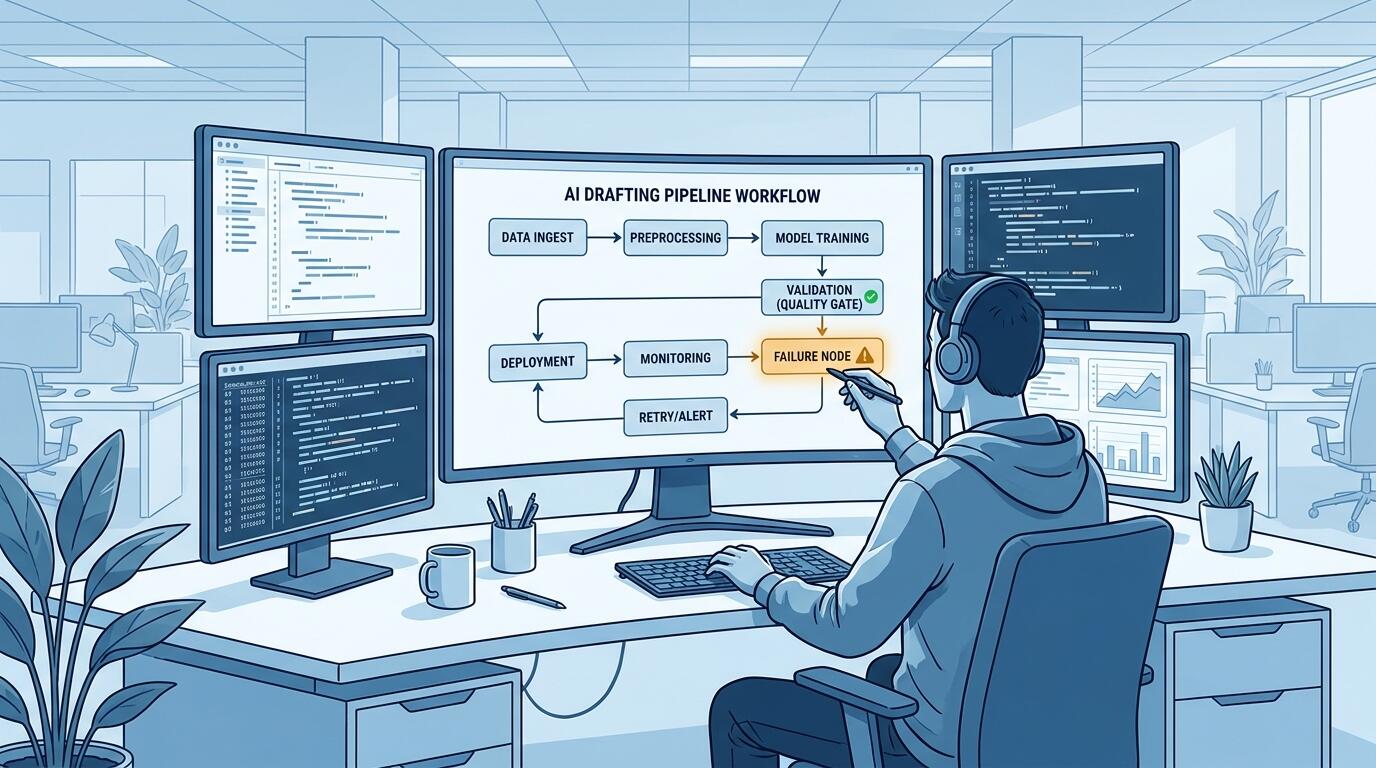
ALT: Engineer reviewing AI drafting pipeline failure points and quality checks in a technical workflow
Why AI Drafting Pipelines Break — and the Checks That Actually Catch It
Key Conclusion: AI drafting pipelines fail in predictable, structural ways — bad prompt design, missing validation gates, undetected hallucinations, and silent upstream data drift. Understanding where each failure mode lives, and matching it to a purpose-built check, is the difference between a pipeline that ships quality output and one that creates invisible technical debt. The comparisons and checks in this article are drawn from patterns observed repeatedly across production AI content and document generation systems.
Every builder who has moved an AI drafting pipeline from proof-of-concept to production has felt the same whiplash: it looked great in demos, then quietly degraded in the wild. The failure was rarely dramatic. It was gradual — a hallucinated citation here, an off-brand paragraph there, a context window that silently truncated, a validation step that was never actually wired in. This article maps the most common failure modes in AI drafting pipelines against the checks that genuinely catch them, structured as a practical comparison a technical team can act on immediately.
The Criteria That Define a Reliable AI Drafting Pipeline
A reliable AI drafting pipeline is one that produces consistent, verifiable output across diverse inputs, at scale, without requiring manual inspection of every result. Four dimensions determine whether a pipeline meets that bar.
Output fidelity measures whether the generated text accurately reflects the source material or stated requirements. Fidelity failures range from subtle rephrasing that changes meaning to outright hallucinations — facts, citations, or names that do not exist. This is the most consequential failure mode because it is the hardest for downstream consumers to detect.
Pipeline observability measures how visible failures are when they occur. A pipeline with low observability fails silently: a prompt change degrades output quality, but no alert fires, no log captures the drift, and the problem surfaces only when a human reads enough bad drafts to notice a pattern. High observability means failures leave a trace that is automatically captured and routed to the team.
Validation coverage measures how many of the known failure modes have an active, automated check in place. Most pipelines have some validation — a length check, a toxicity filter — but leave large categories of failure unmonitored. According to the analysis in "What Your Data Pipeline Is Missing," many teams instrument the infrastructure layer (latency, throughput) while leaving the semantic layer (meaning, accuracy, consistency) entirely unchecked.
Recovery speed measures how quickly a team can diagnose and correct a failure once it is detected. Even a well-instrumented pipeline has limited value if the diagnosis-to-fix cycle takes days. Recovery speed depends on the quality of error logging, the clarity of failure taxonomy, and whether the team has pre-built remediation paths for common failure types.
These four criteria — fidelity, observability, validation coverage, and recovery speed — form the evaluation framework for the comparisons that follow.
The Failure Modes: What Actually Breaks in an AI Drafting Pipeline
The failures in an AI drafting pipeline cluster into distinct categories, each with its own root cause and its own appropriate check. Treating them as a single undifferentiated problem is one of the most common mistakes a team can make.
Prompt Fragility — the Upstream Root Cause
Prompt fragility is the condition where small, unintentional changes to the prompt structure cause large, unpredictable changes in output quality. This is the most upstream failure mode, which means it propagates to every output produced by the pipeline.
In practice, prompt fragility looks like this: a developer edits a system prompt to add a new instruction, not realizing that the change subtly conflicts with an earlier instruction, and output length or tone shifts across the board. Or a new model version is deployed, and the same prompt that worked on the previous version now produces inconsistently formatted output because the new model interprets certain phrasing differently.
The check that catches prompt fragility is a prompt regression test suite — a set of canonical input-output pairs that the pipeline is expected to reproduce within a defined tolerance. Without such a suite, prompt changes are deployed blind. This is analogous to deploying code without a test suite, and as noted in the piece "AI Won't Fix a Broken CI/CD Pipeline," the core discipline of software delivery — test before you ship — applies equally to prompt engineering. No amount of AI capability compensates for the absence of regression testing at the prompt layer.
Context Window Truncation — the Silent Data Loss Problem
Context window truncation is the failure that occurs when the input to a language model exceeds the model's context limit, causing the model to silently drop part of the input and draft output that is incomplete or inconsistent with the full source material.
This failure is particularly dangerous because it is almost never surfaced as an error. The model does not throw an exception. It produces output that appears complete, based on the subset of input it actually processed. In a document drafting pipeline, this can mean a model drafting a summary that contradicts the second half of the source document it never saw.
The check for this failure mode is a pre-inference token count gate — a step that measures the tokenized length of the full input before it reaches the model, and either rejects inputs that exceed a safe threshold, chunks them with overlap, or flags them for human review. This is a low-cost, high-value check that many teams skip because context limits feel like an infrastructure concern rather than a quality concern. They are both.
Hallucination in Constrained Drafting Tasks
Hallucination — the generation of plausible but factually incorrect content — is the failure mode that gets the most public attention and the least systematic mitigation in production pipelines. In constrained drafting tasks (legal document drafts, technical specifications, product descriptions anchored to a catalog), hallucination is especially harmful because the output is expected to be grounded in specific source facts.
The Databricks team has explored AI agent approaches to investigating pipeline failures, including detecting output that deviates from expected grounding. Their work, documented in the post "Databricks AI Agent Investigates Pipeline Failures," illustrates how an agent-based verification layer can be introduced downstream of generation to catch outputs that cannot be traced back to source material.
For most teams, a simpler and equally effective approach is a grounding check: after generation, a retrieval or lookup step verifies that named entities, figures, and key claims in the output can be matched back to the source. Claims that fail matching are either flagged or trigger a regeneration with an explicit grounding instruction appended to the prompt.
Schema and Format Drift — the Integration Killer
Schema and format drift is the failure where the structure of model output diverges from what downstream systems expect. A pipeline that feeds AI-drafted content into a CMS, a document store, or an API endpoint depends on consistent output structure — specific fields present, specific delimiters used, specific length ranges respected.
Format drift happens for several reasons: a model update changes how the model interprets formatting instructions, a prompt is modified to fix one problem and inadvertently relaxes a structural constraint, or an edge-case input causes the model to produce a response pattern it was not trained to avoid.
The check for format drift is a schema validation step — a post-generation parser that asserts the output conforms to a defined schema before it is passed downstream. This is the same principle as validating API responses against a contract, and it is just as non-negotiable in a drafting pipeline as it is in a service mesh. Format drift that reaches downstream systems is expensive to clean up and damages trust in the pipeline across the organization.
Semantic Drift Over Time — the Slow Burn Failure
Semantic drift is the gradual degradation of output quality over time as the distribution of inputs shifts away from what the prompt was designed to handle, model versions change, or the target style evolves without the prompt evolving with it. This is the failure mode that is hardest to detect because no single output is obviously wrong — the degradation is statistical and incremental.
A pattern consistently observed across production AI drafting systems is that teams invest heavily in launch-day quality and underinvest in ongoing quality measurement. A pipeline that has no mechanism for sampling and evaluating output quality over time will drift without any internal signal that it is doing so.
The check for semantic drift is a periodic human or automated evaluation sample — a defined cadence at which a random sample of pipeline output is scored against a quality rubric. This does not need to be expensive: even a small, consistent sample with a structured scoring guide produces a signal that can detect drift before it becomes a crisis.
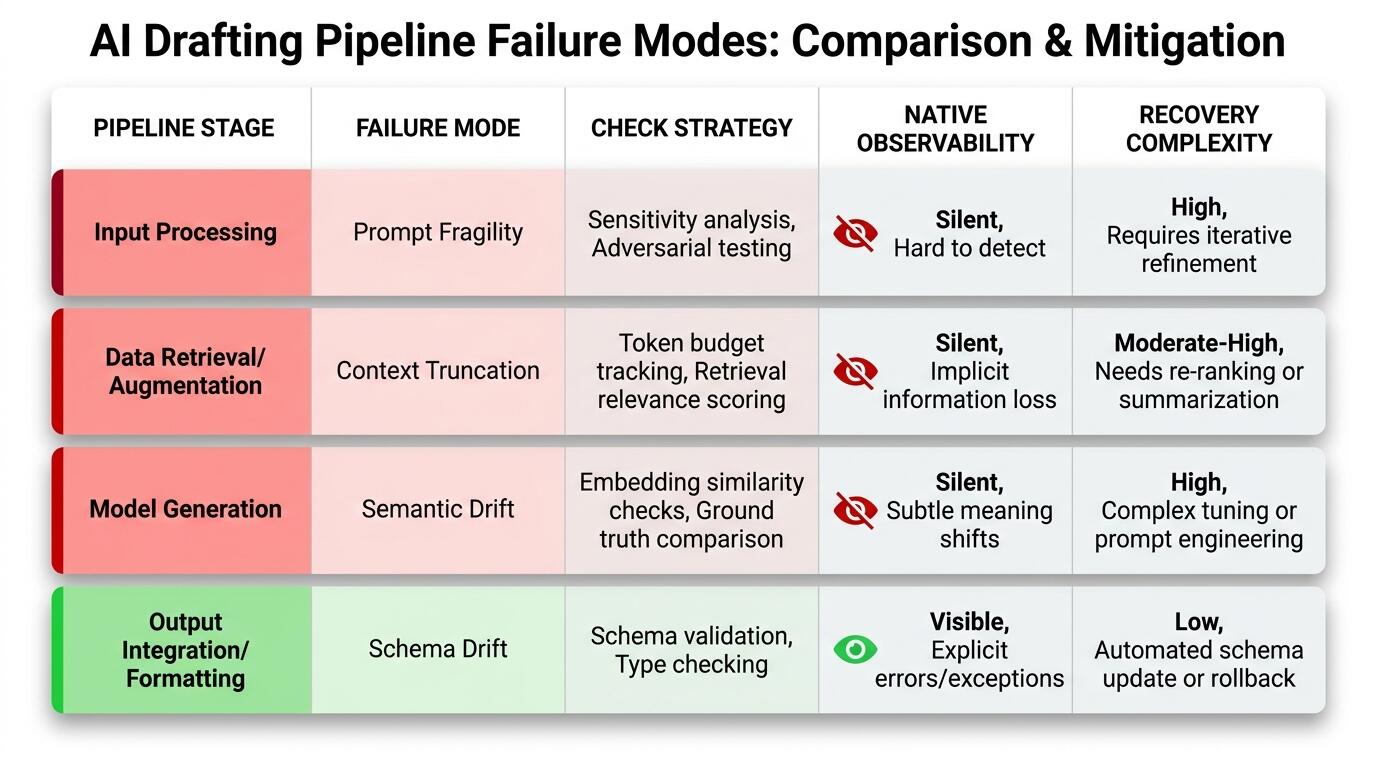
ALT: Comparison table showing AI drafting pipeline failure modes, detection checks, and observability gaps across prompt, inference, and output stages
Head-to-Head: Failure Modes vs. Check Strategies
The following table maps each failure mode to its detection method, the pipeline stage where it applies, and the observability it provides without intervention.
| Failure Mode | Pipeline Stage | Check Strategy | Native Observability | Recovery Complexity |
|---|---|---|---|---|
| Prompt fragility | Pre-inference | Regression test suite | Low (silent) | Moderate |
| Context window truncation | Pre-inference | Token count gate | Very low (silent) | Low |
| Hallucination | Post-generation | Grounding/entity check | Low | High |
| Schema and format drift | Post-generation | Schema validation | Moderate (downstream error) | Low |
| Semantic drift over time | Ongoing | Sampling and evaluation cadence | Very low | High |
The table reveals a consistent pattern: the most consequential failure modes — prompt fragility, context truncation, and semantic drift — have the lowest native observability. They fail silently and accumulate damage before they are noticed. This means the teams most likely to be harmed by these failures are the teams that have not instrumented their pipelines beyond infrastructure metrics.
Format drift and downstream schema failures, by contrast, tend to surface faster because they break integrations in ways that are visible to systems rather than only to human readers. This is why many teams address format drift first — it is the failure that generates the most noise — while leaving the semantically important failures entirely unmonitored.
Recovery complexity also correlates with detection latency. Failures that are caught immediately (schema validation fires on every output) have low recovery complexity because the scope is bounded. Failures that accumulate silently over weeks (semantic drift, prompt fragility) have high recovery complexity because they require reconstructing what changed, when it changed, and how much output is affected.
The practical implication: prioritize checks for the high-damage, low-observability failure modes, even if they are harder to implement than the checks that catch the already-visible failures.
Which Approach Should You Choose? Matching Checks to Your Pipeline Stage
The right check strategy depends on where your pipeline currently sits — not where you want it to be.
If you are operating a pipeline in early production with no existing validation layer, the highest-leverage starting point is a schema validation step and a token count gate. Both are deterministic, cheap to implement, and catch failure modes that produce hard-to-diagnose downstream problems. Add these before anything else.
If you have schema validation in place but no prompt regression tests, the next priority is building a minimal regression suite. A suite of twenty to thirty canonical input-output pairs, evaluated on every prompt change, provides meaningful coverage of prompt fragility without requiring a large investment. This is the equivalent of a smoke test suite — it does not prove the pipeline is correct, but it proves it has not broken in known ways.
If your pipeline is stable and you are observing gradual quality decline without a clear cause, the problem is almost certainly semantic drift. The right response is a structured sampling and evaluation cadence. Define a quality rubric, pull a random sample of recent outputs, score them, and compare the distribution against a baseline established at launch. This will either confirm drift or rule it out, and either answer is useful.
If your drafting task is constrained — outputs are expected to be grounded in specific source documents — and you are not running a grounding check, hallucination risk is unmitigated. The grounding check does not need to be a full RAG evaluation framework; a targeted entity extraction and lookup against the source material is often sufficient to catch the most harmful hallucinations.
For teams building new pipelines from scratch, the recommended sequencing is: token count gate first, schema validation second, regression suite third, grounding check fourth, and sampling cadence fifth. This ordering reflects the cost-to-impact ratio of each check, not the severity of the failure mode it addresses.
People Also Ask
How do you detect hallucination in an AI drafting pipeline without manual review?
Hallucination detection without full manual review relies on automated grounding checks: after generation, the pipeline extracts named entities, numbers, and key claims from the output and attempts to match each against the source material using retrieval or exact lookup. Claims that cannot be traced back to the source are flagged for review or trigger a targeted regeneration. This approach does not guarantee zero hallucinations, but it reliably catches the most harmful category — factual claims that are not present in the source at all.
Are prompt regression tests worth the investment for small AI teams?
Prompt regression tests are especially valuable for small teams precisely because small teams lack the review capacity to manually evaluate output quality at scale. A compact suite of twenty to thirty canonical test cases, run automatically on every prompt change, provides a safety net that scales with the team's output volume rather than with its headcount. The investment to build the initial suite is measured in hours; the cost of deploying a broken prompt to production is measured in the scope of affected output.
How often should you run a semantic quality evaluation on a live drafting pipeline?
The right frequency depends on pipeline volume and the cost of quality degradation in the specific use case. A widely applicable starting point is a structured evaluation on a random sample at a fixed cadence — weekly for high-volume pipelines, monthly for lower-volume ones. The cadence matters less than the consistency: a monthly evaluation run without fail produces a meaningful quality trend over time, while an ad-hoc evaluation run only when problems are suspected produces no baseline to compare against.
Key Takeaways
- The most damaging failure modes in an AI drafting pipeline — prompt fragility, context truncation, and semantic drift — are also the ones with the lowest native observability. They fail silently, which means instrumentation is not optional.
- A token count gate and a schema validation step are the two highest-leverage checks for a pipeline with no existing validation layer. Both are deterministic, cheap to implement, and catch failures that would otherwise surface as confusing downstream errors.
- Prompt regression tests are the software engineering discipline applied to prompt engineering. Deploying prompt changes without a regression suite is the equivalent of deploying code without tests.
- Grounding checks — matching generated claims back to source material — address hallucination in constrained drafting tasks more reliably than general-purpose filtering, because they are specific to the source facts the pipeline is supposed to be grounded in.
- Semantic drift is a slow-burn failure that requires a proactive sampling cadence to detect. If you are not periodically measuring output quality against a baseline, you will not know your pipeline has drifted until the degradation is significant.
The next step is to audit your current pipeline against this failure taxonomy. For each failure mode listed, determine whether you have an active check in place. The gaps in that audit are your priority list.
Stay current on the AI pipeline patterns and tooling decisions that actually matter in production. Darius publishes a bilingual AI briefing — curated by an engineering director who runs multiple AI products — with five to ten sourced, practitioner-focused items per issue. Visit the site and subscribe to get signal without noise delivered directly to you.
References
- Samarth Amodkar / Databricks. "Databricks AI Agent Investigates Pipeline Failures".
https://www.linkedin.com/posts/samarth-amodkar_databricks-dataengineering-aiagents-activity-7501915406362759168-a-dU - AICE. "What Your Data Pipeline Is Missing".
https://www.aice.ai/what-your-data-pipeline-is-missing/ - Ante Prasevic / DEV Community. "AI Won't Fix a Broken CI/CD Pipeline".
https://dev.to/aprasevic/ai-wont-fix-a-broken-cicd-pipeline-8he
Note: Standards and best practices in AI pipeline engineering evolve rapidly. Verify current guidance against the latest official documentation from relevant standards bodies and platform providers.