Build vs. Buy for AI Infrastructure: Revisiting the Framework for Late 2026
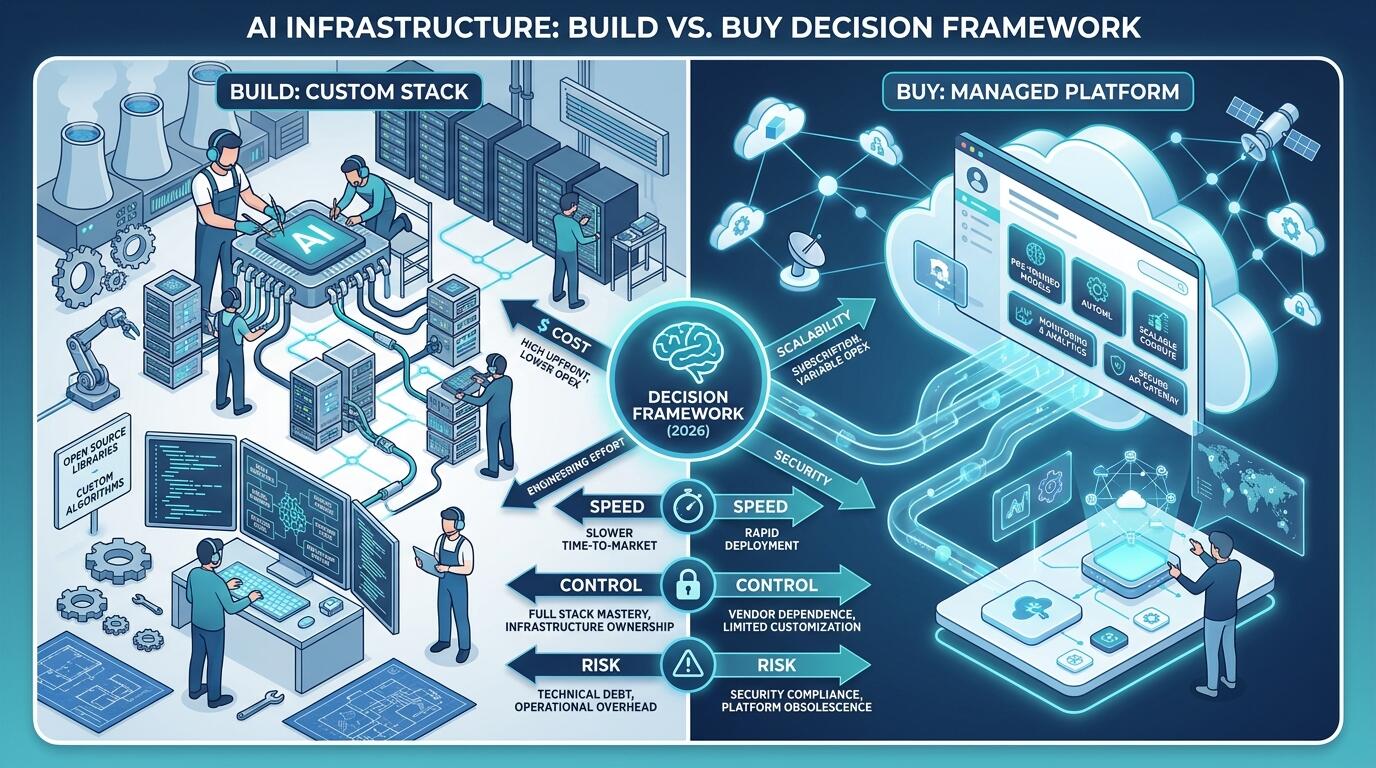
ALT: Build vs buy AI infrastructure decision framework for engineering teams in late 2026
Build vs. Buy for AI Infrastructure: The Decision That Actually Matters for Engineering Teams in 2026
Should your team build AI infrastructure from scratch, or buy a managed solution? The honest answer is that the right choice depends on your organization's specific constraints — but the framework for making that call has shifted significantly, and teams that haven't revisited their assumptions in the past year are likely working with outdated mental models.
This article compares the two primary paths — custom-built AI infrastructure versus managed/purchased AI platforms — across the dimensions that matter most to engineering leaders and founders in the current landscape. The comparison criteria focus on total cost, time to value, control and customization, vendor risk, team capability fit, and long-term scalability. If you're an engineering director, a technical co-founder, or a product leader responsible for an AI-powered product, the goal here is to give you a clear, practitioner-tested framework — not a vendor pitch.
The Evaluation Criteria: How to Judge This Decision Fairly
The build-vs-buy decision for AI infrastructure should be judged on at least six dimensions. Each one tells a different part of the story, and collapsing them into a single "cost" question is where most teams go wrong.
Total Cost of Ownership (TCO) is more than the initial bill. For a build path, TCO includes engineering salaries, infrastructure provisioning, ongoing maintenance, and the opportunity cost of keeping senior engineers occupied with undifferentiated heavy lifting. For a buy path, it includes licensing fees, API call costs that scale with usage, and the hidden cost of fitting your problem into someone else's abstraction.
Time to Value matters enormously for startups and product teams operating under funding constraints or competitive pressure. A purchased platform can reduce the time from idea to a working prototype from months to weeks. A custom build typically inverts that advantage — it's slower upfront but can compound advantages later if done well.
Control and Customization separates teams with genuinely unique AI requirements from those solving common problems. If your use case demands a specific model architecture, a proprietary data pipeline, or fine-grained inference control, a managed platform may hit a hard ceiling.
Vendor Risk and Dependency has become a more pressing criterion as the AI platform market consolidates. API pricing changes, model deprecations, and provider outages are real operational concerns — and a pattern we consistently see in our work with clients is that teams underestimate this risk until they've been burned by it.
Team Capability Fit asks whether your engineering team has the skills to build and maintain the infrastructure you're considering. A brilliant team of product engineers may lack MLOps depth; a research-heavy team may struggle with production reliability engineering.
Long-Term Scalability determines whether the infrastructure you deploy today can grow with your product without requiring a complete rebuild. Both paths carry risk here — built systems can become brittle, and bought platforms can become bottlenecks.
The Contenders: What You're Actually Choosing Between
Custom-Built AI Infrastructure
Custom-built AI infrastructure is the approach of constructing your own model serving layer, training pipelines, data ingestion systems, and orchestration logic using open-source components and cloud primitives — rather than subscribing to a vendor-managed platform that abstracts those concerns away.
This path typically involves assembling tools like open-source model serving frameworks (such as those maintained by the MLOps and LLMOps communities), managed compute from cloud providers like AWS, Google Cloud, or Azure, vector databases for retrieval-augmented generation, and custom orchestration logic. The team owns every layer of the stack.
The headline characteristic of custom builds is maximum control. You choose the model, the serving strategy, the data residency, and the cost optimization levers. For organizations in regulated industries, or those with genuinely novel AI requirements, this control is non-negotiable. The corresponding cost is engineering time — not just to build, but to maintain, monitor, and evolve the system as the underlying technology changes rapidly.
Managed and Purchased AI Platforms
Managed AI platforms are vendor-operated services that provide pre-built infrastructure for model inference, fine-tuning, embeddings, and often workflow orchestration — accessed primarily through APIs or managed cloud services.
This category spans a wide range: foundation model APIs (OpenAI, Anthropic, Google Gemini), cloud-native AI services (AWS Bedrock, Google Vertex AI, Azure AI Studio), and specialized platforms for retrieval, agents, and evaluation. What they share is that the underlying infrastructure complexity is abstracted away. Your team calls an API and gets a result; the serving, scaling, and model maintenance are the vendor's problem.
The headline characteristic of managed platforms is speed. Teams that leverage these platforms can move from idea to production-quality prototype in days rather than months, which is a meaningful competitive advantage in fast-moving markets. The corresponding risk is dependency — on pricing models the vendor can change, on model versions the vendor can deprecate, and on capability ceilings the vendor defines.
The Hybrid Path: Composing Instead of Choosing
A third option — increasingly the default for sophisticated engineering teams — is a deliberate hybrid architecture. A hybrid AI infrastructure approach means using managed APIs for commodity AI tasks (general-purpose language understanding, off-the-shelf embeddings, standard image classification) while building custom infrastructure only for the layers where differentiation is real.
In our experience advising on production AI systems, the hybrid path often represents the highest-leverage choice for teams that have moved past the prototype stage but don't yet have the scale or specialized requirements to justify a fully custom stack. The key discipline is being honest about which parts of your system are genuinely differentiated and which are just expensive plumbing.
Head-to-Head Comparison: Build, Buy, and Hybrid Across the Six Criteria
| Criterion | Custom Build | Managed Platform | Hybrid Approach |
|---|---|---|---|
| Total Cost of Ownership | High upfront; potentially lower at scale with optimization | Predictable subscription/usage costs; can escalate at scale | Moderate; costs scale with scope of custom components |
| Time to Value | Slow (weeks to months before production-ready) | Fast (days to weeks for functional prototypes) | Moderate; fast on managed layers, custom layers add time |
| Control and Customization | Maximum control at every layer | Limited to platform's abstractions and supported models | Selective control where differentiation is highest |
| Vendor Risk and Dependency | Low; open-source components spread the risk | High; single or few vendors; pricing and deprecation risk | Medium; managed risk by limiting vendor scope |
| Team Capability Fit | Requires deep MLOps and infrastructure expertise | Accessible to product-focused engineering teams | Requires both, but in proportional doses |
| Long-Term Scalability | High ceiling; complexity compounds over time | Ceiling set by vendor; migration cost grows with lock-in | High ceiling on custom layers; managed layers stay flexible |
The table above reveals a few non-obvious patterns worth unpacking.
First, the time-to-value gap between custom builds and managed platforms is genuinely large — and it's not closing as fast as some teams assume. According to analysis covered in the article "AI Infrastructure: When to Build, Buy, or Wait" by Whitespectre, the decision to build prematurely is one of the most common and costly mistakes engineering teams make, particularly when the underlying capability is available as a managed service at acceptable quality. That observation holds in the current moment: the gap between what a well-configured API call can deliver and what a bespoke model can deliver has narrowed on common tasks, while the engineering cost of the custom path has not.
Second, vendor dependency risk is real and asymmetric. It's easy to underestimate at the start of a project, when an API works reliably and the pricing seems reasonable. But as a product matures and usage scales, the cost structure of managed platforms can shift meaningfully — and migration to a custom stack at that point carries substantial re-engineering cost. The build vs. buy analysis from CFO Shortlist frames this as a financial risk that engineering leaders and financial decision-makers often evaluate on different timescales — a misalignment worth surfacing explicitly in your organization.
Third, team capability fit is a harder constraint than most leaders want to admit. A team without experienced MLOps engineers will not suddenly gain that capability because they decided to build. The talent market for infrastructure-focused ML engineers remains competitive, and the gap between having the skills and learning them on the job — on a production system — is one of the more reliable sources of project risk in the teams we've engaged with.
Which Should You Choose? Scenario Recommendations for Engineering Teams
The right answer depends on the specifics of your situation. Here's how to map your context to a decision.
If you're a startup building a first AI-powered product and your primary goal is learning whether the product works: choose a managed platform without hesitation. Validate the product hypothesis first. The infrastructure decision is not the variable that determines whether your product finds market fit. A managed API lets you ship, learn, and iterate — and the cost of switching later is far lower than the cost of building infrastructure for a product that doesn't work.
If you're an established product team with validated demand and you're hitting the capability ceiling of a managed platform: this is the signal to evaluate custom infrastructure for specific layers. You don't need to rebuild everything — you need to identify precisely which constraints the platform is imposing, and build custom solutions only for those layers. This is where the hybrid approach earns its value.
If you operate in a regulated industry (healthcare, financial services, legal) with strict data residency, auditability, or model transparency requirements: custom or hybrid infrastructure is likely non-negotiable. Many managed platforms offer enterprise-tier compliance controls, but the specifics vary and evolve — verify them for your specific regulatory context before assuming a managed platform can meet your obligations.
If your AI use case involves genuinely novel model architecture or training on proprietary data at scale: the custom path is the right long-term investment. No managed platform will give you the fine-grained control that cutting-edge research or deeply proprietary training pipelines require. The cost is real — but the alternative is building a product that cannot be differentiated.
Pros and cons summary:
Custom Build — maximum control, scalability ceiling, no vendor dependency; requires deep expertise, slow to value, high ongoing maintenance.
Managed Platform — fast to market, lower capability requirement, predictable short-term cost; vendor dependency, capability ceiling, pricing risk at scale.
Hybrid Approach — balances speed and control, limits vendor risk, grows with the product; requires clear architectural discipline to avoid the worst of both worlds.
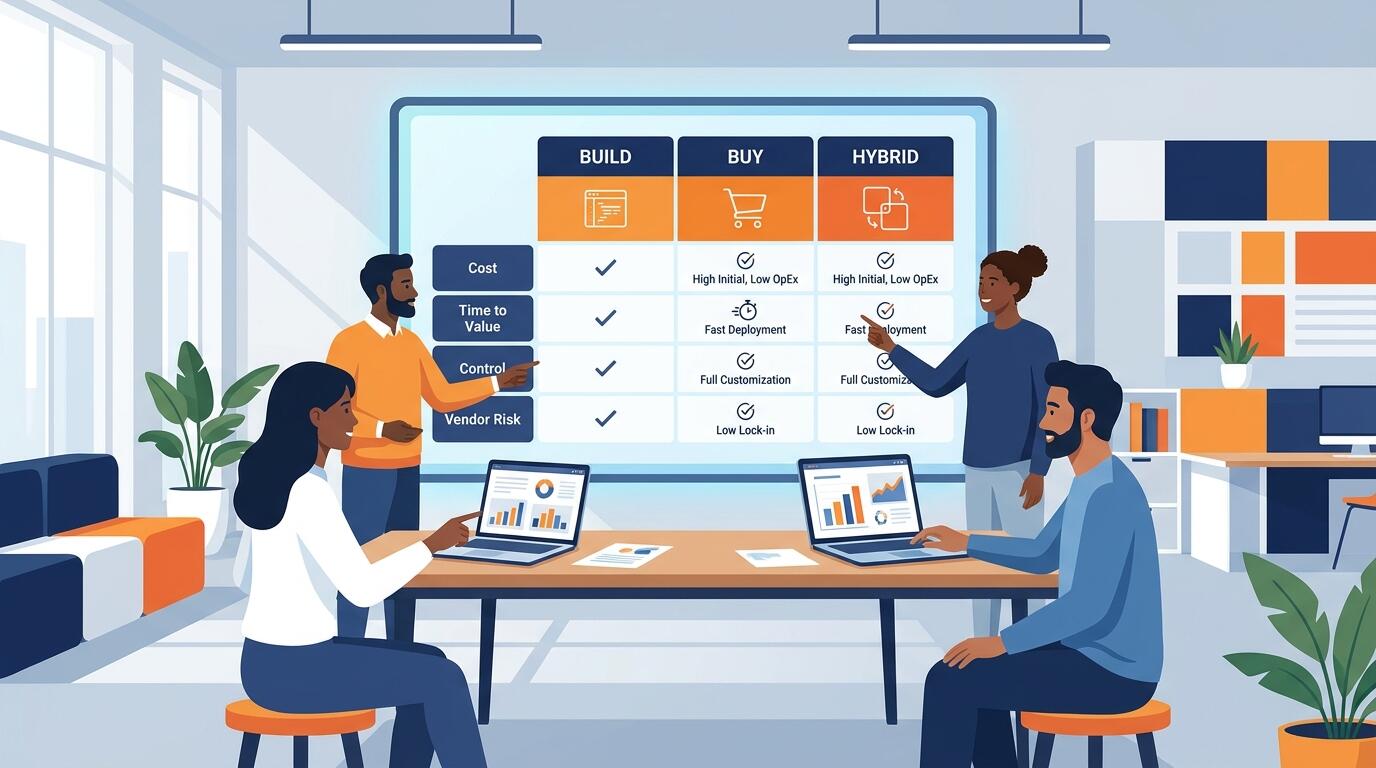
ALT: Engineering team evaluating AI infrastructure options including build buy and hybrid strategies for scalable production systems in 2026
Frequently Asked Questions FAQ
Q1: How do you calculate the real total cost of ownership when deciding between building and buying AI infrastructure?
Total cost of ownership for AI infrastructure should include direct costs (compute, storage, API fees, licensing) and indirect costs (engineering time, maintenance overhead, opportunity cost of senior engineers, and cost of incidents). A pattern we consistently see is that teams focus on the invoice and miss the labor cost. For a build path, a meaningful portion of one or more senior engineers' time will be permanently allocated to infrastructure. For a buy path, factor in what happens to your cost structure as usage scales — per-call pricing can become material quickly at production volumes.
Q2: Is it realistic for a startup with a small engineering team to maintain custom-built AI infrastructure?
Maintaining custom AI infrastructure requires ongoing work — model version management, serving reliability, pipeline monitoring, and security patching. For most small teams, this is a significant tax on engineering capacity that competes directly with product development. The guidance from practitioners and analysis such as "Build vs Buy AI: Which Strategy Makes Sense in 2026" on LinkedIn is consistent: unless your team has dedicated infrastructure engineers and the use case genuinely requires custom infrastructure, managed platforms are the more realistic starting point for small teams. Revisit the decision when scale or capability gaps make it necessary.
Q3: How long does it typically take to migrate from a managed platform to custom-built AI infrastructure?
Migration timelines vary widely depending on how deeply the managed platform is integrated into your product and how much of your business logic has been built around its specific abstractions. Teams that have designed for portability from the start — using clean interfaces between their application code and the AI layer — can migrate specific components in weeks. Teams that have tightly coupled their product logic to a specific platform's API idioms often face months of re-engineering. The most important factor is not when you migrate, but how you architect your system before you need to.
Final Thoughts
The build-vs-buy decision for AI infrastructure in late 2026 is not a one-time call — it's a recurring architectural judgment that should be revisited as your product matures, your team's capabilities evolve, and the platform market continues shifting.
Key Takeaways:
- Start with managed platforms to validate product hypotheses; the infrastructure decision should follow product-market fit, not precede it.
- Evaluate vendor dependency as a serious long-term risk, especially as usage scales and pricing exposure grows.
- The hybrid approach — custom infrastructure only where differentiation is real — is the highest-leverage default for mature product teams.
- Team capability is a hard constraint; don't plan a custom build without honest accounting of the MLOps expertise you actually have.
- Architectural portability is the most valuable property you can build into an AI system from day one, regardless of which path you choose.
The teams that get this decision right tend to share one trait: they treat it as an engineering architecture decision, not a procurement decision. That shift in framing — from "what can we afford to buy" to "what does our system actually need to do" — is where the clearest thinking starts.
If your team is navigating this decision and wants the perspective of an engineering leader who has moved AI systems from concept to production, explore the work and approach at Darius — where the focus is on shipping real products, not theoretical architectures.
Sources & Further Reading
- Whitespectre. "AI Infrastructure: When to Build, Buy, or Wait".
https://www.whitespectre.com/ideas/ai-infrastructure-build-buy-or-wait/ - CFO Shortlist. "Build vs. Buy in 2026: The CFO Reality Check".
https://www.cfoshortlist.com/reports/build-vs-buy - LinkedIn Pulse. "Build vs Buy AI: Which Strategy Makes Sense in 2026".
https://www.linkedin.com/pulse/build-vs-buy-ai-which-strategy-makes-sense-2026--43wnc - IEEE. Institute of Electrical and Electronics Engineers — standards and publications on AI systems engineering and software architecture.
https://www.ieee.org/ - NIST. National Institute of Standards and Technology — frameworks and guidance on AI risk management and trustworthy AI systems.
https://www.nist.gov/
Note: Standards and market conditions evolve rapidly in the AI infrastructure space. Please verify the latest guidance from official sources or consult experienced practitioners before making architectural commitments.