How to Build an AI Product Roadmap That Engineering Can Actually Execute

ALT: Engineering team reviewing an AI product roadmap with feasibility checkpoints and sprint milestones
How to Build an AI Product Roadmap That Engineering Can Actually Execute
Key Conclusion: An AI product roadmap that engineering can execute is built by anchoring every feature to a validated technical dependency, sequencing work around data and model readiness rather than marketing dates, and involving engineering leads before commitments are made public. This approach reduces rework, protects budget, and turns ambitious AI plans into shippable, production-grade releases.
Most AI product roadmaps fail not because the vision is wrong, but because the plan was built without engineering reality checks. This guide is for product leaders, startup builders, and engineering managers who need a roadmap that survives contact with real infrastructure, real data constraints, and real sprint velocity — not just a slide deck that looks good in a board meeting.
Before You Start: Prerequisites & Preparation
Before drafting a single roadmap item, you need clarity on what you are actually building and what engineering can realistically support. A pattern we consistently see in our work with engineering teams is that roadmaps collapse in the first quarter because product and engineering never agreed on a shared definition of "done" for an AI feature. Fixing that upfront costs almost nothing and saves months later.
You need three things in place before you start: a documented understanding of your current data infrastructure (what data exists, where it lives, and how clean it is), an honest inventory of your team's AI/ML capacity (in-house expertise versus what will require external support or managed services), and executive alignment on what tradeoffs are acceptable — speed versus accuracy, cost versus latency, build versus buy. Without these three inputs, any roadmap you produce is a guess dressed up as a plan.
Time and effort for this preparation phase should be treated as a real project phase, not a rushed kickoff meeting. Teams that treat discovery as a genuine sprint — with engineering, product, and at least one data-facing stakeholder in the room — consistently produce roadmaps that need far less mid-quarter rewriting than teams that skip straight to writing epics.
Checklist before starting:
- A current-state audit of data availability, quality, and access permissions
- An honest skills and capacity assessment across your engineering team
- Executive-level agreement on acceptable tradeoffs between speed, cost, and accuracy
- At least one technical lead who will co-own the roadmap, not just review it after the fact
- A rough budget ceiling for infrastructure, compute, and third-party AI services
Step-by-Step Instructions
Step 1: Separate the Product Vision from the Technical Backlog
Start by writing the product vision as a narrative — what problem you are solving and for whom — completely separate from any technical implementation detail. This forces product stakeholders to articulate value before anyone starts estimating effort, which prevents the common trap of engineering being handed a solution instead of a problem. Only after the vision is agreed upon should you begin translating it into technical epics.
Tip: If a vision statement cannot survive being read aloud to a non-technical stakeholder, it is not ready to become a roadmap item.
Step 2: Map Every Feature to Its Underlying AI Dependency
For each proposed feature, explicitly document what it depends on: a specific dataset, a fine-tuned model, a third-party API, or a new piece of infrastructure. According to ProdMap AI's guidance on AI product roadmaps, features that skip this dependency-mapping step are the ones most likely to be delayed mid-sprint because a hidden data or model gap surfaces too late. This step is where engineering earns a real seat at the table, because only they can accurately flag whether a dependency is trivial or a multi-sprint undertaking.
Tip: Create a simple dependency matrix — feature, data needed, model needed, infrastructure needed — and review it with engineering before any date is proposed.
Step 3: Sequence Around Technical Readiness, Not Marketing Calendars
Order your roadmap items by technical readiness first, then adjust for business priority — never the reverse. A feature that depends on a model that hasn't been validated yet should never be scheduled ahead of a feature whose dependencies are already production-ready, regardless of which one a stakeholder wants announced first. This is the single most common reason AI roadmaps miss dates: the sequence was decided by a launch calendar instead of by what the engineering team could actually deliver in order.
If you are building your very first AI-native product rather than adding AI to an existing system, this sequencing discipline matters even more, and it is worth reviewing a structured approach like the minimum viable architecture framework for a first AI-powered app before locking your sequence.
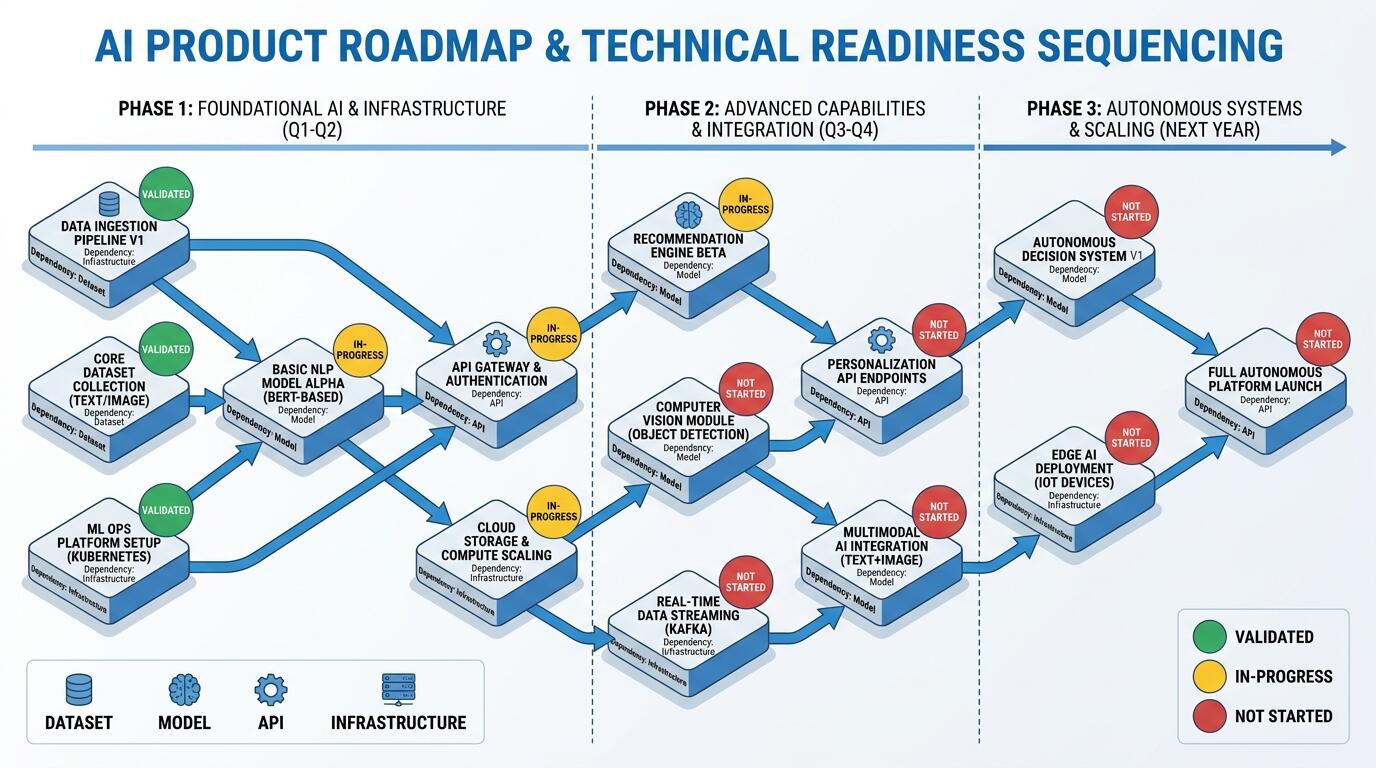
ALT: Roadmap sequencing diagram showing AI feature dependencies ordered by technical readiness
Step 4: Build in Explicit Feasibility Checkpoints
Insert a feasibility checkpoint before every major roadmap phase — a short, time-boxed technical spike where engineering validates that a proposed feature is actually buildable within the assumed timeline and budget. This is different from a sprint planning session; it is a dedicated gate whose only output is a go, no-go, or revise decision. Skipping this step is how teams end up publicly committing to capabilities that, three weeks into development, turn out to require a completely different model architecture or dataset.
Tip: Keep feasibility checkpoints short and scoped to a single risky assumption — testing everything at once defeats the purpose and just becomes a second discovery phase.
Step 5: Distinguish Prototype Milestones from Production Milestones
Your roadmap should clearly label which milestones represent a working prototype and which represent a production-ready release, because the two require dramatically different levels of engineering investment. A prototype milestone proves a concept works; a production milestone means it works reliably under real user load, with monitoring, fallback behavior, and cost controls in place. Conflating the two on a roadmap is one of the fastest ways to blow a budget, because stakeholders start expecting production-grade reliability from what was only ever meant to be a proof of concept.
This distinction is worth treating as a first-class roadmap category rather than a footnote, and teams new to it benefit from studying the practical differences between AI prototypes and production-ready AI systems before setting expectations with leadership.
Step 6: Assign Ownership and Escalation Paths for Each Roadmap Item
Every item on the roadmap needs a named owner — not a team, a person — and a clear escalation path for when a dependency slips. Ambiguous ownership is where AI roadmaps quietly stall, because when a model underperforms or a data pipeline breaks, nobody is accountable for deciding whether to fix, replace, or cut the feature. This is also where leadership structure matters: a roadmap that spans multiple technical domains often needs a dedicated technical decision-maker, and it's worth clarifying that role early using a framework like choosing the right engineering leader for your company's stage.
Tip: A roadmap item without a named owner should be treated as unscheduled, even if it has a date next to it.
Step 7: Review and Re-baseline on a Fixed Cadence
Set a fixed, recurring cadence to re-baseline the roadmap against actual engineering progress — not just when something goes visibly wrong. AI features are uniquely prone to silent drift: a model's performance can degrade, a data source can change format, or a third-party API can alter its pricing, all without triggering an obvious red flag until a customer notices. Regular re-baselining catches this early and keeps the roadmap an honest document rather than a static artifact nobody trusts.
Common Mistakes & Troubleshooting
| Symptom | Likely Cause | How to Fix |
|---|---|---|
| Roadmap dates slip repeatedly despite "on track" status updates | Features were sequenced by business priority instead of technical dependency readiness | Rebuild the sequence using the dependency matrix from Step 2 and re-baseline against real engineering capacity |
| Engineering pushes back late in the sprint on features that were already announced externally | Engineering was not involved before commitments were made public | Require a feasibility checkpoint sign-off from a named technical owner before any external date is shared |
| A "shipped" AI feature works in demos but fails constantly for real users | Prototype milestone was mistaken for a production milestone | Explicitly separate prototype and production milestones on the roadmap and budget for production hardening separately |
| Budget overruns on model or compute costs mid-quarter | No cost ceiling was set during the preparation phase, or usage assumptions were never validated | Add a compute/API cost review as part of every feasibility checkpoint, not just a one-time estimate |
| Roadmap items stall with no clear reason | No individual owner assigned, only a team | Reassign every item to a single named owner with an explicit escalation path |
Pro Tips for Better Results
A common misconception is that an AI product roadmap needs to specify exact model choices and architectures far in advance. In practice, the roadmap should lock in outcomes and constraints — latency targets, accuracy thresholds, cost ceilings — while leaving specific model or vendor selection flexible until closer to the feasibility checkpoint for that item, since the AI tooling landscape shifts faster than most planning cycles.
Treat your roadmap as a living risk register, not just a timeline. The highest-value roadmap column is often not "date" but "biggest unresolved risk," because it forces continuous conversation about what could break the plan rather than a false sense of certainty from a Gantt chart.
Budget for data work as its own roadmap phase, not as a hidden cost inside feature development. Teams that underestimate data cleaning, labeling, and pipeline work consistently see the best return on investment when they front-load this work, because every downstream feature becomes cheaper and faster to build once the data foundation is solid.
Protect a fixed percentage of engineering capacity for technical debt and model maintenance on every roadmap cycle. AI systems degrade differently than traditional software — a model that performed well at launch can quietly underperform months later — and roadmaps that assume zero maintenance capacity inevitably get derailed by unplanned firefighting.
Finally, resist the urge to roadmap every AI feature at the same level of technical ambition. Sequencing a few lower-risk, high-value features early builds organizational trust and funding for the more ambitious, higher-risk items later — a pattern that consistently produces better long-term ROI than front-loading the riskiest work first, a point echoed in Origami Studios' analysis of AI roadmaps that actually ship.
Questions & Answers
Q1: How do I get engineering buy-in on an AI product roadmap before it's finalized?
Involve at least one technical lead from the earliest discovery phase, not just at review time, and use a shared dependency matrix so engineering can flag feasibility risks before dates are set. Roadmaps built collaboratively from the start see far less resistance and far fewer mid-sprint surprises than roadmaps handed down after the fact.
Q2: Is it realistic to put fixed dates on AI features given how unpredictable model performance can be?
Fixed dates are realistic only for items that have passed a feasibility checkpoint confirming their core dependencies are validated. For anything still dependent on unproven data or model performance, use a date range or a checkpoint-based milestone instead of a hard commitment, and re-baseline regularly as confidence increases.
Q3: How much of the roadmap budget should go toward AI infrastructure versus feature development?
There is no universal fixed ratio, since it depends heavily on your existing data maturity and infrastructure. What matters more than the split is setting an explicit budget ceiling during the preparation phase and reviewing actual spend against it at every feasibility checkpoint, so infrastructure costs never quietly crowd out feature delivery.
Final Thoughts
A roadmap that engineering can actually execute rests on three commitments: sequencing by technical readiness instead of marketing pressure, giving every feature a named owner and a validated dependency chain, and separating prototype ambition from production accountability. None of this requires exotic tooling — it requires discipline in how the roadmap is built and how honestly it is re-baselined against reality.
The next step is straightforward: audit your current roadmap against the dependency matrix and feasibility checkpoint approach outlined above, and be honest about which items would fail that test today. Teams that make this shift consistently report fewer late-stage surprises and a much healthier relationship between product ambition and engineering delivery — which is, ultimately, the difference between an AI roadmap that inspires confidence and one that quietly erodes it.
If you are building the underlying technical foundation this kind of roadmap depends on, it also helps to study how fast, disciplined AI products actually get shipped, such as the process behind shipping a first live AI product quickly.
Ready to experience AI that's built to work, not just bolted on? Explore Darius's suite of production-ready AI products — from the AI Cloud Drive to the AI Mock Interview Platform and AI Creator Cockpit — at the Darius website. Visit today to discover tools designed to help you store smarter, interview better, and create faster.
References
- ProdMap AI. "How to Build an AI Product Roadmap (Step-by-Step Guide)".
https://www.prodmap.ai/blog/how-to-build-ai-product-roadmap/ - Origami Studios. "How to Build an AI Product Roadmap That Actually Ships".
https://origamistudios.us/blog/how-to-build-ai-product-roadmap/ - Institute of Electrical and Electronics Engineers (IEEE).
https://www.ieee.org/ - International Organization for Standardization (ISO).
https://www.iso.org/ - National Institute of Standards and Technology (NIST).
https://www.nist.gov/
Note: Standards may be updated; please check the latest official documents or consult professional advisors.