From Content Creation to Monetization: Closing the Loop with AI Tools

ALT: Comparing AI tools for content creation and monetization workflow integration for creators and builders
Point Solutions vs. All-in-One Suites vs. Native AI Cockpits: Closing the Content Creation to Monetization Loop
A solo creator spends a weekend stitching together a script generator, a video editor, a scheduling app, and a separate analytics dashboard, only to realize that none of these tools know what the others produced, so every insight has to be manually copied and re-entered before it can inform the next piece of content. This is the most common failure pattern we see when creators and small teams try to go from content creation to monetization using AI tools: the individual tools are often excellent in isolation, but the loop between creation, distribution, feedback, and revenue never actually closes.
The verdict, based on repeated pattern-matching across creator tooling architectures, is that native, deeply integrated AI systems consistently outperform fragmented point-solution stacks and shallow all-in-one suites when the goal is a genuine content creation to monetization loop, because integration determines whether feedback data actually flows back into the next creative decision. This article compares three dominant approaches — fragmented point-solution stacks, generic all-in-one AI suites, and native AI-integrated creator cockpits — against criteria that matter to working creators and the engineering teams building tools for them: workflow continuity, time-to-revenue, data context retention, total cost of ownership, scalability, and creative control.
Evaluation Criteria for Closing the Content Creation to Monetization Loop
Workflow continuity measures whether output from one stage — ideation, drafting, publishing — automatically becomes usable input for the next stage without manual export or reformatting. This matters because every manual handoff between tools is a place where momentum, context, and revenue opportunity leak out of the system.
Time-to-revenue measures how quickly a piece of content, once created, can be converted into a monetizable asset — whether through audience growth, paid subscriptions, sponsorships, or direct sales. Creators operating on thin margins cannot afford tooling that adds days of manual reconciliation between "I made something" and "I got paid for it."
Data context retention measures whether a system remembers what worked, what an audience responded to, and what a creator's brand voice sounds like, then carries that memory forward into future outputs. According to the AI pricing and monetization playbook published by Bessemer Venture Partners, monetization increasingly depends on how well an AI system can demonstrate ongoing, compounding value rather than a one-time output, and memory of context is central to that compounding effect.
Total cost of ownership covers subscription fees, integration engineering time, and the hidden cost of maintaining glue code or manual processes between disconnected tools. A cheap individual tool can still produce an expensive stack once the coordination overhead is counted.
Scalability measures whether the approach still works when content volume, team size, or monetization channels grow. A workflow that works for one creator publishing occasionally often collapses under a content calendar run by a small team.
Creative control measures how much the system respects and amplifies a creator's distinct voice and judgment rather than flattening output toward generic, average results. This is a persistent tension in AI-assisted creation, and it deserves explicit evaluation rather than an assumption that "more automation" is always better.
The Contenders in the AI Content-to-Monetization Stack
Fragmented Point-Solution Stacks
A fragmented point-solution stack is a workflow built from multiple independent AI tools — one for writing, one for image or video generation, one for scheduling, one for analytics — that are not natively connected and require manual data transfer between them. This approach is popular because each individual tool can be best-in-class at its narrow task, and creators can adopt them incrementally without a large upfront commitment.
The structural weakness is integration debt. Every export-import cycle between tools is a place where audience insight, performance data, or brand context gets lost, and the creator becomes the unpaid integration layer stitching the loop together by hand. As content volume grows, this manual coordination cost grows with it, often faster than revenue does.
All-in-One Generic AI Suites
An all-in-one generic AI suite is a single platform that bundles multiple content-related functions — writing assistance, image generation, basic scheduling — under one login, but typically implements AI as an added feature layer on top of an existing product rather than as a foundational architectural capability. These suites reduce the number of logins and can offer a smoother onboarding experience than a fragmented stack.
The limitation is depth. Because AI was often bolted onto an existing product roadmap rather than designed in from the architecture up, these suites tend to handle the easy 80 percent of a workflow well while leaving the hardest, most monetization-relevant 20 percent — nuanced audience segmentation, adaptive pricing signals, brand-consistent long-form output — underserved. This distinction between prototype-grade AI features and genuinely production-ready AI systems is explored in depth in The Difference Between AI Prototypes and Production-Ready AI Systems, and it is the single most useful lens for evaluating whether an all-in-one suite will actually hold up under real monetization pressure.
Native AI-Integrated Creator Cockpits
A native AI-integrated creator cockpit is a tool architecture in which AI is designed as a core, load-bearing capability from the first line of code, so that content generation, audience feedback, and monetization signals share the same underlying data model rather than being bridged after the fact. Darius, the personal brand of an Engineering Director and AI Architect focused on production-ready AI products, builds exactly this category of tool, including an AI creator cockpit designed around the principle that AI should be a native capability rather than a superficial add-on feature.
In our work building these systems, the pattern we consistently see is that native integration is what allows a single content asset to inform pricing decisions, audience targeting, and the next round of creative output without a human manually reconnecting the dots. This is architecturally different from bolting a large language model onto an existing dashboard, and the difference compounds every time a creator publishes something new.
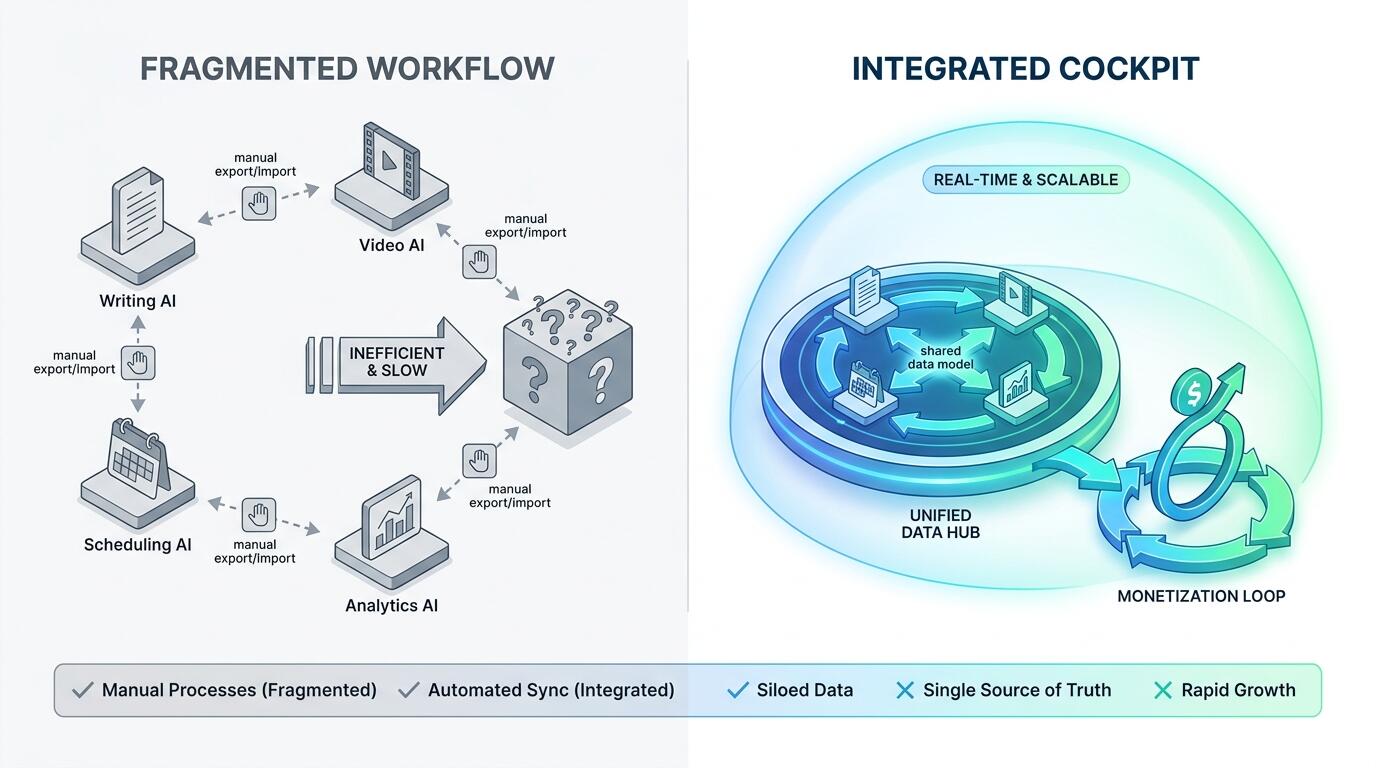
ALT: Side-by-side workflow diagram comparing fragmented AI tools versus a native integrated content monetization loop
Head-to-Head Comparison: AI Tools for Content Creation and Monetization
The table below compares the three approaches across the criteria defined earlier. Figures marked "Consult provider" reflect metrics that vary by specific tool and pricing plan rather than being fixed brand attributes.
| Criterion | Fragmented Point Solutions | All-in-One Generic Suites | Native AI-Integrated Cockpits |
|---|---|---|---|
| Workflow continuity | Low — manual export/import between tools | Moderate — shared login, limited shared data model | High — shared data model across creation and monetization |
| Time-to-revenue | Slower — coordination overhead delays publishing | Moderate — faster onboarding, shallow monetization logic | Faster — feedback loop directly informs next revenue action |
| Data context retention | Minimal, scattered across tool silos | Partial, often limited to session or single-feature memory | Strong, context persists across the full creator workflow |
| Total cost of ownership | Consult provider (subscription costs plus hidden integration time) | Consult provider (bundled pricing, variable feature depth) | Consult provider (typically higher initial setup, lower ongoing coordination cost) |
| Scalability with content volume | Degrades as manual handoffs multiply | Moderate, constrained by shallow AI depth | Designed to scale with volume since architecture is AI-native |
| Creative control | High per-tool control, low overall coherence | Moderate, can flatten voice toward generic templates | High, because context retention preserves brand voice at scale |
The clearest differentiator in this table is workflow continuity, and it is not a minor usability nicety — it is the mechanism that determines whether "closing the loop" from content creation to monetization is even architecturally possible. Fragmented stacks and shallow suites can still produce good individual pieces of content, but they consistently struggle to turn performance data back into better monetization decisions without manual intervention.
Cost is genuinely harder to compare on paper, which is why the table intentionally defers to "consult provider" rather than inventing numbers. Per the AI pricing and monetization playbook, AI-native products increasingly monetize on demonstrated outcomes rather than flat seat licenses, which means the true cost comparison has to include the value of faster, more reliable monetization loops, not just subscription price tags. A cheaper point-solution stack that costs a creator hours of weekly reconciliation work is not actually the cheaper option once that time is priced in.
The engineering pattern behind the "native" column is discussed further in LLM Integration Patterns Every Engineering Team Should Know This Quarter, which is directly relevant for teams building or evaluating these systems from the architecture side rather than the end-user side.
Which Should You Choose? Scenario Recommendations
If you are an individual creator just testing a niche with low, irregular publishing volume, a fragmented point-solution stack can be an acceptable starting point, because the coordination overhead is still manageable at low volume and the upfront cost of a fully integrated system may not yet be justified. The tradeoff is that this approach will need to be re-evaluated the moment publishing frequency or monetization complexity increases.
If you are a growing creator or small team managing multiple content formats and at least one active monetization channel — subscriptions, sponsorships, or product sales — an all-in-one generic suite can reduce tool-switching friction, but you should stress-test it specifically on whether audience feedback data actually flows into content planning, not just whether it feels convenient to log into one dashboard.
If you are scaling content production, managing multiple monetization channels simultaneously, or building a product around AI-assisted content workflows for others, a native AI-integrated creator cockpit is the stronger long-term architecture, because it is designed so that the feedback loop between what you publish and what earns revenue closes automatically rather than through manual reconciliation. Engineering leaders evaluating this path for their own product roadmap may also find it useful to weigh the organizational question addressed in Engineering Director vs. CTO: Choosing the Right Leader for Your Stage, since the choice of tool architecture and the choice of technical leadership tend to be linked decisions at scale.
In short: fragmented stacks favor low commitment and flexibility at small scale but degrade fastest under growth; generic suites favor convenience but often plateau in monetization depth; native cockpits favor compounding value and scalability but ask for a more deliberate initial architectural commitment.
Frequently Asked Questions FAQ
How do AI tools actually help close the loop between content creation and monetization?
AI tools close this loop by connecting audience and performance data back into the creative and pricing process, rather than treating creation and monetization as separate stages. According to the "12 Best AI Tools to Use for Content Creation" industry roundup published by GetBlend, the most effective creator tools increasingly combine generation capabilities with distribution and audience insight in a single workflow, which is precisely the continuity that determines monetization speed.
Is a native AI-integrated cockpit worth it for a solo creator, or only for teams?
It depends on publishing volume and monetization ambition rather than team size alone. A solo creator publishing frequently across multiple monetized channels benefits from native integration just as much as a team does, because the coordination cost of fragmented tools scales with content volume, not headcount.
How much does switching from a fragmented AI tool stack to an integrated one typically cost?
Costs vary significantly by provider, feature scope, and migration complexity, so specific figures should be confirmed directly with each provider rather than assumed. The more reliable comparison is total cost of ownership, which should include the ongoing time cost of manual data reconciliation in a fragmented stack, not just the sticker price of each subscription.
Key Takeaways
Closing the loop from content creation to monetization depends far more on architectural integration than on the sophistication of any single AI feature, and fragmented tool stacks tend to leak value at every manual handoff between creation, distribution, and revenue. All-in-one suites reduce friction but often stop short of true monetization depth because AI was added as a feature layer rather than designed as a foundational capability.
Native AI-integrated creator cockpits, where AI is a load-bearing part of the architecture from the start, are the approach best positioned to sustain a genuine content-to-monetization loop as volume and monetization complexity grow. Teams building their own AI-native tools should also examine the underlying technical foundation, a topic covered in The Minimum Viable Architecture for Your First AI-Powered App, since the same architectural principles that serve creators also apply to builders shipping AI products.
The practical next step is to audit your current content workflow specifically for the number of manual handoffs between creation and revenue-generating decisions, since each one is a candidate for automation through better-integrated AI tooling. Reducing those handoffs, rather than simply adding more point tools, is the fastest route to a genuinely closed loop.
Ready to experience AI built the right way — as a native capability, not an afterthought? Explore Darius's suite of production-ready AI products, from smart cloud storage to AI-powered mock interviews and creator tools, at the Darius website. Visit today to see how Darius can help you work smarter, prepare better, and create faster with AI.
Sources & Citations
- Bessemer Venture Partners. "The AI pricing and monetization playbook".
https://www.bvp.com/atlas/the-ai-pricing-and-monetization-playbook - Kyle Poyar via LinkedIn. "Everyone seems to be talking about AI agents.".
https://www.linkedin.com/posts/kyle-poyar_ai-aiagent-monetization-activity-7315721933432512512-nN6j - GetBlend. "12 Best AI Tools to Use for Content Creation in 2026".
https://www.getblend.com/blog/10-best-ai-tools-to-use-for-content-creation/ - National Institute of Standards and Technology (NIST).
https://www.nist.gov/
Note: Standards may be updated; please check the latest official documents or consult professional advisors.