Hugging Face hands open-model routing to OpenRouter, Claude's text watermark reaches four older models, AWS WorkSpaces signs agents in as the user with session replay
No new models today. The thread is the operating layer around agents and open models: routing, caching, parking and identity with audit, where Hugging Face, AWS, Google and NVIDIA each showed ways to cut cost and stay accountable. On security, Google says autonomous frameworks now turn patches into attacks, while watermarks and outside assessments fill in what can be verified. For product teams, cost and accountability increasingly depend on what surrounds the model.
Language model requests through Inference Providers now go through OpenRouter, which picks a provider per call on live price, speed and reliability and retries on the next one inside the same call if the first fails. It supports OpenAI's Chat Completions and Responses APIs and Anthropic's Messages API.
A suffix on the model id selects a policy or provider (such as :fastest, :cheapest or :novita). Routing is cache-aware: a stable UUID per conversation in the X-HF-Session-Id header keeps it on the provider holding its prompt cache. OpenRouter says the new routing cut capacity errors by 46% and improved time to first token by 16.9% and throughput by 16.3%.
Pricing is unchanged: you pay the provider's price on your Hugging Face bill with no markup, and PRO users get $2 of monthly credits. Breaking change: you can no longer use your own provider API key for language models; custom keys for image and video providers still work.
Figures cited: open-weight models went from 26.8% of tokens on OpenRouter in October 2025 to 71.7% at the end of September 2026, and average $0.28 input and $1.62 output per million tokens, against $1.27 and $6.36 for closed models.
Builder's takeI would route PandaClaws' less quality-sensitive batch rewriting through the :cheapest suffix for a week and compare cost per task and rework rate with the closed model it uses now. Teams already using their own provider keys on Inference Providers need to sort out billing first, since this is a breaking change; for multi-turn chats, send the session id or cache hits will drop.
From November 16, text generated by Claude Opus 4.6, Opus 4.5, Sonnet 4.5 and Haiku 4.5 carries Anthropic's text watermark on supported platforms; the November 3 update already covered Claude Mythos 5, Opus 4.7 and Sonnet 4.6.
Per the docs, the watermark does not change the meaning, quality or readability of the output, adds no tokens or hidden characters and carries no information about you or your organization; no change to requests or response handling is needed.
If a request sets temperature, top_p or top_k to a non-default value, the output might not carry the watermark. The docs warn that frameworks or client libraries may set these for you, so check the request body they send and remove them if you rely on the watermark.
Builder's takeIf your product promises that generated content is identifiable, capture the request body your SDK and framework actually send first; many wrappers set temperature by default. Do not lean on it for cases like AI Interview, where you want to know whether a candidate's answer was AI-written: it covers only some Claude models, and a different model or one changed parameter removes it.
You can describe an agent's needs to a coding assistant such as Claude Code, Codex or Kiro, which builds the WorkSpace from adjustable defaults guided by AWS MCP skills; agents built on Bedrock AgentCore connect with AWS credentials and no agent code. New tools let an agent carry out a series of actions in one call and use the computer-use actions its model already knows.
Agents can now sign in through any OIDC identity provider in addition to SAML. With on-behalf-of sign-in, an agent works as the signed-in user, with that user's directory identity, permissions and Group Policies.
Session replay turns session screenshots into a video paired with a plain-language transcript of the agent's actions, stored in your own S3 bucket and encrypted with your own keys, for security review and audit evidence.
Builder's takeHaving an agent act as the user, within that user's existing permissions, and leave a replayable record is the minimum you need before security and compliance teams will sign off. Our own back-office automation should follow the same order: identity and replay first, more permissions later.
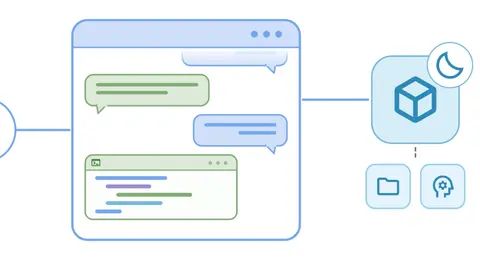
Citing a study of GitHub Copilot agent traces, the agent waits for the user about 80% of the time in a typical multi-prompt session, and a turn averages 396.3 seconds of agent work. Assuming 2 prompts an hour over an 8-hour day, the agent works 22% of the time.
With one Pod per session, 100 coding agents need 34 nodes and about $1,288 a month. Snapshotting idle actors with Agent Substrate after a 2-minute timeout needs a 15-node warm pool plus one control-plane node, saving 40% of the node bill; the pool is full about once in 3,500 turns, when a request waits 5 seconds by default and then gets HTTP 503.
Busier agents save less: at 4 prompts an hour the pool needs 27 nodes and saves 4%, and above about 4.5 one Pod per session is cheaper. The control plane is a fixed cost, so parking pays from about 37 coding sessions. Overcommitting Pods at a 0.25 vCPU request with a 1 vCPU limit fits the same 100 agents on 9 nodes, at the price of agents competing for CPU.
Agent Substrate does not suspend idle actors by itself: your harness must call the suspend API after a timeout. Autoscaling follows worker Pods, not suspended actors, so scale the pool to zero after hours with a scheduled job.
Builder's takeRead with the 11-11 item on NVIDIA donating Agent Substrate to the CNCF, this is the first cost model you can apply directly: measure your prompt rate before choosing. Sessions under 4 prompts an hour suit parking; busier ones should get one Pod each or be overcommitted. PandaClaws' background jobs mostly fire intermittently, so I would instrument how busy its sessions really are first.
Implicit caching reuses eligible prefixes automatically on a best-effort basis; explicit caching marks reusable prefixes with breakpoints, several up to the model's maximum, to cache layers that change at different rates. Minimum prefix length, breakpoint limits and TTL are on each model card, and the TTL resets with each hit.
Cache reads are billed below the standard input rate; depending on the model, cache writes can cost more than standard input. When content after a shared prefix changes on every request, use explicit caching so you do not pay to write content that is never read back.
In the example, an OpenCode coding agent session on the same API uses implicit caching with no configuration, and each later request reads everything up to the end of the previous one from cache. Cross-Region inference can cause extra cache writes at times of high demand.
Builder's takeAI Cloud Drive's document Q&A is the classic fixed long prefix with a different question each time, which suits explicit breakpoints; agent loops are fine with implicit caching. Before launch, check the cached_tokens field in responses, as the post suggests, rather than guessing from the monthly bill.
Endpoints v1.0 measures the balance between serving capacity and responsiveness on coding and enterprise workflows through API endpoints. Generated tool calls and workflow intent are checked against reference values during runs, and separate SWE-bench Verified evaluations assess end-to-end task solving.
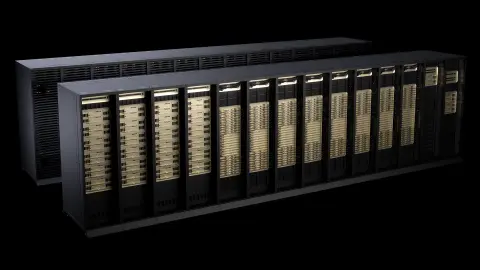
Across Kimi K3, DeepSeek-V4.1-Flash and Qwen3.6-35B-A3B, Vera Rubin NVL72 achieves 5x to 10x the throughput per kilowatt of GB300 NVL72 and 3x to 5x higher end-to-end interactivity at matched concurrency; on Kimi K3 it exceeds 10x throughput per kilowatt at a minimum of 50 tokens per second per user.
The Vera Rubin results are provisional, pending MLCommons verification; the GB300 results are verified.
NVIDIA credits prefix caching, state reuse, Dynamo routing and disaggregated prefill and decode, plus model-specific work such as DeepSeek's MegaMoE kernel and Qwen's multi-token prediction.
Builder's takeFor teams without their own hardware, this suggests hosted open-model prices still have room to fall, but the results are provisional and I would not sign long contracts on them. The practical part is the techniques, which match today's Hugging Face and Bedrock items: most of an agent workload's cost is repeated context, so get caching and session affinity right first.
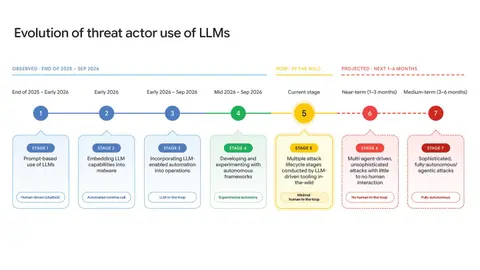
According to GTIG's latest AI Threat Tracker report, attackers use autonomous LLM frameworks to continuously scan software updates, figure out which flaw was patched and build an attack for it, all without human involvement.
Google's response is Google AI Threat Defense, combining Gemini and other frontier models, Wiz's context and prioritization, CodeMender's automated patching and Mandiant's expertise to find and fix flaws continuously.
Builder's takeRead with the 11-14 item where Cloudflare saw requests from AI penetration testing orchestrators rise 30x since October 1: patches now get taken apart automatically as soon as they ship. I would move security updates from a monthly batch to same-day merges, starting with internet-facing services.
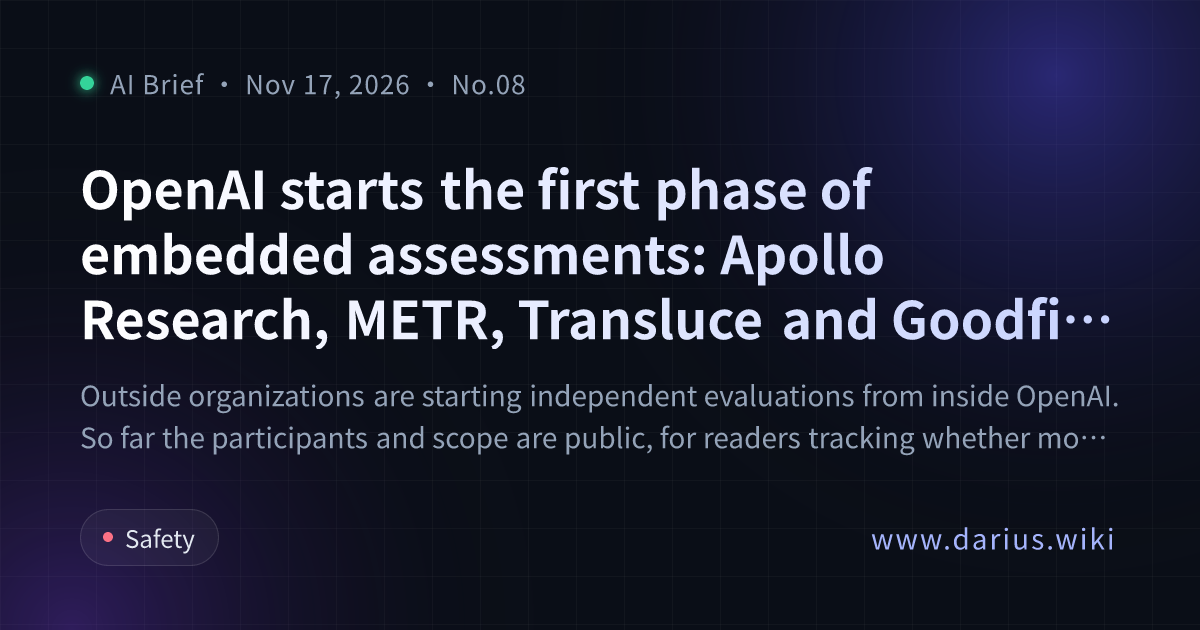
OpenAI announced the first phase of embedded assessments, with Apollo Research, METR, Transluce and Goodfire.
Their scope is to independently evaluate OpenAI's model alignment, safeguards and monitoring systems.
Builder's takeThere is only a list of participants and a scope so far, nothing to act on yet. I would wait for the first reports, check them against the OpenAI models in my products for known gaps in monitoring and safeguards, and then decide where to add my own review layer.
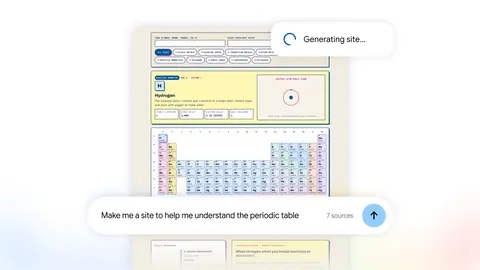
Type "make me a site" in Gemini Notebook chat with a description of what you want; Google's examples include explainers such as an interactive periodic table or a historical timeline, dashboards for quarterly sales data and project trackers with tasks and deadlines.
Built sites open in a new tab to interact with or share. It is rolling out globally on the web for Gemini Notebook users aged 18 and over, including Google Workspace subscribers, with the mobile app coming soon.
Builder's takeTurning sources straight into interactive pages is becoming standard for note-taking products. AI Cloud Drive already understands files, so the next step to try is "turn this folder into a dashboard", tested internally on our own weekly reports to see whether anyone actually reopens it.
Researched and drafted with AI assistance; editorial standards and views set by Darius.
Every Monday, the week in AI in one email
Every Monday morning: the 6 AI stories that mattered most in the past seven days, with my take, in your inbox.
Your email is only used to send the weekly and is never shared. Every email has a one-click unsubscribe link. See the latest issue →