Why Do LLM Evaluations Give Different Scores for the Same Input?
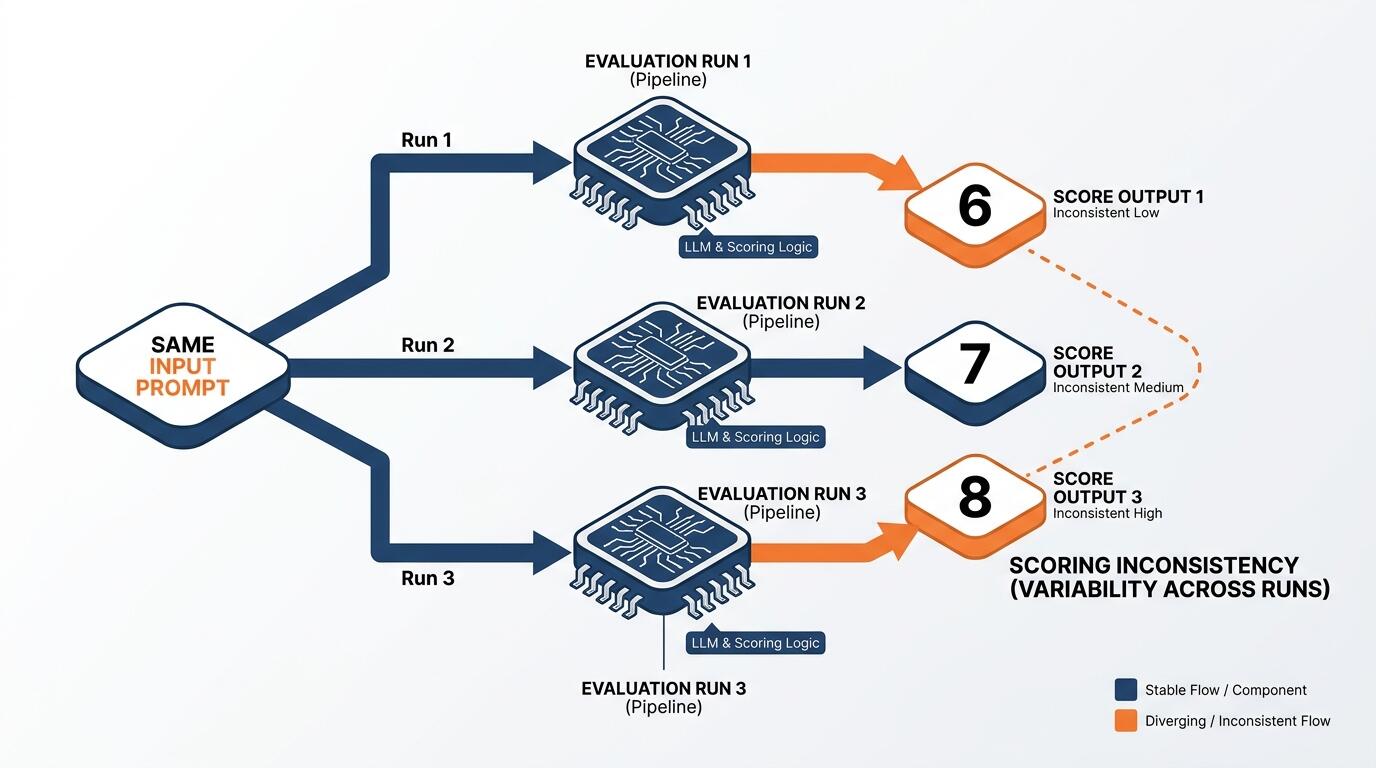
ALT: LLM evaluation scoring inconsistency diagram showing same input producing different scores across evaluation runs
Why LLM Evaluation Scores Are Never as Stable as They Look
LLM evaluation scores fluctuate for the same input because the evaluation process itself is probabilistic, context-sensitive, and often model-dependent — meaning identical prompts fed through the same evaluation pipeline on different runs can produce measurably different results. This is not a bug in your setup. It is a structural property of how large language models work, and understanding the exact mechanisms behind it is the difference between shipping a reliable AI system and chasing phantom quality regressions.
This question deserves serious attention right now because teams everywhere are scaling evaluation pipelines, adopting LLM-as-a-Judge frameworks, and making consequential product decisions based on benchmark scores. If those scores are silently unstable, the downstream consequences — shipping a worse model, misjudging a regression, or over-investing in prompt changes that deliver no real gain — are significant. In our work architecting and shipping live AI systems, evaluation unreliability is one of the most underestimated sources of wasted engineering effort.
The Current Landscape of LLM Evaluation and Why It Is Harder Than It Looks
LLM evaluation is the practice of systematically measuring the quality, safety, and reliability of outputs produced by large language models. For most of the field's early history, evaluation meant static benchmarks — fixed question sets with deterministic correct answers, scored by string matching or human raters. That approach worked reasonably well when models were primarily answering factual questions. It breaks down badly when the task is open-ended: summarization, code generation, reasoning chains, multi-turn dialogue, or any domain where "correct" is a spectrum rather than a binary.
The industry has responded by moving toward two dominant evaluation paradigms. The first is reference-based evaluation, where model outputs are compared against a gold-standard reference using metrics such as ROUGE, BLEU, or BERTScore. The second — and rapidly ascendant — paradigm is LLM-as-a-Judge, where a separate (often larger) language model scores or ranks the outputs of the model under test. According to Confident AI's analysis of LLM-as-a-Judge methodology, this approach has become popular precisely because it scales to open-ended tasks where reference-based metrics fail to capture semantic quality.
Both paradigms carry sources of variance that are rarely documented clearly. Reference-based metrics suffer from sensitivity to surface-level phrasing differences that do not reflect actual quality differences. LLM-as-a-Judge methods inherit all the stochasticity of the judge model itself. The net result, well documented by Evidently AI's work on LLM evaluation metrics, is that teams frequently observe score ranges of several points across identical evaluation runs — and struggle to determine whether those swings reflect a real quality change or pure noise.
The broader context matters here. As organizations invest in AI system architecture patterns that route user requests through multiple LLM layers — retrieval augmentation, tool use, multi-agent orchestration — each layer introduces its own evaluation challenge. A score on a single isolated prompt tells you less and less about end-to-end system quality. And yet, isolated prompt evaluations are still the default in most pipelines.
The Root Causes of Score Instability in LLM Evaluations
Score instability in LLM evaluations stems from at least four distinct, compounding mechanisms. Understanding them separately is essential for diagnosing which one is affecting your pipeline.
Temperature and Sampling Stochasticity
Temperature is the parameter that controls the randomness of a model's token sampling process. A temperature of zero makes the model deterministically select the highest-probability token at each step; any value above zero introduces sampling randomness. Most deployed models — including those used as judges — run with non-zero temperatures, because zero-temperature outputs can be brittle and repetitive.
The practical consequence is that every inference call to an LLM is a probabilistic sample from a distribution. Two calls with the same input, same model, and same configuration will produce different token sequences when temperature is greater than zero. When the model is acting as a judge, those token differences translate directly into different scores. A judge that would score a response as "7 out of 10" on one call might return "6 out of 10" on the next — not because the quality of the response changed, but because the judge sampled a slightly different reasoning path.
Prompt Sensitivity and Framing Effects
Prompt sensitivity refers to the phenomenon where small, semantically equivalent changes to a prompt produce substantially different model outputs. This is one of the most consistently observed and frustrating properties of current-generation language models, and it applies just as powerfully to evaluation prompts as it does to generation prompts.
A judge model evaluating "Rate the following answer for factual accuracy on a scale of 1 to 10" will not necessarily produce the same score distribution as one evaluating "On a scale of 1 to 10, how factually accurate is the following answer?" The ordering of criteria in a rubric, the choice between a numeric scale and a categorical label, and the presence or absence of worked examples all shift the judge's behavior. This is not irrational — it reflects the model's training, which shapes what implicit expectations the prompt activates.
Context Window Position and Ordering Effects
Positional bias in LLM judges is a documented phenomenon where the judge assigns higher scores to responses that appear in a particular position — most commonly, the first or last item in a list when pairwise comparisons are used. Research cited in Confident AI's LLM-as-a-Judge guide identifies this as one of the primary reliability concerns with pairwise evaluation formats.
Even in non-comparative settings, the order in which criteria, examples, or context appear in the prompt influences which aspects of the response the judge attends to most. If your evaluation prompt includes a rubric, the criteria listed first tend to receive disproportionate weight. Reordering the rubric without changing anything else can shift aggregate scores meaningfully.
Judge Model Calibration and Verbosity Bias
Calibration in this context means the degree to which a model's stated confidence or score reflects actual quality differences. Many LLM judges are not well-calibrated out of the box. They exhibit systematic tendencies: a preference for longer responses (verbosity bias), a tendency to score responses that use confident-sounding language more highly regardless of factual content, and a bias toward responses that stylistically resemble the judge model's own training distribution.
These biases are stable within a given judge model but vary across models. If you switch your judge from one model to another — even models of comparable capability — you will likely see a systematic shift in your score distributions that has nothing to do with a change in the quality of the responses being judged.
Evidence, Trade-offs, and Competing Approaches to Evaluation Reliability
The evaluation reliability problem is not theoretical. In practice, teams encounter it through a predictable set of symptoms: regressions that appear and disappear without explanation, evaluation scores that disagree with human judgment, and A/B test results that flip when the evaluation is re-run. A deep technical discussion by Hamel Husain available via YouTube on LLM evaluation covers many of these failure modes in practitioner detail.
The field has converged on several strategies for managing variance, each with distinct trade-offs:
| Perspective / Approach | Strengths | Trade-offs | Best Fit |
|---|---|---|---|
| Deterministic metrics (ROUGE, BLEU, exact match) | Zero run-to-run variance; fast and cheap | Poor semantic coverage; fails on open-ended tasks | Factual QA, classification, structured extraction |
| LLM-as-a-Judge (single judge, default settings) | Scales to open-ended tasks; correlates with human judgment | High variance from temperature; susceptible to positional and verbosity bias | Rapid prototyping; initial quality checks |
| LLM-as-a-Judge (ensemble / multi-judge) | Reduces variance through averaging; more robust calibration | Higher inference cost; complexity in aggregation | Production evaluation pipelines; regressions testing |
| Human evaluation | Ground truth; captures nuance that models miss | Slow, expensive, cannot scale; inter-rater variability | High-stakes decisions; calibrating automated pipelines |
| Hybrid (automated + targeted human) | Balances scalability with ground-truth anchoring | Requires careful selection of when to invoke human review | Mature products with clear quality dimensions |
The ensemble approach — running multiple judge evaluations on the same input and aggregating the results — is increasingly recommended as a practical production standard. It does not eliminate variance, but it narrows the confidence interval enough that score movements become more meaningful. The cost is higher inference spend, which connects to a broader question about how AI inference costs accumulate in production as evaluation runs scale.
A pattern we consistently observe when working with teams on live AI systems is that evaluation reliability problems are often discovered too late — after a team has made architectural or model-selection decisions based on scores that, when examined closely, had confidence intervals wider than the differences they were used to justify. Building evaluation pipelines that make variance explicit — by running multiple samples and reporting ranges rather than point estimates — is one of the highest-leverage improvements teams can make.
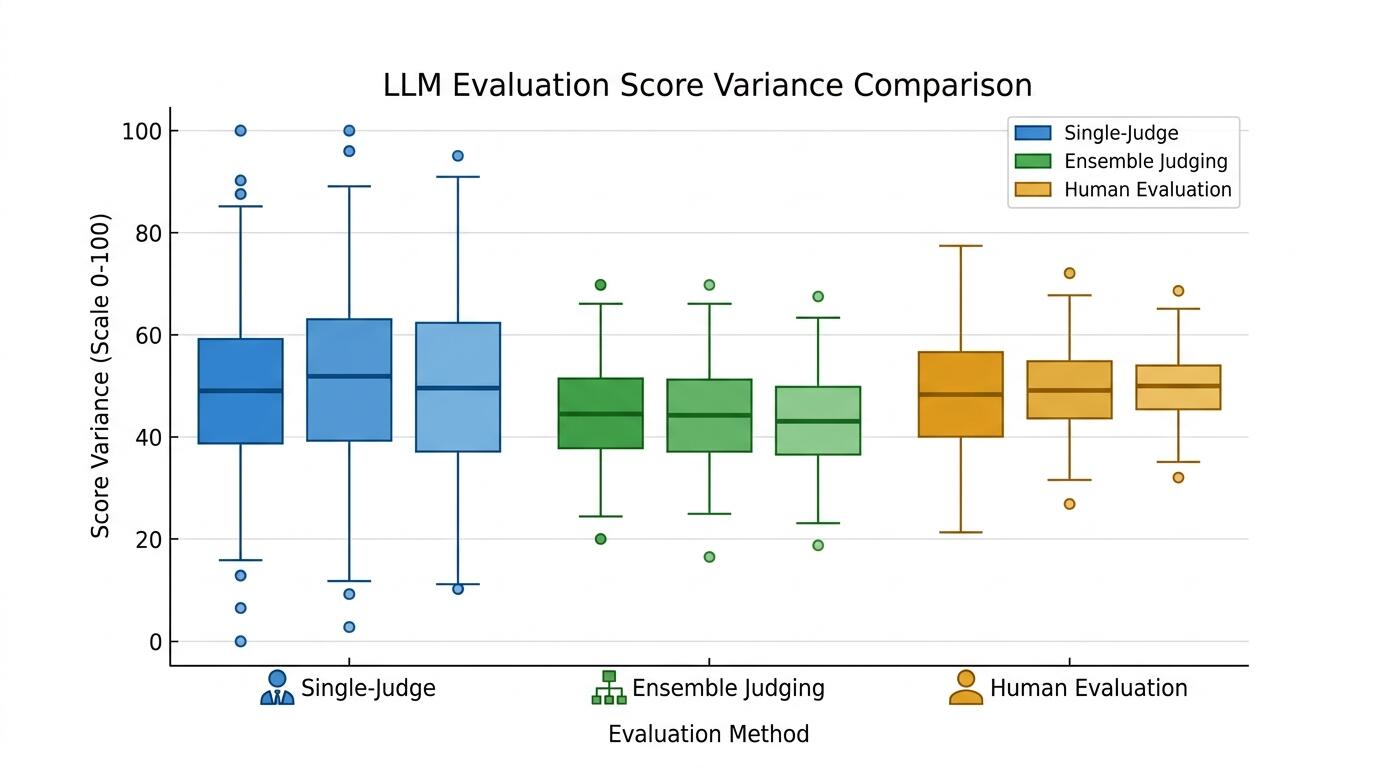
ALT: Comparison chart showing LLM evaluation score variance across single-judge, ensemble, and human evaluation methods for identical inputs
What This Means for Teams Building AI Systems
The direction of the field is toward structured, multi-dimensional evaluation that treats scoring outputs as distributions rather than point values. The emerging best practice, as described in Evidently AI's documentation on LLM evaluation metrics, is to define evaluation rubrics along specific, independently measurable dimensions — factual accuracy, relevance, coherence, safety — and evaluate each dimension separately with purpose-built prompts, rather than asking a judge to produce a single holistic score.
Several actionable implications follow directly from the analysis above:
First, always run your evaluation suite multiple times on the same data and report the mean and variance of scores, not a single number. A score of 7.2 with a standard deviation of 0.8 tells you something fundamentally different from a score of 7.2 with a standard deviation of 0.1.
Second, fix the temperature of your judge model to zero when you are specifically trying to measure regression between two versions of a system. The goal of regression testing is sensitivity to real changes, not sampling a distribution of possible quality assessments.
Third, test your evaluation prompts for sensitivity the same way you test your product prompts. Run semantic equivalents of your rubric and check whether the score distribution is stable. If it is not, you do not yet have a reliable evaluation signal.
Fourth, calibrate your automated pipeline against human judgments on a held-out sample at regular intervals. Without this calibration step, you cannot know whether your automated scores are tracking real quality or judge model idiosyncrasies. For teams architecting systems at scale, understanding what questions to ask before committing to an evaluation architecture is as important as the technical implementation — the principles that apply to choosing an AI architecture partner also apply to choosing your evaluation strategy.
The deeper implication is cultural. Teams need to stop treating evaluation scores as measurements in the engineering sense — precise, reproducible, objective — and start treating them as estimates with known uncertainty properties. That shift in framing is uncomfortable because it makes quality harder to communicate in dashboards and status updates. But it is more honest, and it leads to better decisions.
People Also Ask
Q1: How can I reduce score variance in my LLM evaluation pipeline?
Reducing LLM evaluation score variance involves several concrete steps. Set the judge model's temperature to zero for regression and A/B testing scenarios. Run multiple evaluation passes on the same inputs and aggregate results rather than relying on a single score. Use dimension-specific rubrics instead of holistic single-score prompts, and validate your evaluation prompts for sensitivity by testing semantically equivalent variants. Ensemble judging — using multiple judge models and averaging their outputs — provides the strongest variance reduction at the cost of increased inference spend.
Q2: Is LLM-as-a-Judge reliable enough for production quality gates?
LLM-as-a-Judge is reliable enough for production use when implemented with appropriate controls: ensemble judging, fixed temperature, and regular calibration against human annotations. According to Confident AI's analysis of the methodology, LLM-as-a-Judge achieves strong correlation with human judgment on well-defined evaluation dimensions. The key qualifier is "well-defined" — holistic, single-score prompts are far more variable than rubric-based, dimension-specific evaluation. Used without these controls, LLM-as-a-Judge scores carry enough variance to produce misleading regression signals.
Q3: How much does running a robust LLM evaluation pipeline cost at scale?
The cost of a production LLM evaluation pipeline depends primarily on the volume of inference calls and the model tier used for judging. Ensemble approaches — running three or more judge passes per evaluation — multiply inference costs proportionally. Teams typically find that evaluation inference costs can rival generation inference costs at scale, particularly when evaluating multi-turn conversations or long-document tasks. Structuring evaluation to run asynchronously and targeting intensive evaluation only at meaningful checkpoints — rather than every inference — is the standard approach to managing cost without sacrificing signal quality.
The Bottom Line
Key Takeaway: LLM evaluation scores vary for the same input primarily because of temperature-driven sampling stochasticity in the judge model, prompt sensitivity to framing and ordering, positional bias in comparative evaluations, and systematic calibration issues within specific judge models.
Key Takeaway: Single-run, point-estimate evaluation scores are not sufficient for production quality gates. Reporting score ranges and standard deviations is a minimum requirement for making evaluation results meaningful.
Key Takeaway: Ensemble judging, fixed-temperature regression testing, and dimension-specific rubrics are the three most impactful interventions for improving evaluation reliability without rebuilding your entire pipeline.
Key Takeaway: Calibrating automated evaluation against human judgment at regular intervals is the only way to know whether your pipeline is tracking real quality changes or model artifacts.
Key Takeaway: The fundamental shift teams need to make is treating evaluation outputs as statistical estimates with known uncertainty — not as precise engineering measurements.
The practical next step is to audit your current evaluation setup: check whether you are running single-pass or multi-pass scoring, whether temperature is controlled, and whether your rubrics are dimension-specific or holistic. Those three checks will surface the highest-priority improvements in under an hour of review.
If you're looking to turn your idea into a live, running product — from AI architecture to full-stack execution — visit the Darius website to explore real-world projects, technical insights, and professional services. Whether you're an early-stage founder or a scaling engineering team, Darius brings the hands-on expertise to help you build smarter and ship faster.
Sources & Further Reading
- Confident AI. "LLM-as-a-Judge Simply Explained: The Complete Guide to..."
https://www.confident-ai.com/blog/why-llm-as-a-judge-is-the-best-llm-evaluation-method - Evidently AI. "LLM evaluation metrics and methods, explained simply"
https://www.evidentlyai.com/llm-guide/llm-evaluation-metrics - Hamel Husain. "A Deep Dive on LLM Evaluation"
https://www.youtube.com/watch?v=IsZVCnViwhk
Note: Standards and best practices in LLM evaluation are evolving rapidly; please verify current guidance against the latest official documentation or consult qualified technical advisors.