AI System Architecture Patterns Every CTO Should Evaluate This Quarter
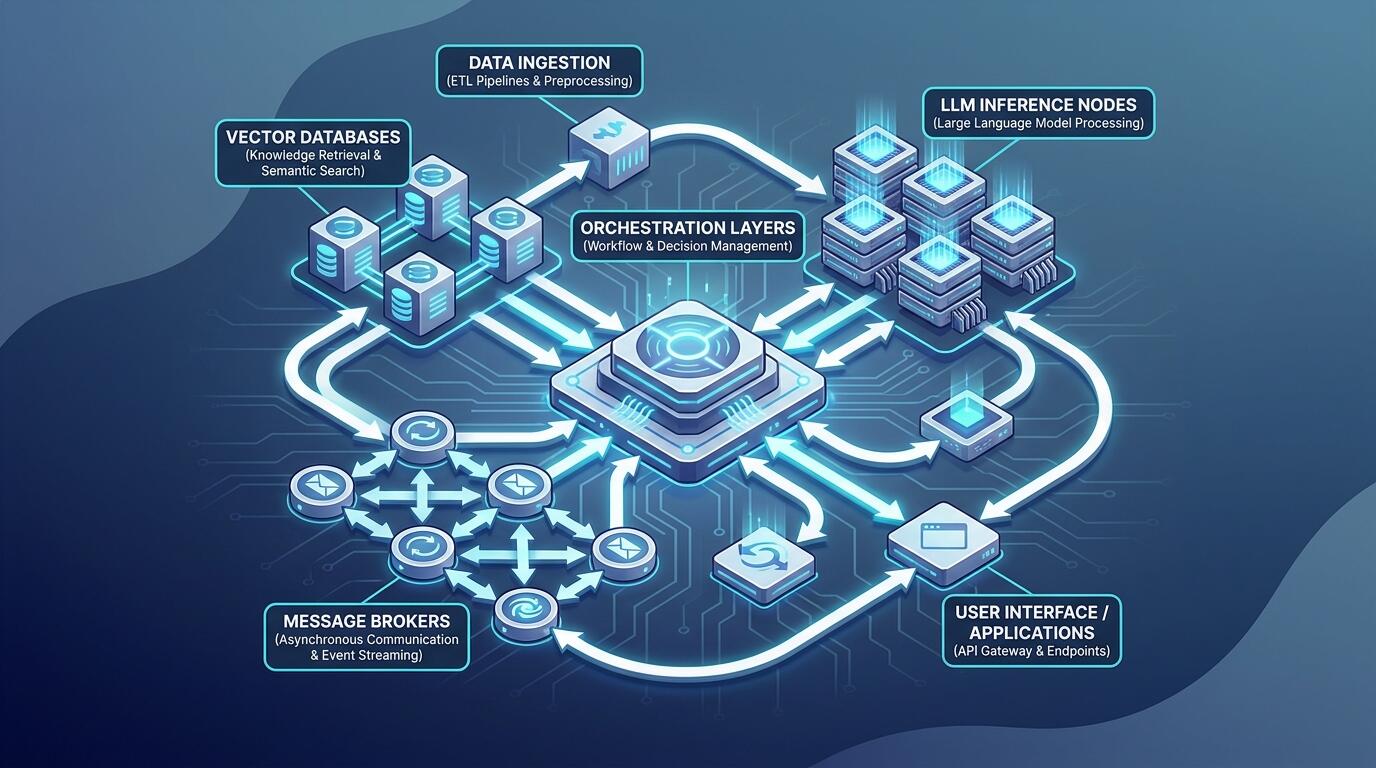
ALT: AI system architecture patterns for CTOs evaluating modern AI infrastructure and design strategies
The Architecture Decisions That Will Define Your AI Products This Quarter
Which AI system architecture pattern should your organization evaluate right now? The honest answer is that there is no single best pattern — but there are a handful of foundational approaches that, chosen well, determine whether your AI product ships reliably and scales gracefully, or becomes a maintenance liability that slows every subsequent sprint.
The architectural decisions made during early product design carry disproportionate weight. In our work consulting with engineering teams and founders, a pattern we consistently see is that organizations who invest deliberately in architecture selection before writing production code avoid the painful — and expensive — refactoring cycles that plague teams who default to whatever framework is trending. This article breaks down the core AI system architecture patterns that deserve serious evaluation this quarter, explains when each is appropriate, and offers a practitioner's lens on how to choose among them.
Which Teams and Projects These Patterns Apply To
Applicable Scenarios:
- Startups building AI-powered products from scratch who want to make defensible architectural choices before scaling
- Engineering teams at growth-stage companies integrating large language models (LLMs) or machine learning pipelines into existing systems
- CTOs and technical leads evaluating whether their current architecture can absorb increased AI workloads without fundamental redesign
Not Applicable/Cautions:
- Organizations that have already shipped and stabilized a well-performing AI system — architectural overhauls mid-product carry significant risk and require careful justification
- Teams lacking the engineering depth to implement and operate distributed or event-driven architectures; in these cases, simpler patterns with lower operational overhead are preferable until capacity grows
Why Architecture Pattern Selection Matters More Than Model Selection
Most conversations about AI products center on model selection — which LLM to use, which embedding model performs best, which inference provider offers the lowest latency. But according to IEEE guidance on software architecture principles, the structural decisions that govern how components communicate, how data flows, and how the system recovers from failure have longer-lasting consequences than any individual technology choice. Models change; architectures persist.
The current generation of AI systems introduces architectural complexity that earlier software categories did not. Non-determinism in model outputs, latency variability in inference calls, the need for retrieval pipelines, and the challenge of orchestrating multi-step reasoning chains all demand architectural patterns purpose-built for these constraints. A CRUD-oriented monolith that worked well for a SaaS product in 2018 will buckle under the demands of a production AI agent system in the present environment.
Market signals reinforce this urgency. The proliferation of AI-native startups and the rapid enterprise adoption of generative AI capabilities have compressed the timeline between prototype and production. Teams that fail to architect deliberately at the outset frequently discover — often at the worst possible moment — that their system cannot handle concurrent users, cannot audit model decisions, or cannot swap in a better model without rewiring half the codebase.
The patterns described below are not theoretical constructs. They are the architectural approaches that appear repeatedly in production AI systems that actually ship and scale. Each one addresses a specific class of problem that teams encounter when moving from demo to deployment.
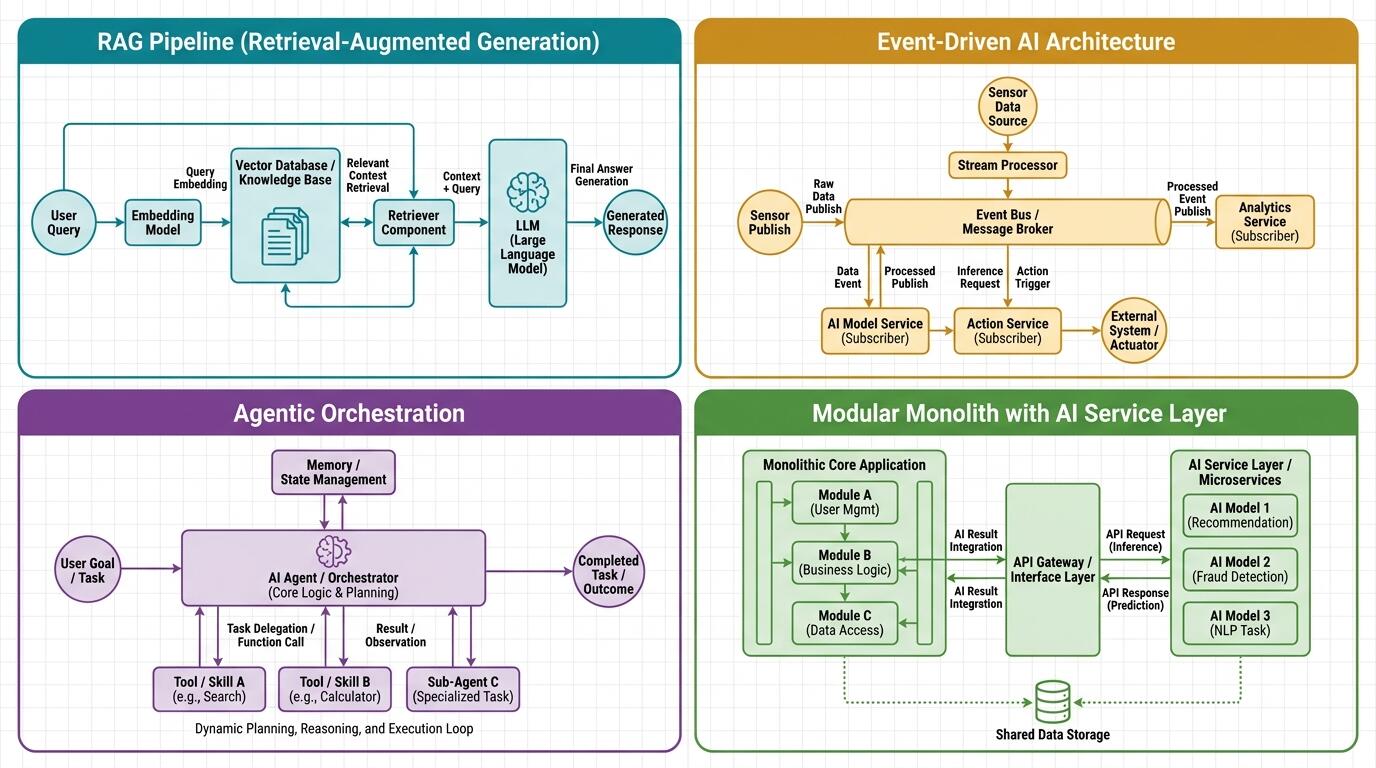
ALT: Diagram illustrating core AI system architecture patterns including RAG pipeline, event-driven design, and agentic orchestration for production AI products
Core AI Architecture Patterns: Evaluation, Comparison, and Implementation Guidance
A Practitioner's Three-Step Framework for Pattern Evaluation
Step 1: Map Your System's Dominant Failure Mode
Before selecting an architecture pattern, identify the single failure mode that would most damage your product. Is it stale or inaccurate information surfaced to users? Is it inability to handle concurrent inference load? Is it opacity in how decisions are made? Each dominant failure mode maps to a class of architecture patterns. This mapping exercise takes focused time with your engineering lead, but it prevents the common mistake of adopting a pattern because it is fashionable rather than because it solves your specific problem.
Step 2: Assess Your Team's Operational Ceiling
Every architecture pattern carries an operational cost. Event-driven architectures, for example, introduce message broker infrastructure that requires expertise to monitor and tune. Agentic systems with multiple LLM calls per request demand latency budgeting and cost modeling that simpler request-response designs do not. Honestly assess what your team can operate reliably in production before committing to a pattern. A well-operated simple architecture outperforms a poorly operated sophisticated one every time.
Step 3: Prototype the Integration Seam, Not the Happy Path
The most revealing architectural test is not whether your system works when everything goes right — it is how it behaves at the integration seam between your application logic and the AI component. Prototype the failure scenario: what happens when the model returns a malformed response? When the vector database times out? When the orchestration layer hits a rate limit? The architecture that handles these failure modes gracefully, with clear fallback behavior and auditability, is the one worth building on.
Comparing the Four Dominant AI Architecture Patterns
The four patterns most relevant to production AI product development today are the Retrieval-Augmented Generation (RAG) pipeline, the event-driven AI architecture, the agentic orchestration architecture, and the modular monolith with AI service layer. Each occupies a distinct position in the design space.
| Comparison Dimension | RAG Pipeline | Event-Driven AI Architecture | Agentic Orchestration | Modular Monolith with AI Layer |
|---|---|---|---|---|
| Primary Problem Solved | Knowledge grounding and factual accuracy | Async AI workloads and scalability | Multi-step reasoning and task automation | Simplicity with AI capability integration |
| Operational Complexity | Moderate | High | High | Low to Moderate |
| Latency Profile | Moderate (retrieval adds overhead) | Variable (async by design) | High (multi-hop LLM calls) | Low to moderate |
| Auditability | High (retrieved context is inspectable) | Moderate (depends on event log design) | Challenging (agent reasoning chains) | High (synchronous, traceable) |
| Best Fit | Knowledge-intensive Q&A, document grounding | Background processing, notifications, batch AI jobs | Autonomous task completion, research agents | Early-stage products, constrained teams |
| Swap Model Without Rewiring | Yes, if abstraction layer is clean | Yes | Partial | Yes |
Detailed Pattern Analysis: What Each Architecture Actually Demands
Retrieval-Augmented Generation (RAG) Pipeline
A RAG pipeline is an architecture pattern in which a language model's response is grounded by dynamically retrieved context — typically retrieved from a vector database or document store — rather than relying solely on the model's parametric knowledge. RAG directly addresses the hallucination and knowledge-currency problems that make raw LLM output unreliable in production.
In practice, a well-implemented RAG pipeline requires more than wiring a vector database to an LLM call. The retrieval quality determines the output quality, which means chunking strategy, embedding model selection, metadata filtering, and re-ranking logic all require deliberate design. Teams that underestimate the engineering depth of retrieval design frequently ship RAG systems that retrieve plausible-sounding but contextually wrong documents — a failure mode that is difficult for end users to detect and erodes trust quickly.
A pattern we consistently see in well-functioning RAG deployments is a clean separation between the ingestion pipeline (which handles document parsing, chunking, embedding, and indexing) and the query pipeline (which handles retrieval, re-ranking, prompt construction, and generation). Keeping these two concerns architecturally separated allows each to evolve independently — critical when your document corpus grows or your retrieval strategy needs tuning without disrupting live inference.
Event-Driven AI Architecture
An event-driven AI architecture is a design in which AI processing is triggered by and produces events on a message bus, decoupling the AI workload from the synchronous request lifecycle of the application. This pattern is the right choice when AI tasks are long-running, resource-intensive, or need to fan out across multiple downstream consumers.
Consider a document processing platform where users upload contracts for AI-powered analysis. Forcing that analysis into a synchronous HTTP request is architecturally unsound — it creates timeout risks, blocks server threads, and degrades the user experience under load. An event-driven approach — where the upload event triggers an AI processing job that emits a completion event consumed by a notification service and a results-storage service — is more resilient and scales horizontally.
The operational cost of this pattern is real. Teams need to instrument their message brokers carefully, design for at-least-once delivery semantics, and build idempotent AI processing logic. Per guidance from organizations like the Association for Computing Machinery (ACM), distributed event systems require explicit attention to ordering guarantees and failure compensation — concerns that are not present in simpler synchronous designs.
Agentic Orchestration Architecture
An agentic architecture is a system design in which an AI agent — an LLM with access to tools, memory, and the ability to plan multi-step actions — executes tasks autonomously across multiple inference calls and external service interactions. Agentic systems represent the frontier of production AI complexity.
The appeal is significant: agentic architectures can automate genuinely complex workflows that no single LLM call could complete. The risks are equally significant. Non-determinism compounds across multiple agent steps, making behavior difficult to predict and reproduce. Cost control is challenging because a runaway agent can make dozens of LLM calls in pursuit of a misunderstood objective. Auditing agent decisions — critical for any regulated industry — requires purpose-built tracing infrastructure.
In our experience advising teams on agentic systems, the most common failure is adopting agentic architecture for tasks that a well-structured RAG pipeline or even a conventional multi-step API workflow would handle more reliably. Agentic orchestration is appropriate when the task genuinely requires adaptive planning — not when it simply requires multiple sequential steps that can be hardcoded.
Modular Monolith with AI Service Layer
A modular monolith with an AI service layer is an architecture in which AI capabilities are exposed as a well-defined internal service within a single deployable unit, with the broader application organized into cohesive modules that enforce clear boundaries. This pattern is frequently undervalued in discussions dominated by distributed systems enthusiasm.
For many early-stage AI products, a modular monolith is the correct choice. It reduces operational overhead, simplifies debugging, and allows the team to move quickly without the coordination costs of microservices. The AI service layer provides a clean abstraction — the rest of the application calls the AI service through a defined interface, which means the underlying model provider can be swapped without propagating changes through the codebase.
The discipline this pattern requires is maintaining the modularity as the codebase grows. Without enforced module boundaries, a modular monolith degrades into an unmaintainable "big ball of mud" — a term used in software architecture to describe systems with no discernible structure. Enforced dependency rules and clear interface contracts are non-negotiable if this pattern is to remain healthy over time.
Advanced Considerations: Where Architectural Thinking Gets Harder
Hybrid Pattern Composition
Production AI systems rarely fit cleanly into a single pattern. A sophisticated product might use a modular monolith as its core application structure, incorporate a RAG pipeline for knowledge-grounded responses, and delegate long-running batch AI jobs to an event-driven processing layer. Hybrid composition is not a failure of architectural discipline — it is often the correct answer. The discipline required is ensuring that each pattern is applied where it genuinely adds value, with clear boundaries between the composed layers.
The Model Abstraction Layer is Non-Negotiable
A common misconception is that tightly coupling your application logic to a specific model provider's SDK is an acceptable shortcut in the early stages. It is not. The AI model provider landscape is evolving rapidly, and teams that hardcode provider-specific behavior into their core application logic consistently face painful refactoring when they need to switch providers, add fallback logic, or experiment with newer models. An abstraction layer — even a minimal one — that normalizes the interface to your AI capabilities is one of the highest-leverage architectural investments you can make early in a project.
Observability is an Architectural Concern, Not an Afterthought
In conventional software systems, observability is important. In AI systems, it is existential. Non-deterministic outputs, latency variability, token cost accumulation, and the difficulty of debugging multi-step reasoning chains mean that teams without purpose-built observability are essentially operating blind. According to the National Institute of Standards and Technology (NIST), AI system trustworthiness depends substantially on the ability to monitor, interpret, and audit system behavior — a standard that demands observability be designed in from the start, not retrofitted after incidents reveal gaps.
People Also Ask
Q1: How do you choose between a RAG pipeline and an agentic architecture for a new AI product?
Choose a RAG pipeline when your core problem is knowledge grounding — when users need accurate, retrievable information from a defined corpus and the interaction is primarily question-and-answer or document-aware generation. Choose an agentic architecture when the task requires genuine adaptive planning across multiple steps that cannot be predetermined. Most products benefit from RAG first; agentic complexity should be introduced only when simpler patterns provably cannot meet the product's requirements.
Q2: Is a modular monolith a legitimate architecture choice for a production AI system, or is it just a stepping stone?
A modular monolith is a fully legitimate production architecture for many AI products — not merely a transitional phase. Teams with well-enforced module boundaries, a clean AI service abstraction layer, and disciplined dependency management can operate high-quality AI products on this pattern indefinitely. The decision to migrate toward a more distributed architecture should be driven by concrete scaling pressures or team growth, not by a reflexive assumption that distributed is inherently more mature.
Q3: How much does architectural complexity affect the time and cost to ship an AI product?
Architectural complexity directly extends delivery timelines and increases both build and operational costs. Higher-complexity patterns — event-driven systems and agentic orchestration — introduce infrastructure that requires configuration, monitoring, and specialized expertise. In our experience, teams that choose architecturally simpler patterns initially and evolve toward complexity only when driven by demonstrated need consistently ship faster and encounter fewer production incidents than teams that architect for hypothetical future scale from day one.
Summary
The most consequential AI architecture decisions are the ones made before significant code is written. Three principles guide sound pattern selection: match the architecture to the dominant failure mode your product cannot afford to encounter; choose a pattern your team can operate reliably at your current scale, not your aspirational scale; and build the model abstraction layer and observability infrastructure as first-class architectural concerns rather than implementation details.
The four patterns — RAG pipeline, event-driven AI architecture, agentic orchestration, and modular monolith with AI service layer — cover the majority of production AI product needs when applied appropriately and composed thoughtfully. None is universally superior; all are appropriate in the right context.
The next step is to take these patterns into your next architecture review. Map each pattern against your specific product requirements, your team's operational capabilities, and your dominant risk scenarios. That mapping exercise is where abstract architectural thinking becomes concrete product advantage.
If you're ready to move from pattern evaluation to production-ready implementation, visit the Darius website to explore in-depth technical insights, review the portfolio of shipped AI-powered products, and connect with an Engineering Director and AI Architect who brings end-to-end expertise — from architecture design through full-stack delivery — to every engagement.
Sources
- IEEE. "Software and Systems Engineering Standards."
https://www.ieee.org/ - National Institute of Standards and Technology (NIST). "AI Risk Management and Trustworthy AI Guidance."
https://www.nist.gov/ - Association for Computing Machinery (ACM). "Computing and Software Engineering Research and Standards."
https://www.acm.org/
Note: Standards and guidance documents may be updated; consult the latest official publications from the relevant authority or seek qualified professional advisors for current recommendations.