What Does It Actually Cost to Run a RAG System for a Month?
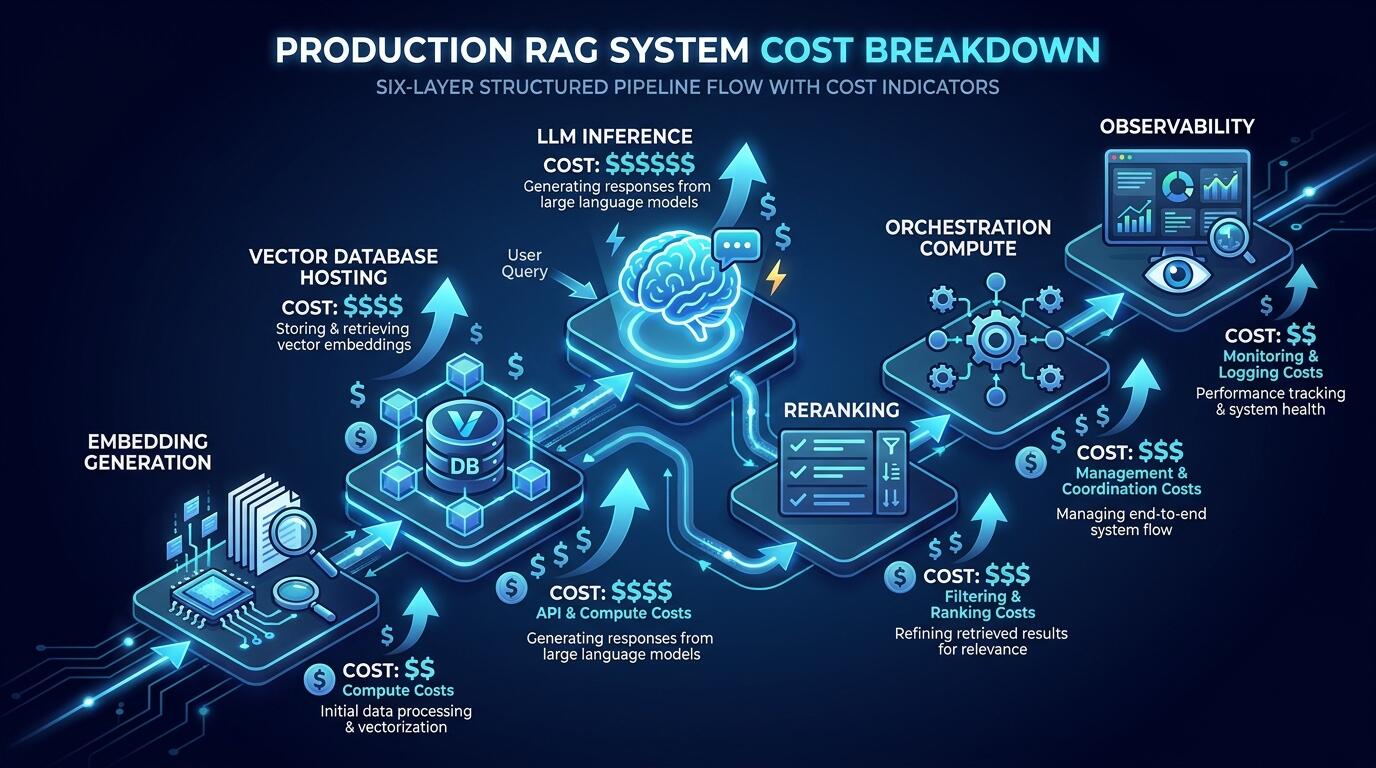
ALT: Monthly RAG system cost breakdown for production AI pipelines including embedding, vector database, and LLM inference
The Real Monthly Bill: Breaking Down RAG System Costs in Production
You've shipped a prototype. Retrieval-Augmented Generation looked clean in staging — fast responses, decent quality, manageable complexity. Then the first real production invoice lands, and the number is nowhere near what your back-of-napkin estimate suggested. This is a pattern we consistently see in our work reviewing AI infrastructure decisions: the gap between "it works in demo" and "it's profitable at scale" is almost entirely a cost accounting problem, not an engineering one.
This article breaks down every meaningful cost driver in a production RAG system — from embedding generation to vector storage, LLM inference to observability — so you can build a realistic monthly budget before you're locked into an architecture. The items below were selected based on what actually moves the needle in production environments, not what gets the most coverage in tutorials.
The Cost Drivers: What Actually Makes Up Your Monthly RAG Bill
A production RAG system's monthly cost is the sum of six distinct layers: embedding generation, vector database hosting, LLM inference, reranking, orchestration compute, and observability. Each layer scales differently and responds to different optimization levers. Ignoring any one of them produces a budget that will miss badly.
Embedding Generation: The Cost That Compounds Quietly
Embedding generation is the process of converting text — your documents, your queries, or both — into dense vector representations that enable semantic search. In a RAG pipeline, you pay for embeddings twice: once at ingestion time when you index your knowledge base, and again at query time for every user request.
Ingestion cost is typically a one-time expense per document corpus, but it resurfaces whenever your data changes significantly. At moderate document volumes (tens of thousands of chunks), ingestion costs from commercial embedding APIs are low enough to ignore. At millions of chunks — think enterprise knowledge bases or frequently updated content — ingestion costs become a real line item. Query-time embedding cost scales directly with request volume, and this is where the compounding happens: high-traffic applications can spend more on query embedding than on the retrieval itself.
Best for: Teams evaluating whether to use hosted embedding APIs versus self-hosting an open-weight embedding model. The crossover point depends on your query volume and compute costs, and it's lower than most teams expect.
Watch out: Switching embedding models mid-production requires re-indexing your entire vector store. Lock-in risk is real — factor migration cost into your initial model selection, not just per-query pricing.
Vector Database Hosting: Storage Is Cheap, Search Is Not
A vector database is a purpose-built data store that indexes high-dimensional embedding vectors and serves approximate nearest-neighbor (ANN) queries at low latency. This is the component that makes retrieval possible in a RAG pipeline, and its cost structure is unlike anything in traditional relational or document databases.
Cost splits into three components: storage (the vectors themselves), compute (running ANN queries), and network egress (moving results to your application layer). Storage for vectors is genuinely inexpensive — a million 1536-dimensional float32 vectors occupies roughly 6 GB, which is a rounding error on most cloud bills. The expensive part is keeping an index in memory for low-latency queries. Managed vector database services typically charge for the memory tier separately from disk storage, and that memory cost scales with index size rather than query volume. On the other hand, serverless vector DB offerings shift the cost to per-query pricing, which favors bursty or low-volume workloads but can surprise you at scale.
Best for: Understanding why your vector DB bill is higher than expected — usually it's the in-memory index cost, not the storage.
Watch out: Managed services abstract away operational complexity but make it easy to over-provision. Audit your index size and actual memory utilization monthly; idle memory is silent waste.
LLM Inference: The Largest and Most Variable Cost Component
LLM inference — the API calls that generate your final answers using the retrieved context — is almost always the dominant cost in a production RAG system. For most teams running against hosted frontier models, inference accounts for a significant majority of the total monthly bill.
The cost structure is straightforward: you pay per token, with input tokens (your retrieved context plus system prompt plus user query) priced separately from output tokens. The dangerous part of RAG cost modeling is that your context window fills up fast. A naive implementation that retrieves ten chunks of 500 tokens each, plus a 500-token system prompt, plus the user query, is already at 5,500+ input tokens before the model writes a single word. At scale, optimizing your context — tighter chunk sizes, aggressive reranking to reduce k, compressed system prompts — is worth more engineering time than almost any other performance improvement.
Model choice matters enormously here. A pattern we consistently see: teams reach for the most capable frontier model for development, then fail to run the substitution analysis before launch. Smaller, faster models handle a significant fraction of RAG queries adequately, and the cost difference between tiers can be an order of magnitude.
Best for: Any team that hasn't yet profiled their average token count per request in production. This single metric drives more cost variance than anything else.
Watch out: Latency and cost are inversely correlated with model capability. Routing easy queries to smaller models (query routing or cascading) is operationally complex but can cut inference costs substantially without quality regression on most requests.
Reranking: The Optional Layer That Changes Your Economics
Reranking is a secondary scoring step that takes the top-k candidates returned by vector search and re-orders them using a more expensive cross-encoder model before passing results to the LLM. The purpose is to improve retrieval precision — reducing the number of irrelevant chunks that inflate your LLM input tokens.
The economics of reranking are counterintuitive: adding a reranking step costs money (either API fees for hosted rerankers, or compute for self-hosted cross-encoders), but it can reduce your LLM bill by allowing you to safely lower k — retrieving fewer chunks while maintaining or improving answer quality. Whether this trade-off nets positive depends on your inference model tier and your query volume. For teams using expensive frontier models with large context windows, reranking often pays for itself. For teams already on cheaper models, the math is less clear.
Best for: High-traffic systems where LLM inference dominates the bill and retrieval precision is imperfect enough to waste tokens on irrelevant context.
Watch out: Reranking adds latency. In latency-sensitive applications, the quality improvement may not justify the additional round-trip, especially if your initial retrieval is already high quality.
Orchestration and Application Compute: The Infrastructure Layer People Forget
Orchestration compute refers to the servers, containers, or serverless functions that run your RAG pipeline logic — query preprocessing, embedding calls, vector DB queries, reranking, prompt construction, LLM calls, and response formatting. This layer is easy to underestimate because it looks like "just glue code," but in practice it's always-on infrastructure that accrues cost continuously.
For low-to-moderate traffic, serverless functions or small container instances are cost-effective. As query volume grows, the serialized nature of a RAG pipeline (multiple sequential API calls per request) means response latency becomes a scaling bottleneck before compute cost does. Teams often over-provision here to meet latency SLOs, which drives up the bill without improving throughput.
Best for: Establishing a realistic baseline cost even before you take your first query — the orchestration layer has a fixed floor regardless of traffic.
Watch out: Connection pooling, caching, and async processing are not optional at scale. Naive synchronous implementations that spawn a new connection to your vector DB and LLM API per request will hit rate limits and latency walls simultaneously.
Observability and Evaluation: The Cost of Knowing What's Broken
Observability in a RAG system means logging inputs, retrieved chunks, prompts, and outputs in a way that lets you diagnose quality regressions, latency spikes, and cost anomalies. This includes trace storage, LLM-specific monitoring tools, and periodic evaluation pipelines that score retrieval quality and answer accuracy.
In our experience, teams that skip observability spend far more money debugging production incidents than they would have spent on proper tooling from day one. Evaluation pipelines — running automated or human-scored assessments on a sample of production queries — are not free. LLM-as-judge approaches that score your RAG outputs programmatically require their own inference budget, which compounds with traffic.
Best for: Any team that has shipped to production without a way to answer "is retrieval quality degrading?" or "which query types are blowing our token budget?"
Watch out: Storing full prompt traces (including retrieved chunks) at high query volumes generates significant storage costs. Implement sampling strategies early — full-fidelity logging for a representative sample is almost always sufficient.
Caching: The Cost Reduction Layer Most Teams Deploy Too Late
Semantic caching is a technique where you cache LLM responses for queries that are semantically similar to previously answered ones, returning the cached result without hitting the LLM API. At the RAG level, you can also cache retrieved chunks for stable document corpora where the same queries recur.
The economics of caching depend entirely on your query distribution. If your user base asks highly repetitive questions (common in internal knowledge bases and support bots), cache hit rates can be high enough to reduce inference costs by a meaningful fraction. If queries are diverse and long-tail, caching infrastructure adds cost without proportional benefit.
Best for: Internal tools, FAQ bots, or any application where a small set of queries accounts for a large share of traffic.
Watch out: Cache invalidation is harder in RAG than in traditional systems because "what counts as the same question" is probabilistic, not exact. Over-aggressive caching can serve stale or subtly incorrect answers after knowledge base updates.
Quick Comparison at a Glance
| Cost Layer | Best For | Key Strength | Limitation |
|---|---|---|---|
| Embedding Generation | Volume estimation and model selection decisions | Predictable per-token pricing | Re-indexing cost on model switches |
| Vector Database Hosting | Right-sizing memory vs. storage tiers | Scales with index size, not just queries | In-memory index cost often underestimated |
| LLM Inference | Dominant cost driver at any meaningful traffic | Direct quality-cost trade-off via model tier | Context length makes cost non-linear |
| Reranking | Improving retrieval precision to reduce LLM tokens | Can net-positive against inference savings | Adds latency; math depends on model tier |
| Orchestration Compute | Always-on infrastructure baseline | Predictable floor cost | Over-provisioning common to meet latency SLOs |
| Observability & Evaluation | Diagnosing regressions and anomalies in production | Makes cost and quality visible | Trace storage costs compound with volume |
| Caching | High-repetition query workloads | Can cut inference costs on repetitive traffic | Cache invalidation is probabilistic, not exact |
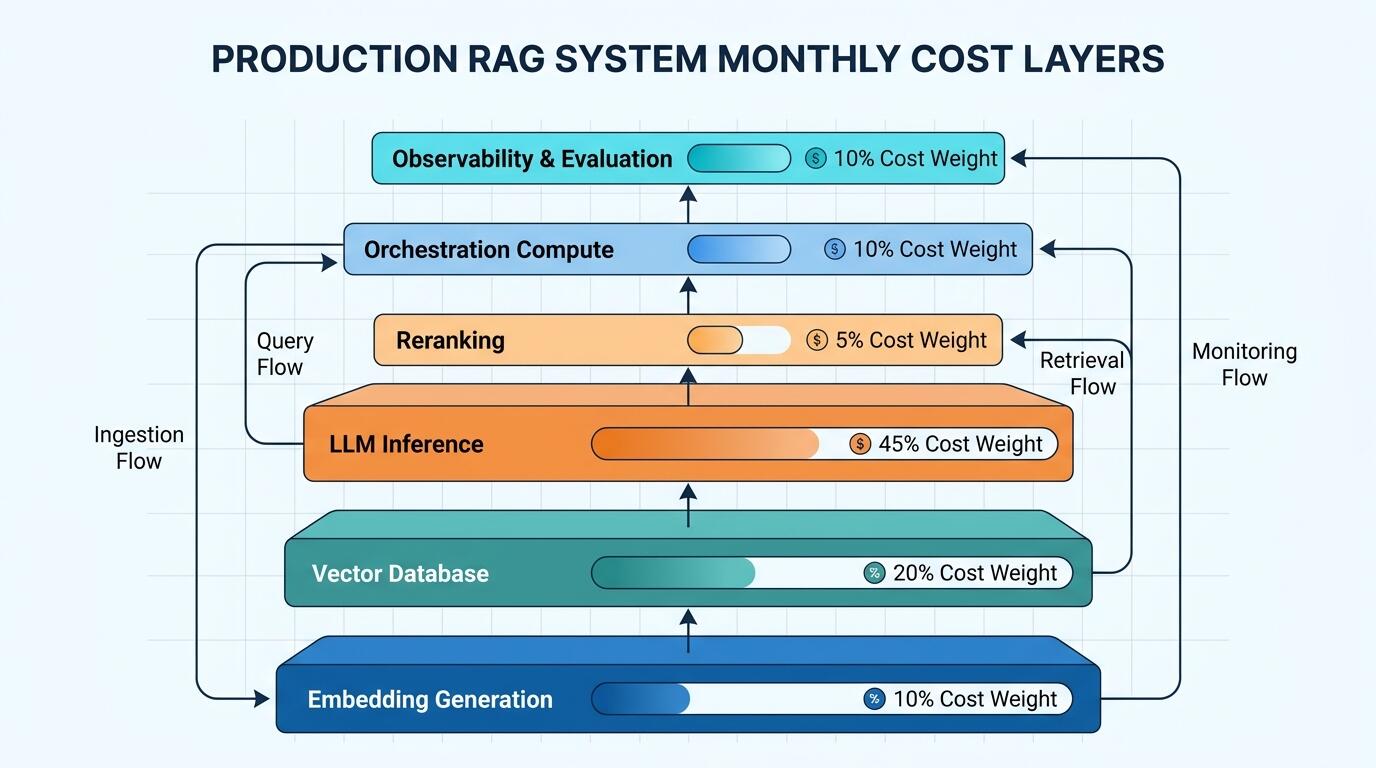
ALT: Diagram of RAG system monthly cost layers — embedding generation, vector database, LLM inference, reranking, orchestration compute, and observability for production AI systems
How to Choose the Right Cost Optimization Path
The right place to start depends on which layer is largest on your current bill — and the answer differs by workload type.
If LLM inference dominates (which it does for most teams), your first lever is token reduction: tighter chunk sizes, lower k with reranking to compensate, compressed system prompts, and model routing for simpler queries. This is where effort has the highest return and where a common misconception misleads teams: many engineers assume retrieval quality is the main RAG problem to solve, when in practice token efficiency is the primary cost and latency driver once the pipeline is working.
If your workload is query-heavy with a stable knowledge base, caching and embedding model self-hosting deserve early evaluation. The crossover point from API-based to self-hosted embeddings is lower than most teams calculate because they forget to include query-time embedding costs, not just ingestion.
If you're early-stage and traffic is low, the observability and orchestration layers should take priority even before cost optimization. You cannot optimize what you cannot measure. A lightweight tracing setup that captures token counts, retrieval latency, and chunk relevance scores per query is the foundation every subsequent decision rests on.
A common misconception worth naming directly: many teams believe that switching to a cheaper LLM is the main cost lever, and it is a lever — but it's often not the first one to pull. Reducing wasted tokens in your context window (irrelevant chunks, bloated prompts, unnecessary history) frequently achieves more cost reduction than a model downgrade, with less quality risk.
Match your optimization sequence to your current stage:
- Pre-launch: instrument observability, profile token counts per request type, model your cost at target traffic.
- Early production: optimize chunk size and k, evaluate reranking ROI, set per-query cost alerts.
- Scaling: run model routing analysis, evaluate self-hosted embeddings, implement semantic caching if query distribution supports it.
Frequently Asked Questions FAQ
Q1: How do I estimate my RAG system's monthly cost before going to production?
Start by profiling a representative sample of queries in staging and measuring average input token count (context + system prompt + query) and output token count per request. Multiply by your expected monthly query volume and your LLM's per-token pricing. Add vector DB memory cost based on your index size, embedding API costs at expected query volume, and a flat estimate for orchestration compute. This bottom-up model is consistently more accurate than top-down benchmarks because context window usage varies sharply by application type.
Q2: Is self-hosting an open-weight LLM cheaper than using an API for RAG workloads?
Self-hosting is cheaper at sufficient query volume but introduces significant operational overhead — GPU infrastructure management, model updates, availability engineering, and serving optimization. The break-even point varies widely depending on your query volume, the GPU tier you can access, and how much engineering time you assign to infrastructure. For most teams below a meaningful query volume threshold, managed APIs are cheaper when you include engineering time. Above that threshold, self-hosting economics improve, but the operational complexity is a real cost that rarely appears in the comparison.
Q3: What does a typical production RAG system cost per month, and how does it scale?
There is no universal figure — costs vary by orders of magnitude depending on query volume, model tier, document corpus size, and architecture choices. Based on documented production deployments analyzed in the community, small internal tools with moderate traffic can run in the low hundreds of dollars monthly, while high-traffic customer-facing systems using frontier models can reach tens of thousands of dollars monthly. The most reliable approach is to instrument your pipeline early, establish a per-query cost baseline, and project forward from measured data rather than industry averages.
Final Thoughts
Key Takeaways:
- LLM inference is the dominant cost in almost every production RAG system — token count per request is the single most important metric to instrument and optimize.
- Vector database cost is driven by in-memory index size, not storage volume. Many teams over-pay here by provisioning for query volume rather than index footprint.
- Reranking can be net-positive against your LLM bill, but the math only works at sufficient query volume and with expensive enough inference models.
- Observability is not optional — teams that skip it spend more on incident debugging and wasted inference than proper tooling would have cost.
- Cost modeling before launch using profiled token counts is consistently more accurate than any benchmark or industry average.
The most actionable next step for any team evaluating or running a RAG system is to establish per-query cost telemetry now, regardless of your current traffic level. Once you have measured cost per request broken down by layer, every subsequent architectural decision — model selection, chunking strategy, caching, self-hosting — becomes a quantifiable trade-off rather than a guess.
If you're building AI products and need to turn complex AI infrastructure decisions into concrete engineering actions, the Darius newsletter is written exactly for this — every entry filtered and interpreted from the perspective of engineers running real AI products in production. Visit Darius to subscribe to the bilingual newsletter and stay in sync with engineers building on the same front lines.
Sources & Citations
- Kalvium Labs. "RAG in Production: What It Actually Costs After Sprint 3".
https://www.kalviumlabs.ai/blog/rag-in-production-what-it-actually-costs-after-sprint-3/ - Spendark. "What a Production RAG System Costs Per Month (2026)".
https://spendark.com/blog/rag-system-cost/ - Darius. "What Does It Actually Cost to Run a RAG System for a Month?".
https://www.darius.wiki/en/blog/technology/rag-system-monthly-cost-production.html - IEEE (Institute of Electrical and Electronics Engineers). Standards and technical resources on AI systems, machine learning infrastructure, and computational cost modeling.
https://www.ieee.org/