Choosing an AI Architecture Partner: Questions Founders Should Ask First
ALT: Founder evaluating AI architecture partner options with technical questions and strategic criteria
Why the Partner You Choose for AI Architecture Defines Your Product's Future
Selecting an AI architecture partner is one of the highest-leverage decisions a founder can make — and also one of the easiest to get wrong. In a landscape where nearly every vendor claims to offer "end-to-end AI solutions," the real differentiator between a partner who ships and one who stalls is almost never visible in a pitch deck. It lives in the quality of their design thinking, their willingness to confront hard tradeoffs early, and their track record of turning architecture into working software that users can actually touch.
This article exists to arm founders, CTOs, and product leaders with the right questions before that decision is made — not after a painful engagement reveals gaps that should have been surfaced in week one.
The State of AI Architecture Consulting Today and How We Got Here
The market for AI architecture expertise is maturing rapidly, but unevenly. Early AI adoption cycles were dominated by researchers-turned-consultants who brought deep modeling knowledge but limited experience in production engineering. That gap produced a predictable pattern: impressive prototypes, fragile deployments, and engineering teams left holding systems they didn't fully understand.
The current landscape looks meaningfully different. The availability of large language model APIs, managed ML platforms, and cloud-native orchestration tools has lowered the barrier to entry for AI development — which paradoxically raises the stakes for good architectural judgment. When building blocks are abundant, the differentiating value shifts entirely to how those blocks are assembled. Choosing the wrong data pipeline design, underestimating inference latency requirements, or coupling business logic too tightly to a third-party model provider can produce systems that appear functional in staging but collapse under production load or fail when a vendor changes their pricing model.
According to guidance published by the IEEE (Institute of Electrical and Electronics Engineers), software architecture decisions made in early project phases have disproportionate influence on long-term system quality attributes — scalability, maintainability, and security among them. The AI context amplifies this dynamic because many architectural choices in AI systems are expensive to reverse: retraining data pipelines, refactoring feature stores, or migrating between model providers can consume months of engineering capacity.
A pattern consistently observed in consulting work across early-stage and growth-stage teams is that founders often underestimate the distinction between AI experimentation and AI engineering. Building a proof of concept that demonstrates a capability is a fundamentally different task from building a system that serves that capability reliably at scale, with observability, graceful degradation, and cost controls in place. The partner selection question, at its core, is about finding someone who understands and respects that distinction — and who has lived on both sides of it.
The growing regulatory environment adds another layer. Per frameworks emerging from standards bodies such as ISO and from government agencies examining AI accountability, organizations deploying AI systems are increasingly expected to demonstrate traceability of model decisions and robustness of data governance. An AI architecture partner who has not internalized these considerations will produce technical debt that manifests as compliance risk — not immediately, but inevitably.
The Underlying Factors That Separate a Real AI Architecture Partner from a Capable Vendor
The questions founders should ask are not arbitrary — they map directly to the mechanisms by which AI architecture engagements succeed or fail. Understanding those mechanisms makes the evaluation far more precise.
End-to-End Ownership Versus Handoff Culture
The most consequential differentiator in an AI architecture partner is whether they think in terms of complete systems or deliverable artifacts. A partner with a handoff culture produces architecture diagrams, recommendation documents, and prototype code — and then considers their work done. A partner with an ownership mindset is concerned with what happens after the diagram: how the system will be monitored, how the team will debug it, and what happens when the model's behavior drifts from its initial performance baseline.
End-to-end technical leadership is the capacity to carry a product from initial architecture decisions through to live deployment, accepting accountability for each layer. In practice, this means the partner should be able to speak fluently about infrastructure, data engineering, model selection, API design, frontend integration, and operational runbooks — not as a generalist who knows a little of everything, but as someone who has shipped systems that depend on all of those layers working together. In work with early-stage teams, it is consistently the hand-off moments — between AI prototype and production backend, between model training and inference serving, between MVP and scaled system — where the most costly gaps appear.
Depth of Systems Design Thinking
Systems design in the AI context refers to the capacity to reason about how components interact under real-world conditions: variable load, partial failures, data quality degradation, and evolving business requirements. An architect who can only reason about the model layer will produce systems that are fragile at their interfaces. The evaluation question here is not "have you worked with transformers?" but "how do you design for model failure, and what does graceful degradation look like in your systems?"
A strong AI architecture partner will have clear, opinionated answers about topics like caching strategies for expensive model calls, fallback logic when a third-party model API returns errors, rate limiting and cost management in inference pipelines, and the tradeoffs between synchronous and asynchronous processing for different AI workload types. These are not hypothetical concerns — they are the decisions that determine whether a product survives its first traffic spike or its first vendor outage.
Breadth of Full-Stack Delivery Experience
AI systems do not exist in isolation. They are embedded in products that have frontends, databases, authentication layers, third-party integrations, and business logic. A partner who has only operated at the model or data science layer will produce architecture recommendations that create friction for the rest of the engineering team. Conversely, a partner with genuine full-stack development experience understands how AI capabilities are surfaced to users, how latency budgets compound across the request chain, and how product requirements constrain what is architecturally feasible.
Communication and Translation Capability
An AI architecture partner serves a dual function: technical expert and strategic translator. Founders and product managers need to make resource allocation decisions, set realistic timelines, and communicate to investors and customers. A partner who cannot translate technical architecture tradeoffs into terms that inform those decisions is only partially useful — and in some cases actively harmful, because it creates information asymmetry that leads to avoidable surprises.
The evaluation test here is simple: ask a candidate to explain a complex architectural decision they made and why they made it over the alternatives. Pay attention to whether the explanation is accessible without being dumbed down, and whether it acknowledges tradeoffs honestly rather than presenting a single option as obviously correct.
Evaluating Approaches: A Structured Comparison for Founders
Different types of AI architecture partners offer distinct value profiles. Founders benefit from mapping their specific situation to the right engagement model before beginning outreach.
| Perspective / Approach | Strengths | Trade-offs | Best Fit |
|---|---|---|---|
| Large consulting firm | Broad team bandwidth, established methodologies, enterprise credibility | High cost, frequent staffing rotation, slower iteration cycles, generalist AI depth | Enterprise organizations with multi-year roadmaps and established procurement processes |
| Specialized AI boutique | Focused AI expertise, faster ramp-up, tighter team cohesion | May lack full-stack or product delivery depth, limited capacity for parallel workstreams | Teams that have an existing engineering base and need targeted AI architecture guidance |
| Independent AI architect with full-stack delivery experience | End-to-end ownership mindset, direct accountability, faster decision cycles, real shipping experience | Capacity constraints on very large engagements, single point of contact dependency | Startups and growth-stage teams that need architecture and execution, not just advisory |
| In-house hire (AI architect / ML engineer) | Permanent institutional knowledge, deepest product context over time | Long hiring timeline, high compensation cost, risk of narrow expertise | Well-funded teams with stable long-term roadmaps and existing technical leadership |
The comparison above is not intended to declare a winner — it is intended to surface the honest tradeoffs that are rarely discussed in sales conversations. A founder building a consumer AI product with a six-person team and a twelve-month runway needs a fundamentally different kind of partner than an enterprise CTO building a data platform for a regulated industry.
A pattern observed repeatedly in work with product-minded founders is that the most dangerous match is a highly credentialed AI research partner placed with an early-stage team that needs to ship. Research credentials do not correlate with deployment experience, and the gap between "we built a model that works" and "we shipped a system that serves users" can consume months and meaningful capital before it becomes visible.
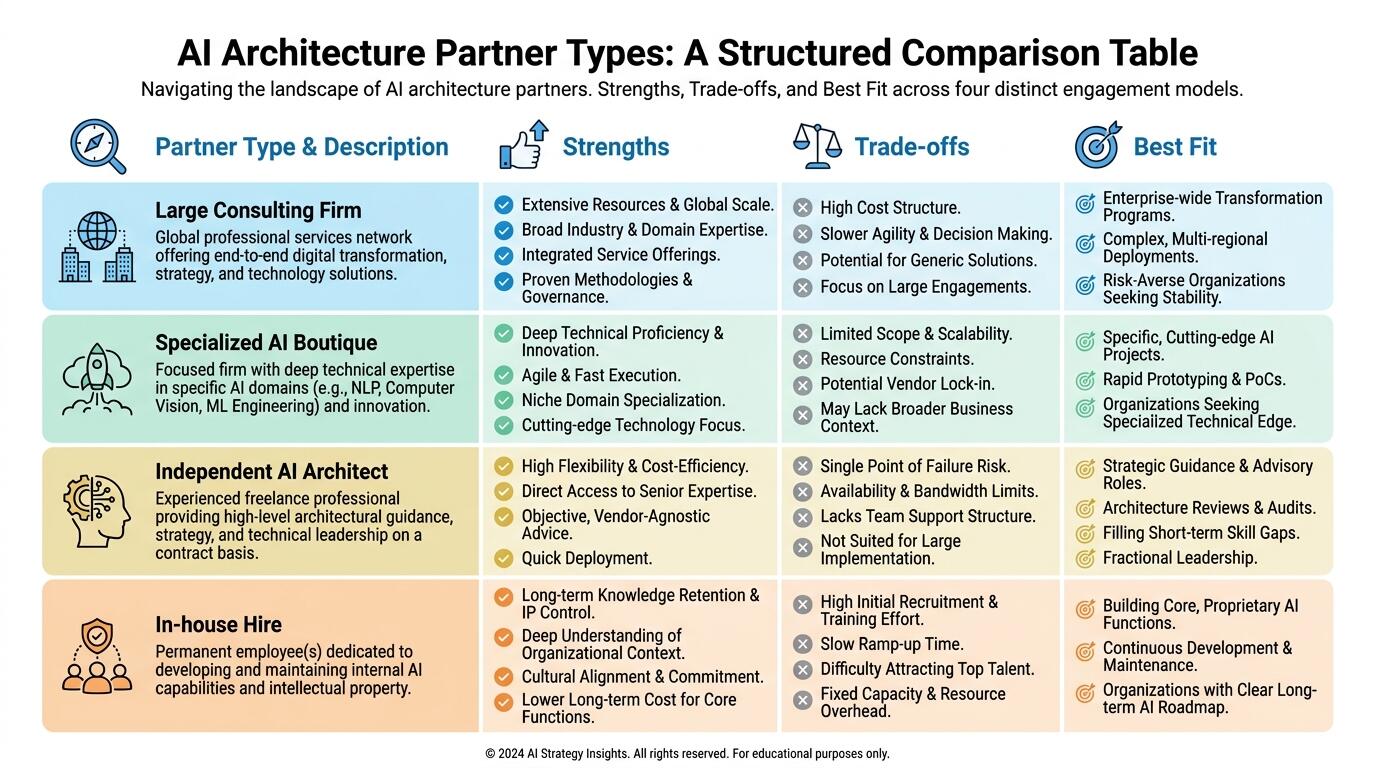
ALT: Comparison table of AI architecture partner types showing evaluation criteria for startup founders and technical decision-makers
Where AI Architecture Partnerships Are Heading and What It Means for Founders Today
The role of the AI architecture partner is evolving alongside the technology itself. As foundation model APIs become more capable and more commoditized, the architectural challenge is shifting from "how do we incorporate AI capabilities" to "how do we build defensible, reliable, cost-efficient AI systems that create durable product value." That shift places even greater premium on partners who understand systems design, data strategy, and product delivery — not just model selection.
Several directional trends are worth tracking. First, observability and evaluation frameworks for AI systems are becoming a baseline expectation rather than an advanced practice. Partners who cannot speak to how they instrument AI system behavior — measuring output quality, detecting drift, logging decisions for audit — are already behind the curve. Second, the cost management dimension of AI architecture is increasingly important: inference costs, token budgets, and caching strategies are architectural decisions with direct P&L implications that belong in the design conversation from day one.
Third, and perhaps most importantly for founders: the regulatory and governance environment around AI is tightening across major markets. According to publicly available guidance from standards bodies including ISO and IEEE, responsible AI deployment requires documentation of system behavior, data provenance, and model decision logic. An architecture partner who treats these considerations as afterthoughts will produce systems that face costly retrofits as compliance requirements land.
Actionable takeaways for founders evaluating an AI architecture partner:
- Ask for specific examples of AI systems the partner has taken from design to live production — not prototypes, not internal tools, but deployed products with real users.
- Request their perspective on a system design challenge relevant to your product context and evaluate the depth of the tradeoff analysis they offer, not just the recommendation.
- Probe for full-stack fluency: can they reason about how their architectural decisions affect your frontend, your database design, your API contracts, and your infrastructure cost?
- Assess communication quality: do they explain things clearly to non-technical stakeholders, or do they default to jargon as a shield?
- Understand their model for ongoing engagement: is the relationship advisory-only, or do they maintain accountability through the deployment and stabilization phase?
Questions & Answers
Q1: How do I evaluate whether an AI architecture partner has real production experience versus theoretical knowledge?
The clearest signal is specificity. Ask a candidate to walk you through an AI system they shipped — what the architecture looked like, what broke during deployment, how they resolved it, and what they would do differently. Theoretical knowledge produces general answers; production experience produces war stories with named tradeoffs. Partners who have shipped real systems will speak fluently about operational concerns — monitoring, cost management, failure recovery — not just model selection and data pipeline design.
Q2: Are generalist software architects equipped to handle AI-specific architecture decisions?
Generalist software architects bring valuable systems thinking, but AI systems introduce unique challenges — model versioning, inference latency management, data pipeline design for training and serving, and probabilistic output handling — that require specific exposure to navigate well. According to IEEE guidance on software architecture quality attributes, AI systems have distinct reliability and maintainability profiles compared to deterministic software systems. A strong AI architecture partner combines foundational software design principles with specific, hands-on experience in the AI layer.
Q3: How long does it typically take to establish a productive AI architecture engagement, and what should the early phase look like?
The ramp-up timeline for an AI architecture engagement depends heavily on the complexity of the existing system context and the clarity of the product requirements. A productive engagement typically begins with a focused discovery phase: reviewing existing technical infrastructure, understanding the product use cases that AI is intended to serve, and identifying the constraints — performance, cost, compliance, team capability — that will shape architectural decisions. Partners who skip or compress this phase to move faster toward deliverables often produce architecture recommendations that are technically sound in isolation but misaligned with the actual product context.
Summary
Choosing the right AI architecture partner is a decision that shapes product quality, engineering velocity, and long-term technical debt in ways that compound over time. The key is asking the questions that reveal how a partner actually thinks and what they have actually shipped — before the engagement begins, not after.
Key Takeaways:
- The most important differentiator in an AI architecture partner is end-to-end ownership mindset — the capacity and willingness to stay accountable from design through live deployment.
- Full-stack fluency matters: AI systems are embedded in broader products, and architectural decisions at the model layer create ripple effects across the entire engineering stack.
- Systems design depth, not model knowledge alone, determines whether an AI system performs reliably in production under real-world conditions.
- Communication and translation capability is a functional requirement, not a soft skill — founders cannot make good resource decisions without clear, honest technical guidance.
- The regulatory and governance dimension of AI architecture is moving from optional to mandatory, and the right partner treats it as an architectural consideration from day one.
The next step is to approach your partner evaluation with the same rigor you would apply to a product architecture review: define the requirements, surface the tradeoffs, and insist on specificity over generality.
If you're looking to turn your next idea into a live, running product — from AI architecture to full-stack execution — explore the work, insights, and professional background at Darius. Whether you're a founder navigating your first AI product decision or a CTO seeking a technical partner who has shipped real systems end-to-end, that is the right place to start.
Sources & Citations
- IEEE (Institute of Electrical and Electronics Engineers). "Software Architecture and Quality Attributes in AI-Enabled Systems."
https://www.ieee.org - ISO (International Organization for Standardization). "AI Management Systems and Governance Frameworks."
https://www.iso.org - NIST (National Institute of Standards and Technology). "AI Risk Management Framework."
https://www.nist.gov