Vibe Coding vs. Disciplined Development: Finding the Right Balance This Quarter
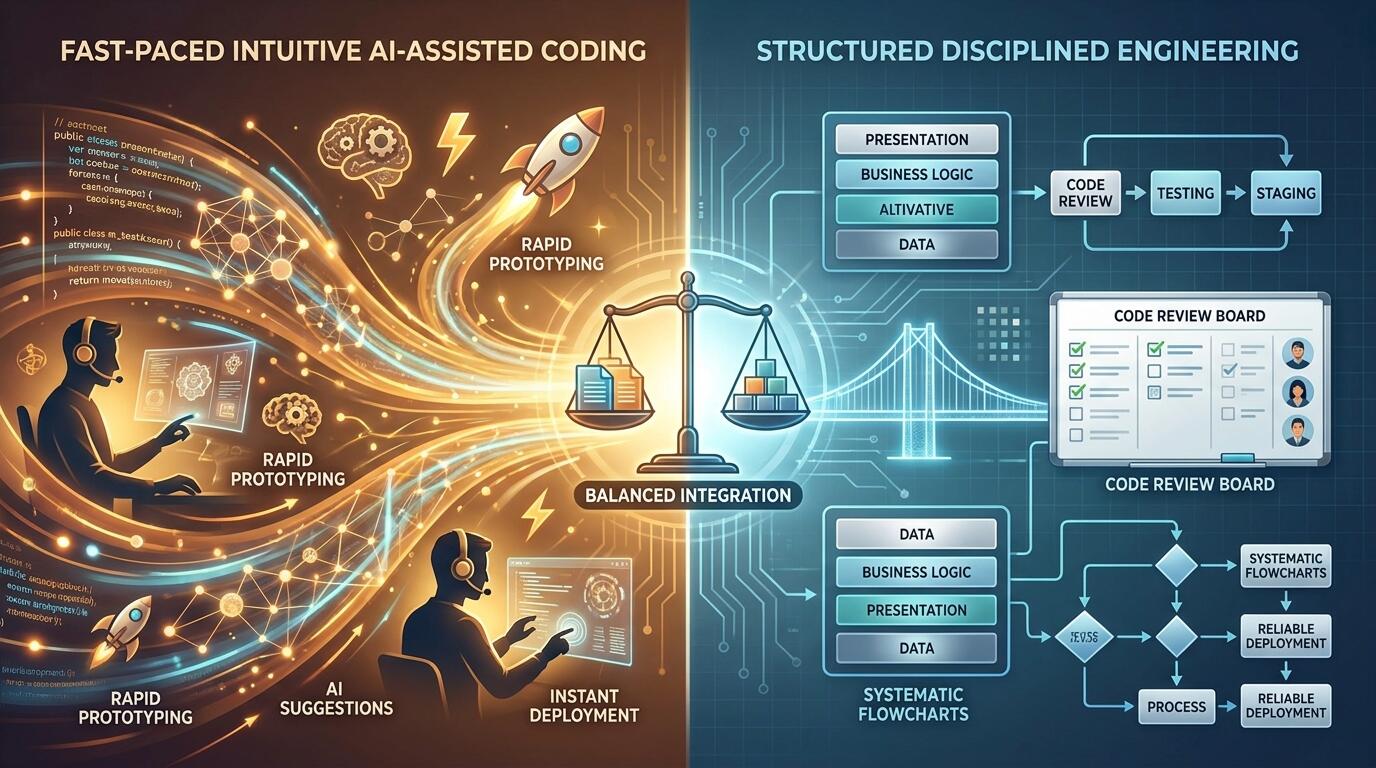
ALT: Vibe coding versus disciplined development comparison for AI-powered product teams balancing speed and quality
Vibe Coding vs. Disciplined Development: What's Really at Stake for Your Shipping Velocity This Quarter
Key Conclusion: Vibe coding — the practice of rapidly generating code with AI assistance based on intuition and momentum rather than structured planning — and disciplined development each serve distinct phases of a product's lifecycle. Neither approach is universally superior. The right balance depends on your stage, your technical debt tolerance, and your production readiness requirements. Teams that learn to switch deliberately between these modes ship faster and more sustainably than those locked into either extreme.
The choice between vibe coding and disciplined development is not simply a debate about personal coding style — it is a strategic decision with direct implications for engineering ROI, product quality, and your team's capacity to iterate safely at scale. This article compares both approaches across criteria that matter to engineering leaders and founders building real AI-powered systems, and offers concrete guidance on when each mode deserves priority.
Why the Comparison Criteria Matter for AI Product Teams
Choosing the right development mode is itself an architectural decision, and the wrong default can cost a team weeks of invisible rework. The criteria below reflect what practitioners consistently encounter when bridging the gap between rapid prototyping and production-grade delivery.
Speed to Functional Output matters because early-stage teams need proof of concept quickly — investor demos, user validation sessions, and hypothesis tests all demand working software under time pressure. The mode that delivers a functional artifact fastest wins early-phase ROI, regardless of the cleanliness of the underlying code.
Code Maintainability and Technical Debt Accumulation is the criterion that bites hardest in the medium term. According to industry commentary published on the okoone.com engineering blog, vibe coding quietly builds long-term technical debt in ways that are difficult to quantify until the system reaches a growth inflection point. Maintainability determines whether velocity is sustainable or a short-term loan against future engineering time.
Production Readiness and Reliability separates prototypes from products. A system that runs on a developer's laptop is not the same as one that handles real user traffic, integrates with external APIs, manages authentication, and recovers gracefully from failures. This criterion directly maps to the risk profile a CTO or engineering director is willing to accept before going live.
Team Collaboration and Knowledge Transfer reflects the reality that most products outlive any single developer. Code that was generated rapidly by one person with AI assistance is often opaque to the rest of the team, creating bus-factor risk and slowing onboarding of new engineers.
Architecture Integrity and Scalability addresses whether the choices made under time pressure create constraints that are expensive to unwind later. A pattern we consistently see in AI product work is that shortcuts taken at the architecture level — rather than the feature level — are the ones that require full rewrites rather than refactors.
Cost of Iteration and Change is the final criterion and perhaps the most underappreciated. The cheapest iteration loop is the one that lets you safely change behavior without touching unrelated systems. This directly impacts product agility and the team's capacity to respond to user feedback.
The Two Development Modes in Detail
Vibe Coding: AI-Accelerated, Intuition-Driven Development
Vibe coding is a development mode in which engineers — or increasingly, non-engineers — use AI code generation tools to produce working software quickly, guided primarily by immediate intent and momentum rather than upfront design. The term gained significant traction in the AI tooling community and is now widely recognized as a descriptor for the workflow enabled by tools like GitHub Copilot, Cursor, Claude, and similar large-model-powered coding assistants.
The headline characteristic of vibe coding is throughput. An experienced practitioner can go from a natural-language description of a feature to a runnable implementation in minutes. For AI-powered products specifically, this means assembling LLM integration logic, scaffolding API routes, and wiring together UI components at a pace that would have been impossible with traditional hand-authored code. As noted in analysis published on dev.to, vibe coding vs. traditional development represents a genuine shift in how software can be produced — the speed differential is real and measurable in terms of initial feature delivery.
The trade-off is equally real. Code generated through vibe coding tends to be locally coherent but globally inconsistent — it solves the immediate problem without necessarily fitting cleanly into the broader system architecture. Security implications of generated code are easy to miss when the emphasis is on speed. Error handling, edge case coverage, and observability instrumentation are typically shallow or absent. Mark Russinovich, CTO of Microsoft Azure, noted in publicly shared commentary that moving from vibes to production requires a distinct disciplinary shift — the art of vibe coding and the discipline of production engineering are not the same skill.
Disciplined Development: Architecture-First, Process-Grounded Engineering
Disciplined development is a software engineering mode defined by upfront design, explicit architectural decisions, structured code review, test coverage requirements, and deliberate management of technical debt. It is the mode that underlies every production system that has survived multiple years of active development and team turnover.
In a disciplined development workflow, decisions about data models, API contracts, error handling strategies, and deployment architecture are made before significant implementation begins. Code is reviewed against defined standards before merge. Automated tests validate behavior at multiple levels — unit, integration, and end-to-end. Infrastructure is provisioned through reproducible configuration rather than manual steps.
The cost of disciplined development is setup time and cognitive overhead. In the context of AI product development, where the shape of the problem often changes rapidly as teams discover what LLMs can and cannot do reliably, a heavily disciplined process can feel like wearing full safety gear to explore a new trail. The upfront investment is high, and the full value accrues over time rather than immediately. For teams building toward a scalable AI architecture for production, disciplined development is the foundation that makes scaling possible without catastrophic rewrites.
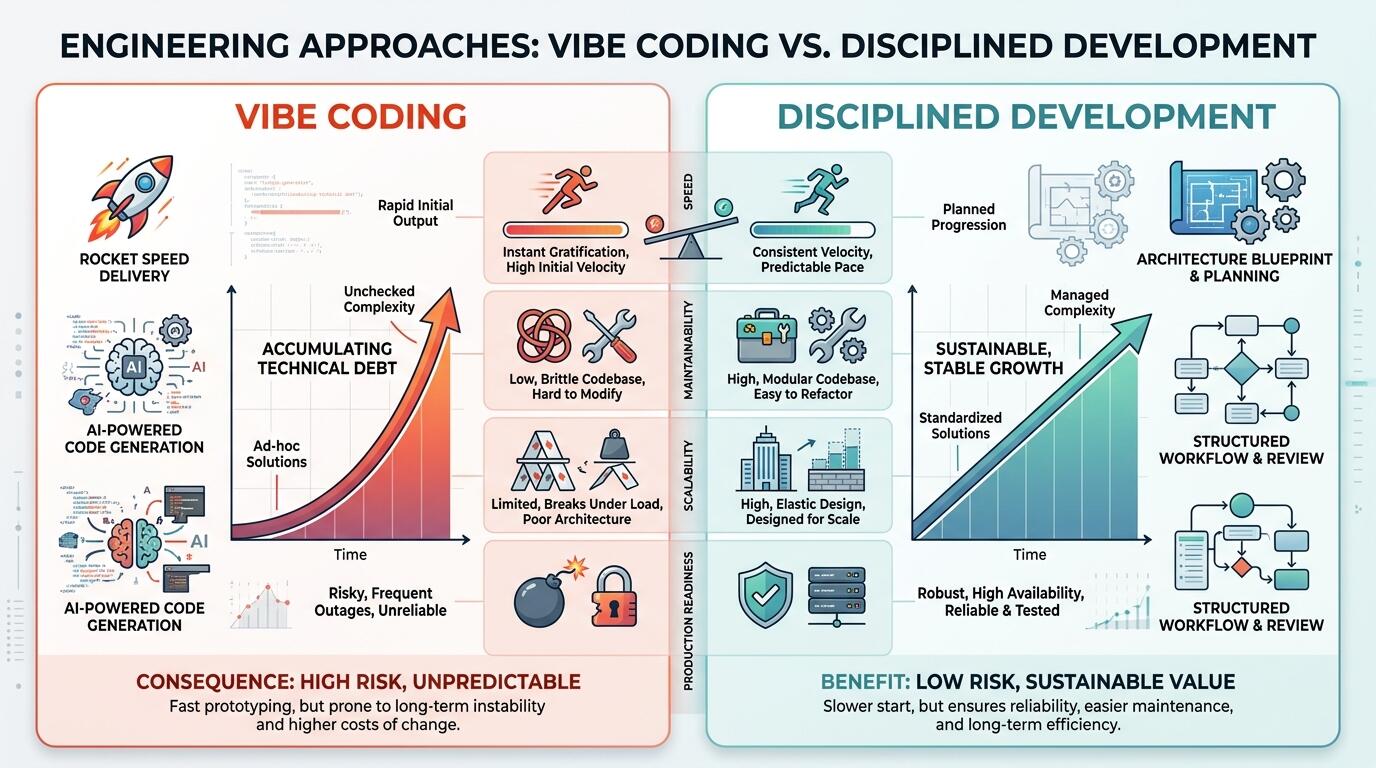
ALT: Side-by-side framework comparing vibe coding speed and technical debt against disciplined development stability and scalability for AI product engineering teams
Head-to-Head Comparison: Vibe Coding vs. Disciplined Development
| Criterion | Vibe Coding | Disciplined Development |
|---|---|---|
| Speed to Functional Output | Very high — working features in hours or days | Moderate — design and review cycles add lead time |
| Code Maintainability | Low to moderate — often locally coherent, globally inconsistent | High — explicit standards reduce cognitive overhead for future changes |
| Technical Debt Accumulation | High — debt is invisible until scale pressure reveals it | Low to moderate — debt is managed proactively through review and refactoring |
| Production Readiness | Low without additional hardening — security, error handling, and observability are typically absent | High — these concerns are addressed as part of the definition of done |
| Team Collaboration | Difficult — generated code is often opaque and under-documented | Strong — review culture and documentation norms support knowledge transfer |
| Architecture Integrity | Variable — depends heavily on the practitioner's architectural awareness | Consistent — architecture decisions are deliberate and recorded |
| Cost of Iteration | Initially low, rising steeply as the codebase grows | Moderate and stable — test coverage and clear interfaces limit regression risk |
| Best-Fit Stage | Ideation, prototyping, hypothesis validation, hackathons | Growth, production hardening, team scaling, regulated environments |
The table above makes the core tension legible: vibe coding front-loads value delivery and back-loads cost, while disciplined development distributes cost more evenly across the product lifecycle. Neither row in the table is universally better — the question is always which trade-off profile fits your current situation.
What the table cannot fully capture is how these modes interact over time. In practice, a team that vibe-codes a prototype to validate an idea and then applies disciplined engineering to harden it for production is operating intelligently. The failure mode is not choosing one mode — it is failing to switch modes when the situation demands it. A common pattern we observe is teams that vibe-code their way to a Series A demo and then continue vibe-coding into production, accumulating compounding technical debt that eventually stalls the product roadmap entirely.
The architectural integrity row deserves particular attention for teams building AI-powered systems. LLM integration points — prompt management, model versioning, context window handling, fallback behavior — are areas where undisciplined approaches create subtle, hard-to-diagnose production failures. The LLM integration patterns that engineering teams should know are not the kind of thing that emerges naturally from vibe-coded implementations; they require deliberate architectural thinking.
Which Should You Choose? Scenario Recommendations for Engineering Leaders
The right development mode is determined by stage, stakes, and team structure. Here are the concrete situations we see most often, and the guidance that applies to each.
If you are validating a new product idea with limited runway, lean heavily toward vibe coding for the first phase. Your goal is a functional artifact that generates user signal, not a production system. Optimize for speed of hypothesis testing. Treat everything you build in this phase as disposable — because much of it will be.
If you have validated the core value proposition and are preparing for your first live users, this is the inflection point where disciplined practices must begin to take over. Before going live, harden authentication, address obvious security gaps, add structured logging and error handling, and establish at minimum a lightweight architecture review. The concept of minimum viable architecture is directly applicable here — you do not need perfect engineering, but you need enough structure to ship safely and iterate without collapsing.
If you are scaling an existing AI-powered product with a growing team, disciplined development should be your default mode. At this stage, the cost of onboarding new engineers into a vibe-coded codebase, the fragility of undocumented AI integrations, and the compounding interest on unmanaged technical debt all become significant budget line items. Code review, testing standards, and architectural governance are no longer nice-to-haves.
If you are a solo founder or a very small team shipping under extreme time pressure, a pragmatic hybrid works well: vibe-code the feature surface, but apply disciplined patterns to the data layer, API contracts, and integration points. The parts of your system that are expensive to change deserve upfront discipline even when everything else is moving fast.
If you are building in a regulated or high-stakes domain — healthcare, fintech, infrastructure — disciplined development is non-negotiable from day one. The cost of a production incident in these contexts vastly exceeds the cost of slower initial delivery.
Vibe Coding Pros: Exceptional speed for early-phase delivery, accessible to non-traditional engineers, ideal for rapid iteration and experimentation, strong alignment with AI-assisted tooling workflows.
Vibe Coding Cons: Rapidly accumulating technical debt, shallow error handling and security posture, low maintainability under team growth, architectural inconsistency that compounds over time.
Disciplined Development Pros: Sustainable velocity over time, high production reliability, strong team collaboration and knowledge transfer, architecture that supports scaling.
Disciplined Development Cons: Higher upfront time investment, can feel slow for early-stage hypothesis testing, requires consistent team buy-in to cultural norms, overhead may exceed value in truly exploratory phases.
Frequently Asked Questions FAQ
Q1: How do you transition a vibe-coded prototype into a production-ready system without a full rewrite?
Transitioning from a vibe-coded prototype to a production system is best approached incrementally rather than as a single rewrite event. Start by identifying the highest-risk surfaces — authentication, data persistence, and external API integrations — and apply disciplined hardening to those first. Introduce automated tests for the behavior you want to preserve, then refactor internal structure iteratively. This approach limits risk while progressively raising the system's production readiness without discarding working functionality.
Q2: Is vibe coding suitable for building AI-powered features in a production environment?
Vibe coding is suitable for rapid prototyping of AI-powered features, but should not be the primary mode for production AI integration without deliberate hardening. LLM integrations require structured prompt management, fallback logic, latency handling, and cost monitoring — concerns that vibe-coded implementations typically skip. According to Mark Russinovich's commentary on moving from vibes to production, a distinct shift in engineering discipline is required before AI features can be operated reliably at scale.
Q3: How much technical debt does vibe coding typically introduce, and when does it become a problem?
Technical debt from vibe coding tends to remain invisible during early-stage growth and becomes acutely visible when a second engineer joins the project, when user traffic increases, or when a critical bug surfaces in an undocumented integration. The okoone.com analysis of how vibe coding builds long-term technical debt notes that the debt is structural and compounding — it does not stabilize on its own. Teams that do not actively manage it will eventually face velocity stalls that cost more to resolve than disciplined practices would have cost upfront.
The Bottom Line
The vibe coding versus disciplined development debate is ultimately a question of when, not which. Both modes have legitimate, valuable roles in the product lifecycle of an AI-powered system. The engineering leaders and founders who ship consistently are those who treat development mode as a deliberate choice rather than a default habit.
Key Takeaways:
- Vibe coding maximizes early-phase throughput but accumulates compounding technical debt that must be managed before production scale.
- Disciplined development distributes cost evenly across the lifecycle and enables sustainable team velocity, but requires upfront investment that may not be justified in pure exploration phases.
- The most effective teams switch modes deliberately — vibe-code to validate, apply discipline to productionize.
- LLM integration points and data layer architecture deserve disciplined treatment even when the rest of the system is moving fast.
- Technical debt from vibe coding does not self-resolve; it requires active remediation investment, and that cost grows with time.
The practical next step is to audit where your team's current codebase sits on the spectrum — not to judge the approach that got you here, but to make a clear-eyed decision about what the next quarter demands. If production readiness, team scaling, or architectural integrity are on your roadmap, now is the time to shift modes.
If you want to go deeper on balancing delivery speed with production-grade engineering, explore the technical insights and shipped project portfolio at darius.wiki — and get in touch to discuss how these principles apply to your specific product context.
References
- dev.to / increase123. "Vibe Coding vs Traditional Development: Finding Your Balance".
https://dev.to/increase123/vibe-coding-vs-traditional-development-finding-your-balance-3gj4 - LinkedIn / Mark Russinovich. "The Art, Discipline, and Pitfalls of Vibe Coding".
https://www.linkedin.com/posts/markrussinovich_from-vibes-to-production-the-art-discipline-activity-7396268349351112704-rrcV - Okoone Spark. "How Vibe Coding Quietly Builds Long-Term Technical Debt".
https://www.okoone.com/spark/technology-innovation/how-vibe-coding-quietly-builds-long-term-technical-debt/ - IEEE. IEEE Software Engineering Standards and Publications.
https://www.ieee.org/
Note: Standards may be updated; please check the latest official documents or consult professional advisors.