The Minimum Viable Architecture: Building Just Enough to Ship
ALT: Minimum viable architecture diagram showing lean system design for shipping production-ready software
Why Building Less Is the Most Strategic Decision You Can Make
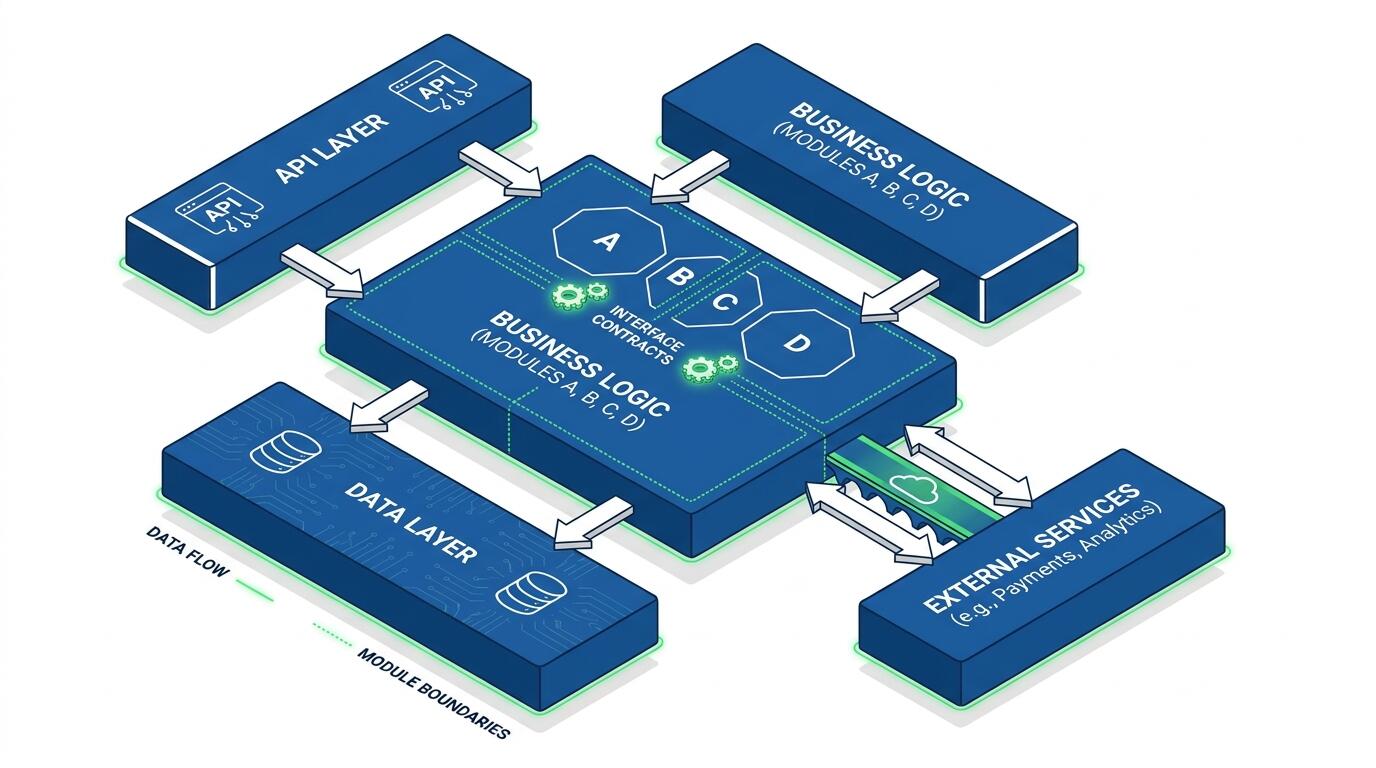
The central question every engineering team faces at the start of a new product is deceptively simple: how much architecture is enough? The answer, consistently validated in practice, is this — you need just enough structure to support your current requirements, with clear seams that allow growth without requiring a full rewrite. That is the essence of minimum viable architecture (MVA): a deliberately scoped system design that delivers production-ready functionality today while preserving the ability to evolve tomorrow.
This topic deserves serious analytical attention right now because the cost of over-engineering has never been higher. Capital is tighter, time-to-market pressure is more intense, and the landscape of available tools — particularly in AI-powered product development — is shifting fast enough that architectural decisions made today may be irrelevant in six months. Getting the scope of your initial architecture right is not a technical nicety; it is a direct determinant of whether your product ships, survives, and scales.
The State of System Design: From Monoliths to Micro-Everything and Back
Software architecture has moved through recognizable phases over the past two decades, and understanding that trajectory clarifies why minimum viable architecture is a timely and practical response to where the industry currently sits.
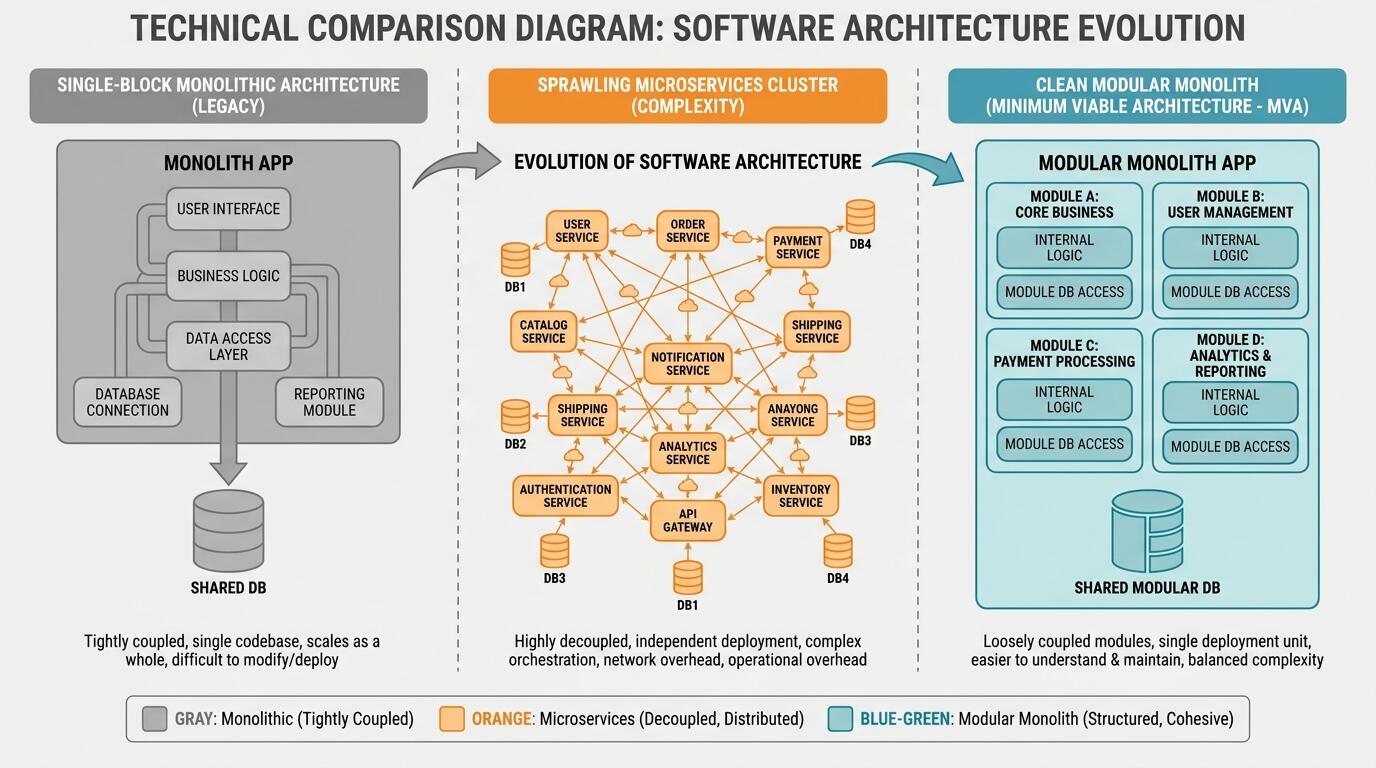
For most of computing history, monolithic architecture — a single deployable unit containing all application logic — was the default. It was pragmatic and fast to build. The problems emerged at scale: a single team's change could destabilize an entire system, deployment became a coordinated ritual, and horizontal scaling required duplicating everything rather than just the constrained component.
The microservices movement, accelerated by the widespread adoption of containerization and cloud-native infrastructure, offered a compelling answer. Decompose the system into independently deployable services, each owning its own data and business capability. The theory was elegant. The practice, as countless engineering teams discovered, introduced substantial operational overhead: distributed tracing, inter-service communication failures, deployment orchestration, and the cognitive load of reasoning about a system composed of dozens of moving parts.
Today, the industry is in a more mature, pragmatic position. According to InfoQ's coverage of minimum viable architecture principles, the most important architectural question is not "monolith or microservices" but "what is the minimum structure that supports today's needs while not closing off tomorrow's options." The conversation has shifted from style to strategy.
In parallel, the rise of AI-integrated products has introduced a new layer of architectural complexity. Machine learning inference pipelines, vector databases, embedding models, and LLM orchestration layers are now legitimate components of production systems — and they each carry meaningful cost and operational implications. Teams building AI-powered products face an even steeper temptation to over-architect, reaching for sophisticated MLOps tooling and complex pipelines before they have validated a single user assumption. The minimum viable architecture lens is especially valuable here: ship a working system with the simplest AI integration that delivers real value, then instrument and iterate.
ALT: System architecture evolution diagram comparing monolithic, microservices, and minimum viable architecture approaches for production software
What Actually Drives Over-Engineering — and How MVA Addresses Each Root Cause
Over-engineering is not a character flaw; it is a rational response to the wrong set of incentives and assumptions. Understanding the mechanisms behind it is the first step to countering them.
The Anticipation Trap
Speculative complexity is the most common driver of bloated early-stage architecture. Engineers — particularly experienced ones — have seen systems fail under load, suffer from tight coupling, and become unmaintainable. So they build preemptively for problems they have not yet encountered. The logic is understandable; the economics are punishing. Every abstraction layer added to handle a hypothetical future requirement is time not spent delivering value, and it introduces real maintenance burden today.
Minimum viable architecture counters this by making a direct distinction between constraints that are genuinely load-bearing right now and those that are merely plausible future concerns. A useful heuristic: if removing a design decision would not break anything in the next three months, it probably should not be in the initial design.
Resume-Driven Development
Resume-driven development (RDD) is a well-documented pattern in the industry where engineers advocate for novel or complex technologies — Kubernetes clusters, event-driven architectures, advanced caching layers — because those technologies are professionally interesting or marketable, not because the problem genuinely requires them. In a working with clients context, this pattern tends to emerge when teams have flexibility in their technology selection but limited accountability to delivery timelines.
The minimum viable architecture approach re-centers the conversation on fitness for purpose. The right tool is the one that ships the working system with the least operational risk and the smallest learning curve for the team actually maintaining it.
Ambiguous Quality Attributes
Non-functional requirements (NFRs) — performance, scalability, reliability, security — are real constraints. But they are frequently treated as binary absolutes ("it must be infinitely scalable") when they are actually functions of specific usage scenarios and acceptable trade-offs. Vague NFRs produce over-engineered architectures because engineers hedge against every conceivable interpretation.
A minimum viable architecture process starts by making NFRs concrete and time-bounded: what response time is acceptable for this user base size, today? What is the actual cost ceiling for infrastructure spend in the first six months? With specific, bounded answers, the architecture can be sized appropriately rather than speculatively.
Missing Architectural Seams
The flip side of over-engineering is under-engineering — building something so tightly coupled that growth requires a full rewrite. Architectural seams are the deliberate design choices that make future decomposition possible without requiring a rewrite: well-defined module boundaries, clear data ownership, dependency injection, and interface-based contracts between components. MVA is not an excuse to write throwaway code. It means writing clean, bounded code that happens to live in a simpler structure today.
As Randy Shoup articulated in his YOW! 2022 talk on minimum viable architecture (available at YouTube), every successful large-scale system started as something simpler — and the key differentiator between systems that scaled gracefully and those that required costly rewrites was the presence of those internal seams, even when the external footprint remained small.
Evidence and Competing Approaches: How MVA Compares in Practice
A pattern consistently observed in product engineering work is that teams reach for architectural complexity at precisely the wrong moment — early, when requirements are fluid, and the cost of rebuilding is still low. The irony is that this early complexity tends to slow down the iteration cycles needed to discover what the product actually needs to be.
The following comparison captures how different approaches to early-stage architecture perform across the dimensions that matter most to founders and engineering leaders:
| Perspective / Approach | Strengths | Trade-offs | Best Fit |
|---|---|---|---|
| Full Microservices from Day One | Independent deployability, team autonomy at scale, fine-grained scalability | High operational overhead, complex local development, expensive in engineering time and infrastructure | Large teams with stable, well-understood domain boundaries |
| Pure Monolith, No Internal Structure | Fastest initial delivery, simple deployment, low infrastructure cost | Becomes unmaintainable quickly, difficult to decompose later, single point of deployment risk | Hackathon prototypes, throwaway experiments |
| Minimum Viable Architecture (Modular Monolith) | Fast delivery with internal seams for future decomposition, lower operational cost, maintainable codebase | Requires deliberate discipline around module boundaries, may need refactoring as scale increases | Early-stage products, AI-integrated systems, startups validating product-market fit |
| Serverless-First | Near-zero infrastructure management, pay-per-use cost model | Cold starts, vendor lock-in risk, complex local testing, difficult to debug distributed call chains | Event-driven workloads with unpredictable or spiky traffic patterns |
According to the analysis published by Multiplayer on building a minimum viable architecture (the essential guide to minimum viable architecture), the modular monolith pattern — a single deployable unit with well-enforced internal boundaries — consistently delivers the best risk-adjusted outcome for early-stage products. It is fast to build, cheap to operate, and structured enough to be decomposed selectively when genuine scale demands it.
This is a position validated in practice across a range of product types. Teams building AI-powered applications, in particular, benefit from this approach because the AI components themselves introduce enough operational complexity (model versioning, inference latency, token cost management) that adding a distributed microservices layer on top creates compounding cognitive and operational burden before the product has found its market.
The key insight is that minimum viable architecture is not a permanent ceiling — it is a calibrated starting point. The decision to decompose a module into an independent service should be triggered by a real, observed constraint: a specific performance bottleneck, a team size that makes shared ownership unworkable, or a scaling requirement with actual usage data behind it. Decomposing based on anticipation is expensive; decomposing based on evidence is engineering.
Where This Is Heading — and What It Means for Your Next Build
The minimum viable architecture movement is not a trend that will reverse. It is a maturation of the industry's understanding that architectural sophistication is not inherently valuable — the value lies in shipping working systems that users trust and that teams can maintain and evolve.
Several forces are reinforcing this direction. Infrastructure abstraction continues to accelerate: managed databases, serverless compute, AI-as-a-service APIs, and platform-as-a-service offerings mean that teams can defer enormous operational complexity to providers and focus their architecture on the application logic that actually differentiates their product. The economic environment is also a factor — engineering time is expensive, and architectures that delay delivery or require large teams to maintain are increasingly difficult to justify.
For AI-integrated products specifically, the minimum viable architecture lens has a clarifying effect on a notoriously complex space. The question is not "what AI infrastructure do we need?" but "what is the simplest AI integration that delivers the capability this user actually needs?" That might mean a single API call to an LLM provider rather than a fine-tuned model. It might mean a lightweight semantic search implementation rather than a full vector database cluster. It means choosing the simplest thing that works, instrumenting it well, and letting real usage data drive the next decision.
Actionable takeaways for engineering leaders and founders:
- Define your load-bearing architectural constraints explicitly, in writing, before you start designing. Everything else is negotiable.
- Treat NFRs as time-bounded, scenario-specific requirements — not vague aspirations for infinite scale.
- Build internal module boundaries from the first commit, even in a monolithic structure. These seams are cheap to add early and expensive to retrofit later.
- Make decomposition a demand-driven decision, not a speculative one. Real traffic data, real team friction, and real performance measurements are your triggers.
- For AI-powered systems, start with managed APIs and the simplest integration path that validates your core use case before investing in custom model infrastructure.
Questions & Answers
Q1: How do you decide when an architecture is "minimum viable" versus just under-engineered?
Minimum viable architecture is defined by the presence of clear module boundaries and honest coverage of today's genuine load-bearing constraints — not by being thin. Under-engineered systems lack internal seams, conflate concerns, and resist change. A well-scoped MVA can be simple in its external deployment footprint while still being internally structured. The test: if a requirement changes, can you make that change in one place without cascading edits across the codebase? If yes, the architecture is viable.
Q2: Is a modular monolith a real production architecture, or just a stepping stone?
A modular monolith is a fully legitimate production architecture for many systems and is not automatically a stepping stone to microservices. Numerous high-traffic production systems operate successfully as well-structured single deployable units. The decision to decompose into independent services should be driven by concrete engineering constraints — specific scaling bottlenecks, team ownership friction, or deployment independence requirements — not by a belief that microservices are inherently more professional or scalable. As InfoQ's coverage of minimum viable architecture principles notes, the starting point matters less than the quality of internal boundaries.
Q3: How long does it typically take to outgrow a minimum viable architecture, and what triggers the transition?
There is no fixed timeline — growth depends entirely on product adoption, team size, and the nature of the workload. The practical triggers are observable and specific: a deployment to one module routinely breaking another, a team becoming large enough that shared code ownership creates coordination overhead, or a single component with demonstrably different scaling characteristics from the rest of the system. When one of those concrete conditions appears, that is the right moment to extract a service — not sooner.
The Bottom Line
Minimum viable architecture is the discipline of building exactly what your system needs to ship and succeed today, with the structural honesty to grow without a rewrite.
Key Takeaways:
- Over-engineering is a form of waste — it consumes engineering time and capital before you have validated the assumptions that justify the complexity.
- A modular monolith with well-enforced internal boundaries delivers the best risk-adjusted outcome for most early-stage products, including AI-powered systems.
- Architectural seams — module boundaries, clear data ownership, interface-based contracts — are the investment that makes future growth tractable.
- Decomposition into microservices or independent services should be triggered by real, observed constraints, not speculation about future scale.
- For AI-integrated products, start with the simplest integration path that delivers the core capability; let instrumented usage data drive infrastructure investment.
The most valuable next step is an architectural audit of your current or planned system: map your genuine load-bearing constraints, identify where complexity is speculative versus necessary, and define the internal seams that will let you grow on evidence rather than assumption.
Ready to build a system that ships today and scales on evidence? Explore technical insights, architectural approaches, and real-world engineering practice at the Darius website — and get in touch if you need hands-on guidance in AI architecture, systems design, or full-stack product development.
Sources & Further Reading
- Randy Shoup. "Minimum Viable Architecture • Randy Shoup • YOW! 2022".
https://www.youtube.com/watch?v=9Q7GANXn02k - Multiplayer. "The essential guide to building a minimum viable architecture".
https://www.multiplayer.app/blog/future-proof-your-mvp-the-essential-guide-to-minimum-viable-architecture/ - InfoQ. "An Introduction to Minimum Viable Architecture".
https://www.infoq.com/news/2014/11/minimum-viable-architecture/ - IEEE. IEEE Standards Association — Software Engineering Standards.
https://www.ieee.org/
Note: Standards and best practices in software architecture continue to evolve; consult the latest official documentation and professional advisors for guidance specific to your system.