How to Design a Scalable AI Architecture for Production in 2026

ALT: Engineering team designing scalable AI architecture for production deployment in 2026
What You'll Build: A Production-Ready AI Architecture That Scales
Key Conclusion: Designing a scalable AI architecture for production in 2026 requires more than selecting the right model — it demands a disciplined, layered approach covering data pipelines, inference infrastructure, observability, and governance. This guide walks engineering leaders and builders through the concrete steps to move from a working AI prototype to a resilient, maintainable system that can handle real-world load, evolving requirements, and the operational demands of a live product.
Most AI systems fail not because the model was wrong, but because the architecture around it was never built for production. If you are a CTO, engineering manager, startup founder, or senior engineer trying to take an AI-powered product from proof-of-concept to live deployment, this guide is for you. It draws directly from the kind of end-to-end technical work that Darius represents — the hard-won experience of shipping real products, not just designing systems on whiteboards.
Before You Start: Prerequisites and Preparation for Scalable AI System Design
Designing a scalable AI architecture is not a single-afternoon exercise. It is a structured engineering process that benefits enormously from preparation. Before writing a single line of infrastructure code or selecting a cloud provider, you need clarity on several foundational dimensions.
Technical prerequisites include a working familiarity with distributed systems concepts — specifically how services communicate, how data flows, and what failure modes look like at scale. You do not need to be an expert in every layer, but you do need enough fluency to make informed trade-off decisions. An understanding of containerization (Docker, Kubernetes) and cloud-native infrastructure patterns is highly valuable. Familiarity with at least one major machine learning framework and experience deploying APIs in production are practical baselines.
Organizational prerequisites matter just as much. You need a clear problem statement: what specific task is the AI system performing, and what does "success" look like in production? Without this, architectural decisions become guesswork. You also need alignment with stakeholders on non-functional requirements — latency tolerance, expected throughput, data privacy obligations, and cost ceilings. According to the IEEE's published guidance on dependable AI systems, explicitly capturing non-functional requirements before design begins significantly reduces costly rework late in the development cycle.
Time and effort will vary considerably based on the complexity of your use case. A focused inference API for a single model is architecturally simpler than a multi-agent pipeline with retrieval-augmented generation and real-time retraining. Expect the design phase alone to demand meaningful, uninterrupted technical attention before you move to implementation.
Checklist before starting:
- You have a clear, written definition of the AI system's production use case and success criteria
- Non-functional requirements (latency, throughput, availability, data retention) are documented and agreed upon
- You understand your team's current infrastructure capabilities and gaps
- You have evaluated data privacy and compliance obligations relevant to your domain
- You have a rough budget or cost ceiling for compute and tooling
- Your team has at least a working knowledge of distributed systems and cloud-native deployment patterns
- You have a staging environment where architectural decisions can be validated before they reach production
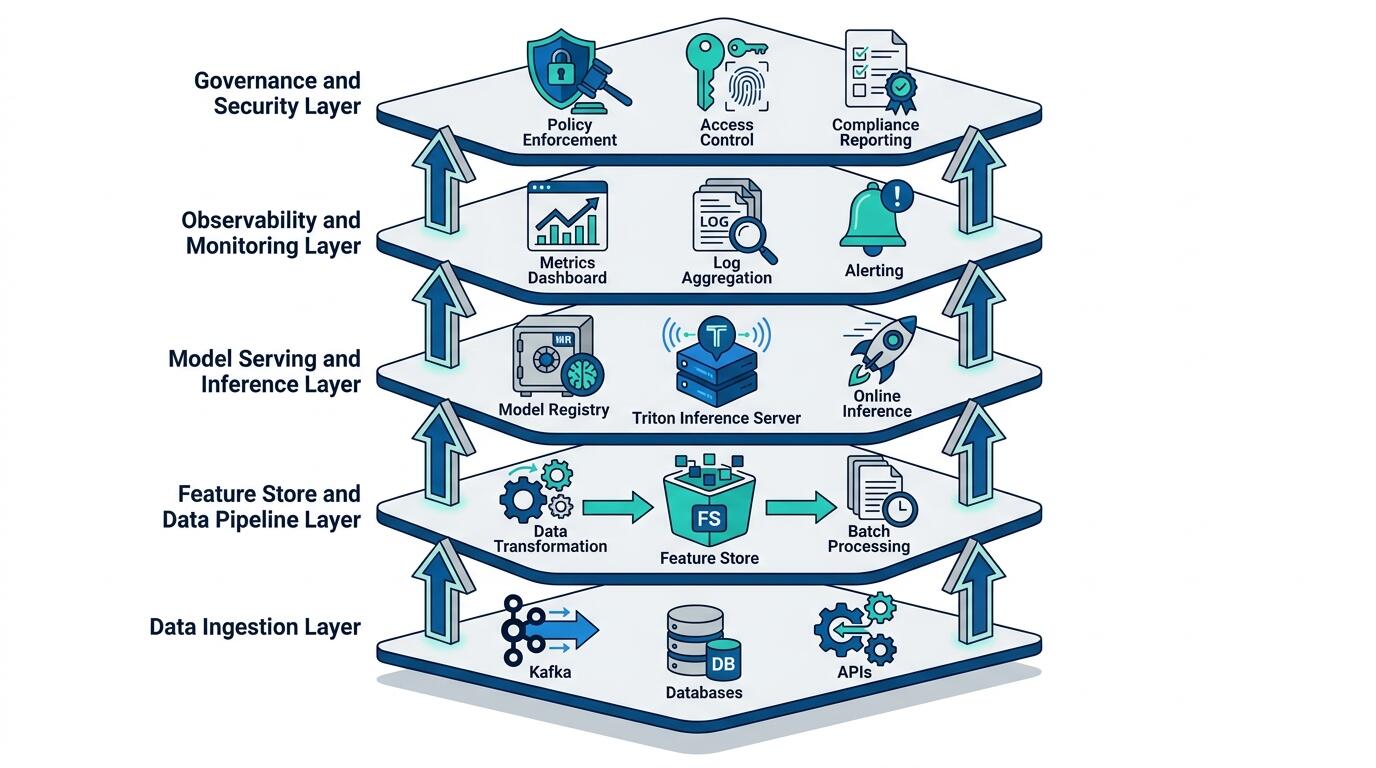
ALT: Layered diagram of a scalable AI architecture showing data ingestion, model serving, observability, and governance components for production systems
Step-by-Step: How to Design a Scalable AI Architecture for Production
Step 1: Define the Architectural Boundaries and System Contracts
A scalable AI architecture begins with explicit boundaries — knowing what your AI system is responsible for and, crucially, what it is not. Start by mapping the system into three broad zones: the data plane (ingestion, storage, preprocessing), the model plane (inference, orchestration, retrieval), and the application plane (APIs, user-facing services, integration points).
For each zone, define its contract: what inputs does it accept, what outputs does it produce, and what service-level expectations does it carry? This is not bureaucratic overhead — it is the foundation that makes every subsequent design decision coherent. In practice, a pattern that consistently surfaces in end-to-end product work is that teams skip this step and then spend months untangling coupling between the model and the application layer when scaling pressure arrives.
Tip: Document these contracts before selecting any specific technology. Technology choices should serve the contracts, not define them.
Step 2: Design a Robust, Decoupled Data Pipeline
Data is the most underestimated architectural concern in AI systems. A production AI architecture needs a data pipeline that is not only functional but operationally resilient — capable of handling late-arriving data, schema evolution, and upstream failures without corrupting model inputs or inference outputs.
The core principle here is decoupling: the data ingestion layer should be independent of the model serving layer. Use an event-driven or message-queue pattern (such as Apache Kafka or a cloud-native equivalent) to buffer between data sources and the processing logic. This decoupling allows you to evolve preprocessing logic, swap data sources, or replay historical data without touching the model infrastructure.
For AI systems specifically, pay close attention to feature consistency — the features computed at training time must be reproducible at inference time. A feature store is the architectural pattern that enforces this consistency. Organizations such as the Linux Foundation's LF AI & Data project have documented feature store patterns as a critical component of production ML infrastructure, precisely because inconsistency between training and serving features is one of the most common sources of silent model degradation.
Tip: Build data validation into the pipeline as a first-class concern, not an afterthought. Detecting schema drift or statistical distribution shifts at ingestion time is far cheaper than debugging them downstream.
Step 3: Choose an Inference Architecture Matched to Your Latency and Scale Requirements
Model inference is the operational core of any AI system, and the infrastructure decision here has far-reaching cost and performance implications. There is no single right answer — the right inference architecture depends on your latency requirements, request volume, model size, and whether your use case tolerates batch processing or demands real-time response.
For synchronous, user-facing applications, a dedicated model serving layer with horizontal auto-scaling is the standard approach. Frameworks designed specifically for model serving — such as those built around ONNX Runtime, Triton Inference Server, or managed cloud inference endpoints — provide the performance optimizations (batching, quantization, hardware acceleration) that a generic web server cannot.
For asynchronous or high-throughput workloads, consider separating the inference request from the response with an asynchronous queue pattern. This architecture absorbs traffic spikes gracefully and prevents cascading failures when load exceeds capacity.
A pattern worth highlighting from production work: teams frequently deploy a model directly inside their application server during prototyping and then never refactor it out. This creates a tight coupling that makes scaling impossible without a full rewrite. Treat the model serving layer as a separate service from day one.
Tip: Always implement a fallback behavior for when the model service is unavailable or exceeds latency thresholds. Graceful degradation is a mark of a production-grade system.
Step 4: Build an Observability Layer for AI-Specific Metrics
Observability is what separates a production system from a deployed prototype. For AI systems, observability goes beyond traditional application metrics (CPU, memory, request latency) to include model-specific signals: prediction distribution, confidence score drift, feature distribution shifts, and error rates by input segment.
Instrument your system to capture these signals from the first production deployment. A structured logging approach — where model inputs, outputs, and metadata are captured in a queryable format — provides the raw material for debugging, auditing, and retraining decisions. According to guidance from the National Institute of Standards and Technology (NIST) on AI risk management, continuous monitoring of model behavior in production is a core practice for maintaining reliable and trustworthy AI systems.
Build dashboards that distinguish between infrastructure health (is the serving layer up?) and model health (is the model performing as expected?). These are separate concerns that require separate tooling and alerting logic.
Tip: Set up anomaly detection on your model's output distribution early. A sudden shift in prediction patterns often signals a data quality issue upstream — catching it before users notice is the difference between a minor incident and a major outage.
Step 5: Implement a Model Lifecycle Management Strategy
A production AI system is not a static artifact — models need to be updated, retrained, versioned, and occasionally rolled back. Without a disciplined model lifecycle management strategy, your architecture will accumulate technical debt rapidly.
The practical elements of this strategy include: a model registry for versioning and metadata tracking, a deployment pipeline with canary or blue-green release capabilities, and automated evaluation gates that a new model version must pass before it reaches production traffic. This mirrors software release practices but adds the dimension of statistical validation — a new model version must not just deploy successfully but must also perform at least as well as its predecessor on agreed evaluation benchmarks.
Experiment tracking tools that record hyperparameters, training data versions, and evaluation metrics for every model run are the infrastructure equivalent of source control for code. Treating model artifacts with the same rigor as code artifacts is a discipline that consistently distinguishes teams building durable AI products from those constantly firefighting.
Tip: Version your training data and preprocessing logic alongside your model artifacts. A model trained on a different version of the data is effectively a different system, even if the model code is identical.
Step 6: Architect for Security, Privacy, and Compliance
Security and compliance are not optional layers to add before launch — they are architectural constraints that shape infrastructure decisions from the start. For AI systems specifically, these concerns extend into areas that traditional application security does not cover: training data provenance, model access controls, prompt injection risks (for LLM-based systems), and output filtering.
Define your data residency requirements early — where data is stored, processed, and transmitted has regulatory implications in many jurisdictions. The European Union's AI Act, which establishes risk-based compliance obligations for AI systems deployed in EU contexts, is a current example of the regulatory landscape that production AI architects must account for. Design your system so that compliance-sensitive data flows are isolated and auditable.
Access controls should be applied at the model API level as well as the infrastructure level. Treat your model endpoints as sensitive services — authenticate callers, log access, and rate-limit aggressively.
Tip: Conduct a threat modeling exercise specifically for your AI system's inputs and outputs. LLM-based systems in particular are vulnerable to adversarial input patterns that have no direct analog in traditional application security.
Step 7: Plan for Cost Efficiency and Operational Sustainability
An architecture that works brilliantly under test conditions but burns through compute budget in production is not production-ready. Cost architecture is a real discipline, and in AI systems — where GPU compute and managed inference services can be expensive — it deserves explicit design attention.
Optimization levers include model distillation or quantization to reduce inference compute, intelligent caching for repeated or near-identical queries, tiered serving that routes simple requests to smaller models and complex requests to larger ones, and autoscaling policies calibrated to your actual traffic patterns rather than worst-case assumptions.
Operational sustainability also means designing for the team maintaining the system. A system that requires heroic manual intervention to keep running is a liability. Invest in runbooks, automated remediation for common failure modes, and clear escalation paths. From consistent experience building and handing off production AI systems, the operational burden is almost always underestimated during the design phase.
Tip: Model your compute costs at the design stage using rough estimates of expected query volume and model inference cost per request. This exercise often surfaces architectural choices — such as synchronous vs. asynchronous processing — that have significant cost implications.
Common Mistakes and Troubleshooting in Scalable AI Architecture
| Symptom | Likely Cause | How to Fix |
|---|---|---|
| Model performance degrades gradually in production | Training-serving skew: features computed differently at inference time than at training time | Implement a feature store to enforce consistent feature computation across both environments |
| Inference latency spikes under moderate load | Model serving not isolated from application server; no batching or hardware optimization | Migrate model serving to a dedicated inference service with batching and appropriate hardware acceleration |
| New model versions silently break production behavior | No automated evaluation gate in the deployment pipeline | Introduce statistical evaluation benchmarks that block deployment if a new version underperforms the baseline |
| Data pipeline failures corrupt model inputs without alerting anyone | No data validation or schema enforcement at ingestion | Add schema validation and distribution checks as first-class steps in the data pipeline, with alerting on failure |
| Compliance audit reveals untracked data flows | Security and compliance treated as post-launch concerns | Conduct a threat model and data flow audit at architecture design phase; isolate sensitive data paths |
| Costs escalate unpredictably as usage grows | No cost modeling done at design time; over-provisioned resources | Instrument cost metrics from launch, model expected costs at design stage, and implement autoscaling and caching |
Pro Tips for Better Results in Production AI System Design
Treat your AI system as a distributed system first. The most common misconception in AI architecture is that the model is the hard part. In production, the model is often the most stable component — the failure modes cluster around data pipelines, network partitions, infrastructure drift, and operational gaps. Design for distributed system resilience from the start.
Separate concerns aggressively. Each layer — data, model, application — should be independently deployable and independently scalable. This is not just an architectural ideal; it is what makes debugging, scaling, and evolving the system practically manageable. Teams that couple these layers tightly pay a compounding tax every time requirements change.
Invest in a staging environment that mirrors production. Many production incidents are caused by differences between the staging and production environments. A staging environment that accurately reflects production data volumes, infrastructure configurations, and traffic patterns catches integration issues before they reach users.
Build for observability before you need it. The instinct is to add monitoring once something breaks. The discipline is to instrument comprehensively at launch so that when something breaks, you have the data to diagnose it quickly. This is especially true for AI systems, where behavioral regressions can be subtle and statistically distributed across a large request population.
Misconception to correct: Many teams believe that using a managed AI service (a hosted LLM API, a cloud AutoML platform) eliminates the need for architectural discipline. It does not. Managed services remove infrastructure management burden but do not remove the need for thoughtful system design around data pipelines, observability, cost management, and integration architecture. The principles in this guide apply regardless of whether you are building on managed services or running your own infrastructure.
People Also Ask
Q1: How long does it take to design a production-ready AI architecture?
The design phase for a production AI architecture is not a fixed-duration activity — it scales with system complexity. A straightforward single-model inference API can be architecturally scoped in days with an experienced architect. A multi-model pipeline with real-time retrieval, complex data ingestion, and compliance requirements may require weeks of structured design work. The key driver of timeline is how clearly non-functional requirements are defined at the outset; ambiguity here is the single largest source of design delay.
Q2: Is Kubernetes necessary for deploying AI models at scale?
Kubernetes is a widely used container orchestration platform that simplifies scaling, deployment, and management of containerized workloads, including AI inference services. It is not strictly necessary for every production AI system — managed cloud inference services can abstract away orchestration for simpler use cases. However, for teams operating complex, multi-component AI systems with strict latency or cost requirements, Kubernetes provides the operational control and flexibility that managed abstractions often cannot. The right choice depends on your team's infrastructure maturity and the operational demands of your specific system.
Q3: What does it cost to run a scalable AI system in production?
Production AI infrastructure costs vary widely based on model size, inference hardware requirements, request volume, and whether you use managed services or self-hosted infrastructure. GPU-accelerated inference is significantly more expensive than CPU-based serving for large models. Cost modeling at the design stage — estimating inference cost per request multiplied by expected query volume — is the most reliable way to forecast operational spend. Architectural choices like caching, model quantization, and asynchronous processing can substantially reduce costs without sacrificing user experience.
Wrapping Up
Designing a scalable AI architecture for production in 2026 is fundamentally an engineering discipline, not a technology selection exercise. The teams that ship durable, reliable AI products share a common approach: they design explicitly, separate concerns, invest in observability, and treat operational sustainability as a design constraint from day one.
Key Takeaways:
- Define architectural boundaries and system contracts before selecting any technology
- Decouple your data pipeline, model serving layer, and application plane from the start
- Build observability for AI-specific signals — prediction drift, feature distribution, and model health — not just infrastructure metrics
- Implement a model lifecycle management strategy with versioning, evaluation gates, and rollback capability
- Address security, privacy, and compliance as architectural constraints, not post-launch additions
- Model your compute costs at design time and build cost efficiency into the architecture
The most valuable next step is to take the checklist and step-by-step framework in this guide and apply it directly to your current system design or audit. If your existing architecture has gaps in any of the seven layers described here, those gaps are worth addressing systematically rather than incrementally.
If you're ready to move from architectural planning to execution, explore Darius — a resource built for founders, engineers, and engineering leaders who need end-to-end technical expertise, from system design through production deployment.
Sources and Further Reading
- IEEE. "IEEE Standards and Publications on Artificial Intelligence and Autonomous Systems".
https://www.ieee.org/ - National Institute of Standards and Technology (NIST). "AI Risk Management Framework and AI Trustworthiness Guidance".
https://www.nist.gov/ - Linux Foundation — LF AI & Data. "Open Source AI and Data Projects, Including Feature Store and MLOps Patterns".
https://lfaidata.foundation/ - European Commission. "EU AI Act: Regulatory Framework for Artificial Intelligence".
https://commission.europa.eu/ - The Open Group. "TOGAF and Enterprise Architecture Standards for Large-Scale Systems Design".
https://www.opengroup.org/
Note: Standards and regulatory documents may be updated; please verify the latest official versions with the relevant issuing organizations before making architectural or compliance decisions.