Storage Costs vs. Embedding Costs: The Real Economics of Making Files Searchable
ALT: Storage costs vs embedding costs comparison for making files AI-searchable in production
What It Actually Costs to Make Your Files Searchable with AI
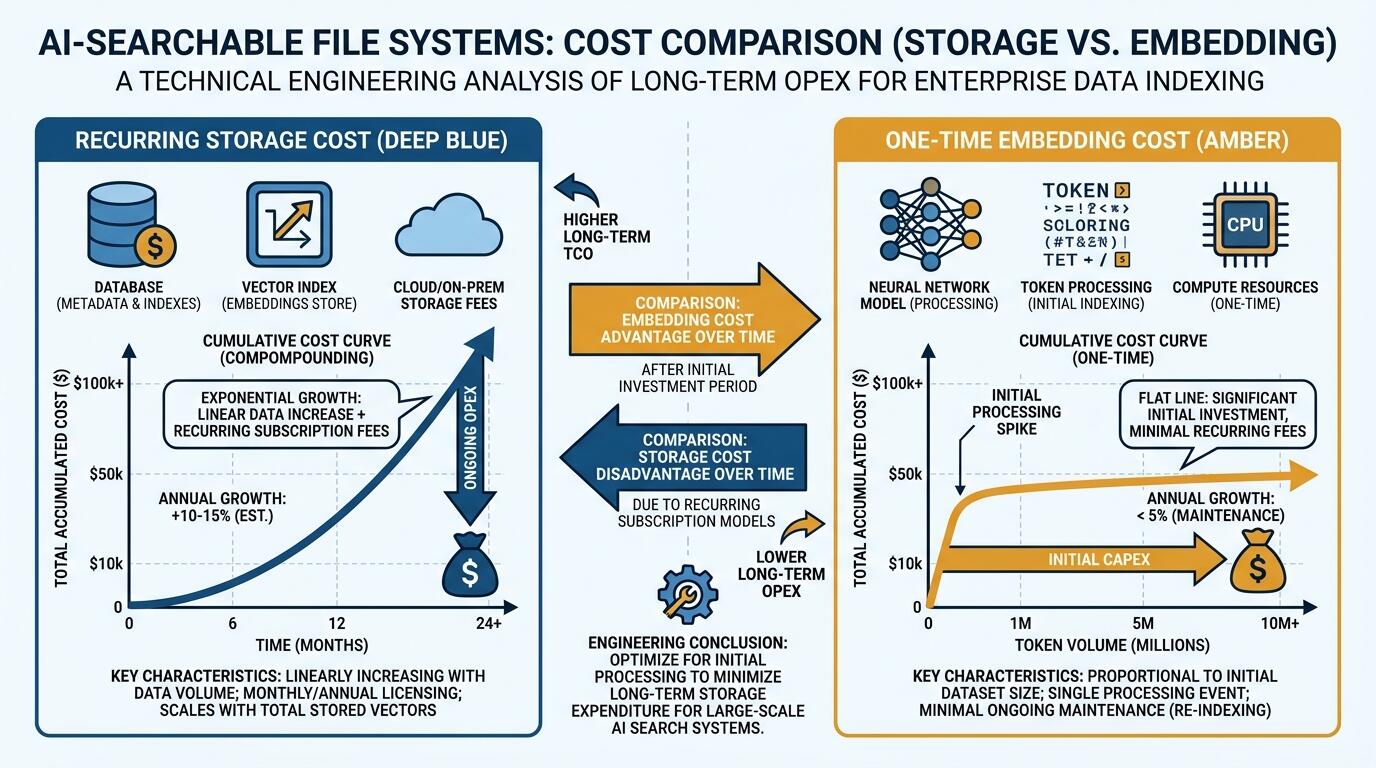
Making files searchable with AI involves two distinct cost categories that teams routinely conflate: the recurring cost of storing data (raw files, vectors, indexes) and the upfront processing cost of embedding that data into a searchable representation. These two costs have fundamentally different structures, scale at different rates, and respond to optimization in entirely different ways. Understanding this distinction is not academic — it determines whether your retrieval-augmented feature is economically viable at scale.
The verdict, stated plainly: embedding costs are a one-time capital expenditure that scales with the size and frequency of your ingestion pipeline, while storage costs are an ongoing operational expenditure that scales with the volume and dimensionality of your vector corpus. Conflating the two leads to budget surprises in both directions — teams either over-invest in powerful embedding models on day one, or underestimate the compounding storage bill they accumulate as their knowledge base grows.
This article compares both cost categories across the most common architectural choices, maps each to real builder scenarios, and gives you a practical framework for making the tradeoff deliberately rather than accidentally.
Evaluation Criteria: How to Judge the Economics of Searchable File Systems
Comparing storage costs and embedding costs requires a clear set of criteria. The dimensions that matter most in production are different from what matters in a prototype, and the right framework surfaces tradeoffs that simple per-unit pricing obscures.
Per-unit processing cost measures what you pay each time a document is chunked and embedded. This matters most during initial ingestion and re-indexing cycles. A model that costs more per token but produces higher-quality embeddings may reduce downstream retrieval failures — reducing the hidden cost of bad search results.
Storage unit cost and dimensionality captures what you pay to persist vectors over time. Vector dimensions directly determine storage footprint: a 1536-dimension embedding takes roughly three times the storage of a 512-dimension one, with compounding effects at scale.
Re-embedding frequency is the dimension teams most consistently underestimate. When your source documents change — product catalogs updated, policies revised, code repositories merged — you pay embedding costs again. High-churn corpora transform what looks like a one-time cost into a recurring one.
Query-time retrieval cost is the runtime cost of actually searching your vector index. Some architectures bundle this into storage pricing; others charge per query. At high query volumes, this can dwarf both embedding and raw storage costs.
Operational complexity and latency determines the engineering overhead required to maintain the system. A cheaper solution that requires manual index management or introduces retrieval latency above acceptable thresholds carries real hidden costs in engineering time and user experience degradation.
Scalability headroom reflects how unit costs behave as your corpus grows from thousands to millions of documents. Some pricing models become dramatically cheaper at scale; others carry minimum commitments that penalize smaller workloads.
The Contenders: Architectural Choices for Searchable File Infrastructure
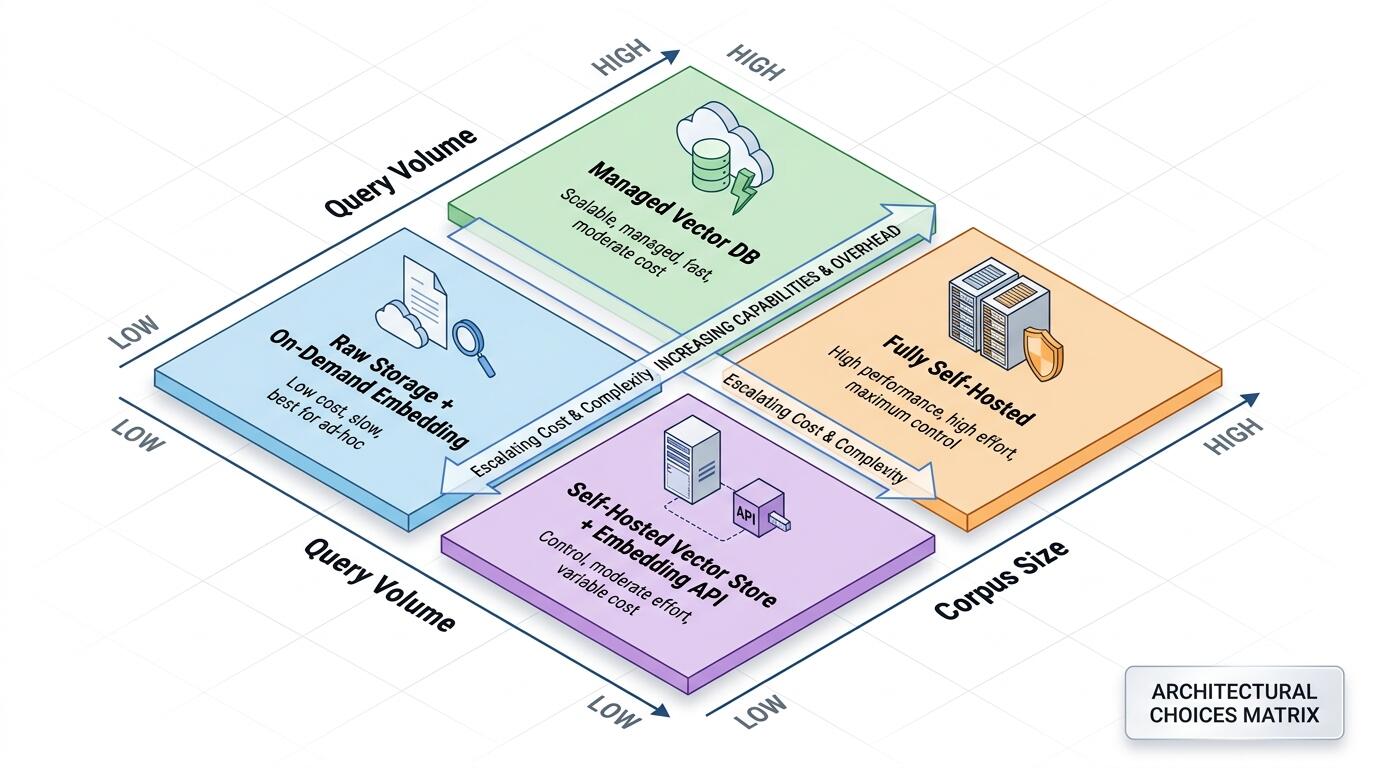
Raw File Storage Plus On-Demand Embedding
The simplest architecture stores original files in object storage (such as Amazon S3 or Google Cloud Storage) and runs embedding on demand — either at query time or in a batch pipeline triggered by document updates. This approach minimizes persistent vector storage costs by avoiding a dedicated vector database entirely, at the expense of higher per-query embedding latency.
This model works well when your document corpus is relatively static and query volume is low. The economics favor it when re-indexing is infrequent and you can tolerate the latency of embedding at retrieval time. The trade-off is that every query incurs embedding API cost, which inverts the cost structure compared to pre-computed approaches.
Managed Vector Database with Pre-computed Embeddings
A managed vector database — such as Pinecone, Weaviate Cloud, or Qdrant Cloud — stores pre-computed embeddings alongside metadata and exposes a query API. You pay for storage capacity (often priced per vector or per GB of index), for write throughput during ingestion, and sometimes for query operations separately.
The economic profile here is predictable storage spend with upfront embedding investment. Once your corpus is embedded and indexed, query costs are low and latency is fast. The risk is that storage costs compound as your corpus grows, and managed services carry a minimum spend floor that makes them expensive for small-scale workloads.
Self-Hosted Vector Store with Embedding API
Deploying an open-source vector store (pgvector on PostgreSQL, Qdrant self-hosted, or OpenSearch with k-NN) alongside a third-party embedding API decouples the two cost centers explicitly. You control infrastructure costs directly — paying for compute and storage at commodity cloud rates — while using a pay-per-token embedding API for processing.
This is the architecture we see most commonly adopted by teams that have outgrown managed service pricing but are not yet large enough to justify self-hosted embedding models. The operational complexity is meaningfully higher, but the cost transparency is excellent: you can attribute every dollar to either infrastructure or embedding API spend.
Self-Hosted Embedding Models with Self-Hosted Vector Store
Running open-source embedding models (such as those from the Sentence Transformers family, or models available through Hugging Face) on your own GPU or CPU infrastructure eliminates per-token embedding costs entirely, replacing them with fixed infrastructure cost. Combined with a self-hosted vector store, this architecture has the lowest marginal cost at scale but the highest upfront investment in infrastructure setup and MLOps overhead.
For teams managing AI products at scale, this is often the right end-state — but it requires the kind of operational maturity that takes time to build. As explored in the build-vs-buy AI infrastructure framework, the decision to self-host embedding models is not just about cost but about your team's capacity to operate ML infrastructure reliably.
Head-to-Head Comparison: Storage vs. Embedding Cost Structures Across Architectures
| Criterion | Raw Storage + On-Demand Embedding | Managed Vector DB | Self-Hosted Vector Store + Embedding API | Fully Self-Hosted |
|---|---|---|---|---|
| Per-unit embedding cost | High (paid per query) | Low (paid once at ingest) | Low (paid once at ingest) | Near-zero marginal cost |
| Storage unit cost | Very low (object storage rates) | Higher (managed service markup) | Commodity cloud rates | Commodity cloud rates |
| Re-embedding cost on updates | High (re-embeds at query time) | Medium (batch re-indexing) | Medium (batch re-indexing) | Low marginal cost |
| Query-time retrieval cost | High (embedding latency) | Low (pre-computed) | Low (pre-computed) | Low (pre-computed) |
| Operational complexity | Low | Low | Medium | High |
| Scalability headroom | Limited by API rate limits | Good, with minimum spend floor | Excellent | Excellent |
| Upfront investment | Minimal | Minimal | Medium | High |
The table reveals a fundamental tension: the architectures with the lowest operational complexity tend to have the least favorable long-run economics, while the architectures with the best unit economics at scale demand the most engineering investment to operate.
The managed vector database option sits in an interesting middle position. It offers pre-computed retrieval speed at low per-query cost, but the managed service pricing structure — typically involving per-vector storage fees, minimum pod sizes, or monthly minimums — means that small corpora can be disproportionately expensive relative to what you would pay on raw infrastructure. Research published by Mixpeek's vector database cost comparison guide documents how dramatically per-vector costs vary across managed providers, reinforcing that "managed" does not mean "cheap at small scale."
The self-hosted vector store with embedding API is the architecture that most cleanly separates the two cost centers. You can see exactly what you are spending on embedding (line-itemed in your embedding provider invoice) and exactly what you are spending on storage and compute (line-itemed in your cloud bill). This transparency is operationally valuable: when costs rise, you immediately know which lever to pull. This separation also makes it straightforward to swap your embedding model — for example, migrating to a smaller, cheaper model when your retrieval quality metrics confirm the quality holds — without changing your storage architecture.
The fully self-hosted path eliminates variable embedding costs but introduces fixed infrastructure cost that does not scale down with usage. It is economically favorable only when your embedding volume is high enough that the fixed infrastructure cost is lower than what you would pay a third-party API. Darryl Ruggles' analysis of vector storage costs across S3, OpenSearch, pgvector, and Pinecone illustrates that the break-even threshold depends heavily on corpus size and query patterns — there is no universal answer.
Which Should You Choose? Scenario Recommendations for AI Product Builders
If you are prototyping or in early product discovery, start with a managed vector database and a third-party embedding API. The operational simplicity lets you iterate on retrieval quality without infrastructure distraction. The cost at this stage is low enough that optimizing it is premature. Optimize for learning speed, not unit economics.
If your document corpus is largely static and query volume is moderate, the managed vector database remains the right choice. The per-vector storage cost is predictable, re-embedding is infrequent, and the retrieval latency is fast. Watch the minimum spend floor — if your corpus is small, you may be paying for capacity you do not use.
If your document corpus is high-churn — meaning documents are frequently updated, added, or deleted — re-embedding costs become a significant budget line. In this scenario, evaluate whether a cheaper embedding model with slightly lower quality is acceptable, since you will be paying per-token repeatedly. Also consider chunking strategies that minimize the volume of content that needs re-embedding when a document changes (chunking at section boundaries rather than fixed character counts, for example).
If you are operating at scale with a large, stable corpus, the self-hosted embedding model is worth serious evaluation. The crossover point where self-hosted becomes cheaper than API-based embedding is reachable sooner than most teams expect, particularly as GPU spot pricing has become more accessible. The operational overhead is real, but teams with existing MLOps infrastructure absorb it more easily.
If your corpus is large and your query volume is high, the combination of self-hosted embedding and self-hosted vector store gives you the best long-run economics. The fixed infrastructure cost amortizes favorably across high usage, and you retain full control over model versions, chunking strategies, and index configuration.
If cost predictability matters more than optimization, managed services are worth the premium. Variable API billing for embedding can produce surprising monthly invoices during re-indexing cycles or ingestion spikes. A managed service with a fixed monthly tier trades some economic efficiency for budget stability — a legitimate choice for product teams operating without dedicated infrastructure engineers.
The honest summary: there is no universally correct answer. The right architecture depends on corpus size, churn rate, query volume, team operational maturity, and risk tolerance for infrastructure management. The decision framework we consistently apply starts with corpus churn rate and query volume, because those two variables most strongly determine which cost center will dominate your total spend.
ALT: Decision framework comparing storage costs and embedding costs for AI-searchable file systems across corpus sizes and query volumes
Questions & Answers
Q1: How do embedding costs change when I update my documents frequently?
Embedding costs scale directly with re-indexing volume. Every time a document changes and you need updated search results, you must re-embed the changed content and update the vector index. For high-churn corpora — such as frequently revised product catalogs or living documentation — this transforms embedding from a one-time ingestion cost into a recurring operational cost. Minimizing re-embedding scope through intelligent chunking strategies (embedding at natural content boundaries rather than fixed sizes) can meaningfully reduce this cost.
Q2: Are self-hosted embedding models always cheaper than API-based embedding at scale?
Self-hosted embedding models are not automatically cheaper — they replace variable per-token API costs with fixed infrastructure costs, which only becomes favorable above a certain usage threshold. Below that threshold, API-based embedding is cheaper because you pay only for what you use, with no idle infrastructure. The break-even point depends on your embedding volume, GPU infrastructure costs, and the engineering overhead of operating the model. Teams that already run GPU infrastructure for other workloads reach break-even more quickly.
Q3: How much does vector dimensionality affect storage costs over time?
Vector dimensionality has a direct, linear effect on storage footprint: doubling the number of dimensions in your embedding model roughly doubles your storage cost, all else being equal. For large corpora, this means the choice of embedding model — specifically its output dimension — is a storage architecture decision, not just a retrieval quality decision. Some newer embedding models achieve comparable retrieval quality at lower dimensions through techniques like Matryoshka Representation Learning, which allows truncating vectors to lower dimensions without proportional quality loss, as documented in research from the information retrieval community.
Wrapping Up
The economics of making files searchable with AI are more nuanced than the API pricing pages suggest. Storage costs and embedding costs are structurally different — one is recurring and compounds with corpus growth, the other is episodic and scales with ingestion and re-indexing frequency — and optimizing your system requires treating them as separate levers.
Key Takeaways:
- Embedding cost is primarily a function of ingestion volume and re-indexing frequency; storage cost is primarily a function of corpus size and vector dimensionality.
- Managed vector databases offer operational simplicity but carry minimum spend floors that penalize small-scale deployments.
- Self-hosted vector stores with third-party embedding APIs provide the clearest cost separation and the most flexibility for model swapping.
- Fully self-hosted embedding becomes economically attractive above a usage threshold that is reachable for serious production workloads, but demands operational maturity.
- High-churn document corpora require explicit re-embedding cost modeling — treating embedding as a one-time cost is a common and expensive mistake.
The practical next step: before choosing an architecture, model your corpus churn rate and expected query volume explicitly. Run the numbers for both your current state and a plausible twelve-month growth scenario. The architecture that is cheapest today is often not the architecture that is cheapest at scale. For teams navigating these infrastructure decisions during active product development, the guidance in the agent pipeline retrieval and verification deep-dive offers additional context on how retrieval economics intersect with pipeline design in real production systems.
If you found this analysis useful and want to go deeper on the operational side — including how the cost structure of running AI pipelines on agents compares to traditional infrastructure — the work of modeling these tradeoffs in production is ongoing.
If this article gave you something to think about, subscribe to Darius at the Darius website — a bilingual AI briefing written by an engineer who actually runs AI products in production. Every issue curates 5–10 of the most important AI developments of the week, with first-hand interpretation you can apply directly to engineering decisions. Every item comes from primary sources; every judgment has been tested against real users, real data, and real costs. Let the most valuable AI signals come directly to your inbox.
References & Further Reading
- Rajni Singh. "Vector Embeddings at Scale: A Guide to Cutting Storage Costs."
https://www.linkedin.com/pulse/vector-embeddings-scale-guide-cutting-storage-costs-90-rajni-singh-cwh6c - Mixpeek. "How Much Does a Vector Database Cost? A 2026 Pricing Guide."
https://mixpeek.com/guides/vector-database-cost-comparison - Darryl Ruggles. "Vector Storage Costs: S3, OpenSearch, pgvector, Pinecone."
https://darryl-ruggles.cloud/the-real-cost-of-vector-storage-s3-vectors-vs-opensearch-vs-pgvector-vs-pinecone/
Note: Pricing structures for cloud services and embedding APIs change frequently. Verify current rates directly with providers before making infrastructure decisions.