How Much Does It Cost to Run a Daily AI Briefing on Agents?
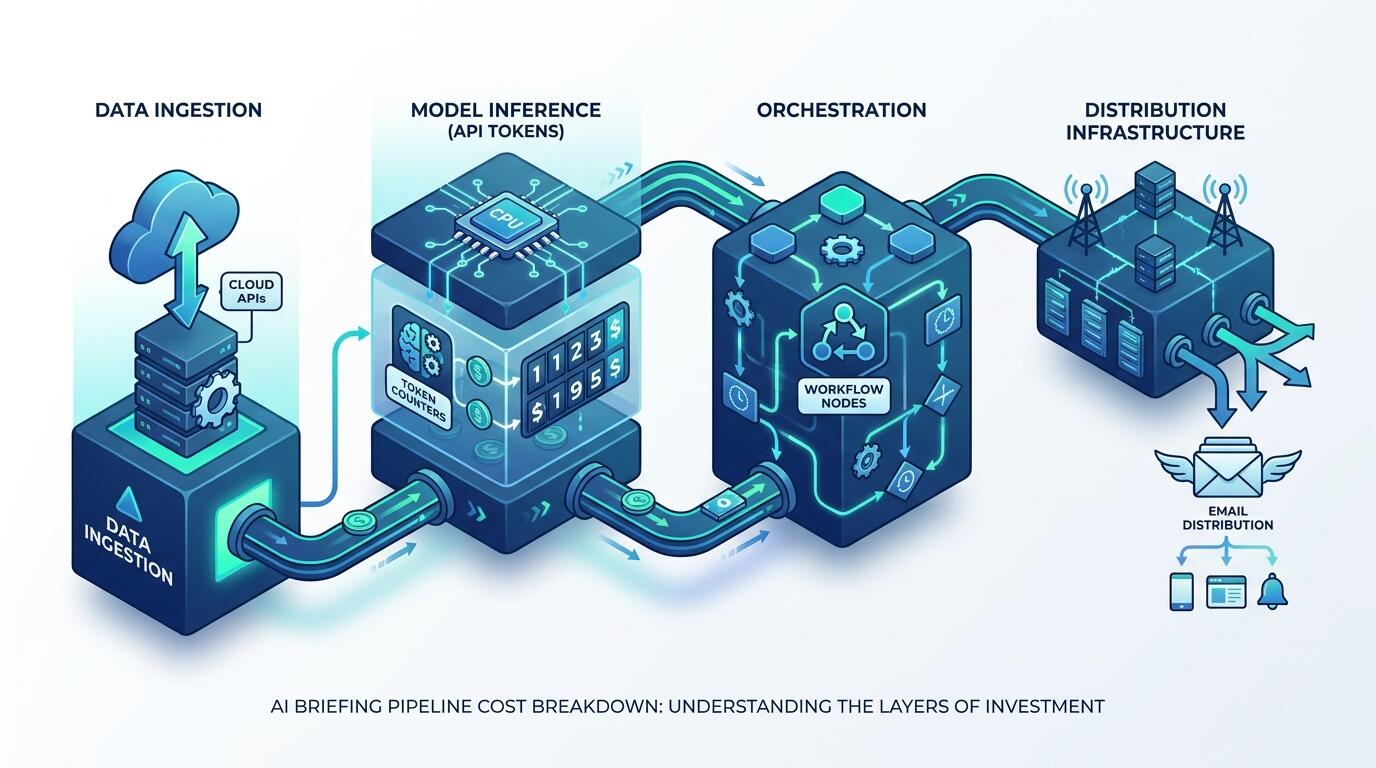
ALT: Daily AI briefing cost breakdown for agent workflows, API tokens, and infrastructure
What Running a Daily AI Briefing on Agents Actually Costs
Running a daily AI briefing on agent topics costs more than most builders expect — not because any single component is expensive, but because the bill compounds across data ingestion, model inference, orchestration, and editorial tooling. The honest answer: a lean, automated pipeline for a daily AI briefing focused on agent news can be operated at genuinely low cost per issue, while a more robust, multi-source, human-in-the-loop setup with quality guarantees sits in a higher cost bracket. Where you land depends on architectural choices made early.
This article breaks down the real cost drivers at each layer — from raw API calls to hosting and distribution — and shares the tradeoffs we navigate daily in producing the Darius AI briefing. The goal is to give you numbers and reasoning grounded in live production, not theoretical estimates, so you can build a budget you can actually defend.
Who This Cost Analysis Applies To
Applicable Scenarios:
- Independent developers or small teams building an automated daily newsletter pipeline around AI agent news
- Technical leads evaluating whether to build or buy a briefing workflow before committing engineering resources
- AI startup founders who want to add a content-intelligence layer on top of their existing product and need to size the infrastructure cost
Not Applicable / Cautions:
- Large media organizations with dedicated editorial staff and existing content licensing agreements — your cost structure differs significantly at scale
- Teams planning to resell briefing content commercially without understanding per-seat API licensing implications
The Problem With Vague "AI Automation" Cost Estimates
Most public estimates for "running an AI pipeline" are useless in practice. They quote a model's per-token price in isolation, without accounting for the total token surface — which includes retrieval context, system prompts, summarization chains, and error-handling retries. For a daily AI briefing focused on the rapidly evolving agent ecosystem, the token count per run is almost never what you expect after the first week of production.
The agent space compounds this problem. Agent-related news is dense with technical nomenclature, source fragmentation across arXiv, GitHub, and vendor blogs, and a high rate of duplicate or near-duplicate coverage. A briefing pipeline that tries to do this well — surfacing genuinely novel signals rather than repackaging the same press release — requires more inference steps than a generic news summarizer, and those steps have a cost.
The Darius briefing was built specifically for this context: a double-language (English and Chinese) AI briefing written from a practitioner's vantage point, covering model releases, technical papers, open-source repositories, and AI policy developments that matter to builders. Producing it daily means the pipeline runs every single day without exception, so cost efficiency at each layer is not a nice-to-have — it is an operational constraint.
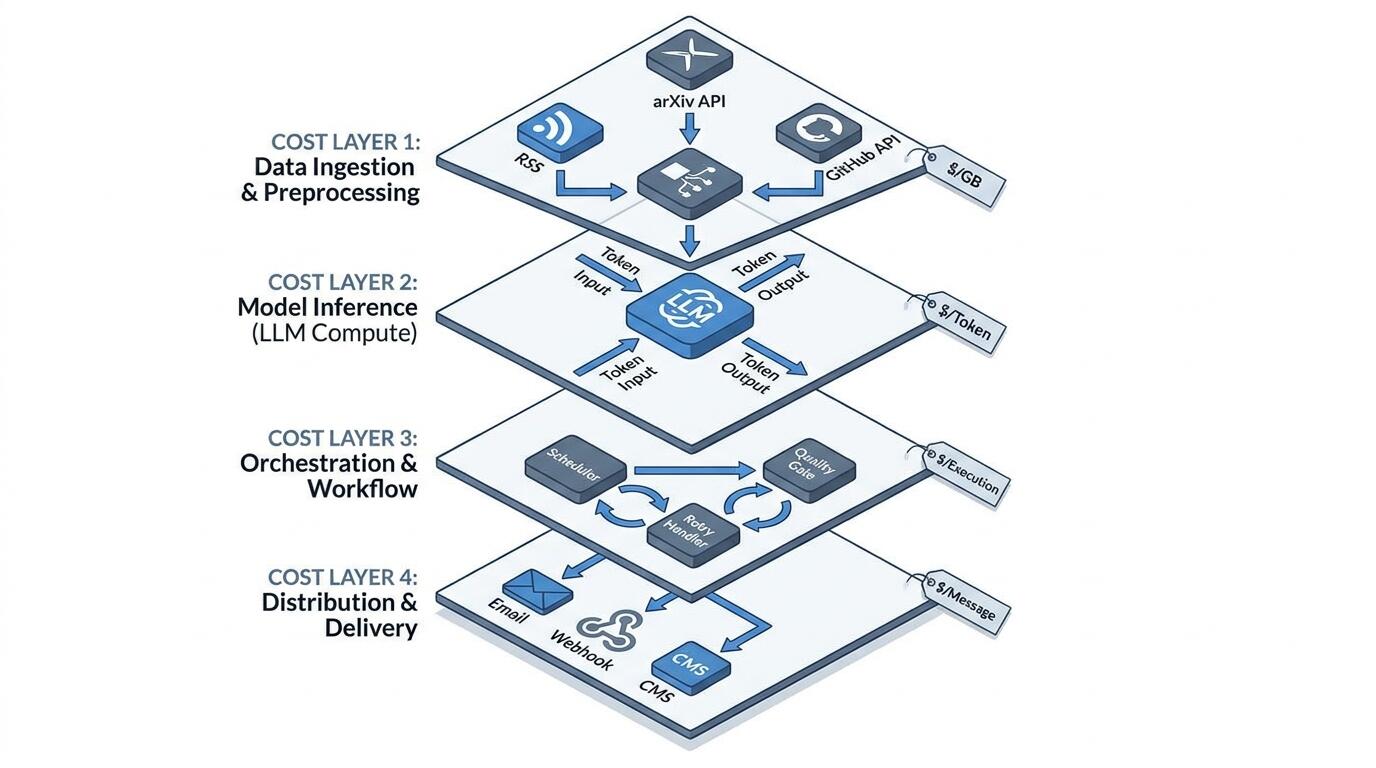
ALT: Diagram of daily AI briefing pipeline cost layers including data ingestion, model inference, orchestration, and distribution infrastructure for agent content
The Cost Layers of a Daily AI Agent Briefing
Getting Started: A Three-Step Frame for Cost Estimation
Step 1: Map Your Source Surface
Before you touch an API, enumerate every content source your briefing will monitor. For an agent-focused briefing, this typically means preprint servers (arXiv), GitHub trending repositories, official model release announcements, regulatory filings, and curated social signals. Each source type has a different ingestion cost profile — some are free RSS feeds, others require a paid API or scraping infrastructure. Block out one to two hours to build a source inventory and tag each with its fetch cost per day. This step alone prevents the most common budgeting mistake: underestimating the raw data layer.
Step 2: Estimate Your Token Surface Per Issue
Take your source list and calculate a realistic upper bound on the raw text volume entering your pipeline daily. Then add system prompt tokens, retrieval augmentation context, and chain-of-thought scaffolding if you use it. A summarization pass on ten to fifteen agent-related articles at roughly one thousand words each already loads significant context before you write a single output sentence. Run a prototype on real content for three to five days and measure actual token counts — not synthetic estimates. This is the only way to get a number you can budget against.
Step 3: Add Orchestration, Storage, and Distribution
Model inference is usually the most visible cost, but orchestration compute (running the scheduling logic, retry handlers, and quality gates), storage (archiving every issue and its source URLs for auditability), and distribution (email delivery, webhook triggers to your CMS) all add to the monthly bill. For low-volume, self-hosted pipelines these are nearly negligible. For pipelines targeting consistent daily delivery with uptime guarantees, they deserve their own line in the budget.
Comparing Build Approaches for Daily Agent Briefing Pipelines
Different teams reach for different architectures. The table below maps the three common patterns against the dimensions that matter most when sizing cost for a daily run.
| Comparison Dimension | Minimal Automated Pipeline | Augmented Human-in-the-Loop | Full Custom Agent Workflow |
|---|---|---|---|
| Primary inference cost driver | Single summarization call per source batch | Multiple passes (retrieval, ranking, draft, edit) | Multi-step agent chains with tool calls |
| Source coverage | Curated, fixed RSS/API list | Broader, with dynamic source discovery | Adaptive, with real-time crawling |
| Human editorial time per issue | Near zero | One to two hours | Varies by quality gate design |
| Infrastructure complexity | Low (cron job + single model call) | Medium (orchestration framework needed) | High (agent runtime, memory, tool registry) |
| Cost predictability | High — bounded by fixed source set | Medium — depends on discovery volume | Lower — agent runs can fan out unexpectedly |
| Output quality ceiling | Good for well-structured sources | High with skilled editor | Potentially high but requires tight guardrails |
The Darius briefing sits in the augmented human-in-the-loop category — not because full automation is impossible, but because the signal quality requirement for a practitioner audience is too high to skip editorial judgment entirely.
The Real Numbers Behind Each Cost Layer
Data Ingestion: Cheaper Than You Think, Until It Isn't
For agent-focused AI news, a significant portion of valuable signal comes from sources with free, machine-readable access: arXiv's API (maintained by Cornell University and available without a paid subscription), GitHub's public REST API (with generous unauthenticated rate limits), and standard RSS feeds from major AI labs. According to the arXiv API documentation maintained by Cornell University, programmatic access to preprint metadata and abstracts is free and rate-limited but does not require a key for basic use.
The cost pressure enters when you need full-text content from news sites that don't provide clean RSS, when you want structured data from sources behind authentication, or when you need real-time Twitter/X data. Scraping infrastructure — whether a managed service or a self-hosted headless browser setup — is the hidden cost that blindsides teams in the first month of production.
Practically, a well-curated source list of fifteen to twenty high-signal feeds covering agent research, model releases, and policy developments can be ingested daily for very low cost, sometimes effectively zero if you're working with open APIs and your own compute. The discipline is in resisting the urge to add dozens of low-signal sources that balloon your downstream token costs without improving output quality.
Model Inference: The Compounding Variable
Inference is where cost estimates most frequently go wrong. The raw per-token price of frontier models has fallen substantially over the past year, and per OpenAI's published pricing (available at their official developer documentation), costs for input and output tokens differ and both matter. But the number that matters for budget planning is total tokens per run, not the per-token rate.
A typical daily briefing issue on agent topics might require:
- Ingesting and chunking fifteen to twenty source documents
- A relevance and deduplication pass to filter noise
- A summarization pass to generate per-item precis
- A synthesis pass to write the final briefing narrative
- An optional translation pass for bilingual output
Each of those steps consumes input tokens (the source content plus system instructions) and output tokens (the generated text). The synthesis and translation steps tend to dominate output token cost. Bilingual output — as in the Darius briefing — effectively doubles the translation-pass cost, though compression techniques (generating one language first and translating rather than generating both independently) reduce this meaningfully.
The practical takeaway: model inference for a daily briefing pipeline can range from very modest to substantial depending on source volume, chain depth, and output length. Builders who front-load a deduplication and relevance filter before the expensive synthesis passes see the biggest efficiency gains.
Orchestration and Infrastructure: Often Overlooked
If you're running a daily pipeline, you need something to trigger it reliably, handle failures gracefully, and log outputs for debugging. For a solo developer, a simple cron job on a lightweight virtual machine or a managed scheduler is sufficient and adds minimal cost. For a team with uptime requirements, you'll want a proper orchestration layer — managed services like cloud-based workflow engines add cost but reduce operational burden.
Storage costs for archiving issues and their source metadata are genuinely small unless you're storing raw scraped content at scale. Distribution — sending the briefing via email — is the one layer where per-subscriber volume starts to matter. Transactional email services are inexpensive at low subscriber counts and scale predictably.
Editorial Tooling and Human Time
For a briefing that targets practitioners who will make product and engineering decisions based on what they read, human editorial judgment has real value that automated quality gates don't fully replace. The cost here is human time, which is the hardest to quantify and the easiest to undercount. A rough way to think about it: what is the opportunity cost of the person doing the review, multiplied by the hours per issue? For a solo founder writing their own briefing, this is absorbed into their working hours. For a team, it becomes a line-item in headcount.
Advanced Considerations: Cost Spikes and Structural Risks
Runaway Agent Loops
Multi-step agent pipelines — where a model can invoke tools, spawn sub-tasks, or iterate on its own output — introduce a cost pattern that flat summarization pipelines do not: unbounded inference depth. A poorly specified stopping condition or an unexpected source format can cause an agent workflow to issue far more model calls than intended before a human sees the result. If you're building a full agent workflow for your briefing, implement hard token and call-count budgets at the orchestration layer and alert on any run that exceeds them.
Source Volatility
The agent ecosystem moves fast. Sources that are authoritative today (a particular research lab's blog, an open-source project's release notes) may go dark, move, or change format without warning. A pipeline with fragile source parsers will fail silently — producing lower-quality output without throwing an error you can act on. Build source health monitoring into the pipeline from day one, not as a retrofit.
Misconception: "Cheaper Model = Lower Cost"
A common mistake is substituting a cheaper, smaller model to cut inference costs without accounting for the increased error rate and retry frequency. If a less capable model requires two or three passes to produce usable output where a more capable model does it in one, the "cheaper" model can end up more expensive per acceptable output. Benchmark on your actual content — agent-related technical writing is demanding input, and capability differences are more pronounced here than on general news.
Frequently Asked Questions
Q1: How do token costs compound in a bilingual AI briefing pipeline?
Bilingual output — producing content in both English and Chinese, as in the Darius briefing — roughly doubles the output token cost if you generate both languages independently. The more cost-efficient approach is sequential: generate the primary-language version first, then run a translation pass on the finalized output. This reduces total output tokens because the translation pass produces similar token volume to the original but benefits from a more constrained task. Retrieval and synthesis input tokens are shared across both passes, so the marginal cost of bilingual output is meaningfully lower than naive doubling suggests.
Q2: Is it cheaper to use open-source models for a daily briefing pipeline?
Open-source models can reduce per-inference cost to near zero if you host them on your own infrastructure, but the true cost shifts to compute and engineering time. For a daily briefing on technically dense agent topics, smaller open-source models may require significant prompt engineering and fine-tuning investment to match the output quality of frontier models out of the box. Whether the total cost of ownership is lower depends on your team's ML infrastructure expertise and the value placed on output quality. Many practitioners running lean briefing operations find managed API access more cost-effective at low to medium volume.
Q3: What is a realistic monthly cost range to run a daily AI agent briefing?
Providing a single number is misleading because cost varies substantially by source volume, model tier, chain depth, and distribution scale. A minimal automated pipeline drawing from a curated set of free APIs, using a single summarization pass with a cost-efficient frontier model, and distributing to a small subscriber list can run at genuinely low cost — well within the budget of a solo developer. A more robust setup with multi-pass inference, broader source coverage, and email distribution at meaningful scale will cost proportionally more. The most reliable path to a real number is to run a five-day prototype with production content, measure actual token and infrastructure costs, and multiply out.
Key Takeaways
Running a daily AI briefing on agent topics is affordable at small scale and cost-controllable at larger scale if you make the right architectural choices early. Three points deserve particular emphasis.
First, the token surface is almost always larger than your initial estimate. System prompts, retrieval context, chain depth, and bilingual output each compound the per-run token count. Measure on real content before you commit to a model tier or pipeline architecture.
Second, data ingestion cost is often misjudged in both directions — free for well-structured open sources like arXiv and GitHub, potentially significant for content requiring scraping or paid APIs. Audit your source list before assuming ingestion is free.
Third, human editorial judgment is not just an overhead cost — it is the quality moat that separates a briefing practitioners trust from one they unsubscribe from. Budget for it explicitly, even if that budget is your own time.
The next step is to prototype with your actual source list for a full production week, instrument every cost layer, and compare the result against the three architectural patterns described above. That week of data is worth more than any estimate.
If you're building AI products and want a practitioner's perspective on agent developments, model releases, and engineering decisions grounded in real production experience, subscribe to Darius — a bilingual AI briefing written by an engineering director running multiple live AI products. Every issue is drawn from first-hand sources and tested against the realities of shipping.
Sources & Further Reading
- arXiv. "arXiv API Access Documentation."
https://arxiv.org - OpenAI. "OpenAI Developer Platform — Pricing and API Documentation."
https://openai.com - GitHub. "GitHub REST API Documentation."
https://github.com - IEEE. "IEEE Standards and Publications on AI Systems Engineering."
https://www.ieee.org
Note: API pricing and platform policies are updated frequently; always consult the latest official documentation before finalizing your cost model.