Interview: What It's Like Running an Automated Newsroom Solo

ALT: Solo operator running an automated AI newsroom pipeline with agents and editorial tools
What Running an Automated Newsroom Alone Actually Looks Like
Running an automated newsroom as a solo operator is genuinely possible today — but the gap between "technically feasible" and "sustainably operational" is wider than most people expect when they start. The tools have matured significantly. Large language models can draft summaries, agents can fetch and rank sources, and scheduling infrastructure has become commodity. Yet the hardest problems remain stubbornly human: deciding what counts as newsworthy, writing editorial rules that a pipeline can actually execute, and knowing when to override the machine before it publishes something wrong.
This matters now because a new class of builder is emerging — engineers, independent developers, and technical leads who are not journalists by training but who recognize that automated content infrastructure can serve a specific, high-value audience if it is built with enough editorial discipline. The automated newsroom is no longer a theoretical concept confined to large media organizations. It is a practical build decision with real tradeoffs, and the people making it deserve a frank, first-hand account of what the work actually involves.
The Current State of Solo AI-Powered Publishing
Automated newsroom technology is a term that describes publishing workflows in which AI agents — autonomous software systems capable of fetching, ranking, drafting, and routing content — handle tasks that human editors previously performed manually. The concept has existed for years at large media companies, but what's shifted recently is the accessibility of the underlying infrastructure.
Retrieval-augmented generation, fine-tuned summarization models, and orchestration frameworks have all become stable enough that a single engineer can wire them together in a few weeks. The result is a pipeline that can ingest from RSS feeds, newsletters, preprint servers, and social signals; score items by relevance; draft structured summaries; and publish on a schedule — without a full editorial team.
What the broader narrative often omits is that this accessibility has a ceiling. Research into AI support for investigative and editorial workflows — including work catalogued in academic literature — consistently highlights that automation handles routine, high-volume tasks well, but struggles with contextual judgment: recognizing when a piece of information is technically accurate but editorially misleading, or when two sources saying the same thing are actually both citing the same original report.
Small and independent newsrooms have the most structural incentive to adopt automation. A small team that previously spent hours on curation and formatting can redirect that time toward original analysis and source relationships. United Robots, one of the more established vendors in automated local journalism, has documented exactly this dynamic: automation frees human capacity for the work that cannot be templated. But "freeing capacity" presupposes that you have capacity to redirect — and for a solo operator, the editorial overhead of maintaining the automation itself is not zero.
The practical landscape today is one where the tooling is real, the use cases are validated, and the limiting factor is not technology but operational rigor. That is the frame for everything that follows.
How the Pipeline Actually Works — and Where It Breaks
A solo automated newsroom pipeline can be decomposed into four sequential stages, each with its own failure mode. Understanding these stages is prerequisite to understanding why solo operation is harder than it looks from the outside.
Stage 1: Retrieval and Source Management
Retrieval is the process by which the pipeline discovers candidate items — articles, preprints, announcements, social posts — from a defined universe of sources. This sounds mechanical, and in part it is. Feed parsers, API clients, and web scrapers handle the ingestion. But the hard work is source list governance: deciding which sources belong in the universe, how they are weighted, and when a new source should be added or an existing one deprecated.
A source that starts authoritative can drift — a technical blog that once published original research may pivot to promotional content. Without a periodic source audit, the pipeline's output quality degrades invisibly. For a solo operator, this audit is one of the tasks that is easy to defer and expensive to ignore.
Stage 2: Ranking and Relevance Scoring
Once items are retrieved, the pipeline must decide which ones are worth processing further. Relevance scoring is typically a combination of keyword matching, semantic similarity against a defined topic model, and recency weighting. The nuance is that "relevant" and "worth publishing" are not the same thing. A retrieved item can be highly relevant to the topic domain but redundant — it covers territory the pipeline already addressed three days ago — or it can be technically on-topic but originate from a source that is amplifying a claim without adding new information.
Getting ranking right requires what I would describe as editorial intent encoded as rules — explicit, testable criteria that the scoring layer can execute without ambiguity. This is harder to write than it sounds. The gap between an editorial instinct ("this is too similar to something we already covered") and a rule a pipeline can evaluate ("reject items where semantic similarity to any published item in the last 72 hours exceeds threshold X") is significant. We have written about this challenge in detail in our post on writing editorial rules an agent can actually follow, and it remains one of the most underestimated problems in solo newsroom operation.
Stage 3: Drafting and Verification
Drafting is where LLMs shine and also where they introduce the most consequential risks. A model that is instructed to summarize a source document will usually produce a fluent, coherent summary. The failure modes are subtle: paraphrasing that changes the meaning of a quantitative claim, confident-sounding synthesis of two sources that actually contradict each other, or — most dangerously — hallucinated attribution where the model introduces a "fact" that appears in neither source.
Verification is the layer that catches these failures before publication. For a solo pipeline, verification typically takes two forms: automated checks (does the draft contain claims not traceable to any retrieved source? does it cite a source by name not present in the retrieval set?) and human spot-checks. The ratio of automated to human verification is one of the core operational decisions a solo builder must make explicitly. A thorough analysis of where AI drafting pipelines fail — and the checks that catch those failures — is essential reading before you commit to a production deployment; we have documented our own experience with this in our post on where an AI drafting pipeline fails and the checks that catch it.
Stage 4: Scheduling, Publishing, and Monitoring
Publishing infrastructure is the most commoditized part of the stack. Scheduled jobs, webhook-triggered deployments, and email delivery services are all mature. The less-discussed element is post-publication monitoring: tracking whether published items are receiving the engagement signals you expect, whether any item generates reader-reported errors, and whether the pipeline's output is drifting from its editorial mandate over time.
For a solo operator, monitoring is often the first thing that gets neglected when the pipeline is running smoothly — and the first thing that matters when it isn't.
Comparing Approaches: What the Evidence Shows
Different builders run solo automated newsrooms differently, and the variation reveals genuine tradeoffs rather than a single correct approach. The table below maps the major strategic choices against their practical implications.
| Perspective / Approach | Strengths | Trade-offs | Best Fit |
|---|---|---|---|
| Fully automated end-to-end | Maximum throughput, minimal time cost per item, consistent publishing cadence | Highest risk of undetected errors; editorial drift accumulates silently | High-volume, lower-stakes content where errors are recoverable |
| Human-in-the-loop at drafting stage | Catches subtle factual and tonal errors before publication | Significantly higher time cost; cadence dependent on operator availability | Niche, expert-audience publications where credibility is the core value |
| Human-in-the-loop at curation only | Balances quality and throughput; human judgment applied where it matters most (source selection and relevance) | Drafting errors still require post-publication correction; requires strong automated verification | Mid-frequency publications with clear topic scope |
| Hybrid with editorial rules as code | Scales editorial judgment without constant human review; rules are testable and auditable | Initial investment in rule specification is high; rules need maintenance as topic landscape evolves | Technical or domain-specific publications where rules can be made explicit |
The honest finding from operating this kind of system is that the "fully automated end-to-end" approach is the easiest to build and the hardest to trust. The moment you remove all human checkpoints, you are betting that your automated verification layer catches every failure mode — and that bet has not yet been validated at the level of reliability most expert audiences require.
Research published through academic channels examining AI use in investigative and editorial contexts reinforces this: automation performs well on structured, repeatable tasks, but edge cases cluster in exactly the situations where editorial judgment matters most. The practical implication for a solo builder is to identify which stage of your pipeline benefits most from human attention and concentrate it there, rather than distributing thin oversight across every stage.
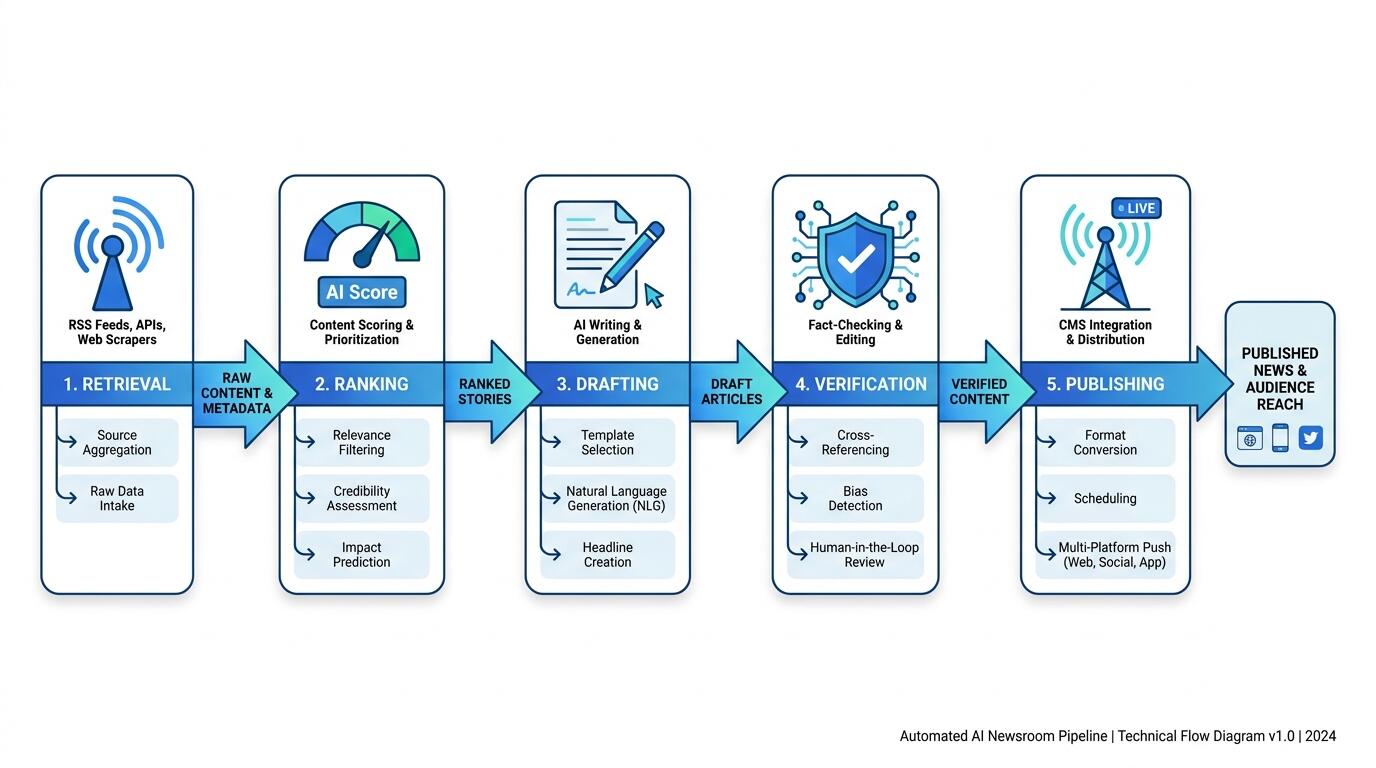
ALT: Diagram of an automated AI newsroom pipeline showing retrieval, ranking, drafting, verification, and publishing stages for solo operators
Where This Is Going — and What It Means for Solo Builders
The automated newsroom for solo operators is moving toward greater reliability at the retrieval and drafting stages, driven by improvements in model accuracy, better tool-calling interfaces, and more robust orchestration frameworks. What is not moving as fast is the tooling for editorial governance — the systems that help a solo operator define, test, and maintain the rules that give the pipeline its judgment.
The near-term implication is that the competitive advantage for solo automated newsrooms will not come from the pipeline itself — that is increasingly commoditized — but from the quality of the editorial rules encoded into it and the depth of the source relationships that feed it. A pipeline with mediocre rules processing excellent sources will consistently outperform a technically sophisticated pipeline pointed at low-quality inputs.
For builders thinking about this practically, three points deserve emphasis.
First, invest in source governance before you invest in pipeline sophistication. A curated, audited source list is the highest-leverage input to output quality, and it is entirely human work.
Second, write your editorial rules as testable specifications, not as prose descriptions. A rule that says "prioritize items with novel findings" is not executable. A rule that says "score higher when the item contains a claim not present in any retrieved item from the prior 72-hour window" is. The discipline of making rules explicit also reveals gaps in your editorial thinking that remain invisible when the thinking stays informal.
Third, budget for monitoring as an ongoing operational cost, not a setup task. The pipeline that is running smoothly today is accumulating drift that will surface as quality degradation in the future. Monitoring is what catches drift before it becomes visible to readers.
For a deeper look at the full technical architecture behind a daily AI briefing — retrieval, verification, publication — we have documented the complete pipeline in our piece on the agent pipeline behind a daily AI briefing.
The solo automated newsroom is a legitimate build. It is not easy, it is not fully solved, and the interesting problems left to solve are editorial, not technical.
Questions & Answers
Q1: How do you maintain editorial quality in a solo automated newsroom without a human review team?
Quality in a solo automated newsroom comes from encoding editorial judgment explicitly into the pipeline rather than relying on ad-hoc human review. This means writing ranked scoring rules for relevance, configuring automated verification checks that flag claims not traceable to retrieved sources, and conducting structured periodic audits of source lists and published output. Human attention is most valuable at the curation and rule-maintenance stages — not as a final read of every drafted item. Spot-checking on a defined schedule, rather than attempting comprehensive review, is a sustainable approach for a solo operator.
Q2: Is it realistic to run a credible, expert-audience publication entirely through automation?
Running a credible expert-audience publication with full automation is possible but requires significant upfront investment in editorial rule specification and verification infrastructure. The evidence from practitioners and academic research on AI in editorial workflows consistently shows that full automation works well for structured, repeatable tasks but produces systematic errors in edge cases where context matters most. Expert audiences are also more sensitive to subtle errors — paraphrased claims, misattributed findings — than general audiences. The most credible solo automated publications tend to use a hybrid model, with automation handling throughput and humans making key curation and rule-governance decisions.
Q3: How much ongoing time does maintaining a solo automated newsroom pipeline actually require?
The ongoing time cost depends on publication frequency and editorial ambition, but most solo operators find that setup time is front-loaded and maintenance is not negligible. Building the initial pipeline — retrieval, ranking, drafting, scheduling — can take several weeks of engineering time. Ongoing maintenance typically involves periodic source audits, editorial rule updates when the topic landscape shifts, review of monitoring dashboards, and occasional manual corrections to published items. For a mid-frequency publication, ongoing maintenance in a steady state often runs to several hours per week — less than a fully manual editorial process, but meaningfully more than zero.
Final Thoughts
Running an automated newsroom as a solo operator is one of the most instructive challenges in applied AI product development. It forces a clarity about what automation actually does well — throughput, consistency, structured execution — and what it does not: contextual editorial judgment, source relationship management, and the detection of its own subtle failures.
Three points are worth holding onto from this discussion.
The quality ceiling of any automated pipeline is set by the quality of its inputs and the precision of its rules. Technology can execute; it cannot substitute for editorial thinking.
Human-in-the-loop is not a binary choice. The practical question is where in the pipeline human attention delivers the highest return — and for most expert-audience publications, that is at curation and rule governance, not at per-item review.
Monitoring is an operational discipline, not a setup checkbox. Pipelines drift. Output quality degrades without visible failure. Treating monitoring as ongoing maintenance rather than a launch task is what separates sustainable operations from ones that quietly lose credibility over time.
If you are at the point of deciding whether to build this kind of system, the honest recommendation is to start with the editorial design — source list, scoring rules, verification criteria — before writing a line of pipeline code. The build questions answer themselves once the editorial logic is clear. The reverse is rarely true.
If you are building AI products and want signal over noise — decisions grounded in first-hand operational experience rather than aggregated headlines — subscribe to Darius, the bilingual AI briefing for builders. Every issue covers the developments that actually matter to people running AI systems in production, with sourced, practitioner-level commentary written by an engineering lead who runs multiple AI products daily.
Sources
- Little Columns. "The Automated Newsroom: Build AI Workflows That Work".
https://littlecolumns.com/courses/ai-newsroom/ - United Robots. "Small Newsrooms Have the Most to Gain from AI and Automation".
https://www.unitedrobots.ai/resources/blog/small-newsrooms-have-the-most-to-gain-from-ai-and-automation - arXiv. "Use Cases of AI and Automation Support in Investigative Journalism".
https://arxiv.org/html/2503.16011v1 - Reuters Institute for the Study of Journalism. Research on AI and Editorial Workflows in Digital Newsrooms.
https://reutersinstitute.politics.ox.ac.uk/ - IEEE. Standards and Publications on AI Systems, Reliability, and Autonomous Decision-Making.
https://www.ieee.org/
Note: Standards and research in this area evolve rapidly; please consult the latest official documents or authoritative sources directly.