RAG Retrieval Quality Checklist for Production Teams
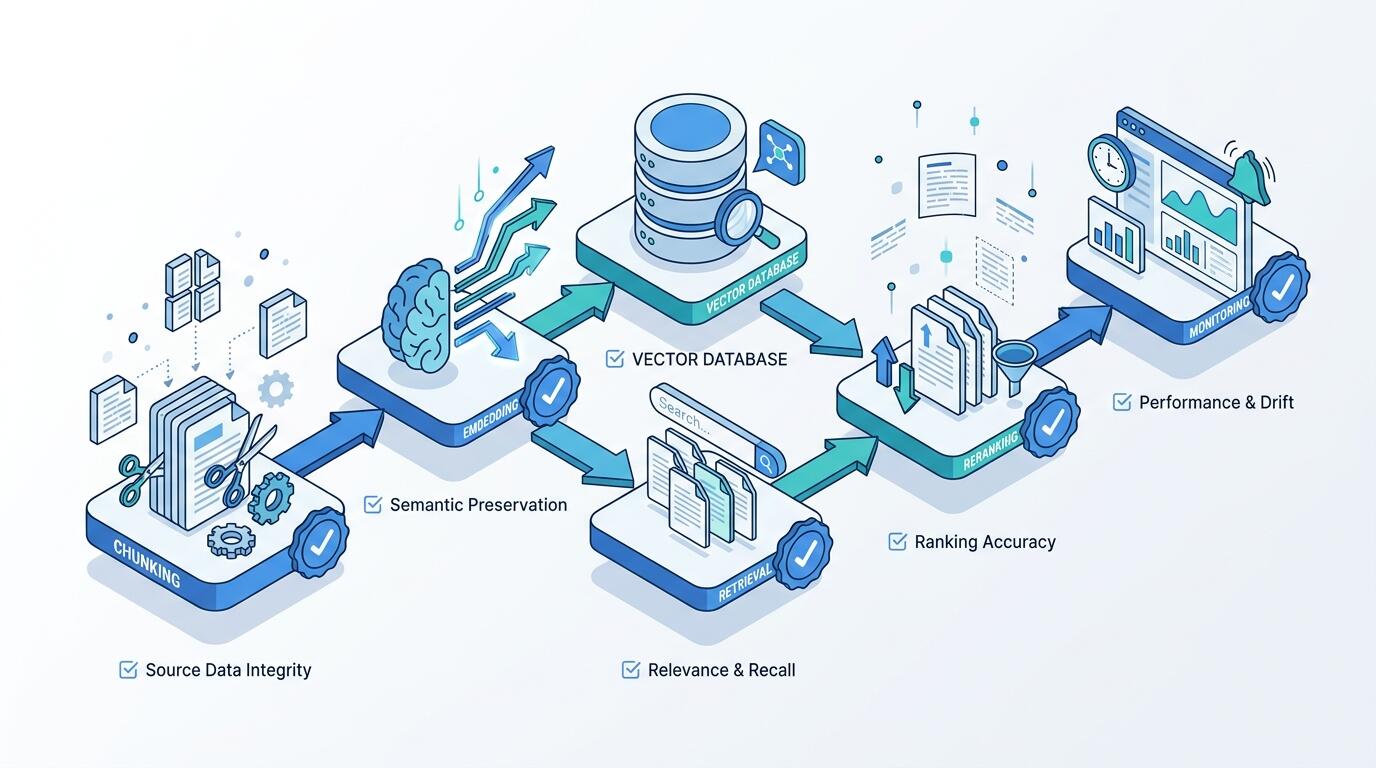
ALT: RAG retrieval quality checklist for production teams building reliable AI systems
Why Retrieval Quality Is the Real Bottleneck in Production RAG Systems
Key Conclusion: Retrieval-Augmented Generation (RAG) is a technique that enhances large language model outputs by grounding them in retrieved external documents rather than relying solely on parametric knowledge. For production teams, retrieval quality — not generation quality — is almost always the root cause of degraded answers, hallucinations, and user trust erosion. This checklist distills the most consequential retrieval checks that teams shipping real systems need to run, organized by impact and operational practicality.
Most production RAG failures I have observed are not generation failures. The model is doing its job. The problem is upstream: the wrong chunks are being retrieved, or the right chunks are retrieved in the wrong order, or the retrieval pipeline silently degrades after a data update and nobody notices until users start complaining. This checklist was assembled from patterns that consistently surface when debugging retrieval pipelines across multiple AI products — it is organized so that any engineer or technical lead can work through it systematically, either during initial build or as part of an ongoing quality review cycle.
The Checklist: Eight Retrieval Quality Checks Every Production Team Should Run
Chunk Boundary and Segmentation Audit
Chunking strategy is the silent variable that most teams set once and never revisit. Retrieval-Augmented Generation systems split source documents into smaller units — chunks — that are indexed and retrieved individually. The boundary at which you split a document determines whether a retrieved chunk contains a self-contained, useful unit of information or an orphaned fragment that confuses the model downstream.
A pattern we consistently see is that teams default to fixed token-length chunking because it is easy to implement, then struggle to understand why retrieved context feels incomplete or contradictory. The problem is that fixed-length chunks frequently split in the middle of a table row, a numbered list, or a logical argument.
Useful things to verify: Does each chunk make sense in isolation when read without surrounding text? Are semantic units — paragraphs, list items, structured data rows — kept intact? Does your chunking strategy handle different document types (PDFs, Markdown, HTML, code) differently, or are you applying one method uniformly?
- Best for: Teams conducting their first full retrieval audit, or teams ingesting heterogeneous document types for the first time.
- Watch out: Smaller, more semantically coherent chunks improve precision but increase index size and retrieval latency. There is a real tradeoff.
Embedding Model Fit Assessment
Retrieval quality depends fundamentally on whether your embedding model's representation space aligns with the semantic distribution of your actual queries and documents. An embedding model that is a general-purpose fit is not necessarily a good fit for your specific domain.
Run a sample of twenty to thirty real user queries against your index and manually inspect the top-five retrieved chunks for each. If you consistently see retrieved chunks that are textually similar to the query but semantically irrelevant — a common symptom in technical, legal, or domain-specific corpora — you likely have an embedding model mismatch.
Consider whether your model was trained on data that resembles your domain. General web-trained models perform worse on specialized vocabulary, code, or structured tabular content. Fine-tuned or domain-adapted embeddings often yield measurable improvements in recall for specialized corpora.
- Best for: Teams operating in specialized domains — healthcare, legal, scientific literature, software engineering — where general-purpose embeddings underperform.
- Watch out: Fine-tuning an embedding model requires labeled relevance data, which is expensive to produce. Start with a strong general model and measure before committing to fine-tuning.
Retrieval Recall and Precision Measurement
Recall and precision are the two foundational metrics for any retrieval system. Retrieval recall measures the fraction of genuinely relevant documents that your system actually returns; retrieval precision measures the fraction of returned documents that are actually relevant. Both matter, and optimizing only one at the expense of the other is a common mistake.
Build a small but representative evaluation set — even fifty question-answer pairs with manually labeled relevant chunks is enough to start. Run retrieval against this set and compute recall at K (does the relevant chunk appear in the top K results?) and mean reciprocal rank (how high does the relevant chunk rank?). Without this baseline, you cannot detect retrieval degradation when you update your index or swap embedding models.
Teams that skip this step often discover retrieval regressions only through user complaints, which is the most expensive possible detection mechanism. A retrieval evaluation harness does not need to be elaborate; it needs to exist.
- Best for: Any team moving a RAG system from prototype to production. This is non-negotiable infrastructure.
- Watch out: Evaluation sets go stale. As your document corpus and user query patterns evolve, your eval set needs to be refreshed periodically — otherwise you are measuring performance on a distribution that no longer reflects reality.
Metadata Filtering and Index Hygiene Check
Every RAG index accumulates technical debt over time. Outdated documents remain indexed, metadata fields become inconsistent, and version-controlled content gets duplicated without anyone noticing. Metadata filtering — using structured attributes like document date, source type, or access tier to narrow retrieval before semantic search — only works if your metadata is trustworthy.
A metadata hygiene audit should answer: Are there documents in the index that should have been removed after a product update? Are date fields populated consistently, or are many records missing timestamps? Are duplicate or near-duplicate chunks present, and are they inflating apparent retrieval confidence by returning multiple variants of the same passage?
Stale content in the index is particularly damaging because the model has no way to know that a retrieved fact is outdated. It will present outdated information with the same confidence as current information. Metadata-gated retrieval — only searching within documents newer than a certain date, or within a specific verified source category — is one of the most reliable defenses.
- Best for: Teams with frequently updated knowledge bases — product documentation, policy documents, news feeds — where the freshness of retrieved information directly affects answer quality.
- Watch out: Over-aggressive metadata filtering can tank recall if your metadata is inconsistently populated. Validate filter coverage before relying on it.
Query Understanding and Expansion Review
Retrieval pipelines that match only the literal form of the user's query miss a significant fraction of relevant results. Query understanding is the process of interpreting what the user actually needs — as distinct from the words they typed — and optionally transforming or expanding the query to improve retrieval coverage.
Common techniques include hypothetical document embeddings (HyDE), where the model generates a synthetic answer and uses its embedding to query the index; multi-query expansion, where multiple reformulations of the same question are used to cast a wider retrieval net; and query decomposition for complex multi-part questions. Each technique adds latency and cost, so it is worth measuring the retrieval lift before adopting one universally.
In practice, a pattern we consistently see is that production teams implement one query strategy at launch and never revisit it, even as their user base and query complexity evolve. Periodically sampling production queries and reviewing retrieval failures is the most reliable way to surface cases where query understanding is breaking down. For a deeper look at how these strategies play out in automated pipeline contexts, the agent pipeline behind a daily AI briefing is an instructive reference — the same retrieval and verification logic applies whether you are building a briefing system or a customer-facing RAG product.
- Best for: Systems handling complex or ambiguous user queries — internal knowledge bases, customer support, technical Q&A — where surface-form matching is insufficient.
- Watch out: Query expansion increases the number of API calls and latency per request. Budget for this before enabling it at scale.
Context Window Composition and Reranking Audit
Retrieving the right chunks is necessary but not sufficient. The composition of the context window — which chunks are included, in what order, and with what framing — materially affects generation quality. Reranking is the process of applying a secondary model or scoring function to re-order retrieved chunks by relevance before they are passed to the language model.
The specific failure mode worth auditing here is lost-in-the-middle degradation: research on large language models has documented that models attend more reliably to content at the beginning and end of a long context window, with information in the middle receiving less attention. This means that a naive concatenation of retrieved chunks, ranked only by initial retrieval score, may systematically bury the most relevant passage in the middle of a long prompt.
A reranking audit should verify: Do you have a reranker in your pipeline? If so, is it actually improving downstream answer quality, or adding latency without measurable benefit? Are you concatenating chunks in a sensible order, or is the order arbitrary? How many chunks are you including, and have you measured whether more chunks help or hurt?
- Best for: Teams with long context windows and high chunk counts per query — enterprise search, document analysis, research assistants.
- Watch out: Cross-encoder rerankers are significantly more accurate than bi-encoder retrieval but also significantly more expensive per query. Evaluate cost-per-query impact at your actual traffic levels.
Retrieval Monitoring and Drift Detection
Retrieval quality is not a one-time property — it degrades. Index composition changes when documents are added or removed. Query distribution shifts as user behavior evolves. Embedding model updates change the vector space. Any of these can cause retrieval to silently get worse without triggering an obvious alert.
Production RAG systems need ongoing retrieval monitoring. At minimum, log retrieval scores for every query and track their distribution over time. A sustained drop in average top-1 retrieval score, or an increase in the variance of scores, is a leading indicator of retrieval degradation. Combine this with periodic manual spot-checks of retrieved chunks for a sample of representative queries.
For teams thinking through where failures propagate in an AI drafting or retrieval pipeline, the analysis in where an AI drafting pipeline fails, and the checks that catch it outlines how to instrument failure detection at each stage — the same principles apply to RAG retrieval monitoring.
- Best for: Any production system where retrieval quality directly affects user-facing output. This is operational infrastructure, not optional.
- Watch out: Retrieval score distributions are only meaningful as relative indicators over time, not as absolute quality signals. Calibrate your alerting thresholds by examining the score distributions of known-good and known-bad retrieval examples.
Security, Access Control, and Sensitive Content Filtering
In multi-tenant environments or systems where the document corpus contains content of varying sensitivity, retrieval-layer access control is a production-critical concern that is often left to the application layer — and inconsistently enforced there. A user querying a RAG system should only retrieve documents they are authorized to access.
This check covers two related issues. First, are per-user or per-role access controls enforced at retrieval time, or only at display time? Enforcing at display time means that retrieved context may include sensitive content that the model processes, even if it is not shown to the user — which is both a data governance risk and a potential source of hallucination from corrupted context. Second, are there sensitive content categories — personal identifiable information, confidential business data, legally privileged communications — that should be excluded from retrieval entirely, and is that exclusion reliably enforced?
- Best for: Enterprises, regulated industries, or any multi-tenant deployment where the document corpus contains information with heterogeneous access requirements.
- Watch out: Retrieval-time access control filtering can significantly complicate index architecture. Address this requirement early in system design rather than retrofitting it later.
Quick Comparison at a Glance
| Check | Best For | Key Strength | Limitation |
|---|---|---|---|
| Chunk Boundary Audit | Teams ingesting heterogeneous document types | Directly improves retrieved context coherence | Requires revisiting ingest pipeline; tradeoff with index size |
| Embedding Model Fit | Specialized domain deployments | Addresses root cause of semantic mismatch | Fine-tuning requires labeled relevance data |
| Recall and Precision Measurement | Any team moving to production | Makes degradation detectable | Evaluation sets must be maintained and refreshed |
| Metadata Filtering and Index Hygiene | High-update-frequency knowledge bases | Prevents stale content from corrupting outputs | Depends on consistent metadata quality |
| Query Understanding and Expansion | Complex or ambiguous query environments | Improves coverage beyond surface-form matching | Adds latency and per-query cost |
| Context Window and Reranking Audit | Long-context, high-chunk-count systems | Addresses lost-in-the-middle degradation | Rerankers add significant compute cost |
| Retrieval Monitoring and Drift Detection | All production RAG systems | Catches degradation before users notice | Score distributions require careful calibration |
| Access Control and Sensitive Content Filtering | Multi-tenant and regulated deployments | Prevents governance and data leakage failures | Architectural complexity if retrofitted |
How to Choose Where to Start
The right starting point depends on where your system currently is in its lifecycle and what symptoms you are observing.
If you have not yet deployed to production, prioritize the checks that are expensive to retrofit: chunk boundary design, embedding model selection, and access control architecture. These are foundational decisions that compound in cost if changed after launch. Read through the considerations on build-vs-buy tradeoffs covered in the framework for AI infrastructure decisions — many of the same principles apply to retrieval infrastructure choices.
If you are already in production and observing answer quality problems, start with the retrieval recall and precision measurement check. This is the fastest way to determine whether you have a retrieval problem at all (as opposed to a generation or prompting problem). Build your evaluation harness first, run it against your current system, and let the numbers tell you which subsequent checks to prioritize.
If you are observing intermittent quality degradation that seems to correlate with document updates or time, the metadata hygiene and retrieval monitoring checks are the most likely to be immediately diagnostic.
A common misconception is that RAG quality is primarily a prompting problem. In practice, prompt engineering improvements plateau quickly when the underlying retrieved context is poor. No amount of system prompt tuning will reliably fix a retrieval pipeline that is returning the wrong documents. Investments in retrieval infrastructure — measurement, chunking strategy, reranking — consistently yield larger quality improvements than prompt iteration alone, particularly in production systems serving heterogeneous user queries.
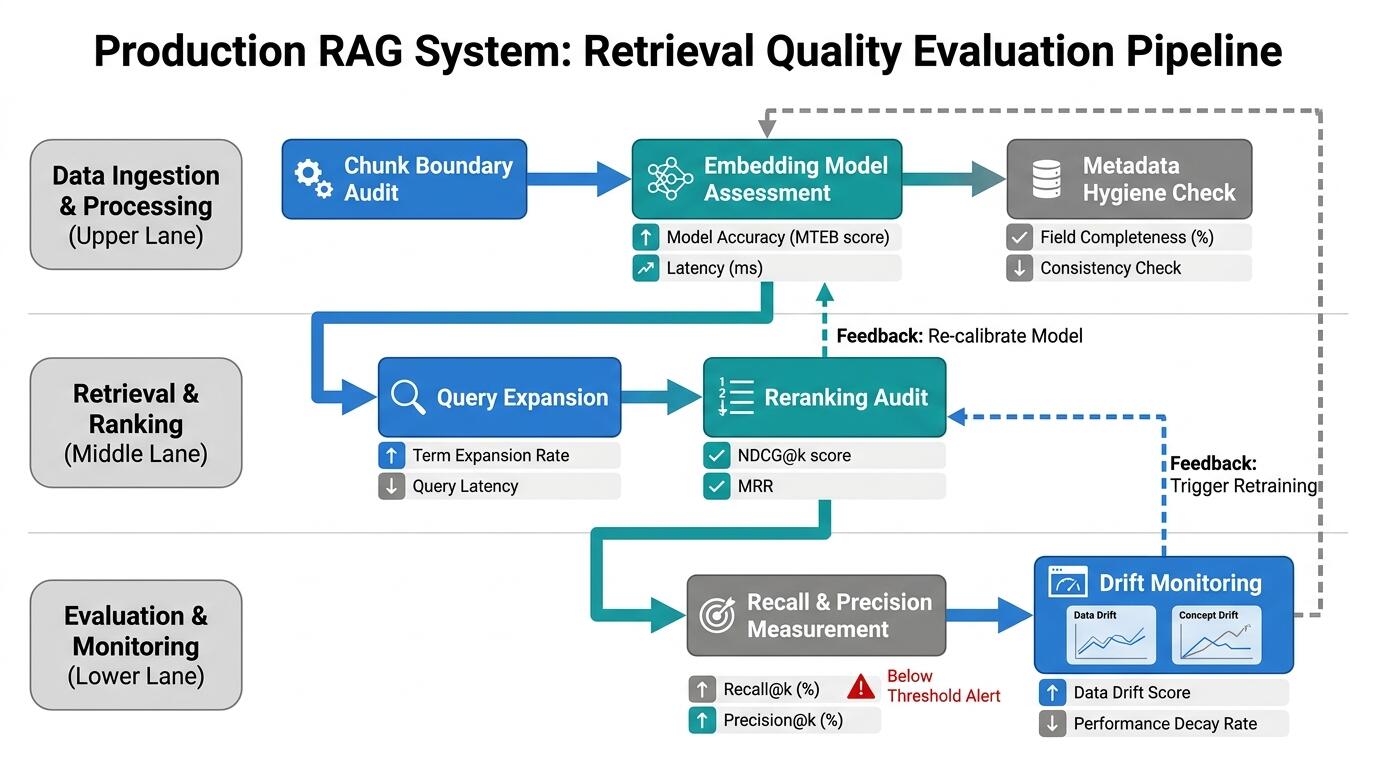
ALT: Retrieval quality evaluation workflow diagram for production RAG systems showing chunk audit, embedding model assessment, recall measurement, and continuous monitoring pipeline for AI teams
Questions & Answers
Q1: How do I quickly measure whether my RAG retrieval is actually the problem vs. the generation step?
The fastest diagnostic is to run a manual retrieval audit on a sample of failed queries. For each query where the final answer was wrong or incomplete, inspect the raw retrieved chunks before the model processes them. If the correct information is present in the retrieved context but the model answered incorrectly, you have a generation or prompting problem. If the correct information is absent from the retrieved chunks, you have a retrieval problem. This separation-of-concerns audit takes less than an hour and immediately directs where to invest engineering effort.
Q2: Is it worth implementing reranking for a small-scale internal RAG system?
Reranking delivers the most value when retrieval recall is already reasonable but precision is the bottleneck — that is, when you are retrieving relevant documents but ranking less relevant ones higher. For small-scale systems with fewer than a few thousand documents, strong initial retrieval with a well-calibrated embedding model often obviates the need for a full cross-encoder reranker. A lighter-weight alternative is to use a simpler lexical scoring layer, such as BM25 hybrid retrieval, as a first reranking step before committing to a more expensive neural reranker.
Q3: How often should a production team re-evaluate its chunking and embedding strategy?
Retrieval infrastructure strategy should be reviewed whenever one of three conditions changes: your document corpus composition shifts significantly (new content types, new languages, a major volume increase), your user query distribution shifts (new use cases, different user segments), or a meaningfully better embedding model becomes available. In practice, a structured retrieval quality review every quarter is a reasonable cadence for active production systems — not because things necessarily break on a quarterly schedule, but because retrieval debt accumulates silently and scheduled reviews create a forcing function for catching it.
Final Thoughts
Retrieval quality is the most under-invested layer in most production RAG systems. The checklist above is deliberately structured around the checks that have the highest leverage on real-world system quality — not theoretical completeness, but the failures that actually hurt users and erode trust in AI-assisted products.
Three points worth keeping in mind as you work through these checks.
First, measurement is the prerequisite for everything else. Without a retrieval evaluation harness and ongoing monitoring, you are operating blind. Build the measurement infrastructure before optimizing anything.
Second, retrieval problems compound. Poor chunking degrades embedding quality; poor embedding quality degrades recall; poor recall makes reranking and prompt engineering irrelevant. Fix issues in pipeline order — ingestion and chunking first, then embedding and retrieval, then reranking and context composition.
Third, retrieval drift is a production reality, not an edge case. Query distributions and document corpora both evolve over time. The teams that maintain retrieval quality over the long run are the ones that treat monitoring and periodic re-evaluation as routine operational practice, not as one-time launch tasks.
Work through the checklist in order of your most pressing current symptom. Each check is self-contained and actionable — start with one, measure the result, and proceed from there.
If you are building AI products and want field-tested analysis of how developments in model capabilities, retrieval infrastructure, and AI tooling translate into real engineering decisions, visit the Darius bilingual AI newsletter — each issue delivers five to ten sourced AI updates with first-hand production context, written by an engineering director running three live AI products.
Sources & Further Reading
- Amazon Web Services. "What is RAG?"
https://aws.amazon.com/what-is/retrieval-augmented-generation/ - Datawhale China. "All-in-RAG — A Comprehensive Guide to Retrieval-Augmented Generation."
https://datawhalechina.github.io/all-in-rag/ - IEEE — Institute of Electrical and Electronics Engineers. Standards and technical resources on information retrieval and AI system evaluation.
https://www.ieee.org/