Comparison: Plain Workflows vs Full Agent Systems for Solo Builders
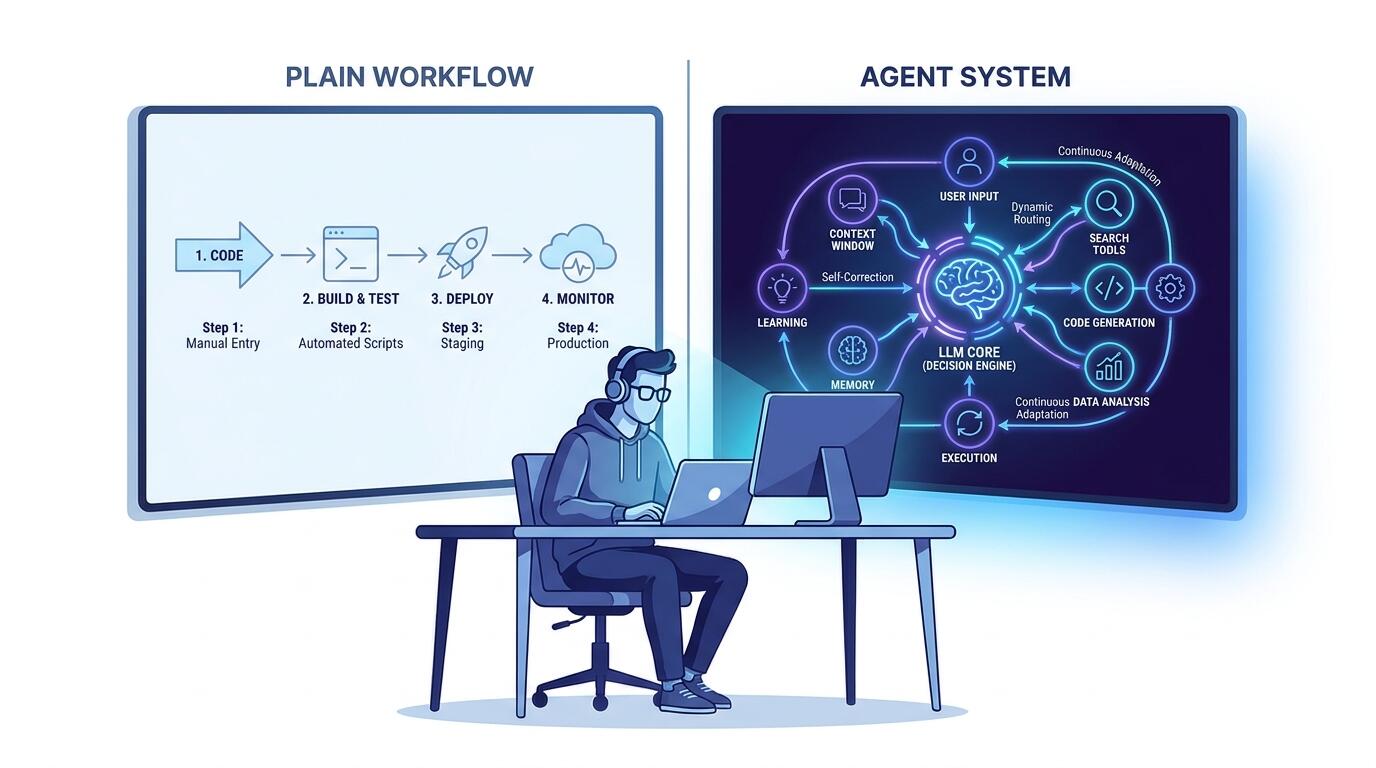
ALT: Solo builder comparing plain AI workflows versus full agent systems for production decision-making
Plain Workflows vs. Full Agent Systems: What Solo Builders Actually Need to Know
Solo builders face a recurring architectural choice when shipping AI products: reach for a plain, deterministic workflow, or invest in a full autonomous agent system. The verdict, drawn from consistent patterns we see in production environments, is that most solo builders should start with plain workflows and graduate to agent systems only when complexity genuinely demands it — not because agents sound more impressive. This article compares both approaches across the dimensions that actually matter in solo development: implementation cost, debuggability, reliability, maintenance burden, and when each genuinely earns its place in production.
The comparison covers two primary architectural patterns — plain orchestrated workflows (scripted, step-by-step pipelines where a developer controls every transition) versus full agent systems (LLM-driven loops where the model itself decides what to do next, which tools to call, and when to stop). The evaluation criteria are chosen specifically for the constraints that solo builders face: limited time, no ops team, and the need to ship and iterate fast.
Evaluation Criteria: How to Judge the Right Architecture for Solo Work
Choosing between plain workflows and agent systems is not primarily a question of which is more powerful. It is a question of which delivers production-reliable output at the lowest operational cost for a team of one.
Implementation speed matters because solo builders cannot afford weeks of plumbing before shipping a first working version. A longer setup time delays feedback and burns runway.
Debuggability is arguably the highest-stakes criterion for a solo operator. When something breaks at 2 a.m. and you are the only person on call, you need to trace exactly what happened, which step produced bad output, and why — without reading through thousands of tokens of agent reasoning.
Reliability and predictability determine whether you can make promises to users or customers. A system that occasionally goes off-script, loops, or calls the wrong tool is a support liability.
Maintenance overhead reflects the ongoing cost of keeping the system working as underlying models, APIs, and prompts change. Agent systems tend to accumulate hidden fragility — a prompt tuned for one model version may behave differently after a silent model update.
Scalability ceiling captures the upper bound of complexity each pattern can handle. Some tasks — multi-step research, open-ended content generation with adaptive structure, autonomous code review — genuinely require agent-level autonomy and cannot be served well by a fixed pipeline.
Cost control is a practical ceiling that plain workflows handle more naturally, because every LLM call is explicit and accountable. Agent loops can generate unexpected chains of calls that inflate token spend in ways that are difficult to budget.
The Contenders: What Each Architecture Actually Is
Plain Orchestrated Workflows: Scripted Pipelines with Developer-Controlled Steps
A plain workflow is an AI pipeline in which a developer explicitly defines every step, every transition, and every tool call. The LLM is one component in a sequence — it receives a well-scoped prompt, returns output, and passes control back to deterministic code. Examples include a document summarization pipeline (ingest → chunk → summarize each chunk → merge), a content moderation chain (classify → flag → route), or an automated briefing generator that retrieves sources, scores them, and formats a digest.
The distinguishing characteristic of a plain workflow is that the control flow lives in your code, not in the model's reasoning. The model does not decide what happens next — your orchestration logic does. This makes behavior predictable and failures isolated: if step three produces garbage output, you know exactly where to look.
Plain workflows are the backbone of a wide range of production AI products today, including many that appear superficially sophisticated. A pattern we consistently see is that teams who started with agent frameworks later refactor back to plain pipelines once they realize that 90% of their use cases follow a fixed, enumerable sequence — and the agent loop was adding overhead without adding value. For a concrete example of how this kind of scripted pipeline works in practice at the infrastructure level, the agent pipeline behind a daily AI briefing walks through retrieval, verification, and publication steps as an orchestrated sequence rather than an open-ended autonomous loop.
Full Agent Systems: LLM-Driven Loops with Autonomous Decision-Making
A full agent system is an architecture in which the LLM acts as the central decision-maker — it chooses which tools to invoke, determines whether it has enough information to answer, decides when to loop back for more retrieval, and signals when the task is complete. The developer provides a set of tools (search, code execution, API calls, memory stores) and a high-level task description; the model drives the rest.
Agent systems are genuinely powerful for tasks with unbounded or unpredictable structure. If a user asks an AI to "research this topic and write a report," the number of sources needed, the depth of each sub-topic, and the shape of the final output cannot be fully specified in advance — which is exactly the kind of task where agent-level autonomy earns its cost. Frameworks such as LangChain, LlamaIndex, AutoGen, and CrewAI have accelerated adoption by abstracting the scaffolding needed to build these loops. However, the abstraction hides a significant amount of complexity that surfaces the moment something goes wrong in production.
For solo builders, the core challenge with full agent systems is not building them — it is operating them. Debugging a failed agent run requires reconstructing a sequence of model decisions, tool calls, and intermediate states that may not have been logged at the right granularity. Prompt changes can alter agent behavior in non-obvious ways. And cost is harder to predict, because the number of LLM calls per task is determined by the model at runtime, not by you. Understanding where these pipelines fail — and building in the right checks — is a prerequisite for trusting them in production, as explored in depth in the piece on where AI drafting pipelines fail and the checks that catch them.
Head-to-Head Comparison: Plain Workflows vs. Full Agent Systems
| Criterion | Plain Workflows | Full Agent Systems |
|---|---|---|
| Implementation speed | Fast — write explicit steps in code | Slower — requires tool definitions, loop logic, and prompt engineering for agent behavior |
| Debuggability | High — failures are isolated to specific steps | Lower — failures may occur anywhere in an open-ended loop; requires structured logging |
| Output reliability | High — deterministic flow, predictable outputs | Variable — model decides path; behavior can shift with model updates |
| Maintenance overhead | Low-to-medium — prompt tuning is localized | Medium-to-high — agent behavior is emergent and harder to audit |
| Scalability ceiling | Limited to tasks with fixed, enumerable steps | High — handles open-ended, multi-step, adaptive tasks |
| Cost predictability | High — every LLM call is explicit | Low-to-medium — call count is model-determined at runtime |
| Solo-builder fit | Strong for most initial production use cases | Appropriate when task complexity genuinely requires autonomy |
The most important takeaway from this comparison is the asymmetry in where each pattern breaks down. Plain workflows fail loudly and specifically — a bad output from step three is easy to find, isolate, and fix. Agent systems fail silently and diffusely — the model may have made a reasonable decision at each step while still producing a wrong or hallucinated final output, and reconstructing where the reasoning went wrong is genuinely hard without purpose-built observability.
The second key difference is cost predictability. In a plain workflow, you can calculate the expected token cost per run precisely, because you wrote every LLM call. In an agent system, a task that normally resolves in three tool calls might occasionally spiral into ten, and you will not know until you receive the API bill. For solo builders operating on tight margins, this unpredictability is a meaningful risk — one that is easy to underestimate during local testing, where tasks tend to be simpler and more cooperative than real production inputs.
The third pattern we see consistently in our work is that teams reach for agent frameworks prematurely, attracted by the flexibility, and spend disproportionate time managing agent misbehavior instead of shipping product features. The discipline of asking "can I express this as a fixed sequence?" before defaulting to an agent loop saves significant operational pain. For deeper thinking on this kind of architectural decision, the build vs. buy framework for AI infrastructure offers a structured lens that applies equally well to the workflow-vs-agent choice.
Which Should You Choose? Scenario Recommendations for Solo Builders
Plain workflows are the right default for the large majority of solo builder use cases. If your task can be expressed as a fixed sequence of steps — even a branching one — start there, ship fast, and only revisit the architecture when you hit a ceiling the workflow genuinely cannot clear.
If you are building a content pipeline (summarization, briefing generation, newsletter formatting, classification), choose a plain workflow. The inputs and outputs are well-defined, the steps are enumerable, and agent autonomy adds complexity without adding user value.
If you are building a customer-facing Q&A or support tool where responses draw from a fixed knowledge base, choose a plain workflow with retrieval-augmented generation (RAG). Structure the retrieval, ranking, and response steps explicitly. An agent loop here introduces unnecessary variability in how questions get interpreted and answered.
If you are building a research assistant that must explore an open-ended topic — deciding how many sources to pull, whether to drill deeper on a sub-topic, how to synthesize conflicting information — then a full agent system is genuinely warranted. The task structure cannot be fully specified in advance, and agent autonomy is doing real work.
If you are building a coding assistant or code review tool that must adapt its analysis strategy based on what it finds in the code, an agent system is appropriate — but invest heavily in structured output validation and logging from the start.
If you are uncertain, default to a plain workflow and treat it as a forcing function for clarity. If you find yourself writing conditional branches for every possible state the task might be in, that is a signal that the task genuinely needs agent-level flexibility. If the branches are manageable, the workflow will serve you better.
Pros and cons summary for solo builders:
Plain workflows offer fast implementation, predictable cost, easy debugging, and straightforward maintenance. Their limitation is a hard ceiling on task complexity — they cannot handle tasks where the right sequence of steps is itself unknown until runtime.
Full agent systems unlock genuinely adaptive, open-ended task handling and scale to complex multi-step reasoning. The tradeoff is higher implementation effort, lower cost predictability, harder debugging, and meaningful operational overhead — all of which hit harder when you are the only engineer and operator.
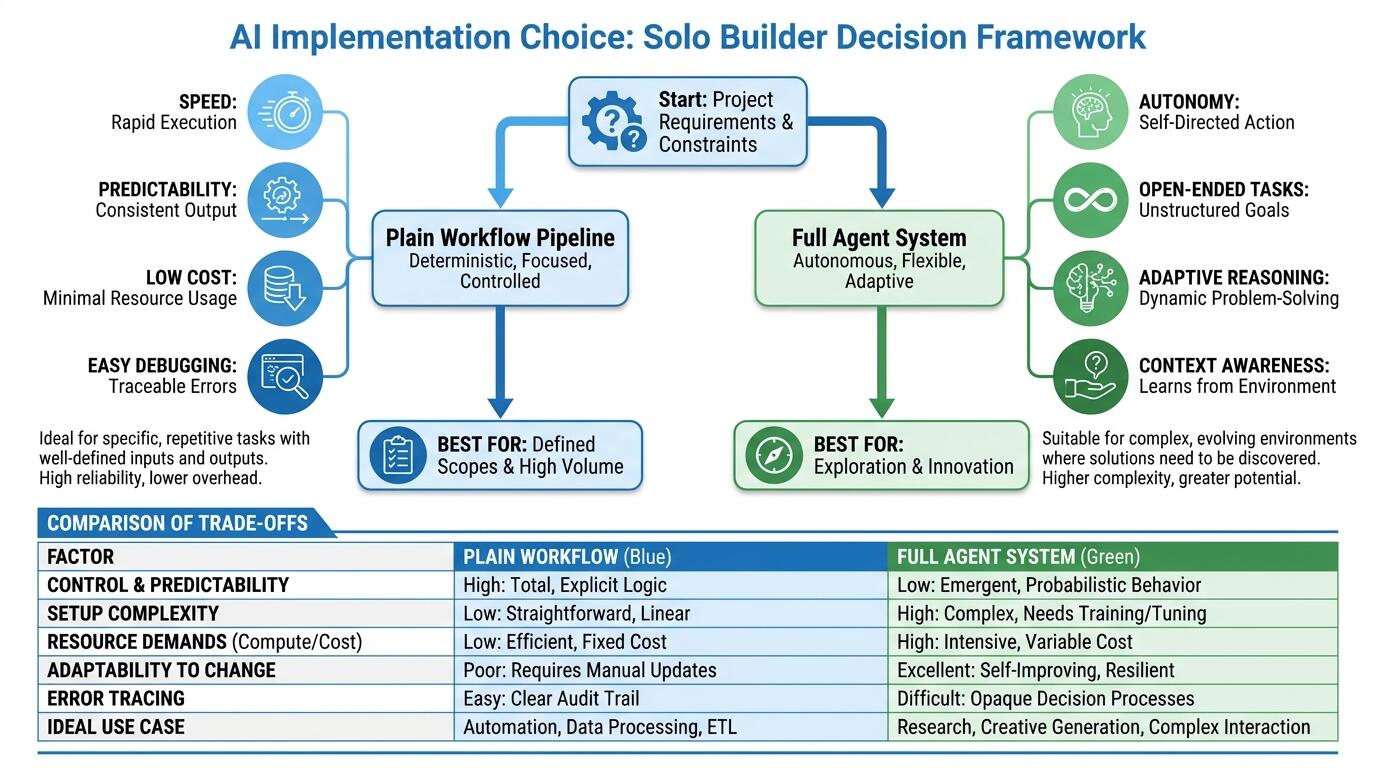
ALT: Decision framework diagram comparing plain AI workflow pipelines and full agent systems for solo builders shipping production AI products
Frequently Asked Questions FAQ
Q1: How do I know when my workflow has grown complex enough to need a full agent system?
A plain workflow has hit its ceiling when you find yourself writing extensive conditional logic to handle task states that the model itself needs to evaluate — not states you can enumerate in advance. A concrete signal: if you are writing more than two or three nested branches to handle variations in model output, and those variations are driven by task content rather than edge cases, that task genuinely benefits from agent-level autonomy. Most tasks do not reach this threshold.
Q2: Are full agent systems harder to keep reliable in production over time?
Yes, meaningfully so. Agent systems are more sensitive to model version changes, prompt drift, and tool API changes because the model's decision logic is not locked in code — it is expressed in prompts and inferred at runtime. A plain workflow's control logic is in your codebase, where it is versioned, reviewable, and testable with standard software engineering practices. For solo builders without a dedicated QA or ops function, this difference in operational stability is significant and should not be underestimated.
Q3: How much more expensive is it to run a full agent system compared to a plain workflow?
Cost comparisons depend on the specific task and model, so no single figure applies universally. The structural difference is that plain workflows have a fixed, developer-defined number of LLM calls per run, making cost per task calculable in advance. Agent systems have a model-determined call count that varies with task complexity — sometimes by a factor of several times for similar inputs. Budget for the upper end, not the average, and instrument your agent runs with per-call logging from day one to catch cost anomalies before they compound.
Key Takeaways
- Plain workflows are the right default for most solo builders. If your task follows a predictable sequence — even with branching — a scripted pipeline delivers faster, cheaper, and more debuggable results than an agent loop.
- Full agent systems earn their cost only when task structure is genuinely open-ended. Research assistants, adaptive coding tools, and multi-step synthesis tasks are legitimate agent use cases. Most content pipelines and Q&A tools are not.
- Debuggability is the hidden cost of agent systems. When something breaks in a plain workflow, you know exactly where. When an agent fails, reconstructing the decision path requires deliberate observability investment that solo builders often underestimate.
- Cost predictability favors plain workflows by design. Every LLM call in a workflow is explicit and accountable. Agent loops generate call counts at runtime, and worst-case spend can be multiples of the typical case.
- The architectural choice is reversible — start simple and upgrade only when you have clear evidence the workflow cannot do the job. Premature agent adoption is a consistent pattern that adds maintenance burden without adding user value.
The practical next step is to map your current or planned AI task against the scenario recommendations above. If it fits a plain workflow, build that first, ship it, and collect real production signal before revisiting the architecture.
If you are building AI products and want to stay current on the engineering decisions that actually matter — distilled from real production experience, not editorial aggregation — subscribe to the Darius bilingual AI briefing. Every issue is curated and interpreted by an engineering director who runs multiple AI products in production, helping you cut through noise and reach insights that are genuinely actionable for builders. Visit Darius to explore the briefing, topic pages, and engineering blog.
Sources & Further Reading
- IEEE Computer Society. "IEEE Standards for Artificial Intelligence and Autonomous Systems".
https://www.ieee.org - Association for Computing Machinery (ACM). "Research and Technical Publications on Autonomous Agents and Multi-Agent Systems".
https://www.acm.org - National Institute of Standards and Technology (NIST). "AI Risk Management Framework and Trustworthy AI Guidance".
https://www.nist.gov - The Linux Foundation. "Open Source AI and LLM Tooling Ecosystem Documentation and Technical Reports".
https://www.linuxfoundation.org
Note: Standards and frameworks may be updated; please check the latest official documents or consult qualified technical advisors for current guidance.