Multi-Agent Systems: When to Use Them and When to Avoid the Complexity
ALT: Multi-agent AI systems architecture diagram showing orchestration complexity versus single-agent design
Multi-Agent Systems: When Does the Added Complexity Actually Pay Off?
Key Conclusion: Multi-agent systems deliver real value when a task requires parallel specialization, independent tool access, or distinct reasoning roles that a single agent cannot cleanly hold at once — but for most production workloads, a well-scoped single agent with strong tooling outperforms a multi-agent architecture on cost, latency, and reliability. The decision to adopt multi-agent design should follow task decomposition analysis, not hype.
Multi-agent systems have become one of the most discussed patterns in applied AI engineering, promoted heavily in conference talks, vendor demos, and social media threads showing agents "collaborating" to solve complex problems. In our work architecting production AI products, we consistently see teams reach for multi-agent orchestration before they have exhausted what a single, well-instrumented agent can do — and the resulting systems are frequently harder to debug, slower to respond, and more expensive to run than the problem justified. This article breaks down exactly when the complexity of coordinating multiple agents earns its keep, and when it becomes an expensive detour from shipping a reliable product.
The Current Landscape of Multi-Agent Adoption
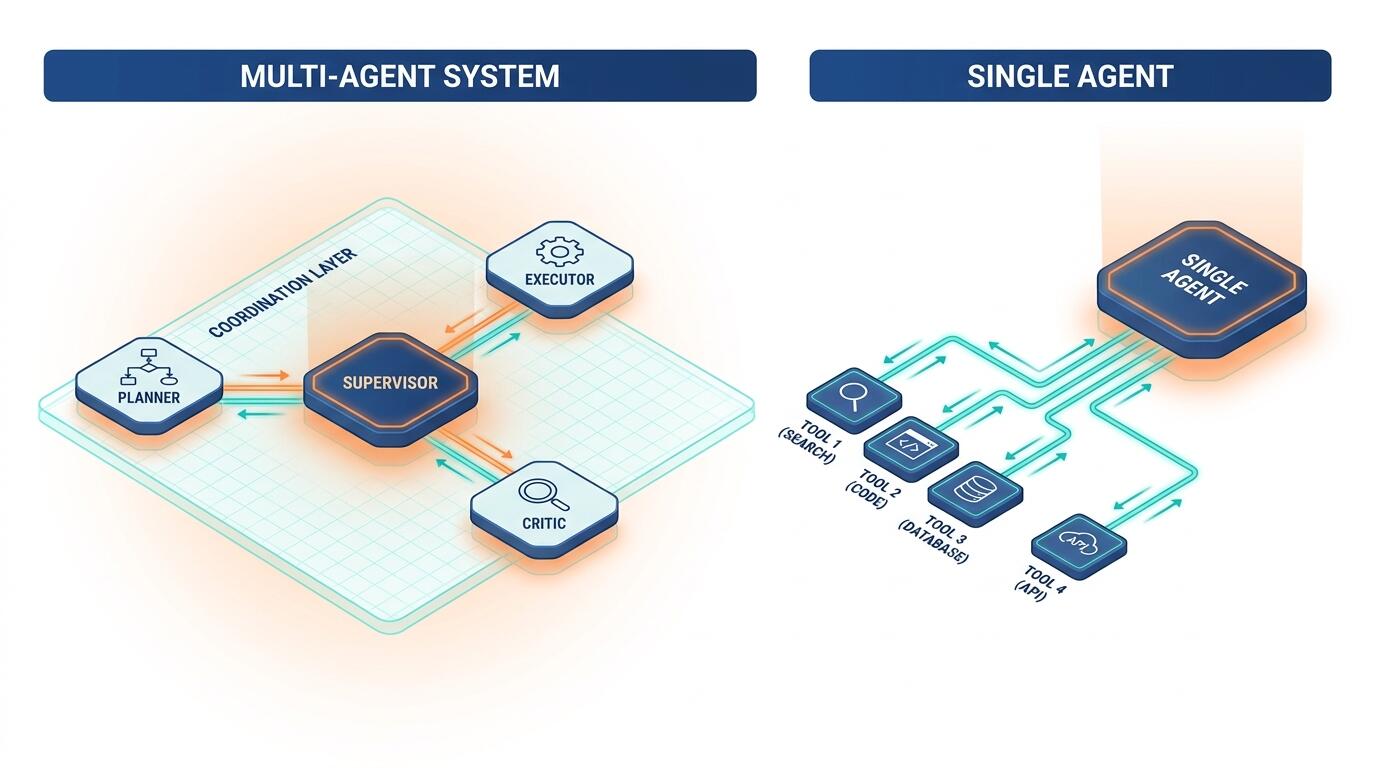
A multi-agent system is an AI architecture in which multiple autonomous or semi-autonomous agents — each with a defined role, memory scope, and often distinct tool access — coordinate to complete a task that would be difficult for a single agent to handle alone. According to IBM, multi-agent systems distribute work across specialized agents that communicate and negotiate to reach a shared objective, a design that mirrors how human teams divide labor across specialists rather than relying on one generalist. This framing matters because it clarifies that multi-agent design is fundamentally an organizational choice, not just a technical one.
The past few years have seen a rapid shift from single large language model calls to orchestrated agent frameworks, driven largely by the maturation of tool-calling, function-calling APIs, and retrieval-augmented pipelines. Frameworks that support agent-to-agent handoffs, shared memory stores, and supervisor-worker patterns have moved from research demos into commercial tooling, and vendors have understandably marketed these capabilities aggressively. Cognizant's research on multi-agent architectures notes that these systems are increasingly applied in domains like customer service triage, supply chain coordination, and code generation pipelines, where discrete sub-tasks map naturally onto discrete agent roles.
At the same time, a countertrend has emerged among practitioners who ship production systems rather than prototypes. Teams building real products — the kind that need to run reliably at scale, under budget, with predictable latency — have started reporting that multi-agent complexity often introduces failure modes that single-agent systems never face: circular reasoning loops, conflicting agent outputs, and cascading errors when one agent's mistake propagates to the next. Galileo's analysis of why multi-agent systems fail highlights coordination breakdowns and unclear ownership of tasks as recurring root causes, echoing what we see repeatedly when auditing client architectures.
This tension — genuine capability versus operational risk — is why the question "when should you actually use multi-agent systems" deserves rigorous treatment rather than default enthusiasm. The pattern we consistently see is that the highest-performing production systems apply multi-agent design surgically, to the 10-20% of workflows that truly benefit from it, while keeping the rest of the system as a lean, well-tooled single agent or a simple sequential pipeline.
ALT: Comparison chart of single-agent versus multi-agent AI system decision criteria and trade-offs
The Mechanism: Why Multi-Agent Complexity Emerges and Where It Breaks Down
Understanding when multi-agent systems help requires understanding what actually happens under the hood when you split a task across agents — and where those splits introduce fragility that a single agent never encounters.
Task Decomposition and Role Specialization
Multi-agent architectures work by decomposing a broader objective into narrower subtasks, each assigned to an agent with a focused system prompt, a defined toolset, and often a separate context window. This specialization can genuinely improve output quality when subtasks require fundamentally different reasoning styles — for example, one agent that plans, another that executes code, and a third that critiques output for factual accuracy. The gain comes from each agent operating with less cognitive load and a cleaner, narrower context than a single generalist agent juggling every responsibility at once.
The failure mode appears when decomposition is done arbitrarily rather than based on genuine task boundaries. Teams often split a task into agents simply because the framework encourages it, not because the subtasks are truly independent. When subtasks are tightly coupled — meaning agent B's output only makes sense in light of agent A's full reasoning trace, not just its final answer — splitting them loses information and introduces translation errors at every handoff.
Coordination Overhead and Communication Protocols
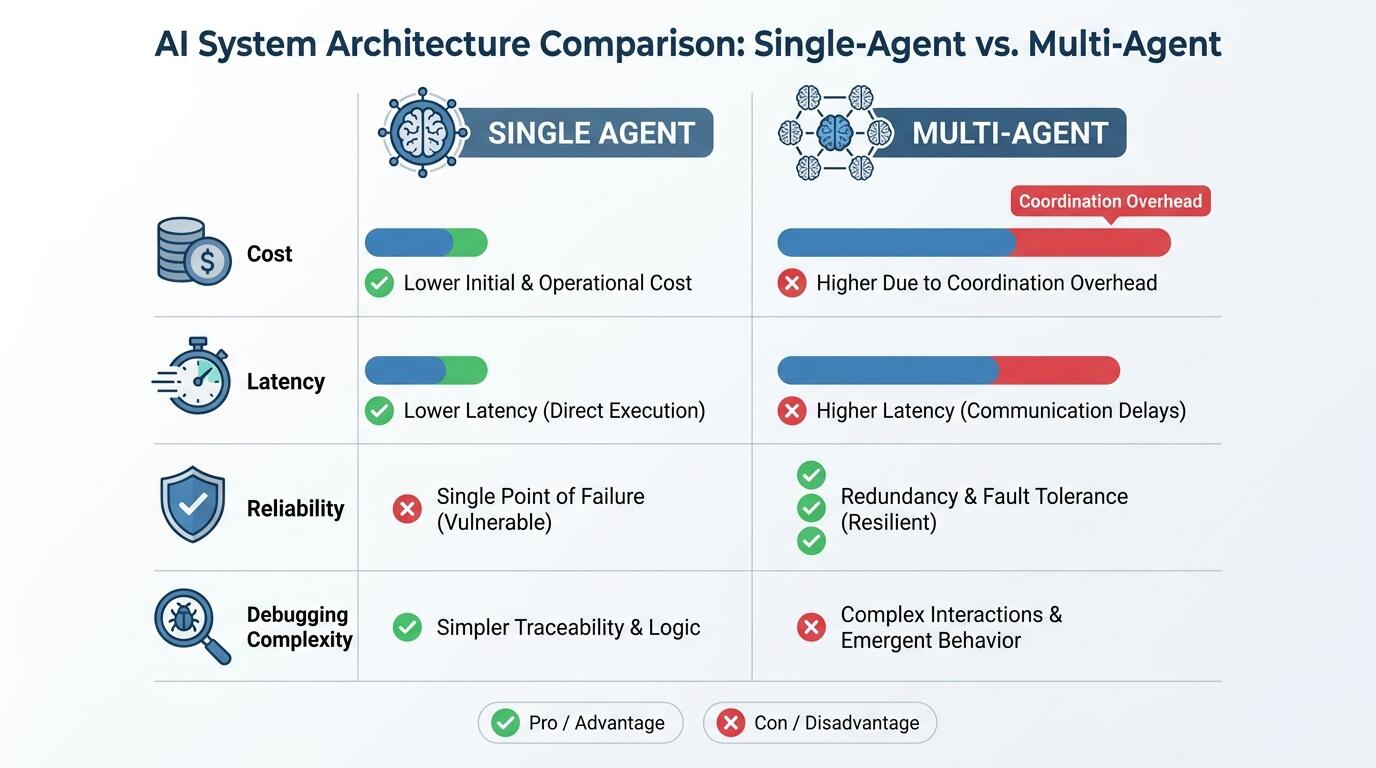
Every multi-agent system requires a coordination layer: a supervisor agent, a shared message bus, or a round-robin handoff protocol that decides which agent acts next and how information passes between them. This coordination layer is itself a piece of software that can fail, and it adds a latency and cost tax on top of whatever the individual agents already consume — each handoff typically means re-serializing context, which multiplies token usage and response time compared to a single continuous reasoning chain.
According to Cognizant's research on multi-agent architectures, communication protocols between agents are one of the most under-engineered parts of these systems, often treated as an afterthought rather than a first-class design concern. In practice, this means teams underinvest in defining exactly what format agents exchange information in, how conflicts are resolved when two agents disagree, and what happens when an agent times out or returns malformed output.
Error Propagation and Debugging Difficulty
A single agent that makes a mistake produces one bad output you can inspect directly. A multi-agent system that makes a mistake often produces a cascading chain: agent A hallucinates a fact, agent B treats it as ground truth and builds on it, and agent C's final output looks polished but is built on a false premise several steps removed. Galileo's analysis of multi-agent failure patterns identifies this cascading error propagation as one of the seven most common reasons these systems fail in production, precisely because the failure is invisible until you trace the full multi-hop reasoning chain.
Debugging this kind of failure is materially harder than debugging a single-agent system. You need full observability into every agent's inputs, outputs, and intermediate reasoning, plus a way to reconstruct the exact sequence of handoffs that led to the final answer — tooling that many teams underestimate when they first commit to a multi-agent design.
Cost and Latency Compounding
Because each agent typically runs its own model inference call, multi-agent systems multiply the number of API calls, and therefore the cost and latency, relative to a single-agent equivalent. A three-agent pipeline that each makes one call per step is not merely three times the cost of a single call — coordination overhead, retries, and context re-transmission often push the real multiplier higher. This is one of the most consistently underestimated factors when teams scope multi-agent projects, and it is a major reason production-focused teams default to single-agent design unless the task genuinely demands otherwise, a principle we detail further in the difference between AI prototypes and production-ready AI systems.
Evidence and Multi-Angle Comparison: Single-Agent vs. Multi-Agent in Practice
The debate between single-agent and multi-agent architecture is not binary in practice — most production systems fall somewhere on a spectrum between a single, heavily-tooled agent and a fully distributed multi-agent swarm. What matters is matching the architecture to the actual shape of the problem rather than defaulting to whichever pattern is trending.
Consider a customer support workflow. A single agent equipped with a knowledge base retrieval tool, a ticketing system integration, and clear escalation rules can resolve the overwhelming majority of support queries without ever needing a second agent, because the task — understand the question, retrieve relevant context, respond or escalate — is fundamentally sequential and coherent. Contrast that with a research and report-generation workflow where one agent gathers data from multiple external sources, a second agent synthesizes findings, and a third agent fact-checks the synthesis against the original sources — here the roles are genuinely distinct enough that separation improves both quality and auditability.
A pattern we consistently see when advising engineering teams is that multi-agent design earns its complexity in three specific situations: when subtasks require genuinely different tool access that would bloat a single agent's permission surface, when parallel execution across independent subtasks meaningfully reduces wall-clock time, and when a dedicated critique or verification agent measurably improves output reliability for high-stakes decisions. Outside of those situations, the coordination tax tends to outweigh the specialization benefit.
| Perspective / Approach | Strengths | Trade-offs | Best Fit |
|---|---|---|---|
| Single-agent with rich tooling | Lower latency, simpler debugging, lower cost, easier to reason about failure | Can become overloaded if the task genuinely spans unrelated domains or tool permissions | Support workflows, coding assistants, most internal automation, early-stage products |
| Sequential multi-agent pipeline | Clear separation of concerns, easier to audit each stage, allows specialized prompts per stage | Adds latency from sequential handoffs, still vulnerable to error propagation across stages | Multi-stage content generation, research synthesis, structured report writing |
| Parallel / supervisor-worker multi-agent | Reduces wall-clock time via concurrent execution, isolates failures to individual workers | Highest coordination complexity, requires robust conflict resolution and observability tooling | Large-scale data processing, multi-source research aggregation, complex planning tasks with independent subgoals |
The evidence consistently points toward a conservative default: start with a single agent and only introduce additional agents when you can articulate, in concrete terms, what specific capability the added agent unlocks that tooling or prompt refinement cannot. This mirrors the broader architectural discipline we advocate in designing the minimum viable architecture for a first AI-powered app — complexity should be earned, not assumed.
Outlook: Where Multi-Agent Design Is Heading and What It Means for Builders
Multi-agent systems are moving toward more disciplined, narrower applications rather than the sprawling, many-agent demos that dominated early experimentation. The current state of the field suggests a maturing consensus: multi-agent orchestration is a specialized tool for specific coordination problems, not a default architecture for every AI product, and tooling for observability, agent-to-agent protocols, and failure isolation is improving specifically because practitioners have demanded better guardrails after encountering production failures.
For engineering leaders and product builders, the practical implication is straightforward. Before committing to a multi-agent design, teams should be able to answer why a single agent with better tools, clearer instructions, or a longer context window cannot solve the problem — because in a meaningful share of cases it can, at a fraction of the operational cost. This decision also has organizational implications: choosing between a lean single-agent system and a multi-agent platform often parallels the broader staffing and leadership decisions teams face, a dynamic explored in Engineering Director vs. CTO: choosing the right leader for your stage, where matching structure to actual need — rather than aspiration — determines long-term success.
Actionable takeaways for teams evaluating this decision include mapping the task into discrete subtasks before choosing an architecture, prototyping the single-agent version first as a baseline, and only adding agents when you can measure a concrete improvement in accuracy, latency, or cost that justifies the added coordination burden. Teams that skip this discipline tend to discover the true cost of multi-agent complexity only after the system is in production and difficult to unwind.
Questions & Answers
Q1: How do I know if my AI task actually needs a multi-agent system?
Ask whether the subtasks require genuinely different tools, permissions, or reasoning styles that cannot coexist in one context. If a single agent with better prompting and tool access can handle the workflow sequentially without quality loss, a multi-agent system is likely unnecessary complexity rather than a genuine capability gain.
Q2: Are multi-agent systems more expensive to run than single-agent systems?
Yes, generally. Each agent typically triggers its own model call, and coordination overhead like context re-transmission between agents further multiplies token usage and latency. Cost and latency compounding is one of the most consistently underestimated factors teams encounter when scoping multi-agent architectures for production.
Q3: What is the most common reason multi-agent systems fail in production?
According to Galileo's research on multi-agent failure patterns, cascading error propagation — where one agent's mistake is silently built upon by downstream agents — is among the most common failure modes. Poor coordination protocols and unclear task ownership between agents are closely related contributing factors.
Summary
Multi-agent systems are a powerful but narrow-purpose architecture, valuable specifically when tasks demand parallel execution, distinct tool permissions, or dedicated verification roles that a single agent cannot cleanly hold.
Key Takeaways:
- Default to a single, well-tooled agent unless you can articulate a concrete capability gap that multiple agents solve.
- Coordination overhead — latency, cost, and error propagation across handoffs — is the hidden tax of multi-agent design.
- Reserve multi-agent architectures for genuinely parallel, multi-tool, or verification-heavy workflows, not general-purpose tasks.
- Prototype the single-agent version first as a baseline before adding orchestration complexity.
- Treat architecture decisions as organizational decisions, matching system design to the real shape of the problem rather than to trend-driven defaults.
The next step is to evaluate your current or planned AI workflow against these criteria before committing engineering resources to multi-agent orchestration — the discipline of asking "does this task truly need it" is what separates production-ready AI systems from expensive experiments.
Ready to experience AI built the right way — as a native capability, not an afterthought? Explore Darius's suite of production-ready AI products, from smart cloud storage to AI-powered mock interviews and creator tools, at the Darius website. Visit today to see how Darius can help you work smarter, prepare better, and create faster with AI.
Sources
- IBM. "What is a Multi-Agent System?".
https://www.ibm.com/think/topics/multiagent-system - Cognizant. "Multi-Agent Systems: Architecture, Applications & Real-World Use Cases".
https://www.cognizant.com/us/en/ai-lab/blog/what-are-multi-agent-systems - Galileo. "Are Your Multi-Agent Systems Failing for These 7 Reasons?".
https://galileo.ai/blog/why-multi-agent-systems-fail - IEEE. "IEEE Standards and Research on Autonomous and Intelligent Systems".
https://www.ieee.org/
Note: Standards may be updated; please check the latest official documents or consult professional advisors.