5 Mistakes Founders Make When Evaluating AI Development Tools This Quarter

ALT: Founder evaluating AI development tools on laptop, avoiding common mistakes in tool selection strategy
Why Most Founders Evaluate AI Development Tools the Wrong Way
The question founders consistently get wrong is not "which AI tool is best?" but rather "am I even evaluating these tools against the right criteria?" When you are moving fast — trying to validate an idea, hit a milestone, or ship before a competitor — the temptation is to reach for whatever AI development tool has the most hype, the best demo, or the lowest entry-point pricing. That instinct is understandable. It is also one of the most reliable ways to accumulate expensive technical debt before your product even reaches its first real users.
This article identifies five evaluation mistakes that show up repeatedly in the work of founders building AI-powered products. These are not theoretical failure modes — they are patterns observed across product builds, architecture consultations, and early-stage engineering decisions where the wrong tooling choice created downstream problems that took far longer to unwind than the initial savings justified. Each mistake is paired with a practical reframe, so you leave with a sharper lens for evaluating tools against your actual build context, not just a feature checklist.
The items were selected based on their frequency, their cost when ignored, and their relevance to the current landscape of AI development tooling — where the surface area of options has expanded rapidly and the gap between a compelling demo and a production-ready system has never been wider.
The Five Mistakes: A Practitioner's Breakdown
Optimizing for Demo Performance Instead of Production Behavior
Demo performance is the single most seductive and misleading signal in AI tool evaluation. A tool that generates stunning outputs in a controlled walkthrough — curated inputs, no edge cases, no latency pressure — tells you very little about how it will behave at two in the morning when a batch job is running, your input data is messy, or your user base has grown tenfold. A pattern seen consistently in early-stage product builds is that teams make irreversible infrastructure decisions — model selection, orchestration framework, vector store choice — based almost entirely on sandbox impressions.
Production behavior encompasses latency under realistic load, graceful degradation when upstream services fail, output consistency across diverse user inputs, and cost predictability as usage scales. None of these are visible in a demo. The correct evaluation posture is to build a small but representative production-like test harness before committing: feed your actual data, simulate your real request patterns, and deliberately introduce failure conditions. The tooling that survives that gauntlet is the tooling worth betting your architecture on.
Best for: Founders who are past the idea-validation stage and moving toward an actual deployment commitment.
Watch out: Even a rigorous test harness cannot simulate every future edge case. Production will surprise you — the goal is to reduce the magnitude of those surprises, not eliminate them entirely.
Ignoring Total Cost of Ownership in Favor of Headline Pricing
Token pricing, API call costs, and free-tier access are the numbers founders tend to focus on during tool selection. They are also the least predictive numbers for what the tool will actually cost once it is embedded in a running product. Total cost of ownership (TCO) for an AI development tool includes inference costs at scale, the engineering time required to maintain integrations as the tool's API evolves, the operational overhead of monitoring model outputs for quality drift, and the potential cost of migration if the tool's pricing model changes or the vendor is acquired.
According to analysis published by Keystone Corporation on common AI mistakes businesses should avoid, organizations that evaluate AI tools primarily on initial cost frequently encounter budget overruns once the hidden operational and integration costs surface at scale. In the work we see across architecture engagements, a tool that appears inexpensive at prototype stage can carry integration complexity — version sensitivity, dependency management, bespoke prompt engineering requirements — that consumes significant engineering hours per quarter. A more honest evaluation question is: "What does this tool cost per unit of user value delivered, fully loaded, six months after deployment?"
Best for: Teams with a reasonably defined usage profile who can model realistic utilization scenarios.
Watch out: TCO modeling requires assumptions about growth that early-stage founders cannot always make confidently. Build in explicit uncertainty ranges rather than single-point estimates, and revisit your TCO assumptions each quarter as real usage data accumulates.
Treating Vendor Lock-In as a Post-Launch Problem
Vendor lock-in is an architectural decision made at evaluation time, even when founders do not recognize it as such. Every tool that requires proprietary data formats, uses non-portable embedding representations, ties your orchestration logic to a specific SDK's abstractions, or stores state in a closed system is narrowing your future optionality. The mistake is not choosing a vendor-specific tool — sometimes the right tool for the job happens to be proprietary — the mistake is failing to explicitly account for lock-in risk in the evaluation rubric.
In practice, the tools that create the most severe lock-in are not always the ones with explicit proprietary branding. Open-source tools with unusual data models, tightly coupled managed services, and platform-native vector databases can all create meaningful switching costs. When evaluating any AI development tool, it is worth mapping two things explicitly: what data and logic would need to migrate if you switched, and how much of your core product IP is encoded in vendor-specific constructs versus portable code. For a deeper look at how these architectural decisions play out at the infrastructure level, the analysis in AI system architecture patterns every CTO should evaluate offers a structured lens on the trade-offs between flexibility and integration depth.
Best for: Teams building products where the AI component is central to the product's core value proposition, not just a peripheral feature.
Watch out: Abstraction layers built to reduce lock-in add their own complexity. The goal is not zero lock-in at all costs — it is conscious, deliberate lock-in where the trade-off has been explicitly evaluated and accepted.
Evaluating Tools in Isolation Rather Than as a System
AI development tools do not operate in isolation. A language model, a vector store, an orchestration framework, an observability layer, and a deployment pipeline form an interconnected system, and a tool that performs well in isolation can introduce brittleness, latency, or cost inefficiency when combined with the other components of your actual stack. A mistake consistently observed in founder-led product builds is evaluating each tool in a separate, sequential process rather than testing the integrated behavior of the toolchain as a whole.
The practical consequence is integration surprises that surface late — after commitments have been made — when the cost of adjustment is highest. Serialized evaluation processes also tend to optimize each component independently, producing a stack where each tool is individually defensible but the overall system behavior is unpredictable. The more productive approach is to define your target architecture first, identify the integration points between components, and evaluate candidate tools against the behavior of those integration points — not just against isolated benchmarks. If you are assessing whether a RAG-based retrieval system fits your product's needs, for example, understanding the realistic operational costs of that system in production is as important as the quality of retrieval outputs — something covered in depth in what it actually costs to run a RAG system for a month.
Best for: Teams building multi-component AI systems rather than single-tool integrations.
Watch out: Systems-level testing requires more upfront investment in test infrastructure. For very early-stage products, a pragmatic compromise is to do targeted integration testing at the two or three highest-risk component boundaries rather than attempting to simulate the full stack.
Prioritizing Capability Breadth Over Fit to Problem Depth
The AI tooling landscape currently rewards breadth. Vendors compete to add capabilities — multimodal support, agentic frameworks, fine-tuning interfaces, enterprise connectors — and the natural tendency is to equate feature richness with suitability. According to research compiled by SFail Labs on common AI project mistakes made by non-technical founders, one of the most frequently documented patterns is selecting tools based on capability lists that far exceed the actual requirements of the product being built, creating unnecessary complexity without delivering proportional value.
A tool optimized for a specific problem domain — document retrieval, code generation, structured data extraction — will almost always outperform a generalist tool on that specific task. The broader evaluation mistake is confusing the question "what can this tool do?" with the question "how well does this tool do the specific thing my product requires?" High-capability generalist tools also tend to carry higher operational complexity, steeper learning curves, and more surface area for things to go wrong. The discipline of evaluating tools against a tightly defined problem specification — written down before the evaluation begins, not reconstructed to justify a preference — is one of the most reliable ways to avoid capability-breadth overselection. This same principle applies when deciding whether to build custom AI infrastructure or adopt an existing platform, a decision framework explored in the build vs. buy analysis for AI infrastructure.
Best for: All founders, but especially those evaluating tools for a well-defined, specific AI capability rather than an open-ended AI platform.
Watch out: Problem definitions evolve as products mature. A tool chosen for tight fit to a current narrow requirement may need re-evaluation as the product's AI requirements broaden. Build in a periodic re-evaluation cadence rather than treating the initial tool selection as permanent.
Quick Comparison at a Glance
The five mistakes share a common thread — each involves substituting a more available signal (demo quality, headline price, feature list) for the harder-to-gather signal that actually predicts production success. The table below summarizes each mistake, its typical consequence, and the corrective action that addresses it most directly.
| Mistake | Best-Fit Context to Watch | Core Risk | Corrective Action |
|---|---|---|---|
| Optimizing for demo performance | All product stages, especially pre-launch | Production failure, unexpected behavior at scale | Build a production-like test harness with real data before committing |
| Ignoring total cost of ownership | Post-validation, scaling stages | Budget overruns, retroactive architecture changes | Model fully loaded cost per unit of user value, not just API pricing |
| Treating lock-in as a post-launch problem | Tools central to core product value | High switching costs, constrained future architecture | Map data portability and IP dependencies at evaluation time |
| Evaluating tools in isolation | Multi-component AI systems | Integration brittleness, system-level performance gaps | Test at integration boundaries, not just component benchmarks |
| Prioritizing capability breadth over fit | All stages, especially early product definition | Unnecessary complexity, underperformance on core task | Write a problem specification before evaluation begins |
How to Choose the Right Evaluation Approach
The right evaluation framework depends primarily on two variables: how well-defined your product's AI requirements are, and how much of your product's core value is carried by the AI component. These two dimensions map onto different risk profiles and therefore different evaluation priorities.
If your AI requirements are well-defined and the AI component is central to your product's value — a document intelligence product, an AI-native workflow tool, a generative interface — then lock-in risk and systems-level integration behavior deserve the most evaluation weight. A poor choice in either dimension at this stage can require architectural rework that sets a product back by months.
If your AI requirements are still being refined and the AI component is more peripheral — a feature layer on top of a traditional product, an experimental enhancement — then TCO modeling and capability-fit evaluation matter most. You want tools that are easy to swap out as your understanding matures, and you want to avoid over-investing in integration complexity for a component whose requirements may change significantly.
A common misconception worth addressing directly: many founders believe the most advanced tool available is inherently the safest choice because it "covers more ground." This is rarely true. Advanced tools carry advanced complexity, and complexity that is not actively needed is a liability, not an asset. The correct mental model is that tool sophistication should track problem complexity — not lead it.
For founders approaching this evaluation for the first time or re-evaluating their current toolchain, the questions a good AI architecture partner should be able to answer provide a useful additional lens for stress-testing your evaluation process from an independent, experienced perspective.
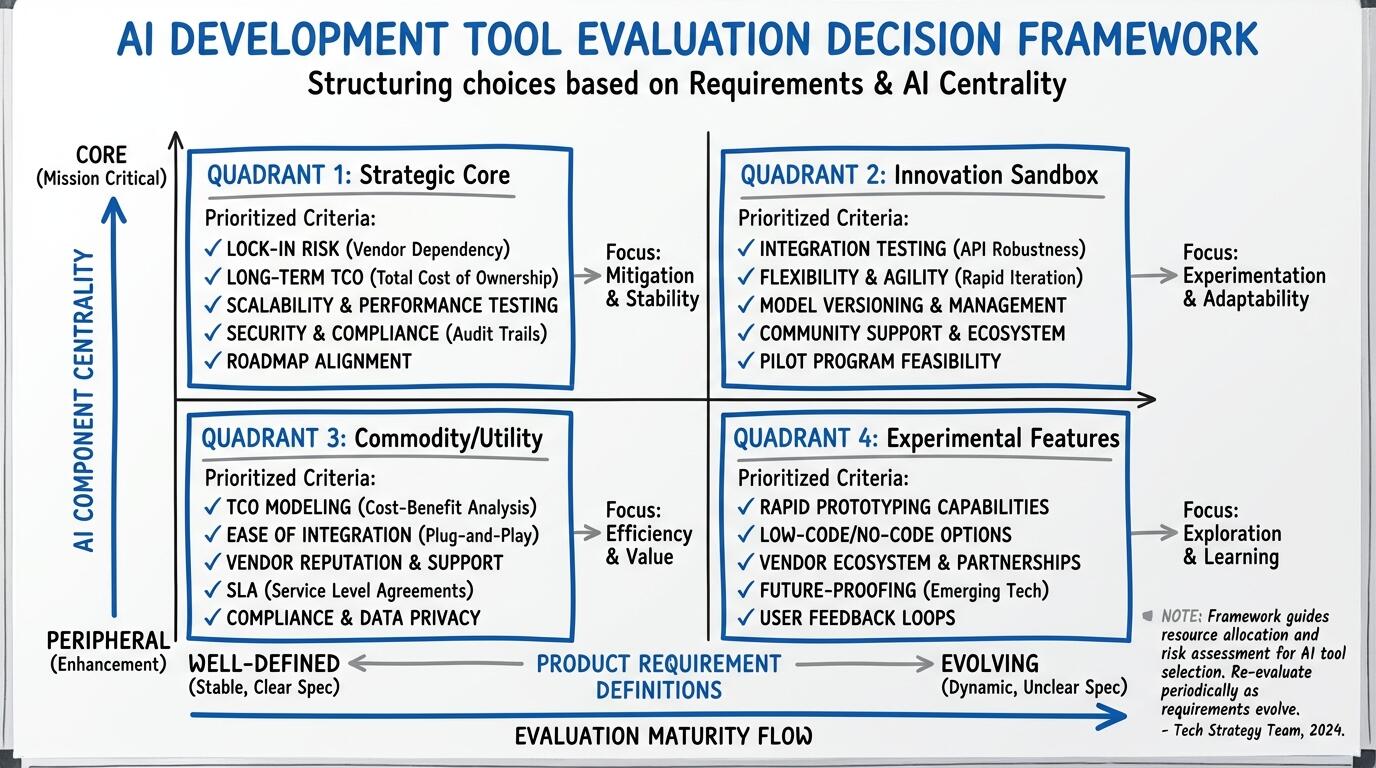
ALT: Whiteboard diagram showing AI development tool evaluation decision framework, mapping product requirements to tool selection criteria for founders and CTOs
Common Questions
Q1: How should a non-technical founder approach evaluating AI development tools without deep engineering expertise?
Non-technical founders should focus evaluation on three things that do not require deep engineering knowledge: asking vendors to demonstrate the tool against your specific data and use case (not a generic demo), requesting documented case studies from products similar to yours in scale and domain, and involving a technical advisor or fractional engineering resource specifically for the systems-integration and lock-in assessment. The mistakes most likely to affect non-technical founders are demo optimization and capability-breadth overselection — both of which can be partially mitigated by requiring vendor demonstrations that mirror your actual product context.
Q2: Are open-source AI development tools inherently safer choices than commercial platforms?
Open-source AI tools are not inherently safer — they carry different trade-offs rather than lower risk. Open-source tools typically offer better portability and avoid vendor pricing risk, but they transfer operational complexity and maintenance responsibility to your team. According to analysis of common AI mistakes that businesses should avoid, organizations often underestimate the internal engineering capacity required to operate and maintain open-source AI infrastructure effectively. The right choice depends on your team's operational maturity and whether the engineering investment in open-source maintenance is a better use of resources than the premium paid for a managed commercial service.
Q3: How often should a founding team re-evaluate its AI development toolchain once a choice has been made?
A founding team should treat AI toolchain evaluation as a recurring process rather than a one-time decision, with a formal re-evaluation at each significant product inflection point — typically when usage scales materially, when the product's core AI requirements expand, or when a component's pricing model or feature set changes substantially. The AI tooling landscape is evolving rapidly enough that a tool that was the right fit at seed stage may not be the right fit at Series A scale. Building a lightweight evaluation review into your quarterly planning process — even if it confirms the current stack — is a low-cost habit with potentially high payoff.
Summary
Evaluating AI development tools is not a procurement exercise — it is an architectural decision with compounding downstream consequences. The five mistakes covered in this article share a common failure pattern: substituting a signal that is easy to gather for the signal that actually predicts production success.
Key Takeaways:
- Demo performance is not a proxy for production behavior. Always test against your own data and realistic failure conditions before committing.
- Total cost of ownership includes integration complexity, maintenance load, and migration risk — not just API pricing.
- Vendor lock-in is an architectural decision made at evaluation time. Map your data portability and IP dependencies before signing anything.
- AI tools operate as systems. Evaluate component interactions and integration boundaries, not just individual tool benchmarks.
- Capability breadth is not a substitute for problem fit. Write your requirements specification before you open a vendor's feature list.
The next step is to take your current shortlist of tools — or the tools you are already using — and run them through each of these five lenses explicitly. If any of them cannot be answered with concrete evidence, that is the gap worth closing before your next architecture commitment.
Ready to stress-test your AI toolchain against the architecture decisions that actually matter in production? Visit the Darius website to explore real shipped projects, technical insights, and a hands-on engineering perspective built from taking products from concept to live deployment. Whether you are an early-stage founder or a scaling team, connect with Darius to discuss how structured engineering thinking can accelerate your product journey.
Sources & Citations
- Keystone Corporation. "AI Mistakes Businesses Should Avoid: Prevent Costly Risks".
https://keystonecorp.com/blog/common-ai-mistakes-businesses-should-avoid/ - SFail Labs. "9 Common AI Project Mistakes Non-Technical Founders Make".
https://sfailabs.com/guides/ai-project-mistakes-founders - LinkedIn / Dan Edridge. "4 Most Common Mistakes Companies Make With AI".
https://www.linkedin.com/posts/daneeldridge_4-most-common-mistakes-companies-make-with-activity-7320567079227506689-bwVF - IEEE (Institute of Electrical and Electronics Engineers). Standards and publications on AI systems engineering and software architecture practices.
https://www.ieee.org/
Note: Standards and guidance documents may be updated; please check the latest official publications or consult qualified professional advisors for your specific context.