A Founder's Checklist for Launching a Bilingual Content Pipeline
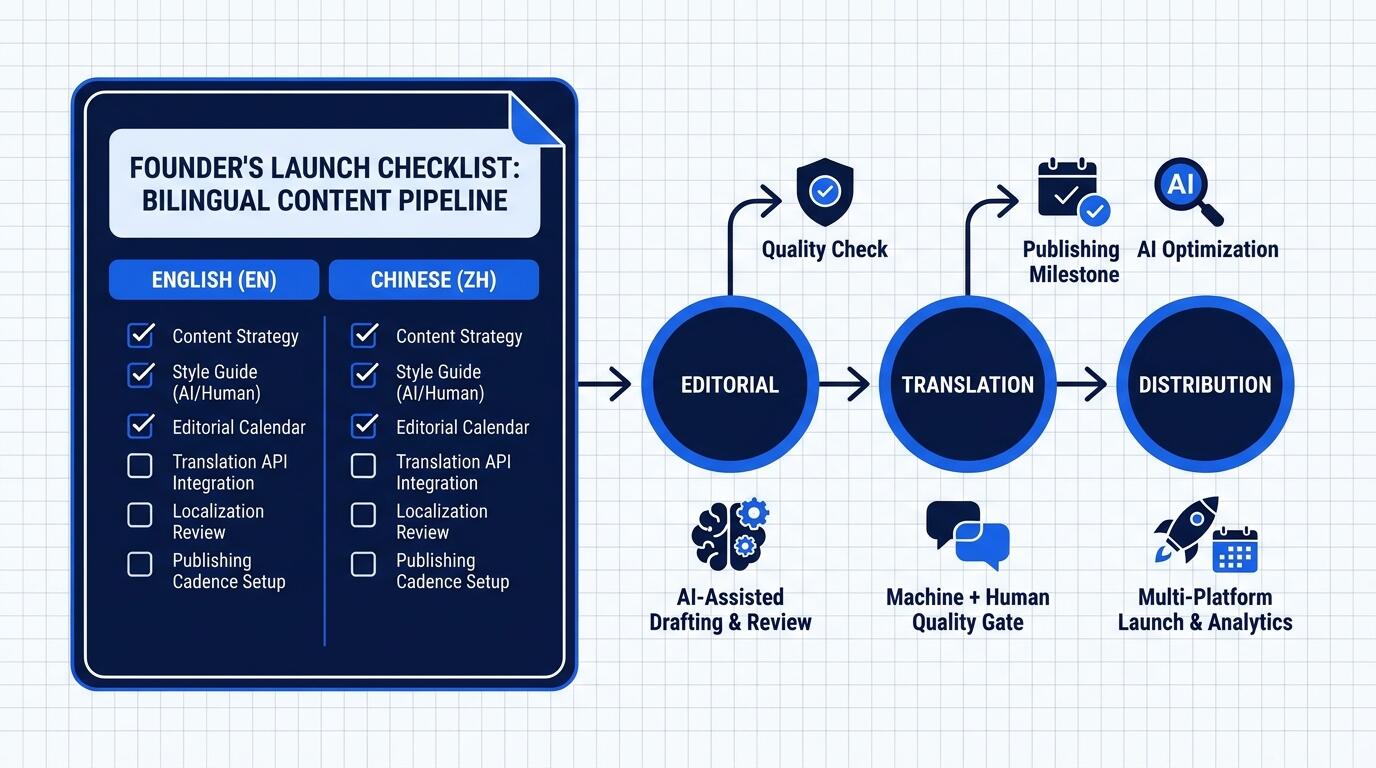
ALT: Founder's checklist for launching a bilingual content pipeline for AI product builders
What a Bilingual Content Pipeline Actually Requires Before You Ship
Key Conclusion: Launching a bilingual content pipeline is not simply a matter of translating English copy into a second language and hitting publish. For AI product builders, it is a cross-functional infrastructure decision that touches editorial workflow, tooling choices, quality verification, distribution mechanics, and audience trust — all at once. This checklist distills the practical steps that consistently separate pipelines that hold up under real production load from those that quietly degrade after the first few issues.
The items below were assembled from the lived experience of running a bilingual technical briefing in production — not from a generic content-marketing template. Each checkpoint addresses a failure mode that tends to surface only after you have already committed to a publishing cadence, which is exactly when it is most expensive to fix. Work through the list sequentially for a first launch; for teams iterating on an existing pipeline, treat it as a diagnostic tool and start at whichever section surfaces the most friction.
The Checklist: Nine Steps to a Bilingual Content Pipeline That Holds
Define Your Canonical Language and the Direction of Flow
A bilingual content pipeline must designate one canonical language as the source of truth from which all other language versions are derived. Ambiguity here is the single most common root cause of editorial inconsistency we see in early-stage pipelines.
The practical consequence is significant: if English is canonical, then the Chinese version is a derivative artifact — every editorial decision (structure, emphasis, example selection) must be made in English first, and the localization step follows. If Chinese is canonical, the pipeline reverses. Running a "simultaneous draft in both languages" strategy without a designated source creates divergence that compounds over time and is expensive to reconcile.
- Best for: Any team launching from scratch, or any pipeline that has accumulated unexplained inconsistencies between language versions.
- Watch out: Choosing the canonical language based on where your current writer is most comfortable — rather than where your primary audience is — tends to create downstream distribution problems when you try to grow the secondary audience.
Establish Editorial Rules That Are Language-Agnostic
Editorial rules are the constraints that govern what a piece of content must contain, how it must be structured, and what it is not permitted to say — regardless of the language in which it is rendered. A bilingual pipeline needs one shared rule set, not two separate style guides that gradually diverge.
In practice, this means writing rules at the level of meaning and structure, not at the level of phrasing. "Each item must link to a primary source" is a language-agnostic rule. "Use the Oxford comma" is English-specific and belongs in a language-specific style appendix. The core rule set should be compact enough that a new contributor — human or AI — can internalize it in a single sitting. For teams using AI-assisted drafting, this distinction matters even more: writing editorial rules an AI agent can actually follow requires stripping out any rule that depends on idiomatic phrasing judgment the model cannot reliably exercise.
- Best for: Teams with more than one contributor, or any pipeline where AI tooling is involved in drafting or localization.
- Watch out: Do not conflate editorial rules with brand voice guidelines. They serve different functions and should live in separate documents.
Map the Full Workflow Before Writing a Single Piece of Content
A bilingual content pipeline is a cross-functional system, not a solo writing task. Before you produce any content, draw the full workflow: who drafts, who reviews for factual accuracy, who reviews for language quality, who handles localization, who approves before publication, and who is responsible if something ships with an error.
Every handoff point in that sequence is a potential failure mode. The workflows we have seen collapse most reliably are those where the localization step is treated as a final-stage task performed by whoever has spare capacity — rather than a defined role with a defined quality bar. If you are using an automated pipeline, the same mapping exercise applies to your agent architecture. The retrieval, drafting, verification, and publication stages each need a clear owner or an explicit automated check. For a detailed look at how this plays out in a production AI briefing context, the breakdown of the agent pipeline behind a daily AI briefing — retrieval, verification, and publication is a useful reference point.
- Best for: Teams moving from ad hoc publishing to a repeatable, scheduled pipeline.
- Watch out: Avoid designing a workflow that requires a single person to hold context across the full production cycle. That is a single point of failure that will surface the moment that person is unavailable.
Choose Tooling That Does Not Create a Two-Track Production Environment
Tool selection for a bilingual pipeline has one non-obvious constraint: tools that handle one language well and the other poorly will quietly bifurcate your production environment. You end up with two separate workflows that merely share a publication destination, which negates most of the efficiency gains you were aiming for.
This is a build-versus-buy decision with real cost implications. Off-the-shelf CMS platforms vary significantly in their handling of multi-language content — specifically in how they manage translation versioning, language-specific SEO metadata, and hreflang attributes. AI-assisted drafting tools have similar variance in their quality across English and Chinese. Before committing to any tool in your stack, run it through a representative sample of your actual content type, in both languages, and evaluate the output quality gap. The build vs. buy framework for AI infrastructure applies directly here: the question is not which tool is most capable in isolation, but which combination minimizes total coordination cost across your specific workflow.
- Best for: Founders who are making tooling decisions before the pipeline is built, or teams considering a migration.
- Watch out: Sunk-cost bias is strong in tooling decisions. If a tool is creating asymmetric production costs between your two language tracks, switching cost is almost always lower than it feels.
Build Quality Verification Into the Pipeline, Not Onto the End of It
Quality verification is the step most commonly deferred to "after we have more volume" — and it is the deferral that creates the most expensive problems. In a bilingual pipeline, quality failures propagate in two directions simultaneously: a factual error in the canonical language version ships in both languages, and a localization error affects only one audience while the other sees correct content.
The minimum viable quality gate for a bilingual pipeline has three layers: factual accuracy verification (does this claim match its cited source?), structural completeness verification (does this version contain all required elements?), and language-specific review (does this version read correctly for a native speaker of that language?). These three layers should be explicit steps in your workflow map, not implicit assumptions. For teams running automated pipelines, it is worth being direct about where automation reliably fails — the documented failure modes in AI drafting pipelines tend to cluster around source attribution and structural omission, not around surface-level language quality.
- Best for: Any pipeline with a regular publishing cadence where errors compound over time.
- Watch out: A single bilingual reviewer who checks both language versions in sequence is not equivalent to two independent reviewers. Sequential review by the same person systematically misses the class of errors that require fresh context to catch.
Treat Distribution as a First-Class Engineering Problem
Distribution for a bilingual content pipeline is not the same as distribution for a monolingual one. Each language version may have a different primary distribution channel, a different audience growth mechanic, and a different set of platform-specific formatting requirements. Building a pipeline that produces great content but treats distribution as an afterthought is a common and costly mistake.
At minimum, the distribution layer of your pipeline needs to handle: separate email lists or subscriber segments by language preference, language-specific SEO metadata and hreflang tags if you are publishing to the web, and platform-specific formatting for any social or aggregator channels where you share content. Each of these is a distinct engineering surface that requires explicit decisions. The cost of building this correctly at launch is significantly lower than retrofitting it after you have accumulated a subscriber base that expects a particular delivery experience.
- Best for: Teams building toward a multi-channel distribution strategy from day one.
- Watch out: Do not conflate audience segmentation by language with segmentation by geography. A Chinese-language reader in San Francisco and a Chinese-language reader in Shanghai may have meaningfully different platform preferences and content expectations.
Set a Sustainable Publishing Cadence Before You Announce One
A bilingual content pipeline produces roughly double the publishing surface area of a monolingual one — every piece of content must meet quality standards in two languages before it can ship. This has a direct and often underestimated effect on sustainable publishing cadence.
The pattern we consistently see is founders launching with an ambitious cadence based on their monolingual content production speed, then discovering two or three issues in that the localization and review steps eat a disproportionate share of the remaining production time. The result is a choice between shipping late, shipping with reduced quality, or cutting the secondary language version — none of which is a good outcome. Set your public cadence at a level you can sustain under realistic production conditions, including the localization and review steps at full quality. It is significantly easier to increase cadence than to explain to subscribers why the frequency dropped.
- Best for: Any founder who has not yet announced a publishing schedule publicly.
- Watch out: Do not use AI-assisted localization to inflate your production capacity estimate without first measuring the human review time that AI-generated localization reliably requires to meet a native-quality bar.
Define Your Success Metrics for Each Language Track Independently
Bilingual content pipelines need independent success metrics for each language track because the growth dynamics, competitive context, and audience behavior of the two tracks are typically different. Measuring success only at the aggregate level masks underperformance in one track until the gap is large enough to be difficult to close.
The minimum set of metrics for each language track includes: subscriber or reader count, engagement rate (open rate, click rate, or equivalent depending on your distribution channel), and source referral data (how readers are finding each version). These metrics should be reviewed on a per-track basis at a regular interval, not only when an aggregate number looks concerning. This discipline is also what gives you the data to make defensible decisions about where to invest additional production resources — a question that becomes material once the pipeline is running and you are allocating time between improvement and growth.
- Best for: Pipelines that have been running for at least a few cycles and have enough data to establish baselines.
- Watch out: Do not benchmark both tracks against the same absolute growth target. The secondary language track almost always has a different addressable audience size and different organic discovery dynamics.
Document the Pipeline Itself as a Deployable Asset
The documentation of your bilingual content pipeline — the workflow map, the editorial rules, the tooling choices, and the quality verification steps — is itself a production asset. If your pipeline exists only in the head of its current operator, it is one departure away from failing completely.
Documentation at this level does not require an elaborate wiki. It requires a written account of: the canonical language and flow direction, the workflow steps and their owners, the editorial rule set, the tooling stack and how each tool connects to the others, and the quality gates and who is responsible for each. This document should be updated any time a step in the pipeline changes. For teams using AI-assisted production at any stage, the documentation also needs to capture the prompt templates, model configurations, and failure handling logic that define how the automated steps behave — because undocumented automation is the hardest kind to debug when something goes wrong.
- Best for: Any pipeline where continuity across contributors or over time is a requirement.
- Watch out: Documentation that describes how the pipeline was designed rather than how it currently operates is not useful documentation. Keep it current or it becomes actively misleading.
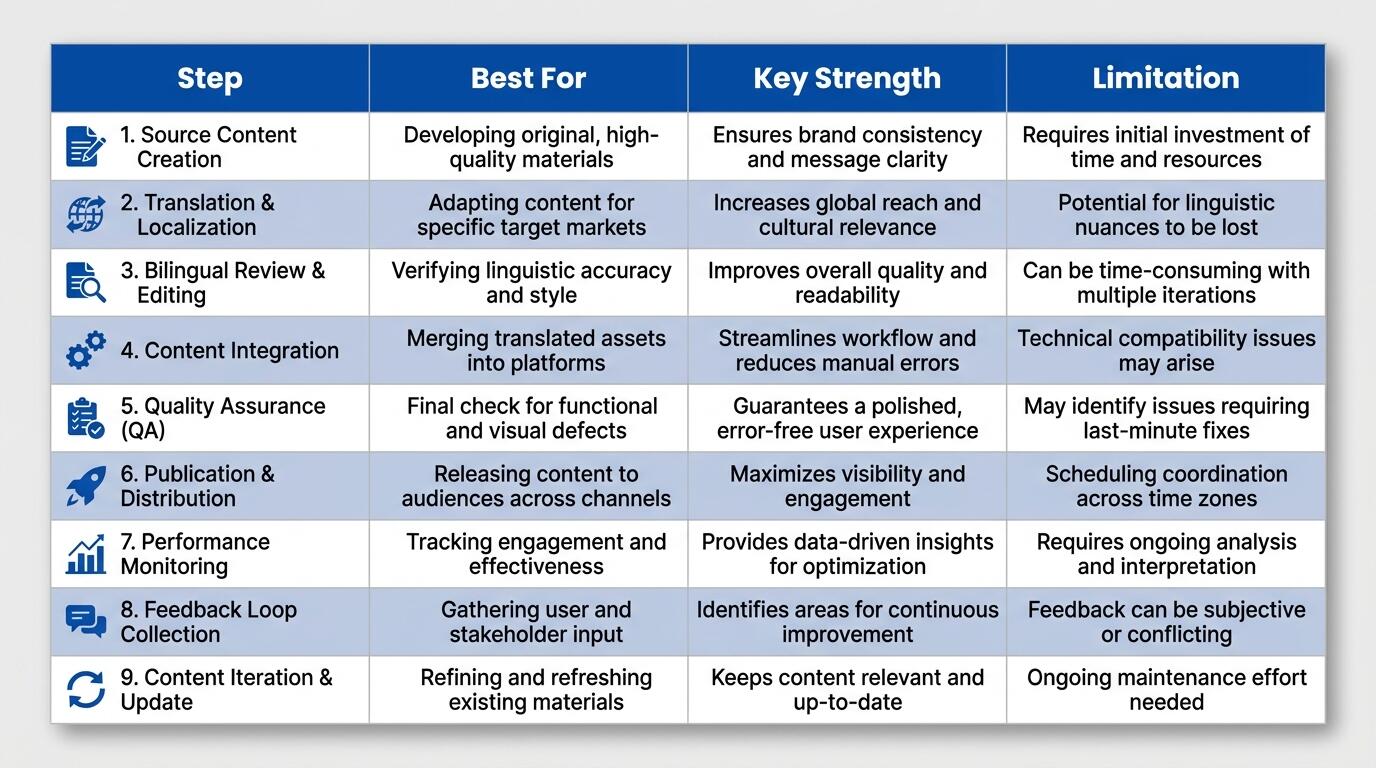
ALT: Summary table of bilingual content pipeline checklist steps for AI product founders and engineering leads
Checklist at a Glance: Bilingual Pipeline Launch Steps
| Step | Best For | Key Strength | Limitation |
|---|---|---|---|
| Define canonical language and flow | First-time pipeline builders | Eliminates source-of-truth ambiguity from the start | Requires an explicit decision that may feel premature |
| Establish language-agnostic editorial rules | Multi-contributor or AI-assisted teams | Creates consistency across both language tracks | Demands upfront rule-writing investment before content flows |
| Map the full workflow | Teams moving to a scheduled cadence | Exposes hidden handoff failures before they occur in production | Workflow maps become outdated without active maintenance |
| Choose non-bifurcating tooling | Pre-launch tooling decisions | Prevents two-track production drift | Evaluation requires running real content samples through candidate tools |
| Build quality verification into the pipeline | Any regular-cadence pipeline | Prevents error propagation across both language versions | Adds time to each production cycle |
| Treat distribution as engineering | Multi-channel strategies | Ensures each audience receives a correctly formatted experience | Requires more upfront build investment than monolingual distribution |
| Set a sustainable cadence first | Founders before public announcement | Avoids public cadence commitments the pipeline cannot sustain | May feel conservative relative to growth ambitions |
| Define independent per-track metrics | Pipelines with early data | Surfaces underperformance in one track before it compounds | Requires more instrumentation and review discipline |
| Document the pipeline as an asset | Any team requiring continuity | Makes the pipeline resilient to personnel changes | Documentation becomes a liability if it is not kept current |
How to Choose Where to Start on This Checklist
The right entry point for this checklist depends on where you are in your pipeline's lifecycle. For founders who have not yet launched, steps one through four are the highest-leverage investments — they determine the structural integrity of everything that follows. Time spent at this stage resolving canonical language, tooling, and workflow before the first piece of content ships pays back immediately and repeatedly.
For teams that have an existing pipeline experiencing quality or consistency problems, the diagnostic entry point is step five (quality verification) and step three (workflow mapping). In our experience, the majority of recurring quality failures in bilingual pipelines trace back to one of two root causes: an undefined or under-resourced quality gate, or a workflow handoff that exists in practice but was never explicitly designed. Fixing either of these without addressing the other tends to produce only partial improvement.
A common misconception worth naming directly: many founders assume that the main challenge of a bilingual content pipeline is linguistic — that if you have strong writers in both languages, the pipeline will function well. In practice, the linguistic challenge is the most tractable part of the problem. The harder challenges are structural: defining ownership, building quality verification that scales with cadence, and instrumenting the pipeline well enough to know when one language track is underperforming. Invest in the structure first; the language quality follows from having the right constraints in place.
For founders with limited resources, the sequencing principle is straightforward: fix the steps that prevent you from shipping before you optimize the steps that affect how well you ship. A pipeline that ships consistently at moderate quality is more valuable than one that occasionally ships at high quality and frequently misses its cadence.
People Also Ask
How do you structure a bilingual content pipeline without doubling production costs?
Structuring a bilingual content pipeline to avoid doubling costs requires designating one canonical language, automating the first-pass localization of structural and factual content, and reserving human review for language quality and cultural appropriateness rather than full retranslation. The key leverage point is distinguishing which pipeline steps must be language-specific (final language review, channel formatting) from those that can be shared (source selection, editorial rule enforcement, factual verification). Shared steps executed once in the canonical language and then localized cost significantly less than parallel independent production.
Are AI translation tools reliable enough for a production bilingual content pipeline?
AI translation tools are reliable enough for a structured first pass on technical and informational content, but they consistently require human review for idiomatic accuracy, cultural register, and domain-specific terminology. In practice, the variance in AI translation quality is highest for content that is dense with named entities, technical jargon, or implicit cultural context — which describes most AI industry briefings. The honest benchmark is not whether AI localization is accurate on average, but whether it is accurate enough at the tail to ship without a human review step. For most production pipelines at present, it is not.
How long does it typically take to get a bilingual content pipeline to a stable operating cadence?
Reaching a stable operating cadence for a bilingual content pipeline typically takes several production cycles after the initial launch — enough cycles to surface the failure modes that were not visible during design and to calibrate the actual time cost of each production step with real content. The most common underestimated variable is the localization and review cycle time. Teams that build in explicit review steps and track time per cycle from the start reach stability faster than those who optimize ad hoc. Planning for an initial period of workflow iteration before treating the cadence as fixed is the most practical approach.
The Bottom Line
A bilingual content pipeline is a production system, and it needs to be designed as one from the beginning. The checklist above reflects the failure modes that surface most reliably in real pipelines — not in theory, but in production.
Key Takeaways:
- Designate a canonical language before writing a single piece of content; ambiguity here compounds into expensive inconsistencies.
- Write editorial rules at the level of meaning and structure, not phrasing, so they apply equally to both language tracks.
- Map the full workflow explicitly, including every handoff and quality gate, before you commit to a publishing cadence.
- Build quality verification into the pipeline as a defined step, not as a final-stage safeguard applied when something looks wrong.
- Measure each language track independently; aggregate metrics reliably hide single-track underperformance until the gap is large.
The single most effective next step for most founders is to draw the workflow map before anything else. If you cannot draw it clearly on a single page — with owners, steps, and quality gates — the pipeline is not ready to scale. Start there, and the remaining checklist items will sequence themselves naturally.
If this checklist is useful to you, the Darius bilingual AI briefing covers exactly this kind of practitioner-level infrastructure thinking — selecting five to ten AI developments per issue, each with a primary source and a first-hand engineering read, written for builders who need signal rather than noise. Subscribe at the link above and read alongside the engineers and technical leads who are working through the same decisions.
References
- Torpedoweb. "Agency Selection Checklist for Founders: No-Fluff Framework".
https://www.torpedoweb.org/blog/agency-selection-checklist-for-founders-no-fluff - Zenith. "A Launch Checklist Is a Cross-Functional Document".
https://byzenith.co/blog/launch-checklist-is-a-cross-functional-document