Why Editorial Rules for Agents Matter More Than the Model You Choose

ALT: Editorial rules for AI agents matter more than model choice in production systems
The Question Everyone Is Asking Wrong: Model Selection vs. Agent Governance
Most teams building AI agents spend the majority of their early effort on model selection — benchmarking GPT-4o against Claude, debating Gemini's context window, tracking every new release from every frontier lab. That instinct is understandable, but it increasingly misses the point. The central thesis here is direct: once you move past a basic capability threshold, the editorial rules governing your agent's behavior produce more reliable, more consistent, and more trustworthy output than upgrading to the next model tier. This article examines why that's true mechanically, where the evidence comes from in practice, and what it means for how you build.
This question deserves deeper analysis right now because the industry has reached an inflection point. Frontier models from multiple providers have converged on a level of general capability that is, for most production use cases, genuinely sufficient. The differentiating variable has shifted — and teams that recognize this early will stop chasing model upgrades and start investing in the governance layer that actually controls output quality.
How We Got Here: The State of Agent Deployment Today
Agentic AI systems — systems in which a language model takes sequences of actions, makes decisions across multiple steps, and operates with some degree of autonomy — are no longer experimental. Engineering teams at companies of varying sizes are deploying agents in production for tasks ranging from content generation and customer support to data synthesis and internal tooling. What was a research pattern two or three years ago is now a standard architectural choice.
The early phase of this adoption was dominated by model anxiety. Teams worried, reasonably, about whether any model was capable enough to handle their specific workload. That concern drove intense focus on capability benchmarks, model APIs, and fine-tuning experiments. The question "which model should we use?" was the right first question, because capability gaps were real and consequential.
That landscape has changed substantially. The gap between leading models on most practical tasks has narrowed to the point where swapping providers rarely produces a step-change improvement in output quality for a well-defined production task. What teams are discovering instead — and this is a pattern we consistently see in building and operating AI products — is that inconsistency, drift, and failure modes in production agents almost always trace back not to the model's raw capability but to the absence of clear, enforceable behavioral rules that the agent can actually follow.
The industry has begun to recognize this. Discussions of "agent-ready enterprises" increasingly center on process structure and constraint design rather than model selection. The shift mirrors what happened in software engineering when the focus moved from raw processor speed to system architecture: capability thresholds matter up to a point, and then the design above the hardware becomes the primary lever.
Why Editorial Rules Are the Actual Control Surface
Editorial rules for agents are explicit, structured constraints that define what an agent should do, how it should reason, what it may and may not produce, and under what conditions it should escalate or refuse. They are distinct from a system prompt in scope — a system prompt is often a starting instruction; an editorial ruleset is a governing document that shapes every decision node in an agent's workflow.
The Model Capability Plateau
Modern frontier models — whether from OpenAI, Anthropic, Google, or other major providers — have reached a capability level where, for a large class of production tasks, they can all produce acceptable output. The practical difference between a well-prompted run on a mid-tier model and a poorly-governed run on a frontier model is not which model wins. The poorly-governed frontier model produces inconsistent, unpredictable output far more often. Raw capability does not substitute for behavioral consistency.
How Behavioral Drift Accumulates
Behavioral drift is the tendency of an agent operating without firm editorial constraints to gradually deviate from intended output characteristics across sessions, contexts, or scale. In a single-turn interaction, a capable model usually performs well. In a multi-step agentic pipeline — where outputs from one step become inputs to the next — small deviations compound. Without explicit rules anchoring the agent's behavior at each decision point, the system converges toward whatever the model finds statistically comfortable, not what your product requires.
We have observed this pattern directly in production. An agent tasked with synthesizing information for a briefing product, operating without structured editorial rules, will reliably begin to introduce voice inconsistencies, change the level of abstraction between items, and eventually start making implicit editorial judgments — emphasizing certain topics, downplaying others — based on nothing more than distributional patterns in its training data. This is not a model defect. It is the predictable behavior of a capable system operating without adequate governance.
The Verification Problem at Scale
Verification — confirming that agent output meets quality and factual standards before publication or delivery — is only tractable if you have defined what "correct" looks like in advance. Editorial rules are exactly that definition. Without them, every verification step requires a human to make a fresh judgment call, which does not scale. With them, automated checks can be structured around specific, testable criteria. The operational difference is substantial: a governed agent pipeline can run at volume with targeted human review at defined checkpoints; an ungoverned pipeline requires proportionally more human review as volume increases, defeating the purpose of automation.
This connects directly to how a daily AI briefing agent pipeline handles retrieval, verification, and publication — the verification layer only functions reliably when it has explicit rules to check against, not vague expectations.
Trust as an Engineering Property
Trust in an AI system is not a perception problem; it is an engineering property that must be designed in. Users and downstream systems that depend on an agent's output develop calibrated expectations over time. When those expectations are violated — when output quality is inconsistent, when the agent makes decisions that seem arbitrary — trust degrades. Once degraded, it is expensive to rebuild. Editorial rules are the primary mechanism for making an agent's behavior predictable enough that trust is warranted. A better model does not automatically produce more trustworthy behavior; a better-governed model does.
Evidence and Trade-offs: Rules vs. Model Upgrades
The case for prioritizing editorial rules over model selection holds across multiple angles of analysis. The comparison is not theoretical — it emerges from the operational reality of building and maintaining agents in production.
Teams that have invested in formal governance structures for their agents consistently report more stable output quality over time than teams that prioritize model tier. The mechanism is straightforward: governance structures are durable across model updates, while prompt-only approaches must be re-validated every time the underlying model changes. When a new model version is released — which happens frequently across all major providers — a team with strong editorial rules can re-evaluate the model against a fixed behavioral specification. A team without those rules must reconstruct their quality baseline from scratch.
The following table contrasts the two primary approaches:
| Perspective / Approach | Strengths | Trade-offs | Best Fit |
|---|---|---|---|
| Model-first strategy | Leverages latest capability improvements; lower initial governance investment | Output consistency depends on model stability; re-validation required with each model update; behavioral drift unaddressed | Early-stage prototyping; single-turn use cases with low consistency requirements |
| Editorial rules-first strategy | Produces consistent, auditable behavior at scale; governance transfers across model versions; enables structured automated verification | Higher upfront investment in rule design; rules require maintenance as product scope evolves | Production agents; multi-step pipelines; content or information products with defined quality standards |
| Hybrid (rules + model selection) | Combines durability of governance with capability improvements from model upgrades; structured evaluation process | Requires ongoing investment in both dimensions; rule-model compatibility must be tested at each transition | Mature agent products operating at meaningful scale with clear quality SLAs |
The evidence from documented production deployments — including the experience of building multiple AI products that run continuously in production — consistently favors the rules-first approach for any system where output quality and consistency are non-negotiable. Model upgrades are additive improvements within a governed system; they are not substitutes for governance in an ungoverned one.
It is worth noting that the argument here is not that model selection is irrelevant. There are real capability thresholds below which no amount of governance compensates for an insufficient model. The argument is about where the marginal return lies once that threshold is crossed — and for most teams building today, the marginal return on governance investment substantially exceeds the marginal return on moving to a higher model tier.
For teams working through the structural question of what to build vs. what to rely on externally, the governance layer is one of the few components where the build-vs-buy framework for AI infrastructure consistently points toward building: your editorial rules encode your product's specific quality definition, and that is not something a generic model provider can supply.
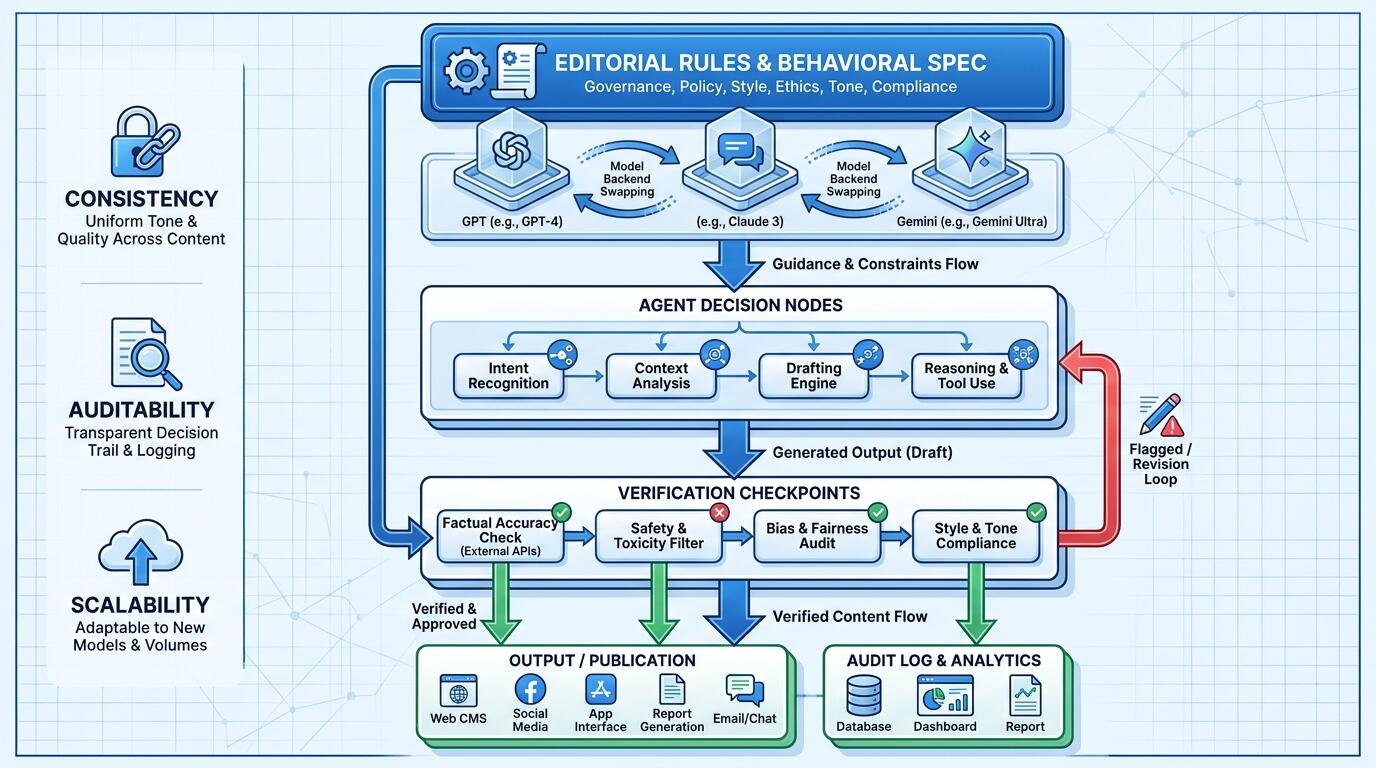
ALT: Diagram showing editorial rules as the control layer governing AI agent decisions in a production pipeline, emphasizing governance over model selection for consistent output quality
Where This Is Heading: Implications for AI Product Builders
The direction is clear: as model capability continues its broad convergence at the frontier, the competitive differentiation in AI products will increasingly come from the quality of the governance layer — the editorial rules, behavioral specifications, and verification architectures that sit above the model. This is already visible in the most mature AI product companies, where the proprietary value is not the model being used but the system of constraints and processes wrapped around it.
For engineering teams and technical leaders, this has several concrete implications.
Editorial rules should be treated as a first-class engineering artifact. They should be versioned, reviewed, and maintained with the same rigor as code. When rules change, the change should be tracked and the impact on agent behavior evaluated systematically. This is not the current practice at most teams, where rules live in system prompts that are edited informally and rarely audited.
Designing rules that an agent can actually follow requires understanding where agents typically fail — not at the level of raw capability, but at the level of ambiguous instructions. Rules that are too abstract or that contain implicit assumptions the agent cannot surface will be interpreted inconsistently. Concrete, specific, testable rules produce predictable behavior. For a deeper treatment of the practical craft of writing editorial rules an AI agent can actually follow, the design principles deserve their own dedicated attention.
Verification architecture is the operationalization of editorial rules. Every rule should have a corresponding check — either automated or human-reviewed at a defined cadence. Rules without verification are aspirational; rules with verification are operational. The investment required to build this verification layer is substantial but bounded, and it compounds positively: a rule verified once becomes a durable quality guarantee for every subsequent run.
Model selection, in a governed system, becomes a structured evaluation exercise rather than an anxious search. You have a defined behavioral specification. You test candidate models against that specification. You select the model that best satisfies your specification at your cost point. This is a tractable engineering problem, not an open-ended judgment call.
The practical takeaway for teams building now: if you do not have a written, versioned behavioral specification for your agent, write one before you benchmark your next model upgrade. The specification will almost certainly improve your current model's output more than any model change would.
Common Questions
Q1: How do you write editorial rules that are specific enough to be useful without over-constraining the agent?
Effective editorial rules are structured around observable, testable outputs rather than internal agent states. Define what the output should look like — its format, level of specificity, voice, what it must include, and what it must never include — rather than trying to specify how the agent should think. Start with the most frequent failure modes in your current output and write rules that directly address them. Rules that are too broad produce inconsistent behavior; rules that are too granular become brittle. The practical approach is iterative: start narrow, observe behavior, and extend coverage as you identify new edge cases in production.
Q2: Are editorial rules sufficient to prevent hallucination and factual errors in agent output?
Editorial rules are a necessary but not sufficient control for factual accuracy. Rules can require citation of sources, prohibit unsupported assertions, and mandate a verification step before output is finalized — all of which reduce the incidence and impact of hallucination. However, rules operate on the structure and process of output generation, not on the model's internal knowledge state. A complete accuracy strategy combines editorial rules (governing output structure and citation requirements), retrieval architecture (grounding outputs in verified source material), and human verification checkpoints at defined stages. Rules alone are not a factual guarantee; rules combined with retrieval and verification get you substantially closer to one.
Q3: How much time does it take to develop and maintain a meaningful editorial ruleset for a production agent?
The initial investment varies with the complexity of the agent's task domain, but a working first version is typically achievable within a focused week of effort for a single-task agent. The more relevant cost is ongoing maintenance: editorial rules require revision when product requirements change, when new failure modes emerge in production, or when the underlying model is updated. Teams that treat rules as living documentation — reviewed on a defined cadence and updated in response to observed behavior — find the maintenance cost is manageable and the return on consistency is consistently positive.
Summary
The central argument of this article can be stated plainly: for AI agents operating in production, behavioral governance — the editorial rules that define what an agent should and should not do — is a more reliable lever for output quality than model selection, once a basic capability threshold has been crossed.
Three points anchor this conclusion. First, frontier model capability has converged to the point where the marginal return on moving to a higher model tier is, for most tasks, lower than the return on investing in a formal governance layer. Second, behavioral drift and verification failures in production agents trace back overwhelmingly to the absence of explicit, enforceable rules, not to model limitations. Third, editorial rules are durable assets that transfer across model updates and enable structured, scalable verification; model selection without governance is a recurring cost with diminishing returns.
The practical path forward is not to stop paying attention to models — it is to stop treating model selection as the primary design decision in your agent architecture. Write your behavioral specification first. Build your verification layer around it. Then evaluate models against the specification you have defined. That sequence produces better outcomes and a more maintainable system than any amount of model benchmarking done in the absence of a governance framework.
If this piece sharpened how you think about agent architecture, subscribe to Darius at Darius — a bilingual briefing written by an engineering director running three AI products in production, delivering 5–10 curated items per issue with primary sources and hands-on analysis, so you can turn industry signal into actionable judgment.
References & Further Reading
- mlearning.substack.com. "What are 'agent-worthy' creative workflows? How to build your first agent guide".
https://mlearning.substack.com/p/what-are-agent-worthy-creative-workflows-how-to-build-your-first-agent-guide - Mint.ai. "4 Reasons Media Teams Shouldn't Build AI Agent Systems Alone".
https://www.mint.ai/blog/4-reasons-media-teams-shouldnt-build-ai-agent-systems-alone - LinkedIn Pulse. "AI Agents Don't Just Need Better Models. They Need Agent-Ready Enterprises".
https://www.linkedin.com/pulse/ai-agents-dont-just-need-better-models-agent-ready-enterprises-c0qte - IEEE. IEEE Standards Association — standards and publications on AI system behavior, safety, and governance.
https://www.ieee.org/ - National Institute of Standards and Technology (NIST). AI Risk Management Framework and related AI governance publications.
https://www.nist.gov/
Note: Standards and frameworks may be updated; please check the latest official documents or consult professional advisors.