Five Mistakes Teams Make When Automating Editorial Work
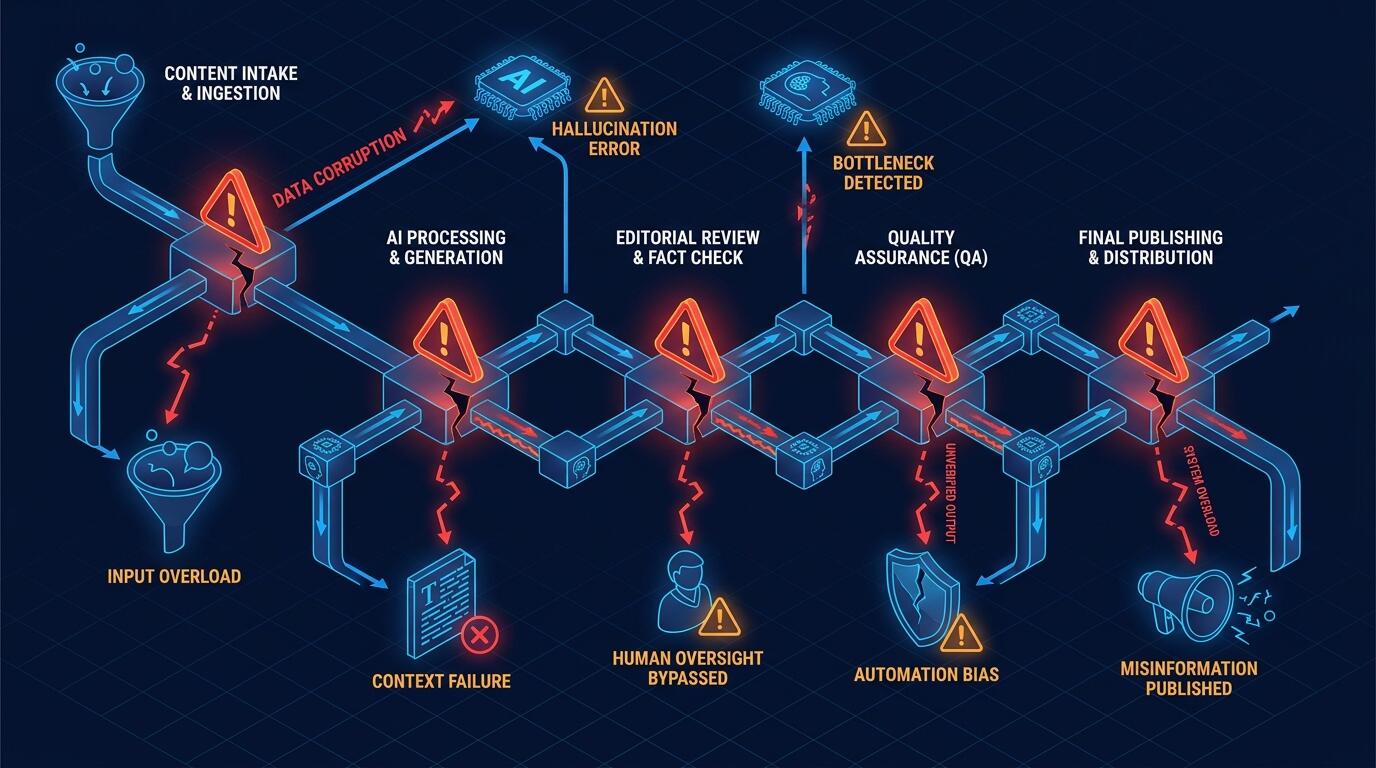
ALT: Teams automating editorial work face five critical mistakes that undermine AI content pipeline reliability
Why Editorial Automation Breaks Down Before It Scales
Editorial automation is the practice of using AI agents, language models, and structured pipelines to handle tasks traditionally owned by human editors — content triage, summarization, fact-checking, scheduling, and publication. The five mistakes covered in this article are the failure patterns that consistently surface when teams move from prototype to production.
These patterns were not assembled from a literature survey. They come from the direct experience of building and operating AI-driven editorial systems — the same kind of infrastructure that powers a daily briefing pipeline processing dozens of sources, applying editorial judgment, and publishing without manual intervention every cycle. The goal here is to cut past the surface-level advice and give builders a clear map of where things actually go wrong.
Each mistake is presented with enough depth to be actionable. If you are already mid-build, use this as a diagnostic. If you are at the planning stage, use it as a checklist before you commit architecture decisions.
The Five Mistakes That Quietly Sink Editorial Automation Projects
Treating Prompt Engineering as a Substitute for Editorial Specification
The most pervasive mistake in editorial automation is confusing a well-written prompt with an actual editorial specification. A prompt is an instruction to a model for a single invocation. An editorial specification is a durable, versioned document that defines voice, judgment criteria, scope boundaries, factual handling rules, and escalation conditions — and it must be written to survive model upgrades, team changes, and edge cases your prompt author never anticipated.
In practice, teams write a prompt that works well against a handful of test articles, ship it, and call the editorial layer "done." When the model starts producing outputs that feel off — subtly wrong tone, missed nuance, inappropriate confidence on uncertain claims — the instinct is to patch the prompt. This creates prompt sprawl: a fragile tangle of competing instructions with no clear owner and no version history.
The right foundation is a machine-readable editorial ruleset that separates concerns cleanly: what the agent is allowed to assert, what it must hedge, what it must escalate to a human, and what constitutes a disqualifying error. For a detailed treatment of how to structure this, the guide on writing editorial rules an agent can actually follow lays out the scaffolding in practical terms.
Best for: Teams who have shipped a first version and are starting to see output quality drift as volume or topic breadth increases.
Watch out: Writing a comprehensive editorial specification is a significant editorial investment, not an engineering one. If the editorial voice has never been formally defined for human writers either, that gap must be closed before automation can honor it.
Skipping Human-in-the-Loop Design Until Something Goes Wrong
Many teams treat human review as a cost to eliminate rather than a risk control mechanism to architect carefully. The result is binary: either a human reviews everything (which defeats the productivity purpose) or a human reviews nothing (which creates liability and quality exposure). Neither is the right answer.
A well-designed human-in-the-loop layer for editorial automation is probabilistic and tiered. The system should route outputs to human review based on confidence signals — model uncertainty, topic sensitivity, source reliability scores, novelty of claims — not on a flat percentage or a fixed schedule. This is not an afterthought; it is a core architectural decision that belongs in the design phase.
A pattern consistently seen in production editorial systems is that teams discover they need this layer only after a significant output error reaches publication. At that point, retrofitting tiered review into an already-deployed pipeline is expensive and disruptive. The engineering cost of designing it correctly from the start is a fraction of the remediation cost.
Best for: Any team targeting a publication cadence where a single erroneous output has meaningful reputational or operational consequences.
Watch out: Human-in-the-loop design can become a bureaucratic bottleneck if review criteria are not precise. "A human should review anything that looks wrong" is not a routing rule — it is a way to burn out your reviewers while providing false assurance.
Conflating Retrieval Quality with Output Quality
Editorial automation pipelines almost always depend on a retrieval layer — a system that fetches relevant source material before generation. A common mistake is optimizing the generation stage aggressively while treating retrieval as a solved problem. In practice, retrieval quality is the single largest upstream determinant of output quality, and it deserves proportional engineering investment.
Retrieval failures in editorial contexts are not always obvious. The system may retrieve documents that are topically adjacent but temporally stale. It may surface sources that are high-authority in aggregate but unreliable on the specific sub-topic. It may miss the most important new development because it was published in a format or language the retrieval system handles poorly. None of these failures produce an error message — they produce plausible-sounding content that is quietly wrong.
The full report on the agent pipeline behind a daily AI briefing documents how retrieval, verification, and publication interact in a live system — including where retrieval failures surface and how verification catches them before they propagate. The key engineering insight is that retrieval and verification must be instrumented separately, with independent quality metrics, not treated as a single undifferentiated "pre-generation" step.
Best for: Teams running high-frequency editorial pipelines where source freshness and factual precision are non-negotiable quality attributes.
Watch out: Adding more retrieval sources without improving source selection logic often increases noise rather than coverage. More is not better — better signal selection is better.
Designing for the Happy Path and Ignoring Editorial Edge Cases
Software engineers are trained to handle exceptions, but in AI pipeline design there is a persistent tendency to optimize for the representative case and defer edge case handling. In editorial automation, edge cases are not rare — they are the terrain. News cycles produce novel entity types, contested facts, rapidly evolving situations, and content that sits at the boundary of the system's defined scope. These are not edge cases in the statistical sense; they are a structural feature of editorial work.
The mistake manifests in several ways: pipelines that have no defined behavior for "I don't know enough to publish this," systems that default to generation when retrieval returns insufficient material, and agents that handle clearly satirical or synthetic source content the same way they handle authoritative reporting.
A useful frame from organizational research — specifically the dynamics described in work on team dysfunction, including perspectives aligned with AI team dysfunction analysis — is that avoidance of difficult conversations about failure modes is itself a failure mode. Teams that do not explicitly design for "what does this system do when it encounters something outside its competence" are implicitly deciding that it will handle those cases poorly, silently.
Concretely, every editorial automation system needs a defined abstention behavior: a mechanism by which the agent can signal that a piece of content requires human judgment and route it accordingly, rather than generating a low-confidence output and presenting it with the same confidence as a high-quality one.
Best for: Teams operating in domains with high topic volatility — technology news, financial markets, regulatory developments — where edge cases arrive daily.
Watch out: Over-indexing on edge case handling can make a system so conservative that its throughput drops below what justifies automation. The goal is appropriate abstention, not maximum abstention.
Treating Automation as a Deployment Event Rather Than an Ongoing System
Perhaps the most strategically costly mistake is treating the launch of an editorial automation pipeline as a project completion rather than a system that requires ongoing operation, monitoring, and calibration. This error is not unique to editorial automation, but it is particularly damaging here because model behavior drifts, source landscapes change, and editorial standards evolve — all on timelines that are faster than most engineering teams expect.
In practice, this looks like: a pipeline ships, performs well in the first weeks, and then quietly degrades over months as the models it depends on are updated, as the sources it retrieves from change their formats or reliability profiles, or as the content domain shifts in ways the original design did not anticipate. Without active monitoring — output quality sampling, source reliability tracking, human reviewer feedback loops — degradation is invisible until it is significant.
This is directly analogous to the infrastructure maintenance discipline described in frameworks for evaluating AI infrastructure build vs. buy decisions: the operational cost of a system is often larger than its build cost, and teams that do not plan for it will underinvest in it. Editorial automation systems need a defined operating model — who owns quality monitoring, at what cadence, with what escalation criteria — before they go live.
Best for: Any team that has moved past the pilot phase and is running editorial automation as a production dependency for a published product.
Watch out: Monitoring overhead can be minimized with the right instrumentation design, but it cannot be eliminated. A system that cannot be monitored cannot be trusted.
Quick Comparison at a Glance
| Mistake | Best Caught By | Core Risk | Mitigation |
|---|---|---|---|
| Prompt as editorial specification | Early output review sessions | Quality drift at scale | Machine-readable editorial ruleset with version control |
| No human-in-the-loop architecture | First significant output error | Reputational and factual exposure | Tiered, confidence-based routing designed before launch |
| Retrieval quality neglected | Factual accuracy audits | Plausible but wrong outputs | Separate retrieval and verification instrumentation |
| Happy-path-only design | Edge case volume in production | Silent failure on novel content | Defined abstention behavior and escalation routing |
| Automation as deployment, not system | Gradual quality degradation | Invisible drift over months | Defined operating model with ongoing quality monitoring |
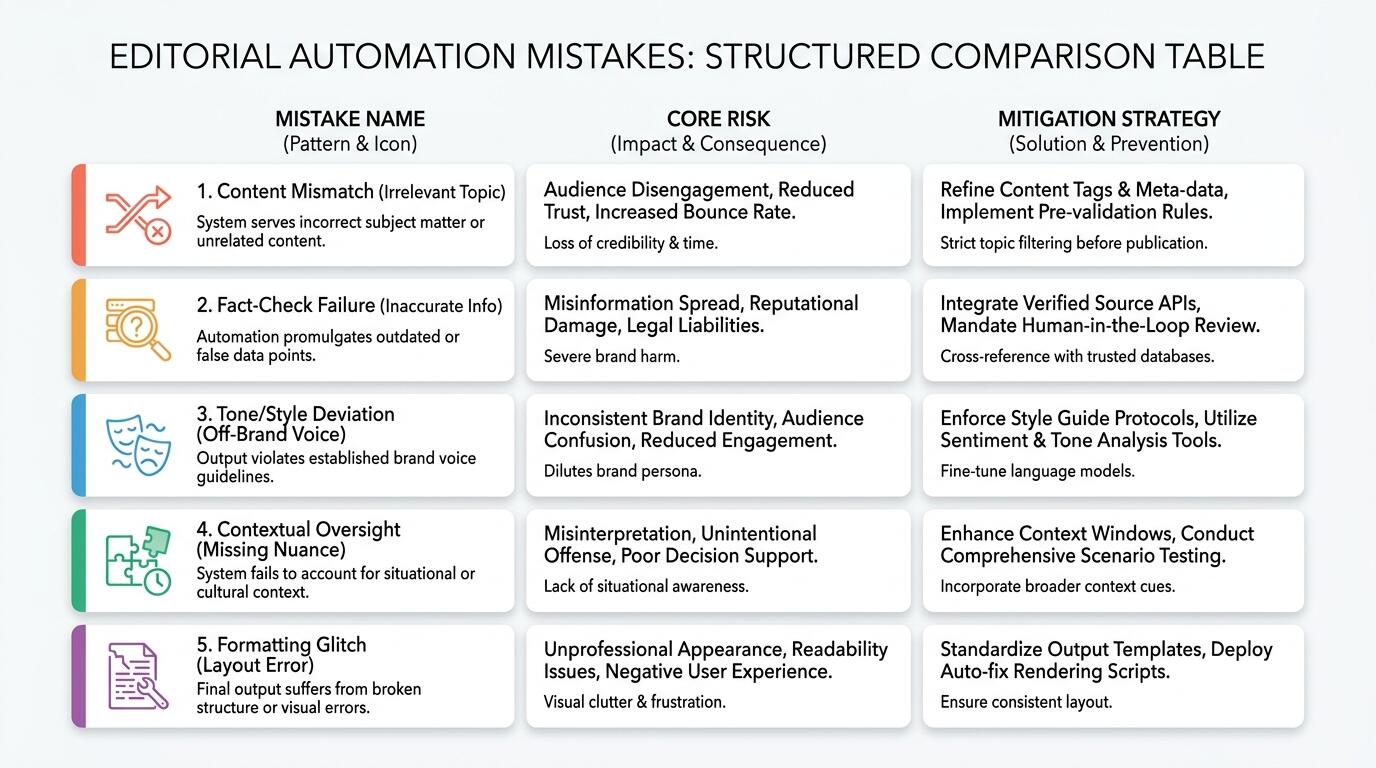
ALT: Comparison table of five common editorial automation mistakes showing risks, mitigation strategies, and AI pipeline quality control approaches
How to Identify Which Mistake Is Costing You Most Right Now
The five mistakes above rarely appear in isolation, but they do tend to surface in a rough sequence tied to where a team is in its automation maturity.
If your pipeline is in early design or prototype stage, the most important investment is in editorial specification and human-in-the-loop architecture. These two decisions are the hardest to retrofit later and the cheapest to get right upfront. If you are not sure how to formalize editorial rules in a form an agent can use, start there — it will shape every other architectural decision.
If your pipeline has been running for weeks and output quality feels inconsistent, retrieval quality is the most likely culprit. Before adjusting prompts or swapping models, audit what the retrieval layer is actually returning for a representative sample of inputs. The diagnosis is almost always in the sources, not the generation.
If your pipeline has been running for months and you are noticing gradual quality decline without obvious cause, the operational model is the problem. The system is drifting and there is no mechanism catching it. The fix is not technical — it is organizational: defining ownership, monitoring cadence, and escalation criteria.
A common misconception worth addressing directly: many teams believe that using a more capable model solves editorial automation problems. In almost every case observed, model capability is not the bottleneck. The bottleneck is specification clarity, retrieval quality, edge case handling, and operational discipline. A better model applied to a poorly specified editorial task produces better-sounding wrong outputs, not better editorial judgment.
Common Questions
Q1: How do you know when an editorial automation pipeline is ready for production?
A pipeline is ready for production when it has a defined editorial specification (not just a prompt), a documented abstention behavior for edge cases, and a human-in-the-loop routing mechanism for confidence-flagged outputs. Beyond these structural requirements, the pipeline should have been run against a realistic volume of inputs — including adversarial and edge case examples — with output quality evaluated by someone who can make genuine editorial judgments, not just by automated metrics. Latency and throughput targets should also be validated under realistic load before treating any deployment as production-grade.
Q2: Is prompt engineering sufficient for maintaining editorial quality at scale?
Prompt engineering alone is not sufficient for maintaining editorial quality at scale. Prompts are single-invocation instructions; they do not encode the durable, versioned editorial criteria that a production system needs to behave consistently across model updates, topic shifts, and edge cases. According to organizational research on team dysfunction in data and AI contexts, the absence of explicit shared standards is a primary driver of quality inconsistency — the same dynamic applies to AI editorial pipelines. A machine-readable editorial ruleset, maintained separately from the prompt layer, is the correct long-term structure.
Q3: How long does it typically take to see quality degradation in a deployed editorial pipeline?
Quality degradation timelines vary by pipeline design and operating environment, but a pattern consistently observed in production systems is that detectable drift becomes apparent within one to three months of deployment without active monitoring. The primary drivers are model updates from API providers (which change behavior without always announcing it), source reliability shifts, and domain evolution that the original specification did not anticipate. The practical implication is that quality monitoring cannot be deferred — it needs to be in place from the first week of production operation, not added after problems surface.
Final Thoughts
Automating editorial work is one of the highest-leverage applications of AI for content-driven products, but it is also one of the most unforgiving when the underlying architecture is weak. The five mistakes covered here share a common root: underestimating the specificity that editorial judgment requires, and overestimating what a language model will do correctly in the absence of precise instruction and robust infrastructure.
Key takeaways for builders:
- An editorial specification is not a prompt — it is a durable, versioned document that must be designed before the pipeline is built.
- Human-in-the-loop architecture belongs in the design phase, not the post-incident review.
- Retrieval quality is the largest upstream determinant of output quality and deserves its own instrumentation.
- Abstention behavior — the system's ability to say "I don't know enough" — is a feature, not a gap.
- Editorial automation is an ongoing system, not a deployment event; it requires a defined operating model from day one.
The teams that get editorial automation right are not the ones with access to the best models — they are the ones who treat editorial judgment with the same engineering rigor they apply to any other production system. If you are in the process of building or scaling an AI editorial pipeline, auditing against these five failure patterns is a useful starting point before making any significant architectural or infrastructure commitment. For teams weighing broader AI tooling decisions, the framework for evaluating AI development tools before signing a contract offers a complementary lens on how to assess vendor and tooling choices with the same rigor.
If you are building AI products and want practitioner-level analysis of AI developments — sourced, verified, and written from direct engineering experience — subscribe to the Darius bilingual AI briefing. Every issue is written by an engineering director running multiple production AI systems, with every insight tested against real systems before it reaches you.
Sources & Citations
- LinkedIn / Jean-François Deldon. "The 5 dysfunctions of a (data & AI) team".
https://www.linkedin.com/pulse/5-dysfunctions-data-ai-team-jean-fran%C3%A7ois-deldon-gg0pf - Giorgio Sironi. "Book review: The 5 Dysfunctions of a team".
https://www.giorgiosironi.com/2018/12/book-review-5-dysfunctions-of-team.html - Innovation Village. "How Lencioni's 5 Dysfunctions Explain 90% of Remote Team Failure".
https://innovation-village.com/how-lencionis-5-dysfunctions-explain-90-of-remote-team-failure/ - IEEE. IEEE Standards and Publications on AI Systems and Automated Decision-Making.
https://www.ieee.org