Designing Fallbacks and Human Confirmation Into Agent Systems
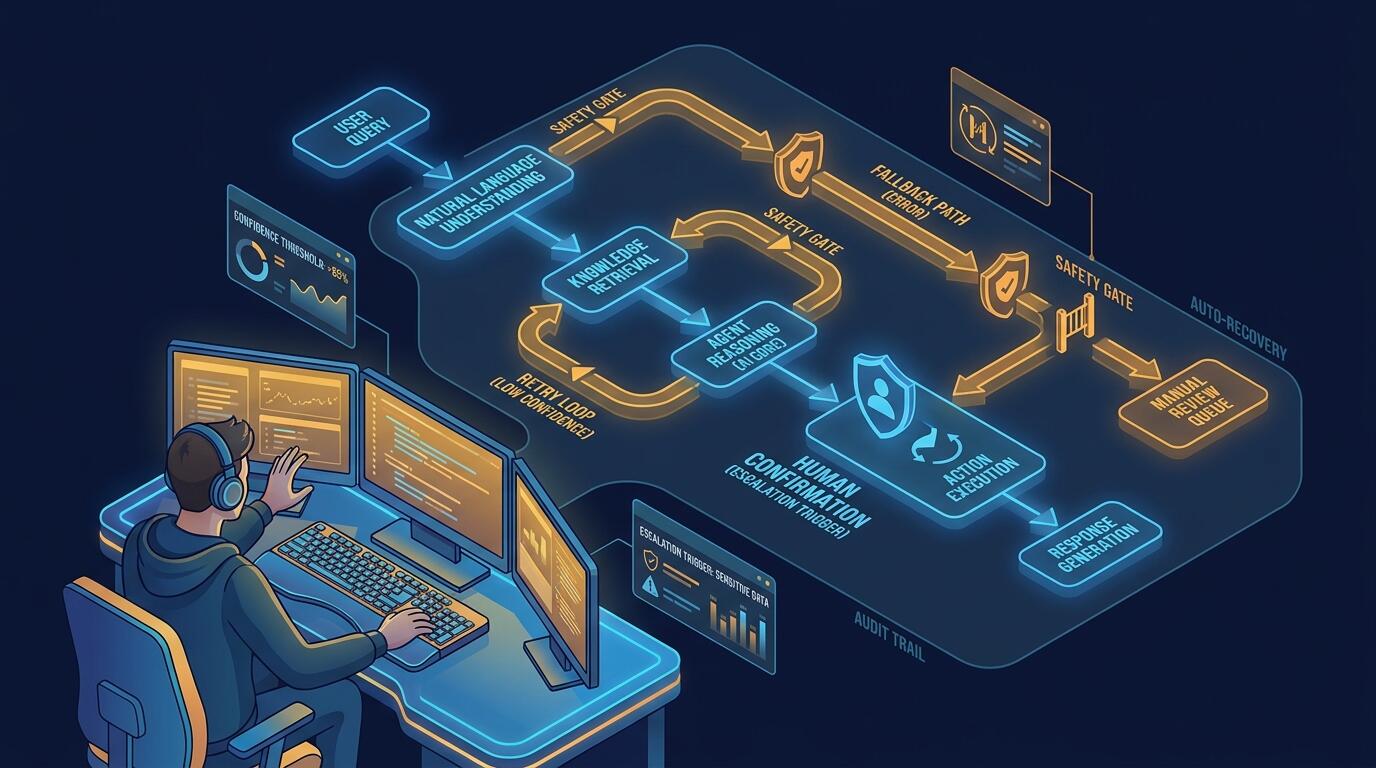
ALT: Engineer designing fallback mechanisms and human confirmation checkpoints into an AI agent system
Why Agent Systems Break Without Fallbacks and Human Confirmation
Key Conclusion: Designing fallbacks and human confirmation into agent systems is not a defensive afterthought — it is a foundational engineering discipline. Without deliberate failure modes, graceful degradation paths, and well-placed human checkpoints, autonomous agents will eventually take consequential actions your users never intended. The systems that survive production are the ones built with these mechanisms from the start, not patched in after the first incident.
AI agents — software systems that autonomously plan and execute multi-step tasks on behalf of users — are moving from demo environments into real production workloads. In our work building and running multiple AI products, including an AI-native cloud drive, an AI interview simulator, and a multi-platform content publishing workbench, a pattern we consistently see is this: the failure mode is rarely the model itself. It is almost always the absence of a controlled path for when the model is wrong, uncertain, or operating outside its intended scope.
This article breaks down the engineering decisions behind robust fallback design and human confirmation loops, drawing from patterns we have applied in our own production systems.
When This Guidance Applies to Your Agent Build
Applicable Scenarios:
- You are deploying an agent that takes real-world actions: sending messages, writing to databases, calling external APIs, or making purchases.
- Your agent operates across multiple steps where an early error compounds downstream.
- The cost of an incorrect action — financial, reputational, or operational — exceeds the cost of a brief human confirmation pause.
Not Applicable / Cautions:
- Pure read-only query agents with no write-side effects can often operate with lighter fallback overhead.
- Adding confirmation gates to every trivial step creates friction that erodes user trust and adoption — calibration matters.
The Problem With Fully Autonomous Agents in Production
Fully autonomous agents — agents that execute tasks end-to-end without any human-in-the-loop checkpoints — are appealing in demos and fragile in production. The core issue is not that language models are unreliable; it is that reliability distributions are uneven. An agent may handle ninety-five percent of inputs correctly and catastrophically mishandle the remaining five percent in ways a deterministic system would never permit.
The challenge compounds in agentic pipelines because actions are sequential and stateful. If step three of a seven-step pipeline consumes a malformed output from step two, the error does not stay local. It propagates, mutates, and often becomes invisible by the time the final output is delivered. This is fundamentally different from a single-turn language model call, where a bad response is obvious and contained.
In the AI industry, the trajectory is clearly toward longer-horizon agents — systems that plan across many steps, use tools, spawn sub-agents, and operate asynchronously over extended periods. The IEEE and broader software engineering community have long documented that safety-critical systems require explicit failure handling, graceful degradation, and defined escalation paths. The same principles apply to AI agents, and the gap between what teams ship and what those principles require is closing fast.
For a deeper look at how agentic pipelines handle retrieval, verification, and publication decisions, see how the agent pipeline behind a daily AI briefing manages retrieval and verification at each stage — the same fallback logic applies across agent types.
Core Architecture: Building Fallbacks and Confirmation Loops
Three-Step Quick Start for Adding Fallback Logic to an Existing Agent
Step 1: Map Every Action Node That Has Side Effects
Before writing a single line of fallback code, produce a complete action inventory. Walk your agent's execution graph and mark every node that writes data, calls an external service, charges a resource, or triggers a communication. These are your risk surface. Any node with side effects is a candidate for either a fallback handler or a confirmation gate — or both. This inventory exercise typically takes a few hours for a simple pipeline and a full working day for a complex, branching agent graph.
Step 2: Classify Each Action by Reversibility and Stakes
Not all actions are equal. Assign each action node two properties: reversibility (can this action be undone?) and stakes (what is the cost if this action is wrong?). A low-stakes, fully reversible action — appending a draft to a staging buffer — needs minimal intervention. A high-stakes, irreversible action — sending an email to a customer list, executing a financial transaction, deleting a record — demands either a confirmation gate before execution or a deterministic rollback mechanism after. This classification matrix becomes your fallback policy document.
Step 3: Implement the Three Layers — Retry, Fallback, Escalate
Once your policy is defined, implement three response layers for every classified node. The first layer is retry with backoff, appropriate for transient tool failures. The second layer is fallback to a simpler or safer alternative path — for example, returning a partial result rather than failing entirely, or switching to a conservative default action. The third layer is escalation to a human confirmation checkpoint, invoked when the agent's confidence is below threshold, the action is irreversible, or the input is anomalous. Each layer should log its trigger condition so you can audit and tune the system over time.
Comparing Common Approaches to Human-in-the-Loop Design
Human confirmation in agent systems is not a single pattern. Teams implement it differently depending on their latency tolerance, user experience goals, and risk profile. The table below compares three common approaches.
| Comparison Dimension | Synchronous Gate | Asynchronous Review Queue | Confidence-Threshold Trigger |
|---|---|---|---|
| User experience impact | Blocks the workflow until confirmation is received | Agent continues to a safe holding state; human reviews later | Transparent to user unless threshold is breached |
| Latency cost | High — proportional to human response time | Low upfront; deferred cost | Near-zero for high-confidence actions |
| Best for | High-stakes, irreversible actions requiring immediate approval | Batch workflows, audit-heavy environments | High-volume agents with variable input quality |
| Implementation complexity | Low — a simple interrupt and resume pattern | Medium — requires a queue, a review UI, and state persistence | High — requires calibrated confidence scoring |
| Failure if human is unavailable | Agent is blocked until timeout or default policy applies | Queue depth grows; need a drain policy | Risk of over-confidence if scoring is poorly calibrated |
Each approach is a tool, not a universal answer. In practice, robust agent systems layer all three: confidence thresholds to avoid unnecessary interruptions, asynchronous queues for moderate-risk actions, and synchronous gates for the highest-stakes operations.
Designing Fallback Paths That Actually Work
Fallback logic is a set of predefined alternative behaviors an agent executes when its primary path fails or produces an unacceptable result. The most common mistake teams make is treating fallbacks as error messages — a polite apology surfaced to the user when the agent cannot proceed. This is the minimum viable fallback, but it is rarely sufficient.
A well-designed fallback path has three properties. It preserves whatever partial progress was made — if the agent completed five of seven steps before failing, those five steps should not be discarded. It leaves the system in a safe and auditable state — no side effects should be pending in an unknown state. And it provides enough context for a human reviewer to understand what happened and resume or override the agent's work.
In our own pipeline work, a pattern we consistently see succeed is the "safe harbor" pattern: when any agent node fails or returns a result below a confidence threshold, the agent does not attempt to recover autonomously. Instead, it routes the current state — including all intermediate outputs and the specific failure reason — to a structured handoff queue. A human operator or a deterministic fallback function then handles that queue item explicitly. This eliminates the class of bugs where the agent "tries to fix its own mistake" and produces compounding errors.
For teams building editorial or content agents specifically, understanding where an AI drafting pipeline fails and the checks that catch it is directly relevant — the failure taxonomy there maps closely to what any multi-step agent encounters.
Error classification matters. Not all failures are the same, and your fallback logic should distinguish between them:
- Tool call failures (network errors, rate limits, malformed API responses) — retry with backoff is appropriate.
- Model output quality failures (the response is valid JSON but semantically wrong) — confidence scoring, human review, or a deterministic rule override is appropriate.
- Scope violations (the agent is being asked to do something outside its defined boundaries) — hard reject with explanation, never silent degradation.
- State corruption failures (the agent's internal state is inconsistent with the world state) — halt, do not retry, escalate immediately.
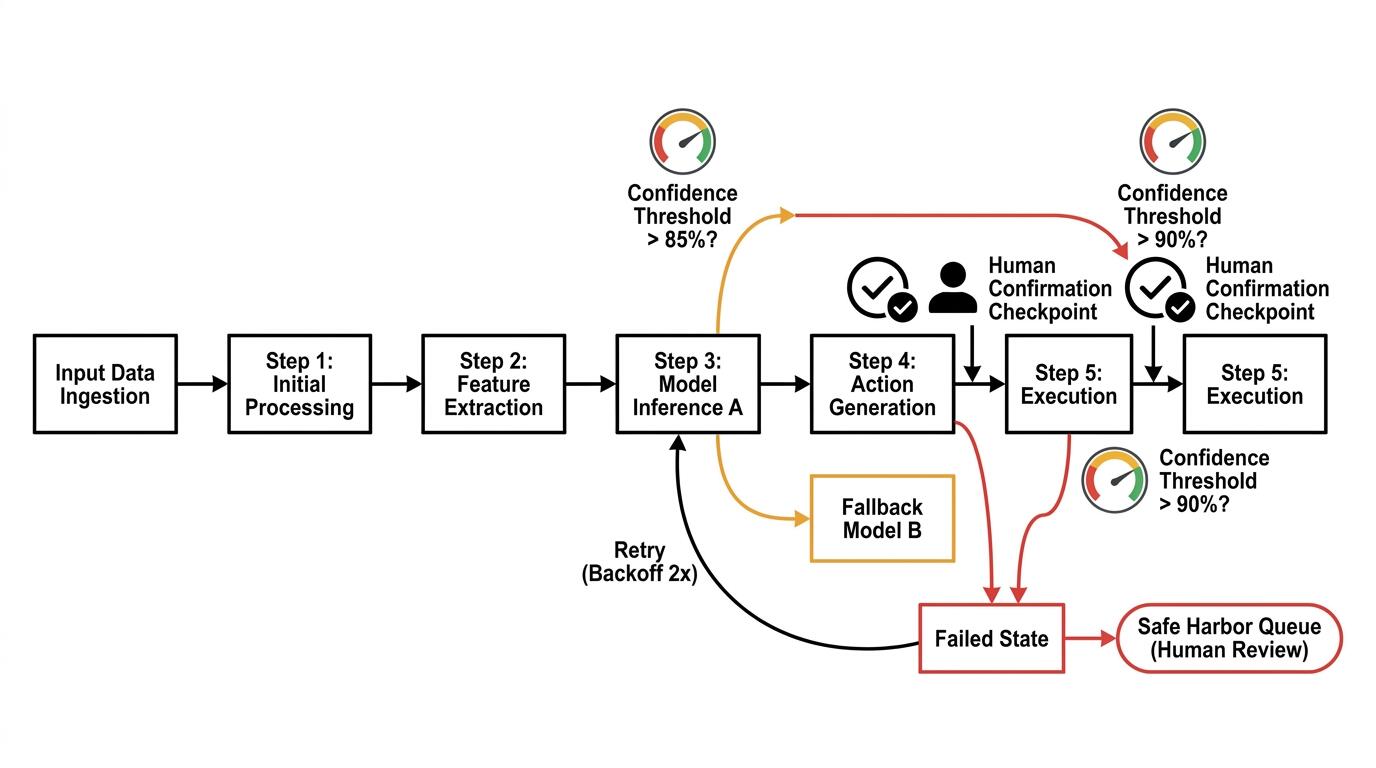
ALT: Diagram showing agent action nodes with fallback paths, confidence thresholds, and human confirmation checkpoints in a multi-step AI system
Implementing Human Confirmation: The Engineering Details
Human confirmation in agent systems means inserting a checkpoint where a human must explicitly approve, modify, or reject a pending agent action before execution proceeds. The concept is straightforward; the implementation is where teams consistently underinvest.
The first implementation requirement is state serialization. The agent must be able to pause cleanly at a confirmation point and resume correctly after the human responds. This requires that all agent state — the current execution context, the pending action, the inputs that led to it — be serialized and stored durably. If the system crashes between the agent pausing and the human confirming, the state must be recoverable. This is a non-trivial engineering requirement that many early agent implementations skip, resulting in lost work or duplicate actions.
The second requirement is a clear, actionable confirmation interface. Showing a human reviewer a raw JSON blob from the agent's internal state is a failure of design. The confirmation UI or notification should present: what the agent is about to do, in plain language; why the agent is pausing, specifically; what the human's options are (approve, reject, modify, or defer); and what happens if no response is received within the timeout window. The quality of human review decisions is directly proportional to the quality of the information presented.
The third requirement is a defined timeout and default policy. Human operators are not always available. Every confirmation gate needs an explicit answer to the question: what does the agent do if no human responds within N minutes? The options are to proceed with the default action, to escalate to another reviewer, or to cancel and notify. There is no universally correct answer — it depends on the stakes — but there must always be an explicit answer baked into the system.
For teams thinking about the structural rules that govern agent behavior more broadly, the practice of writing editorial rules an agent can actually follow is a useful complement — the same principle of explicit, machine-readable policy applies to fallback and confirmation rules.
Advanced Considerations for Production Agent Systems
Calibrating confidence thresholds requires data, not intuition. A common misconception is that you can set a confidence threshold at launch and leave it. In practice, model confidence scores — whether from token log-probabilities, classifier outputs, or self-reported uncertainty — need to be calibrated against observed outcomes. A threshold that is too high creates excessive human interruptions. A threshold that is too low lets uncertain actions through. Both erode trust. Budget time after launch for threshold analysis, and treat it as an ongoing operational discipline, not a one-time tuning exercise.
Fallback and confirmation design are also product decisions. Teams sometimes frame these as purely engineering concerns, but they directly shape user experience. A user who encounters a confirmation gate for a trivial action will lose trust in the agent's competence. A user who discovers the agent took a major irreversible action without asking will lose trust in the agent's safety. The right balance — minimizing interruptions while ensuring oversight where it genuinely matters — requires product judgment alongside engineering rigor.
Avoid the "apologetic agent" anti-pattern. When agents fail silently, output vague apologies, or degrade to unhelpful generic responses without explaining why, users cannot calibrate their trust. Every fallback that surfaces to a user should explain the situation in plain terms, state what will happen next, and — where possible — offer an alternative path. Opacity in failure modes is as harmful as opacity in the agent's reasoning.
People Also Ask
Q1: How do you decide which agent actions require human confirmation?
The primary criterion is irreversibility combined with stakes. If an action cannot be undone and carries meaningful cost — financial, communicative, or data-destructive — it should require human confirmation. A secondary criterion is novelty: if the agent is encountering an input pattern it has not been validated on, a confirmation gate reduces risk even for actions that are technically reversible. Map your action inventory to these two axes and set policy accordingly.
Q2: Are fallback mechanisms the same as error handling in traditional software?
Fallback mechanisms in agent systems share conceptual roots with traditional error handling but are more complex. Traditional software has deterministic failure modes; agent systems have probabilistic failure modes where the output may be structurally valid but semantically wrong. This means fallback logic must handle not just execution errors (exceptions, timeouts) but also quality failures — cases where the agent "succeeds" technically but produces a result that should not be acted upon. Both layers require explicit design.
Q3: How much does adding confirmation gates slow down an agent workflow?
Latency impact depends entirely on where gates are placed and how responsive reviewers are. Synchronous gates blocking on human approval can add minutes to hours per checkpoint — acceptable for high-stakes, low-frequency actions, but prohibitive for high-frequency tasks. Asynchronous review queues decouple the latency from the agent's forward progress. For most production systems, a combination of confidence-threshold triggers (near-zero latency) and asynchronous queues for moderate-risk actions keeps throughput high while preserving oversight.
Final Thoughts
Designing fallbacks and human confirmation into agent systems is, fundamentally, an exercise in engineering humility. It is the acknowledgment that models are probabilistic, inputs are unpredictable, and the real world is not a controlled test environment. Three principles summarize the practical approach:
First, build the safety surface before optimizing for capability. An agent that does less but fails gracefully is more valuable in production than one that does more but fails opaquely.
Second, treat human confirmation as a signal, not just a safety valve. Every time a human reviewer overrides or modifies an agent action, that is structured feedback. Collect it, analyze it, and use it to improve your confidence scoring and fallback policies over time.
Third, design for the operator, not just the user. Your agent will encounter edge cases at three in the morning when no one is watching. The fallback and confirmation architecture you build now determines whether those edge cases are recoverable incidents or unrecoverable failures.
The investment in these systems pays dividends in user trust, operational stability, and the ability to extend agent autonomy confidently over time — because you have built the infrastructure to verify it is working.
If you are building AI products and want signal over noise on decisions exactly like these, subscribe to Darius — each issue delivers five to ten sourced AI developments with hands-on analysis from real production systems, so every item you read can inform your next technical decision.
Sources & Citations
- IEEE. "IEEE Standards for Software and Systems Engineering."
https://www.ieee.org/ - NIST. "Artificial Intelligence Risk Management Framework (AI RMF)."
https://www.nist.gov/ - ISO/IEC. "ISO/IEC Standards for Information Technology and Safety-Critical Systems."
https://www.iso.org/