Choosing Your Tech Stack for a New Product in 2026: A Decision Guide

ALT: A developer choosing a tech stack for a new product in 2026, reviewing architecture diagrams and framework options
How to Choose the Right Tech Stack for Your New Product in 2026
Every new product starts with the same deceptively simple question: what should we build it with? The answer shapes your team's velocity, your infrastructure costs, your ability to integrate AI, and ultimately whether you ship something that can survive contact with real users. This guide is for tech founders, startup CTOs, product managers, and engineering teams who are standing at that fork in the road right now — and who want a structured, practitioner-tested way to make the decision without second-guessing themselves six months later.
Before You Start: Prerequisites and Preparation for Evaluating Your Stack
Choosing a technology stack is not a purely technical decision. It is a product decision, a team decision, and a business strategy decision wrapped into one. Before you open a single benchmark comparison or framework tutorial, you need to be clear on the inputs that will constrain and guide every choice you make downstream.
The single most common mistake teams make — and a pattern we see consistently in our work with early-stage products — is evaluating frameworks in isolation, without first articulating the product's non-functional requirements: how many concurrent users it must support at launch, what latency is acceptable, whether data sovereignty rules apply, and what the expected growth curve looks like. Without those answers, tech stack debates become preference contests.
Here is what you need to have in hand before you begin the evaluation process:
A written product requirements document, even a rough one. You do not need a 50-page specification. You need clarity on core user flows, expected data volume, and any regulatory constraints (GDPR, HIPAA, SOC 2, etc.) that will affect your infrastructure choices.
An honest skills inventory of your current team. A stack that no one on your team knows deeply will cost you far more in ramp-up time than any theoretical performance advantage it might offer. Document who knows what, at what depth.
A budget and timeline reality check. Some stacks require more DevOps overhead. Some managed services cost significantly more at scale. Factor this in before you fall in love with a particular technology.
A clear AI integration plan (or lack thereof). In 2026, almost every new product has some AI surface — whether that is a recommendation engine, an LLM-powered feature, or an intelligent search layer. Knowing whether AI is a core feature or a future possibility changes which stack choices keep your options open.
Checklist before starting:
- Product requirements document (even a rough draft) is written and shared with the team
- Team skills inventory is documented — not assumed
- Regulatory and compliance requirements are identified (data residency, privacy laws, industry standards)
- AI integration scope is defined: core feature, future roadmap, or not planned
- Infrastructure budget and operational capacity are estimated
- Timeline to first production deployment is agreed upon
- A designated decision-maker or decision process is in place to prevent endless debate
Getting this preparation right cuts your evaluation time significantly and dramatically reduces the risk of expensive rework later.
Step-by-Step: How to Make a Sound Tech Stack Decision for a New Product
Step 1: Define Your Product's Core Constraints and Non-Negotiables
The right tech stack for a new product is the one that best fits your specific constraints — not the most popular one on Hacker News this month. Start by writing down your hard constraints: the things that, if a technology cannot satisfy them, immediately disqualify it.
Hard constraints typically fall into four categories: performance requirements (throughput, latency), compliance requirements (data residency, industry regulation), team expertise (languages and ecosystems your team can actually ship in), and ecosystem requirements (must integrate with a specific third-party platform or legacy system). Treat these as filters, not preferences.
Tip: Write your constraints in the form of testable statements — "our API must handle X concurrent requests without exceeding Y milliseconds of latency under Z load." Vague constraints lead to vague stack decisions.
Step 2: Map Your Product's Architecture Pattern Before Choosing Frameworks
Before you pick a frontend framework or a database, you need to decide what kind of system you are building. A tech stack is a set of choices that serves an architecture — not the other way around.
The major architecture patterns in 2026 each carry different stack implications. A monolith-first approach (often the right call for early-stage products) points you toward full-stack frameworks that keep your team moving fast. A microservices architecture requires investment in orchestration, service mesh, and inter-service communication that most early teams cannot afford to maintain. An event-driven architecture is the right choice when your product is fundamentally reactive — financial platforms, real-time collaboration tools, IoT systems. A serverless-first architecture trades operational complexity for vendor dependency and cold-start latency, which is a reasonable trade for many stateless API workloads.
If your product has meaningful AI components, your architecture decision becomes especially consequential. For guidance on designing systems that can support production AI workloads without collapsing under real-world load, see this practical resource on designing a scalable AI architecture for production in 2026.
Tip: Resist the pull toward complexity. In our experience working with startups and scale-ups, the teams that ship fastest almost always choose the simplest architecture that can satisfy their current requirements — with clear seams to evolve later.
Step 3: Evaluate Frontend, Backend, and Data Layer Choices Against Your Constraints
With your architecture pattern decided, you can now make informed choices at each layer of the stack. Each layer should be evaluated on the same criteria: ecosystem maturity, team expertise, operational overhead, AI and integration friendliness, and long-term maintainability.
Frontend: In 2026, React and its ecosystem (Next.js for SSR/SSG, React Native for mobile) remain the dominant choice for teams that need a large talent pool and mature tooling. Vue and Svelte are valid alternatives for smaller teams that prioritize developer experience and bundle size. The critical question is not which framework is "best" in the abstract — it is which framework your team can maintain and hire for. TypeScript is now a baseline expectation for any production frontend, not an optional enhancement.
Backend: The backend choice is where your performance and scalability constraints land hardest. Node.js (TypeScript) is a strong default for teams that want to share language context across frontend and backend. Python remains the dominant language for AI and data-heavy backends, and its ecosystem (FastAPI, Django) has matured significantly for production use. Go and Rust are the right choices when raw throughput and low memory footprint are hard requirements. Java and the JVM ecosystem (Spring Boot, Kotlin) are still the standard in enterprise and financial services contexts where operational stability and long-term support contracts matter.
Data layer: Your database choice is the hardest to reverse, so it deserves the most care. PostgreSQL is a safe, battle-tested default for relational workloads and has strong support for JSON, vector embeddings (via pgvector), and full-text search — making it a surprisingly capable all-rounder for AI-adjacent applications. MongoDB and other document databases are appropriate when your data model is genuinely document-shaped. Redis remains the standard for caching and session management. If your product requires vector search at scale for LLM-powered features, purpose-built vector databases are worth evaluating early.
Tip: Avoid the "polyglot persistence" trap. Using five different databases because each is theoretically optimal for a different data shape sounds smart in a blog post and creates operational nightmares at 2 AM. Start with one or two, and add complexity only when a specific, measured bottleneck demands it.
Step 4: Assess AI Integration Readiness of Your Stack
AI integration readiness is a new dimension of tech stack evaluation that did not exist with the same urgency even a few years ago. In 2026, most production products are expected to have some LLM-powered capability — whether that is intelligent search, document processing, customer-facing chat, or autonomous workflow automation.
The key question is not "can this stack run AI?" — almost any stack can make an API call to an LLM provider. The real question is: "how well does this stack support the operational patterns that production AI features require?" Those patterns include streaming responses, structured output parsing, retrieval-augmented generation (RAG) pipelines, async job queues for long-running inference tasks, and cost-aware routing between models.
Python-based backends have the deepest native integration with AI tooling — LangChain, LlamaIndex, Hugging Face Transformers, and most model SDKs are Python-first. Node.js has excellent support for LLM API calls and streaming, but the broader AI ecosystem is thinner. If AI is a core feature of your product, let that fact pull you toward Python for your backend, even if it means managing two languages across your stack.
For teams building LLM-powered features and needing practical integration patterns beyond just API calls, the LLM integration patterns guide covers the production-grade patterns that matter most.
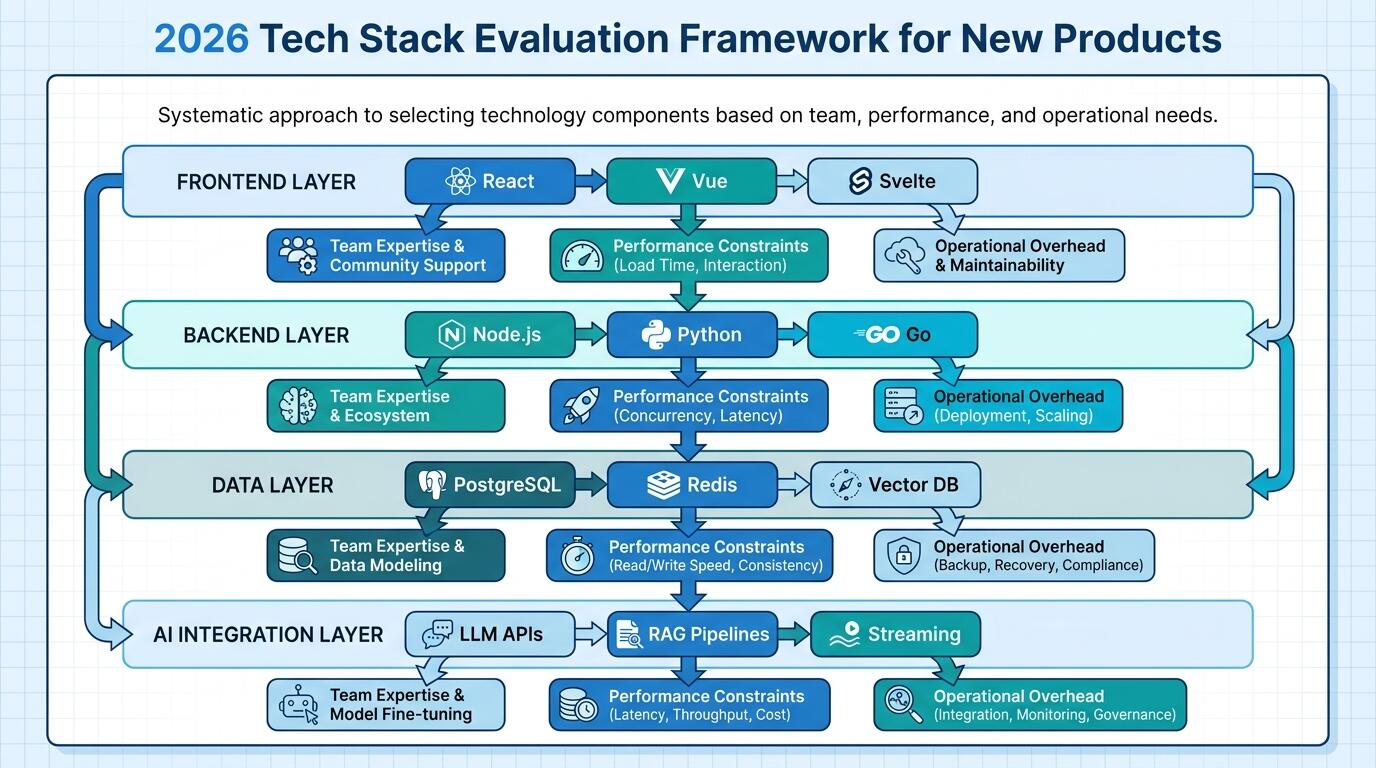
ALT: A decision framework diagram showing how to evaluate frontend, backend, data layer, and AI integration options when choosing a tech stack for a new product in 2026
Step 5: Evaluate DevOps, Deployment, and Operational Overhead
The best-designed stack is worthless if your team cannot deploy, monitor, and maintain it reliably. Operational overhead is consistently underestimated by teams making initial stack decisions, and it is one of the most common sources of delayed launches.
The three primary deployment paradigms in 2026 are: managed cloud platforms (Vercel, Railway, Render, Fly.io), which offer fast time-to-deployment at the cost of reduced control; container-based deployments on cloud providers (AWS, GCP, Azure) using Kubernetes or simpler orchestration, which offer full control at the cost of significant DevOps investment; and serverless-first deployments (AWS Lambda, Cloudflare Workers), which shine for stateless, event-driven workloads but introduce cold-start latency and stateful workload limitations.
For most early-stage products, a managed platform is the right starting point. The goal at launch is to ship something real users can use — not to build a perfectly optimized infrastructure that takes months to stand up. You can always migrate to more sophisticated infrastructure once you have validated demand and understood your actual traffic patterns.
Tip: Make sure your chosen stack has first-class support on your deployment target. Some newer frameworks have limited support on certain platforms, which creates friction that compounds over time.
Step 6: Pressure-Test Your Stack Decision Against Future Scenarios
A tech stack is a long-lived asset. The choice you make at the start of a product will shape hiring decisions, performance ceilings, and refactoring costs for years. Before you finalize your decision, run it through a set of future scenarios.
Ask: if this product succeeds and we need to scale to ten times our current load, what breaks first? If we need to onboard three new engineers in the next six months, how hard is this stack to learn? If a new AI capability emerges that we want to integrate, does our current architecture support it without major surgery? If we need to add a mobile client, how much of our backend can be reused?
None of these questions require you to predict the future accurately. They require you to identify the largest risks in your current choice and decide whether those risks are acceptable given your specific context. Teams that do this exercise often find they are comfortable with their initial choice — but occasionally they discover a constraint they had not considered that changes the decision.
For product teams under time pressure, the discipline of shipping fast while keeping architecture decisions reversible is one of the most valuable skills an engineering team can develop. The resource on shipping your first live product quickly addresses this tension directly.
Step 7: Document the Decision and Set a Review Checkpoint
A tech stack decision is not final — it is the best decision available given current information. Document why you made the choices you made, what alternatives you considered, and what signals would cause you to revisit the decision. Set a specific review checkpoint — typically after reaching a meaningful usage milestone or after a fixed period of operating in production.
This documentation discipline serves two purposes. First, it prevents "why did we choose this?" debates from reliably recurring every time a new engineer joins the team. Second, it gives you a structured way to evolve the stack as your product and team mature, rather than accumulating undocumented technical debt.
Tip: Store your architecture decision records (ADRs) in the same repository as your code. An ADR is a short document that captures the context, the decision, and the consequences of a significant technical choice. It takes minutes to write and saves hours of future confusion.
Common Mistakes and Troubleshooting When Selecting a Tech Stack
| Symptom | Likely Cause | How to Fix |
|---|---|---|
| The team debates the stack for weeks without deciding | No documented constraints or decision criteria; the debate is driven by preferences rather than requirements | Write down hard constraints first; use those to eliminate options before comparing the remaining candidates |
| The chosen stack becomes a bottleneck six months after launch | Scalability requirements were not defined upfront; the stack was chosen for developer comfort, not product needs | Conduct a load and performance assessment early; identify the first bottleneck and plan a targeted migration rather than a full rewrite |
| AI features are slow or expensive to integrate later | AI integration was treated as a future concern; the backend language and data layer were chosen without AI workloads in mind | Introduce a Python-based AI service layer that communicates with your existing backend via a well-defined internal API |
| High operational costs are discovered post-launch | Cloud and managed service costs were not modeled at realistic traffic levels | Run a cost model at 10x expected launch traffic before committing to any managed service; optimize the highest-cost components first |
| New engineers struggle to contribute quickly | The stack is unusual, poorly documented, or relies on custom tooling that exists only in one engineer's head | Favor mainstream frameworks with large communities; invest in onboarding documentation and architectural context |
| The product cannot comply with a regulatory requirement after launch | Compliance was not assessed during stack selection; the chosen cloud region or storage solution does not meet data residency rules | Audit compliance requirements before any infrastructure is deployed; data residency and encryption choices are among the hardest to change retroactively |
Pro Tips for Better Stack Decisions
Separate the decision from the ego. In our work with engineering teams, the most contentious stack debates are almost always driven by individual engineers advocating for technologies they are personally excited about, rather than technologies that best serve the product. Build a decision process that explicitly separates personal preference from documented product requirements.
Use the "boring technology" principle deliberately. McKinley's well-known "choose boring technology" argument — which favors proven, widely-understood tools over novel ones — is not a call to avoid innovation. It is a call to reserve your novelty budget for the parts of your product that genuinely differentiate it. Use established, boring infrastructure where possible so you can afford to be creative where it matters.
Treat AI as a first-class architectural concern, not a plugin. A common misconception is that AI capabilities can always be bolted onto an existing product after the fact. Sometimes that is true. But when AI is a core value driver — when it is the reason users choose your product — it needs to be reflected in your data model, your API design, and your infrastructure choices from the beginning. Retrofitting AI into a system that was not designed for it is costly and often yields poor results.
Build for the team you have, not the team you imagine. Teams frequently choose architectures designed for engineering organizations ten times their current size. A microservices architecture managed by a three-person team is not a sign of technical ambition — it is a source of operational drag. Right-size your architecture to your actual team and scale it as the team grows.
Validate choices with a time-boxed spike. Before committing to an unfamiliar technology, run a structured spike — a focused, time-limited prototype that exercises the specific capabilities you are uncertain about. A spike that reveals a showstopper is one of the most valuable things your team can produce. Treat negative results as equally useful to positive ones.
Frequently Asked Questions FAQ
Q1: How do I choose between a monolith and microservices for a new product in 2026?
For most new products, start with a well-structured monolith. Microservices introduce significant operational complexity — service discovery, distributed tracing, inter-service communication overhead — that is difficult for small teams to manage effectively. A monolith built with clear internal module boundaries can be decomposed into services later, once you have enough real traffic data to know where the seams should actually be. According to patterns documented by technology practitioners and engineering organizations, the majority of successful microservices architectures evolved from monoliths rather than being built that way from day one.
Q2: Is it necessary to include AI capabilities in every new product's tech stack in 2026?
Not every product needs AI features, but every product team should evaluate whether AI creates meaningful value for their specific users before deciding against it. The more relevant question is whether AI is a core differentiator or a nice-to-have enhancement. If AI is central to your value proposition, it must be a first-class architectural concern, not an afterthought. If it is a future enhancement, your stack choices should at minimum avoid decisions that make AI integration unnecessarily difficult later — such as choosing a backend language with a thin AI ecosystem when Python is a viable alternative.
Q3: How long does a thorough tech stack evaluation typically take, and when is it too long?
A structured tech stack evaluation — covering requirements gathering, constraint mapping, option shortlisting, and spike validation — can be completed in one to three weeks for most early-stage products. When evaluation stretches significantly beyond that, it is usually a sign that constraints are not documented, that the team lacks a designated decision-maker, or that the debate has shifted from requirements to preferences. Set a clear deadline for the decision. An imperfect stack decision made on time and shipped is almost always more valuable than a perfect decision arrived at after months of analysis paralysis.
Key Takeaways
Choosing a tech stack for a new product in 2026 is a structured decision process, not a guessing game. Three principles stand out above all others from the practitioner experience behind this guide.
First, constraints come before preferences. The right stack is always relative to your product's specific requirements, your team's actual skills, your compliance obligations, and your operational capacity. Any evaluation that starts with "which framework is best?" before answering those questions is backwards.
Second, AI readiness is now a standard evaluation dimension. In 2026, the question is not whether your stack can support AI — it is how well it supports the production patterns that real AI features require. Plan for this from the beginning, even if AI is not in your first release.
Third, simplicity is a feature. The teams that ship fastest and maintain their products most sustainably are almost always the ones that chose the simplest architecture capable of meeting their requirements — and resisted complexity until a specific, measured need demanded it.
The next step is to apply this framework to your specific product. Write down your constraints, map your architecture pattern, evaluate each layer against those constraints, and set a decision deadline. A clear process, applied honestly, will get you to a defensible choice faster than any amount of benchmark reading.
Ready to move from stack decision to shipped product? Visit the Darius website to explore real-world technical insights, production architecture case studies, and hands-on guidance from an Engineering Director and AI Architect who builds for results — then reach out when you are ready to architect and ship with confidence.
Sources & Citations
- LinkedIn Pulse. "How to Choose the Right Tech Stack in 2026 Without..."
https://www.linkedin.com/pulse/choosing-right-tech-stack-2026-technource-tulhf - GainHQ. "How To Choose Tech Stack In 2026: Expert Guide For..."
https://gainhq.com/blog/how-to-choose-tech-stack/ - Nanobyte Technologies. "The 2026 Tech Stack Guide: How Startups and Enterprises Can Choose Scalable, Secure, Future-Ready Tools."
https://nanobytetechnologies.com/Blog/The-2026-Tech-Stack-Guide-How-Startups-and-Enterprises-Can-Choose-Scalable-Secure-Future-Ready-Tools - IEEE. IEEE Standards and Technical Resources on Software Engineering and Systems Architecture.
https://www.ieee.org/ - Cloud Native Computing Foundation (CNCF). Cloud Native Landscape and Technology Guidance for Production Systems.
https://www.cncf.io/
Note: Standards and technology guidance may be updated; please check the latest official documents or consult professional advisors for the most current recommendations.