How to Ship Your First Live Product in 30 Days

ALT: Engineer reviewing architecture diagram to ship first live product in 30 days on whiteboard
Ship Your First Live Product in 30 Days: A Practical Guide for Builders
You have an idea. It might be an AI-powered tool, a developer utility, or a SaaS product you've been sketching in Notion for months. You know the technology. You know the problem it solves. And yet, somehow, weeks turn into months, and the product never ships. This is one of the most common patterns seen in work with technical founders and senior engineers: the gap between "almost done" and "live in production" is wider than anyone anticipates — and it's almost never a technical problem.
This guide is for CTOs, engineering managers, startup founders, and senior engineers who want a structured, honest framework for shipping a first live product within 30 days. Not a prototype. Not a demo. A real, deployed, production-ready product that real users can access.
Before You Start: Prerequisites and Preparation for a 30-Day Launch
Shipping a live product in 30 days is achievable, but only if you enter the sprint with the right foundation already in place. Attempting a compressed build timeline without preparation doesn't accelerate delivery — it manufactures technical debt and guarantees scope chaos.
Before committing to a 30-day window, you need honest answers to a set of foundational questions. What is the single core user action your product must support? Who is the first user, and how will they access the product? What infrastructure and tooling will you use, and are those decisions already made? These are not questions to answer mid-sprint.
What you need before starting:
- A clearly defined problem statement and a named target user (not a persona — an actual type of person you can reach and talk to)
- A stack decision already made: frontend framework, backend language, database, and hosting environment
- A CI/CD pipeline or at minimum a repeatable manual deployment process
- Access to all required third-party services and API keys (payment processors, authentication providers, AI model APIs, etc.)
- A communication channel with at least one potential early user
- A working local development environment
- A rough feature list ranked by necessity — not by preference
Effort and time framing: The 30-day window assumes focused, sustained effort — not a side-project pace. If you are building alone, plan for a disciplined daily commitment. If you have a small team, establish clear ownership of each layer of the stack from day one. Ambiguity in ownership is one of the earliest and most destructive failure modes in compressed timelines.
Checklist before starting:
- Problem and core value proposition defined in one sentence
- Stack and infrastructure choices finalized
- Repository created with initial project structure committed
- Deployment target confirmed (cloud provider, container strategy, or platform-as-a-service)
- API keys and service accounts provisioned
- At least one potential user identified and willing to give feedback
- Feature list pruned to the minimum viable scope
Step-by-Step Instructions: How to Ship Your First Live Product in 30 Days
Step 1: Define a Ruthlessly Scoped MVP
The single most reliable predictor of whether a product ships on time is how honestly the team has scoped the minimum viable product. A viable product is not a feature-complete product — it is the smallest set of functionality that allows a real user to accomplish the core job the product is designed to do.
In practice, this means writing down every feature you believe the product needs, and then cutting at least half of them before writing a single line of code. The features that survive should be the ones that, if missing, would make it impossible for a user to derive any value at all. Every other feature is a post-launch consideration.
A pattern consistently seen when working on compressed build timelines is that engineers underestimate scope by conflating "technically simple" with "buildable fast." Authentication, email delivery, error handling, and responsive layout are all technically simple — and together they consume a week of focused work. Scope them explicitly.
Tip: Write the scope as a one-page document with three columns: "Must ship," "Nice to have," and "Post-launch." Refer to it daily. When new ideas emerge mid-sprint — and they will — they go into the third column, not the first.
Step 2: Establish Your Architecture Before Writing Application Code
Architecture decisions made under time pressure tend to be the ones that constrain the product for years. Before writing application code, spend time — ideally one to two focused days — defining the system boundaries, data models, and integration points.
For an AI-powered product, this means deciding how the AI layer integrates with the application layer, where state is managed, how API calls are authenticated, and how failures are handled gracefully. For a more conventional product, it means defining the data model, the API surface, and the deployment topology. According to IEEE software engineering guidance, upstream design decisions have an outsized downstream effect on maintainability and defect rates — a principle that holds with particular force when timelines are compressed.
The output of this step should be a lightweight architecture document: a diagram showing system components and their relationships, a data model sketch, and a list of the external dependencies the system relies on.
Tip: Prefer boring, well-understood technology for your infrastructure layer. A 30-day build is not the moment to evaluate an unfamiliar database or a novel orchestration framework. Reserve architectural experimentation for post-launch iterations.
Step 3: Build the Core User Flow First, Everything Else Second
Once architecture is defined and the development environment is running, the first code you write should implement the single core user flow end to end — even if it is ugly, incomplete, and missing validation. The goal is to produce a working vertical slice of the product as quickly as possible.
A vertical slice means a user can arrive, take the primary action the product is designed to support, and receive a meaningful response. Everything else — polished UI, edge case handling, secondary features — is built after this slice exists and is testable.
This approach has a compounding benefit: it forces every integration point to be exercised early. Authentication, database writes, external API calls, and deployment all get tested within the first week rather than the final 48 hours. Problems discovered in week one are recoverable. Problems discovered in week four often are not.
Tip: Deploy the vertical slice to production — even in a broken state — as early as day three or four. Having a live URL, however incomplete, changes the psychological relationship to the project and surfaces environment-specific issues before they become launch blockers.
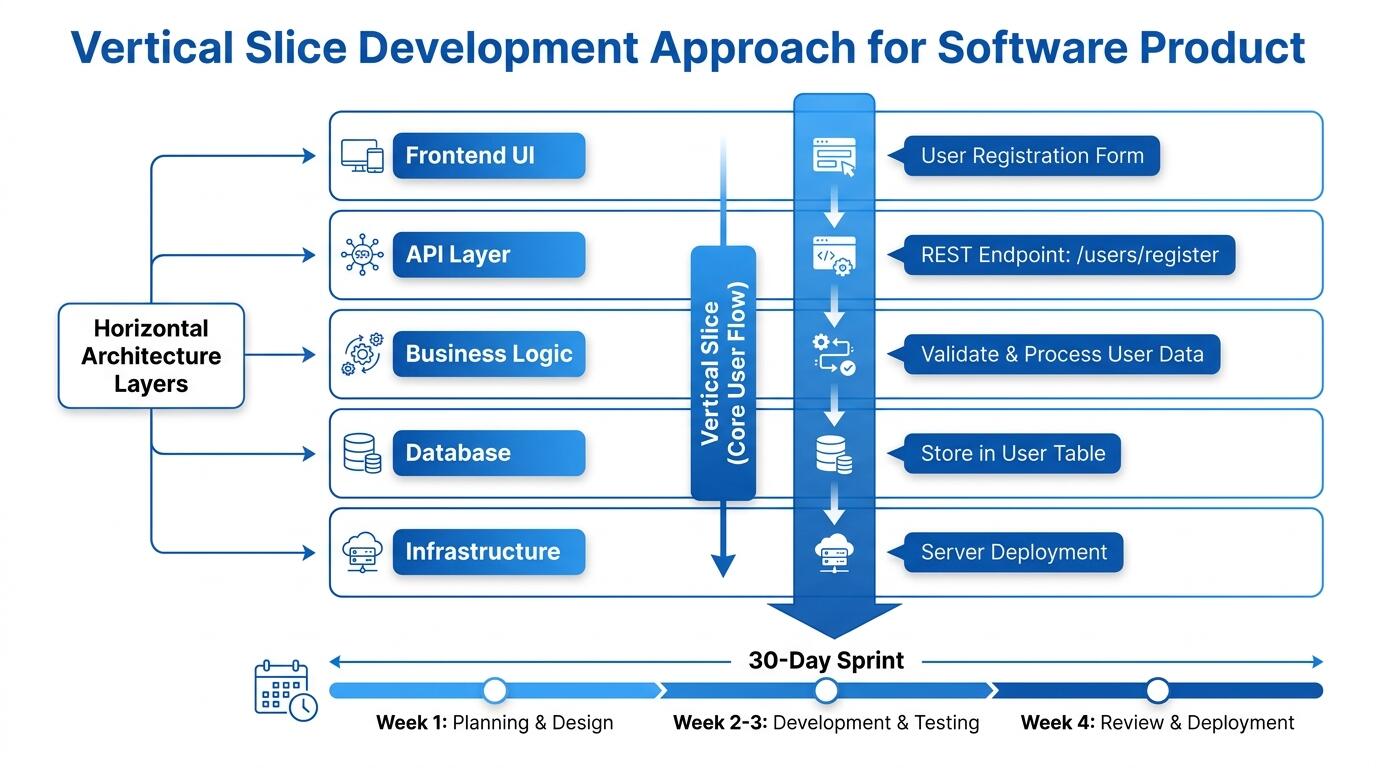
ALT: Diagram showing vertical slice development approach for shipping a live product in 30 days with architecture layers
Step 4: Instrument Observability From Day One
Observability — the ability to understand what your system is doing in production from its outputs — is not a post-launch concern. It is a prerequisite for shipping confidently. A product you cannot observe in production is a product you cannot trust, and a product you cannot trust is not truly shipped.
At minimum, instrument structured logging, error tracking, and a basic health check endpoint before you move past week one. For AI-powered products, also log model inputs and outputs (with appropriate privacy considerations) so you can diagnose unexpected behavior in production. Services that provide error aggregation and alerting are widely available and integrate quickly into most stacks.
Per established software reliability engineering practice, the cost of diagnosing a production issue without observability is substantially higher than the cost of instrumenting logging and error tracking before launch. In a 30-day timeline, an uninstrumented system that breaks in production can cost days of debugging — time the sprint cannot absorb.
Tip: Set up at minimum one alert that pages or notifies you when the application throws an unhandled exception. This single signal, reliably delivered, is worth more than any dashboard built after the fact.
Step 5: Conduct a Structured Pre-Launch Review
A structured pre-launch review is a deliberate, checklist-driven process for verifying that the product is ready for real users before it is publicly accessible. It is distinct from testing — testing confirms functionality, while a pre-launch review confirms readiness across security, reliability, and user experience dimensions.
Conduct this review in week four, at least three to five days before your planned launch date. This buffer is not optional — it exists to absorb the issues the review will surface.
A practical pre-launch review covers the following areas:
- Security: authentication flows, input validation, secrets management, and HTTPS enforcement
- Data integrity: database migrations applied cleanly, backup strategy confirmed
- Error handling: graceful failure states for every external dependency
- User experience: core flow tested by someone who did not build it
- Performance: response times acceptable under expected initial load
- Legal and compliance: terms of service, privacy policy, and any data handling obligations appropriate to your jurisdiction
Tip: Ask someone who was not involved in building the product to complete the core user flow without any guidance. The friction points they encounter are the friction points your first real users will encounter.
Step 6: Launch to a Controlled Group First
A public launch and a controlled launch are not the same thing. Shipping your product to a small, known group of early users before opening it broadly is one of the most consistently undervalued practices in compressed build timelines. It creates a feedback loop before you are exposed to the full surface area of unknown usage patterns.
Identify five to ten people who have expressed genuine interest in the problem your product solves. Give them access before the public launch. Observe how they use the product — ideally through a brief conversation or a structured feedback form — and address any blocking issues before opening more broadly.
This is not a soft launch designed to protect feelings. It is a technical and product risk mitigation strategy. A pattern consistently observed in early-stage product development is that the first real users surface integration failures, UX confusion points, and edge cases that internal testing never reaches — because internal testers know how the system is supposed to work.
Tip: Establish a direct communication channel with your early access group — a shared Slack channel, a Discord server, or even a group email thread. The speed of feedback in the first 48 hours post-launch is directly correlated with how quickly you can resolve blocking issues.
Step 7: Ship, Then Iterate
Launching a live product means accepting that the product is not finished — it never will be. The discipline of shipping is the discipline of recognizing when the product is good enough to deliver real value to real users, and choosing to make it available rather than continuing to refine in private.
After launch, establish a weekly cadence: review what broke, what users asked for, and what usage patterns emerged, then prioritize the next iteration accordingly. The 30-day sprint ends at launch. The product's real development begins the day after.
Tip: Resist the urge to immediately build the features that were deferred during scoping. Spend at least one full week post-launch in observation mode — understanding how real users interact with what you built before deciding what to build next.
Common Mistakes and Troubleshooting When Shipping Your First Live Product
| Symptom | Likely Cause | How to Fix |
|---|---|---|
| Week three and the product still isn't deployable | Infrastructure and deployment left until the end of the build | Make deployment a day-one concern; deploy a "hello world" to production before writing application code |
| Scope keeps expanding mid-sprint | Feature ideas not being captured and deferred deliberately | Maintain a written "post-launch" list; any new idea goes there immediately and is not discussed until after launch |
| Integration with a third-party API fails in production but works locally | Environment configuration differences; secrets not properly managed in production | Use environment variable management from the start; test every integration against a staging environment that mirrors production |
| Product launches but no one uses it | Target user was not engaged before launch; no access path prepared | Identify and communicate with at least five potential users before launching; have a clear, direct call to action ready on launch day |
| Post-launch bugs take days to diagnose | Insufficient logging and error tracking in production | Instrument structured logging and error aggregation before launch — not after a problem surfaces |
| Authentication works locally but breaks in production | Session management or cookie configuration differs between environments | Test auth flows end to end in the production environment during pre-launch review |
| Product is live but slow under load | No performance baseline established; N+1 query problems or unindexed database columns | Add database indexes on query-critical columns early; load test the core flow before launch |
Pro Tips for Better Results When Shipping Fast
Use infrastructure-as-code from the start, even on a small project. The discipline of defining your infrastructure declaratively — even with simple tools — means your environment is reproducible and auditable. This matters acutely when something breaks in production and you need to understand what changed.
Write the simplest version of every feature, then stop. There is a consistent pattern in compressed builds where engineers implement a feature, get it working, and then spend additional time making it more elegant or flexible than the current scope requires. That additional time is borrowed from other critical-path work. Ship the simplest version that satisfies the requirement.
Treat your deployment pipeline as a product, not an afterthought. A manual, multi-step deployment process is a liability. Every manual step is a potential for error, and in a 30-day timeline, deployment errors are disproportionately costly. Invest early in a repeatable, ideally automated deployment process — even a simple script that codifies the correct sequence of commands is substantially better than relying on memory.
A common misconception: fast shipping means low quality. In practice, the discipline required to ship in 30 days — ruthless scoping, early deployment, structured review, and deliberate iteration — produces more coherent products than extended build cycles without constraints. Constraints force prioritization, and prioritization forces clarity about what the product actually is. The teams and founders who ship fastest are frequently the ones with the clearest product thinking, not the ones cutting corners on engineering quality.
Monitor your early users actively, not passively. Dashboards and analytics are useful, but in the first weeks after launch, direct conversation with early users produces higher-quality signal than any metric. Per established product development practice, qualitative feedback from a small number of engaged users consistently outperforms quantitative data from a large undifferentiated user base in early product iterations.
Questions & Answers
Q1: How do you decide what features to cut when scoping a 30-day product launch?
Deciding what to cut requires a single clarifying question for each feature: if this feature is absent, can a user still accomplish the core job the product is designed to do? If the answer is yes, the feature is a candidate for deferral. Evaluate the remaining list against the 30-day constraint honestly — accounting for integration time, testing, and deployment, not just raw development time. Features that survive this filter are your MVP scope.
Q2: Is it realistic to build and ship an AI-powered product in 30 days?
Shipping an AI-powered product in 30 days is realistic when the AI layer is treated as an integration rather than a research problem. Using an established model API rather than training a custom model, defining the AI's role in the user flow precisely before building, and investing in prompt engineering and error handling early all make the timeline achievable. The constraint applies to the product — scope, architecture, and user experience — not the AI model itself.
Q3: How much time should be allocated to pre-launch review and testing in a 30-day build?
In a 30-day build timeline, the pre-launch review should begin no later than day 25, leaving at minimum three to five days to address issues surfaced before the launch date. Functional testing of the core user flow should be ongoing throughout the build — not concentrated at the end. Security review, environment verification, and external user testing of the core flow are the highest-priority pre-launch activities and should not be compressed below two full working days of dedicated effort.
Summary
Shipping your first live product in 30 days is a discipline as much as it is a technical challenge. Three principles anchor every successful sprint of this kind.
First, scope is the variable you control most directly. Scoping honestly and ruthlessly — before the sprint begins and again whenever new ideas emerge — is the single highest-leverage decision in the entire 30-day window.
Second, deployment is a first-class concern, not a final step. Products that deploy early, observe production behavior early, and iterate on real data consistently outperform products that deploy once at the end of a long build cycle.
Third, real users surface problems that internal testing cannot. Structured engagement with a small group of early users before and immediately after launch is one of the most reliable risk mitigation strategies available, and it costs almost nothing to execute.
The next step is to apply this framework to your specific context. Write your scoped feature list today. Make your stack decision. Set a launch date. The 30-day clock starts when you commit to a scope, not when you start writing code.
If you're ready to turn your next idea into a deployed, working product, explore technical insights, architecture thinking, and real-world project experience at the Darius website — built for founders, engineers, and technical leaders who want to build things that actually ship.
Sources & Citations
- IEEE. "IEEE Standards for Software Engineering and Systems Design".
https://www.ieee.org/ - ShippingEasy. "How to Ship: Your First Few Days".
https://shippingeasy.com/blog/how-to-ship-your-first-few-days/ - Google. "Site Reliability Engineering: Principles and Practices".
https://sre.google/
Note: Standards and best practices may be updated; please check the latest official documents or consult professional advisors.